Category Archives: News

For the Virginia National Guard in Afghanistan, shortwave is the solution

Photos by Spc. Crystal Davis, 55th Signal Company

(Source: NATO Press Release)

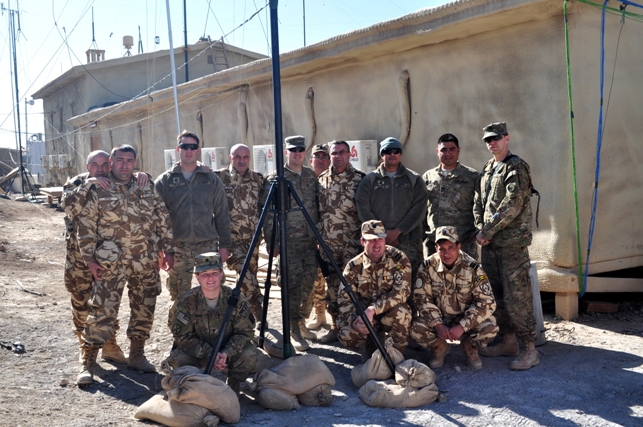
Soldiers of the Virginia Army National Guard’s 116th Infantry Brigade Combat Team are deploying technology in a revolutionary way in Afghanistan using a short wave radio transmitter that can reach almost every radio in Zabul province.

This is the first time a province-wide transmitter has been used in Afghanistan. The transmitter allows the Zabul provincial and district government to send messages to rural Afghan homes.

“No other unit in the International Security Assistance Force has ever done this at any level,” said Master Sgt. Joel E. Fix of Fort Belvoir, Va. speaking of the novel application of the technology. “We have the ability to target the signal toward specific districts or the whole province.”

Radio and word of mouth are the primary means of spreading news and information in rural Afghanistan. Listening to the radio – thousands of which were distributed by NATO-ISAF – is a cultural norm for Afghans, many of whom follow both the BBC and Voice of America.

Fix, a 14-year veteran of the Guard on his third overseas deployment, came up with the transmitter solution in response to a problem raised in discussions with Afghan officials: “How could the Government of the Islamic Republic of Afghanistan communicate to their people in remote areas?”

It was a particularly timely dilemma. As GIRoA expanded its influence into every district, GIRoA’s continued legitimacy rested on the ability to reliably reach and involve ordinary Afghans in their parliamentary democracy. Specifically, the district governors of Mizan and Day Chopan in Zabul province each wanted to invite the elders of their districts to grand shuras in September 2011.

Day Chopan has the highest elevations of Zabul province with deep valleys unreceptive to radio signals.

The 116th “Stonewall Brigade”, in partnership with Romanian troops and Soldiers of the Alaska-based 1st Battalion, 24th Infantry Regiment, all members of Combined Team Zabul, came together to brainstorm a solution. Traditional options raised by CTZ such as leaflet drops, broadcasting radio transmissions from aircraft and even flying aircraft with loudspeakers attached were all denied.

“The government was looking for ways to communicate with people on a greater scale, but there were gaps in the coverage. Short wave radio is the solution we came up with,” said Fix.

Short wave radio is known in the U.S. as ham radio which allows two way communications. The Zabul transmitter is one way. Most radios used by Afghans are receive-only.

“I was soliciting for bids for a transmitter and was referred to Don Butler to assist with the project,” said Maj. William R. O’Neal a Smithfield, Va. native with the 116th.

Butler, an Air Force veteran from the ‘60’s, is a ham radio enthusiast from Gun Barrel City, Texas who provided design help for the transmitter. Butler’s call sign is N4UJW.

“Ham radio is two way communications over short wave. Our transmitter is one way,” said Fix. “With this configuration, no matter where they are, there’s no reason the Afghan’s can’t get a signal. The frequency is close to but not the same as the one for the BBC. That makes it easy to find and remember,” he added.

The transmitter owes its success to a technique called NVIS – Near Vertical Incidence Skywave – which involves bouncing radio signals off the ionosphere – a layer of the atmosphere. Two NVIS antennas are placed horizontal to the ground unlike a traditional vertical transmitter. The second part of the NVIS antenna is called a ground wire and helps to boost the signal by forcing it to go straight up instead of outward and limited by the curve of the earth.

“In a traditional short wave broadcast, you get your antennas up as high as you can go,” said Fix. “It bounces off the F2 layer of the ionosphere but gives you limited coverage with ‘skip points’. Using NVIS and our reflector wire, the signal goes up at a very steep angle and straight back down which can penetrate deeper into mountain valleys. When we were looking at this system, it was a no brainer,” he added.

The transmitter is operated and maintained by coalition forces including the U.S. and Romanian soldiers and broadcasts content from the local government. At first glance it doesn’t seem very impressive: two antennas, the ever-useful 550 cord, and some wire that feeds into a box with one port and an on/off switch.

“Our goal is to transfer the transmitter to the provincial government as part of the transition,” said O’Neal.

Unlike some new technologies developed and used as part of Operation Enduring Freedom, this transmitter is inexpensive and effective.

“It has resulted in a savings of around 3,100%,” said Fix. “It would take 30-32 FM systems to cover the same area.

(Above Source: NATO Press Release)

We added emphasis (bold) in the press release above. We also filed this article under “Why shortwave radio?” Feel free to check out all of our articles with the same tag.


Kim Jong-il is dead, but not Voice of Korea

This morning, we learned that North Korean leader, Kim Jong-il, has died–perhaps as much as two days ago. That’s the difficulty about information coming from countries under totalitarian rule–the “facts” are whatever is decided upon by those in power. North Korea, especially, is known for being secretive and even paranoid about the free flow of information on either side of their borders.

When it comes to radio, North Korea is certainly one of the most informationally-isolated places on our planet. Hence, governments around the world spend a good deal of resources aiming broadcasts at those who live in North Korea. The hope is that in a country where the average citizen doesn’t even know what the internet is, information via radio broadcasts will penetrate the borders, allowing those within the country to hear outside voices, outside opinions, and enjoy (however briefly) the breath of freedom. That’s what I love about radio, specifically the shortwave variety; it has very little regard for national borders and, unlike the internet, listeners can’t be readily traced or tracked–or punished. This is a common theme at the SWLing Post.

Of course, radio information flows both ways, so the Voice of Korea sends its own message to the rest of the world. VOK is–to say the least–an oddity in the international broadcasting community. Its propaganda is pure, its bias is obvious and determined, but it does allow outside listeners to read between the lines, thus getting a glimpse into the rigid, restrictive culture of this state.

So, over the coming days, I challenge you to find Voice of Korea on the radio dial (see frequencies below) and listen to their biased perspective on history in the making. As I’ve suggested, sometimes you learn more about what’s really going on by listening between the rosy lines.  For example, today even the VoK website makes no mention of their leader’s death (see this morning’s screen capture); that fact, alone, tells you something about how this event has disrupted their flow of information.

This is what I’ve always loved about shortwave radio and international broadcasting–you can listen to different perspectives, and draw conclusions yourself.  It’s your own interpretation of events, thus you’re not entirely reliant upon news media for your views and ideas. Unfortunately, this is becoming a lost art here in the modern world, where people generally find it easier to subscribe to one media outlet and often develop blind faith in the sound bites they receive–a form of self-subscribed propaganda.

So that you can form your own opinions, we’ve provided the Voice of Korea’s full B11 schedule (courtesy of PCJ Media) below. See if you can catch this most interesting (and elusive) DX.  Listen carefully…

VOK Pennant (Courtesy of Wikimedia Commons)

Voice of Korea B11 Schedule (via PCJ Media)
0100 GMT (10am local) to North East Asia on 7220kHz, 9345kHz and 9730kHz
0100 GMT (10am local) to Central and South America on 11735kHz and 15180kHz
0200 GMT (11am local) to Southeast Asia on 13650kHz and 15100kHz
0300 GMT (12pm local) to North East Asia on 7220kHz, 9345kHz and 9730kHz
1000 GMT (7pm local) to Central and South America on 11710kHz and 15180kHz
1000 GMT (7pm local) to Southeast Asia on 11735kHz and 13650kHz
1300 GMT (10pm local) to Europe on 13760kHz and 15245kHz
1300 GMT (10pm local) to North America on 9335kHz and 11710kHz
1500 GMT (12am local) to Europe on 13760kHz and 15245kHz
1500 GMT (12am local) to North America on 9335kHz and 11710kHz
1600 GMT (1am local) to Near and Middle East, North Africa on 9990kHz and 11545kHz
1800 GMT (3am local) to Europe on 13760kHz and 15245kHz
1900 GMT (4am local) to Southern Africa on 7210kHz and 11910 kHz
1900 GMT (4am local) to Near and Middle East, North Africa on 9975kHz and 11535kHz
2100 GMT (6am local) to Europe on 13760kHz and 15245kHz

If you do not succeed in finding Voice of Korea on the air, check out this website which contains hours of recorded VOK broadcasts.

Radio Australia increases shortwave broadcasts into Papua New Guinea on 17,750 kHz

(Source: Radio Australia News)

Papua New Guinea’s parliament was resuming on Monday, despite no clear resolution to the country’s political crisis. 

Peter O’Neill says his government has taken control of the police and state offices.

[…]Earlier he said: “This clear direction now – this building will be in lockdown, only accessible to the Prime Minister (myself) and the Public Services Minister, who’s got an office in this office, and only the workers of this office. 

“No other members of the public will be allowed to come into this office.”

[…]ABC Radio Australia has increased its shortwave broadcasts to Papua New Guinea to help inform people about developments in the PNG political crisis.

Between 0930 and 1700 Port Moresby time, an extra frequency, 17750 kHz, will be added to the broadcast services for PNG.

John Cusack to star in new movie: THE NUMBERS STATION

In the new movie, The Numbers Station, John Cusack will play a former black ops agent  who is assigned to protect a code operator (Malin Ackerman) for an isolated covert CIA broadcast station–the two characters fight for survival after a surprise attack.

There are few details about the movie released at this point, but we will keep you updated when we receive new information.

I can say this: prepare for a lot more interest in numbers stations in 2012.

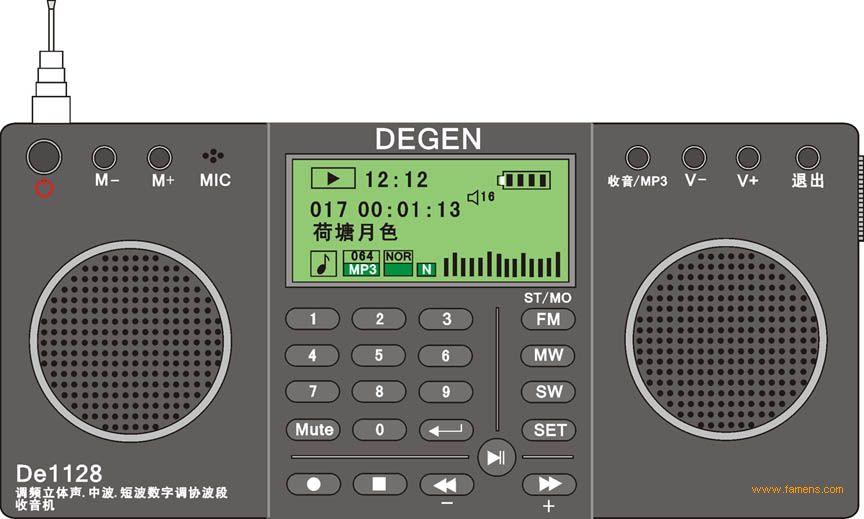
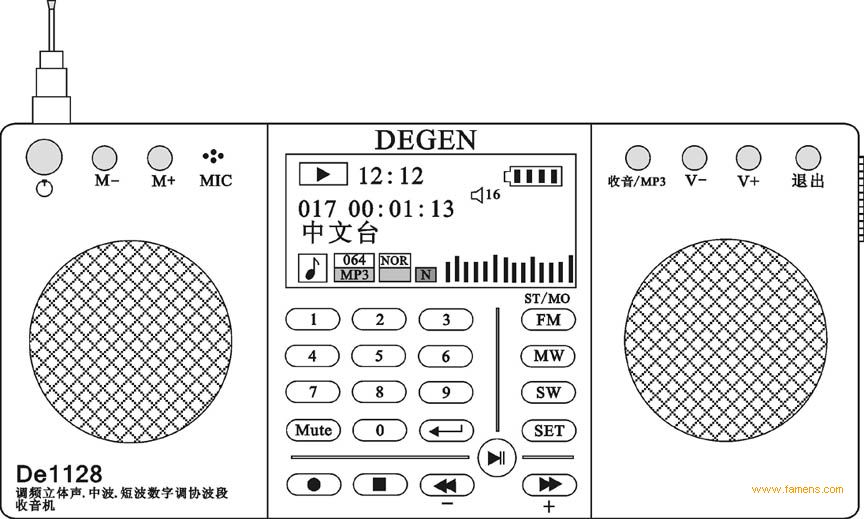
A new Degen portable in the works–the Degen DE1128

Preliminary drawings of the Degen DE1128

It appears that Degen is working on a new dual speaker portable shortwave radio–the Degen DE1128.

It looks like the DE1128 will have MP3 recording features, including a built-in microphone. The footprint and layout seem strikingly similar to the new Tecsun PL-398MP.

We will post more information on this radio as it becomes available.

CS Monitor: Don’t let Voice of America broadcasts go static

(Source: Christian Science Monitor)

Voice of America (VOA), the jewel in America’s public diplomacy effort abroad, is set to be streamlined. Some programs can be downsized. But VOA is in the national interest, especially as Russia, China, and Iran expand state-supported media. Cuts should be handled with care.

[…]An earlier BBG decision to shut down VOA’s Mandarin and Cantonese services to China, in favor of TV and social media, produced a firestorm not only among VOA staffers but also with members of Congress who support VOA and preside over its budget (and who temporarily blocked the move). Though shortwave radio may be in eclipse, there are still remote areas of the world dependent on it.

This article is authoritative in that it’s author, John Hughes was once director of VOA during the Reagan administration.

We’ve echoed so many times on this website what Mr. Hughes puts forth in his argument, that any downsizing should be handled with care. There are still many communities on this planet where shortwave radio is literally a lifeline of information.

SiLabs brings shortwave to car radios

Silicon Labs, a manufacture of DSP (Digital Signal Processing) chips that are in many of the shortwave radios we feature here on SWLing.com, is now taking their technology to car radios. They have announced the Si476x chip family which features AM/FM, longwave, shortwave (SW), NOAA weather band, FM RDS decoding and AM/FM HD Radio reception.

To my knowledge, this is the first time in years that shortwave has been strategically implemented in a car radio product.

Read their full press release below:

(Source: SiLabs Press release via Kim Elliott)

AUSTIN, Texas–(BUSINESS WIRE)–Silicon Laboratories Inc. (NASDAQ: SLAB), a leader in high-performance, analog-intensive, mixed-signal ICs, today introduced the industry’s most advanced automotive tuner IC family designed to deliver the highest RF performance coupled with advanced signal processing while reducing the cost and complexity of car radio systems. Offering superior price/performance for the global car radio market, the new Si476x tuner family provides a best-in-class multiband receiver solution for automotive infotainment head-units and AM/FM car radios from all classes of providers ranging from Tier 1 suppliers to aftermarket car radio makers.

According to J.D. Power and Associates, the global automotive market is expected to exceed 76 million light-vehicle unit shipments this year. The car radio technology deployed in these vehicles is evolving rapidly as innovations in communication technology proliferate in the automotive infotainment market. The basic car radio has been transformed into a sophisticated infotainment system that includes multiple tuners to deliver FM phase diversity reception, receive radio data system (RDS) data for info-navigation systems, support AM/FM HD Radio technology and provide detailed station quality metrics for living lists of broadcast content. These strenuous broadcast performance demands require advanced silicon innovations to enable a superior in-vehicle audio experience.

Silicon Labs developed the Si476x receiver family to address these major automotive industry trends. The Si476x receivers leverage Silicon Labs’ patented digital low-IF technology and combine most of the traditional external bill of materials into a highly integrated, single-chip CMOS solution. The receivers provide unprecedented flexibility, offering a modular architecture that supports scalable multi-tuner designs. The Si476x supports all worldwide broadcast radio bands including AM/FM, college FM, longwave (LW), shortwave (SW), NOAA weather band, unparalleled FM RDS decoding and AM/FM HD Radio reception. iBiquity Digital Corporation, the developer of HD Radio technology, has certified the Si476x family to provide AM/FM HD Radio tuner outputs and reception with compatible HD Radio demodulator ICs.

“The introduction of the Si476x tuner family represents a major new product offering from a world leader in RF products and a global player in the HD Radio market,” said Jeff Jury, chief operating officer of iBiquity. “Automakers are continuing to embrace HD Radio technology, with more than 20 automotive brands to date announcing the technology as a factory-installed infotainment feature. The Si476x family offers a compelling new solution for this market.”

The Si476x family represents the automotive industry’s first viable receiver alternative to enable developers to pair a best-in-class tuner IC with the optimal choice of audio digital signal processors (DSPs) to create highly cost-effective back-end audio processing designs. Silicon Labs has worked with leading silicon providers such as Cirrus Logic and Freescale Semiconductor to deliver comprehensive audio system solutions that break the expensive partitioning approach required by current car audio solutions.

“The combination of Cirrus Logic’s broad portfolio of audio ICs and Silicon Labs’ Si476x radio ICs provides automotive OEMs with a very powerful platform for building highly differentiated in-car entertainment products,” said Carl Alberty, director of marketing for audio products at Cirrus Logic. “By working closely with Silicon Labs, we have developed an optimized car radio platform that delivers best-in-class audio and RF technology, enabling our customers to build outstanding products.”

The superior linearity of the Si476x tuner’s integrated RF front-end, combined with a high-performance on-chip radio DSP and microcontroller, delivers outstanding RF dynamic range and immunity to multi-path fading. With this innovative architecture, the Si476x family raises the bar for such key features as selectivity, sensitivity, IMD3 break-in, desensitization, noise blanking, weak signal processing, dynamic channel bandwidth control and advanced dual-tuner FM phase diversity reception.

“The Si476x family not only delivers superior radio reception performance at the best system cost, it also provides unprecedented flexibility in audio processing solutions for car radio designs,” said Diwakar Vishakhadatta, general manager of Silicon Labs’ broadcast audio products. “With the introduction of the Si476x family, automotive developers are no longer locked into using more expensive bundled audio/radio solutions that may not address the audio processing requirements of their infotainment platforms.”

Pricing and Availability

Samples and production quantities of the Si476x car radio tuner ICs are available now in a compact 6 mm x 6 mm 40-pin QFN package. Pricing for automotive-grade Si476x tuner ICs begins at $11.62 (USD) in 10,000-unit quantities. The Si4763LNA-A-EVB and Si4767PD-A-EVB evaluation boards are available to automotive customers for $450 (USD).

The Si476x family, the latest addition to Silicon Labs’ portfolio of automotive-grade radio tuners, complements the company’s popular Si474x and Si475x tuner families, which target cost-sensitive entry- and mid-level radio designs. The Si476x family addresses premium-grade, performance-intensive automotive radio and head-unit requirements. For additional Si476x product information, please visit www.silabs.com/pr/automotive-tuner.

Silicon Laboratories Inc.

Silicon Laboratories is an industry leader in the innovation of high-performance, analog-intensive, mixed-signal ICs. Developed by a world-class engineering team with unsurpassed expertise in mixed-signal design, Silicon Labs’ diverse portfolio of patented semiconductor solutions offers customers significant advantages in performance, size and power consumption. For more information about Silicon Labs, please visit www.silabs.com.