Category Archives: Radio History

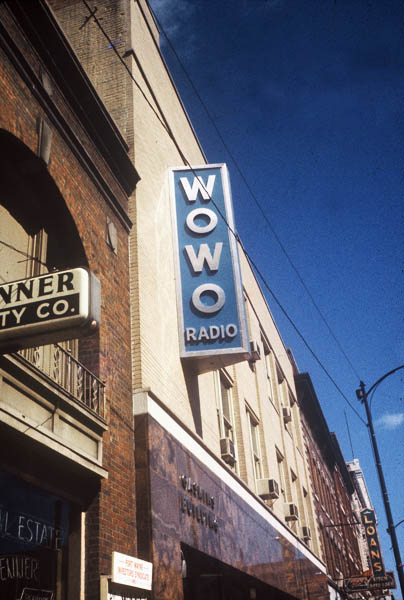
Website devoted to the history of WOWO

Photo source: historyofwowo.com

Many thanks to SWLing Post contributor, Dave Snyder, who shares the following in reply to our previous post about a chunk of the WOWO fire escape in lucite:

Thomas,

Have you ever visited “www.historyofwowo.com“–?

This site was put together by Randy Meyer and has hundreds of photos from 95+ years of broadcasting. Many pictures are from me as I worked there from 1969 to 1982. The link below is to the promotional items page where there is another picture of the “World Famous WOWO Fire Escape” chunk of steel cast in lucite.

These were made in 1978 after the station moved from the Gaskins Building to the Central Building. (By the way, the Central building is no longer there.)

The Gaskins Building was a dismal place with no windows. The air and news people had to open the door to the fire escape to see if was sunny or raining. That is why the local temperature was from the World Famous Fire Escape. My piece of fire escape is in a box in the basement.

http://www.historyofwowo.com/the_rest.html

Many thanks for sharing this, Dave! WOWO is such an iconic AM station with such a deep history–I’m grateful all of these photos and history are being archived and shared online.
Click here to view HistoryofWOWO.com.

Voice of America Museum director to present history of Bethany transmitting station

(Source: Cincinnati.com)

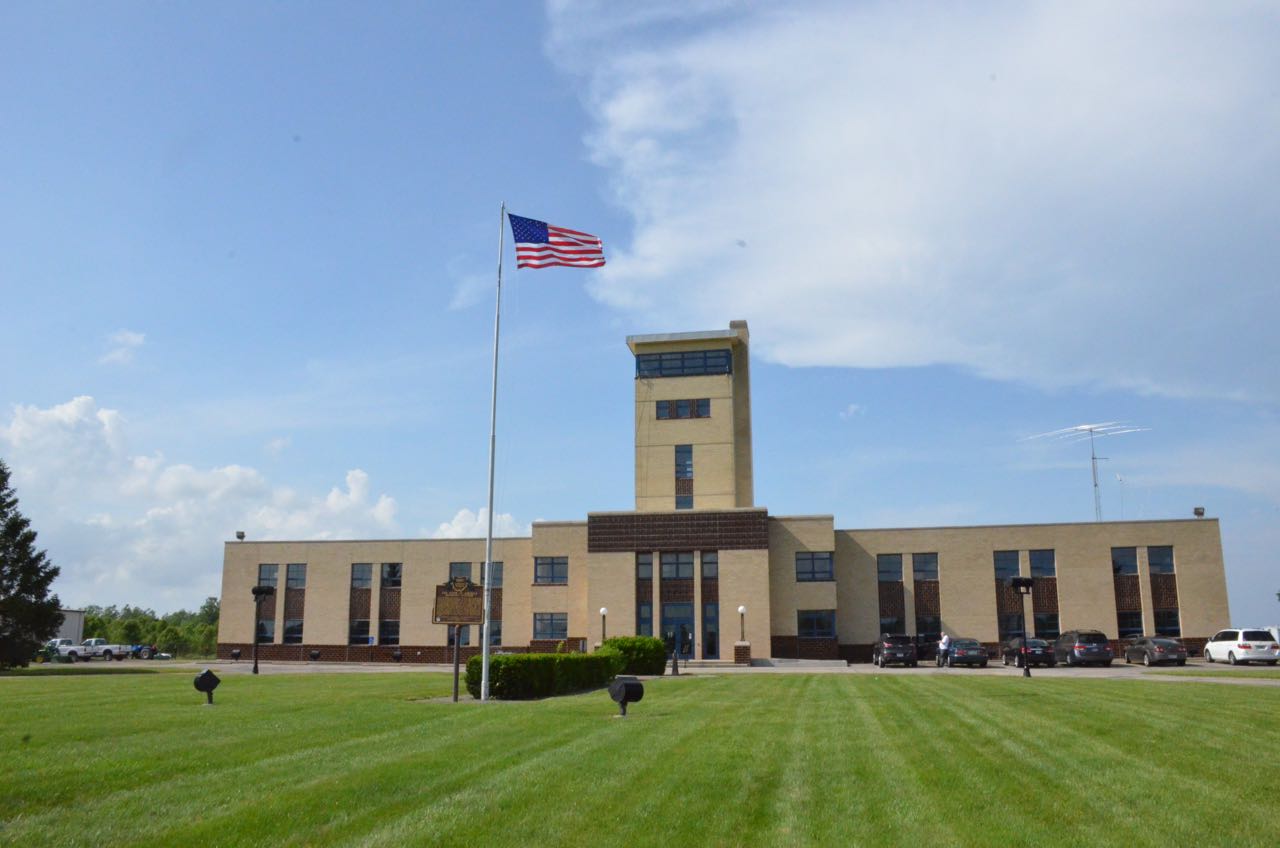
If you’ve ever wondered why the VOA-Bethany Station needed a secured, square mile of land surrounding its 1944 art deco building in West Chester, Jack Dominic has the answer.

Dominic, the National Voice of America Museum of Broadcasting director, will speak on the “History of the VOA-Bethany Station and the VOA Museum Today” Wednesday, April 3, from 7 to 8:30 p.m. at the MidPointe Library in West Chester’s community room.

The free event is the second of a four-part series, “The Voice of Truth in America: Celebrating 75 Years of the VOA Bethany Station,” with the MidPointe Library System.

The VOA museum hosts other free events this year to commemorate the 75th anniversary of the VOA-Bethany Station, which now houses the Cold War-era history and broadcasting museum.

“From World War II through the Cold War, the VOA-Bethany Station played a vastly important role in transmitting real news via shortwave radio to people living in countries that lacked a free press,” said Ken Rieser, VOA museum board president. “And it all started here in Cincinnati, with two brothers who developed the technology that evolved into the commercial radio industry.”[…]

The VOA museum will host its fourth annual “75 Years of Rockin’ the Radio” fundraiser Saturday, Sept. 21, with dinner and dancing. Sponsorships are now available.

Museum hours are 1 to 4 p.m. Saturdays and Sundays at 8070 Tylersville Road. Admission is $5 for adults and $1 for children.

For a complete schedule of 2019 VOA museum events, “The Voice of Truth in America,” series and WCARA events, visit www.voamuseum.org, www.midpointelibrary.org and www.wc8VOA.org.

Read the full new release at Cincinnati.com.

WWII Machine Shop Supervision film includes the Hammarlund Super Pro

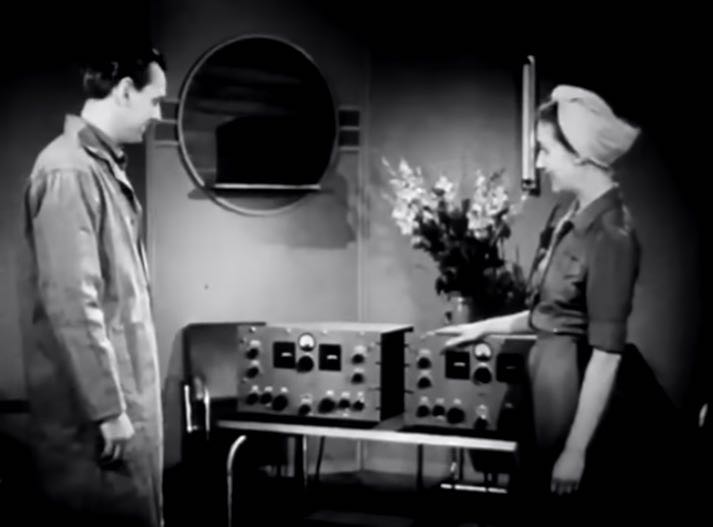
Many thanks to SWLing Post contributor, Colin Snow (KM6NTW), who notes that the following 1944 film “Maintaining Workers’ Interest” from the US Office of Education, features the Hammarlund Super Pro.

The video starts at the point in the film where the Super Pro is featured. To view the film from the beginning, click here.

https://vimeo.com/399908150

Click here to view on YouTube.

Guest Post: Indian DXer enters into Limca Book of Records

Many thanks to SWLing Post contributor, Sandipan Basu Mallick (VU3JXD), for sharing the following guest post:


Indian DXer enters into Limca Book of Records

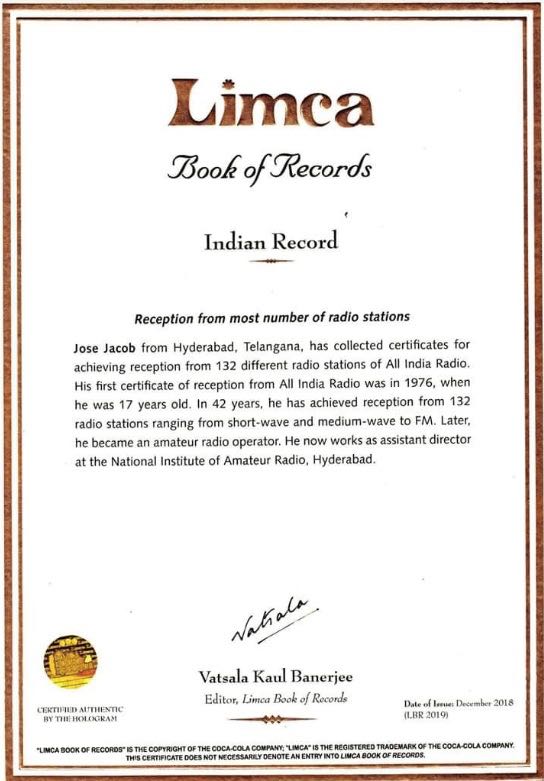
Jose Jacob from Hyderabad, India has collected QSL from 132 different stations of All India Radio over a period of 42 years. Radio stations ranging from Shot wave, Medium wave, FM to the latest DRM mode. In the process he has achieved the feat of creating an Indian Record of collecting maximum number of QSL of different stations of a radio broadcaster in India.

As a teenager Jose started listening to radio and started to write to stations way back in 1973, when in his school days. Few years later in 1976 he first wrote to All India Radio, when his reception report was first verified with a QSL. Over next 42 years, he has used various mediums, ranging from inland letters, post cards to emails, for sending reception reporting. Currently he has over 2500 QSL from 130 different countries, many of which left the airwaves.

Over the years, with his special interest in All India Radio, he is one of key country contributors, from India, of World Radio TV Handbook updating about All India Radio to the directory of global broadcasting.

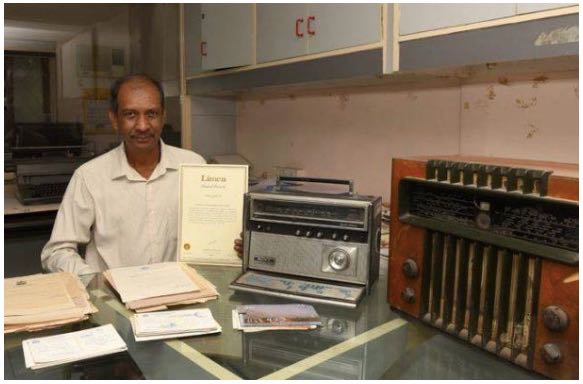
Jose Jacob, is also a licensed amateur radio operator with call sign VU2JOS currently serving as Asst. Director at the National Institute of Amateur Radio (NIAR) www.niar.org

Jose Jacob (VU2JOS) with Certificate from Limca Book of Records

Limca Book of Records is an annual reference book published in India documenting human and natural world records. The world records achieved by humans are further categorised in education, literature, agriculture, medical science, business, sports, nature, adventure, radio, and cinema with Limca book of Records rules. (https://www.coca-colaindia.com/limca-book-of-records)

Limca Book of Records has recognized the feat as one of the Indian records in the radio category and awarded the certificate acknowledging the achievement.

QSL received in 1997 from All India Radio, Nagpur

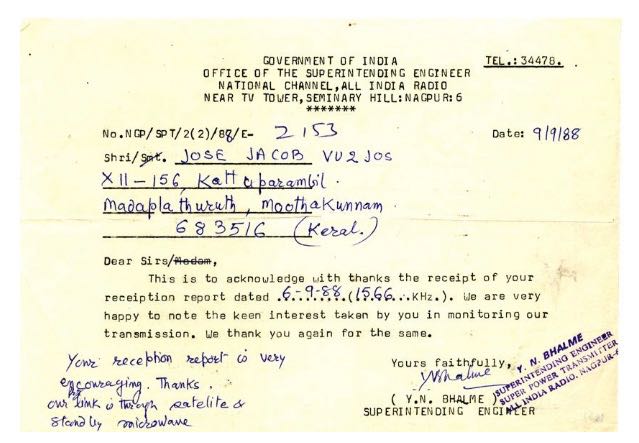
QSL received in 1988 from All India Radio, Nagpur

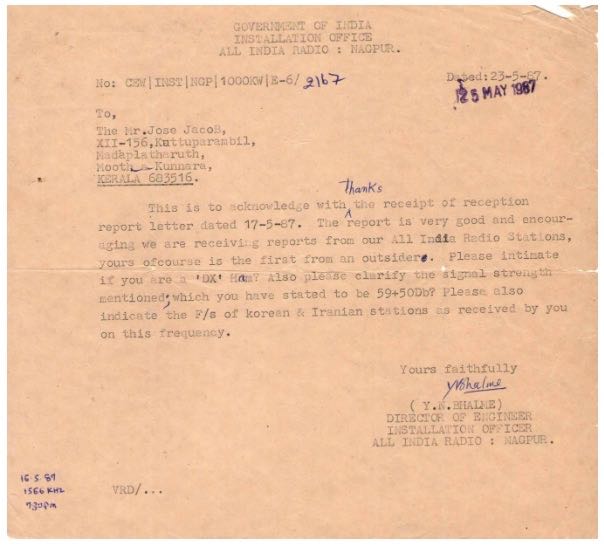
QSL received in 1987 from All India Radio, Nagpur


Congratulations to Jose Jacob VU2JOS for an amazing accomplishment!  Thank you for sharing this news, Sandipan!

CNN Travel features the abandoned Duga Radar site near Chernobyl

(Source: CNN Travel via Heath Hall)

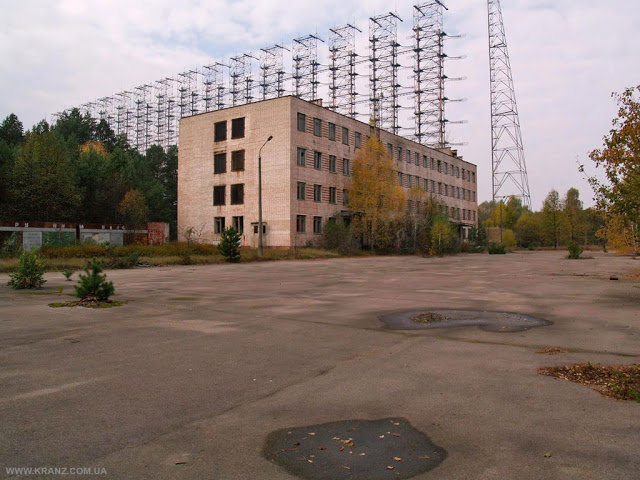
(CNN) — The peaceful untouched forest north of Ukraine’s capital, Kiev, is a perfect spot to enjoy the outdoors — save for one fact.

It contains the radiation-contaminated Chernobyl Exclusion Zone, established in 1986 after the world’s worst nuclear disaster sent a wave of radiation fallout across Europe.

Since 2011 it’s been a major draw for adventurous tourists, but the forests here conceal another legacy of the Cold War, with a far more sinister and mysterious reputation.

The Duga radar.

Though once a closely guarded secret, this immense structure can be seen for miles around, rearing up through the mist over the horizon — a surreal sight.

From a distance, it appears to be a gigantic wall. On close inspection, it’s an enormous, dilapidated structure made up of hundreds of huge antennas and turbines.

The Duga radar (which translates as “The Arc”) was once one of the most powerful military facilities in the Soviet Union’s communist empire.

It still stands a towering 150 meters (492 feet) high and stretches almost 700 meters in length. But, left to rot in the radioactive winds of Chernobyl, it’s now in a sad state of industrial decay.

Anyone exploring the undergrowth at its feet will stumble upon neglected vehicles, steel barrels, broken electronic devices and metallic rubbish, the remainders of the hasty evacuation shortly after the nuclear disaster.[…]

Click here to continue reading the full article and explore the photo gallery at CNN Travel.

Advice on preserving 1940s era homemade records

At the Winter SWL Fest last week, my friend, Andrew Yoder (author of the Pirate Radio Annual) told me about a recent find: homemade records by amateur radio operator W3JJN.

Andrew wrote about these recordings on his blog:

[…]Before open-reel decks were wire recorders. Information was magnetized onto a fine reel of stainless steel wire. It was essentially the same concept as tape decks, whether open reel or cassette, only the tape system was a refinement (an oxide coating on a plastic tape), rather than trying to magnetize a wire.

[…]Before wire recorders were record recorders. These took an audio source and the needle cut a blank disc with grooves. From what I understand, these homemade discs weren’t meant to be played back too many times because the needles wore into the grooves more quickly than commercially manufactured records. I’m not sure what they were all made from, but I know that some were aluminum discs with a thin layer of plastic.

I always look for the homemade records because there weren’t too many options for audio sources back then. By the open-reel tape era, a lot of people were recording entire albums to tape, so they weren’t necessarily recording the radio. But, for example, in 1940, the options were basically either family greetings, someone singing or a band playing, or the radio. And chances are good that any recording you find is the only one in existence.

I found three of these on Saturday.

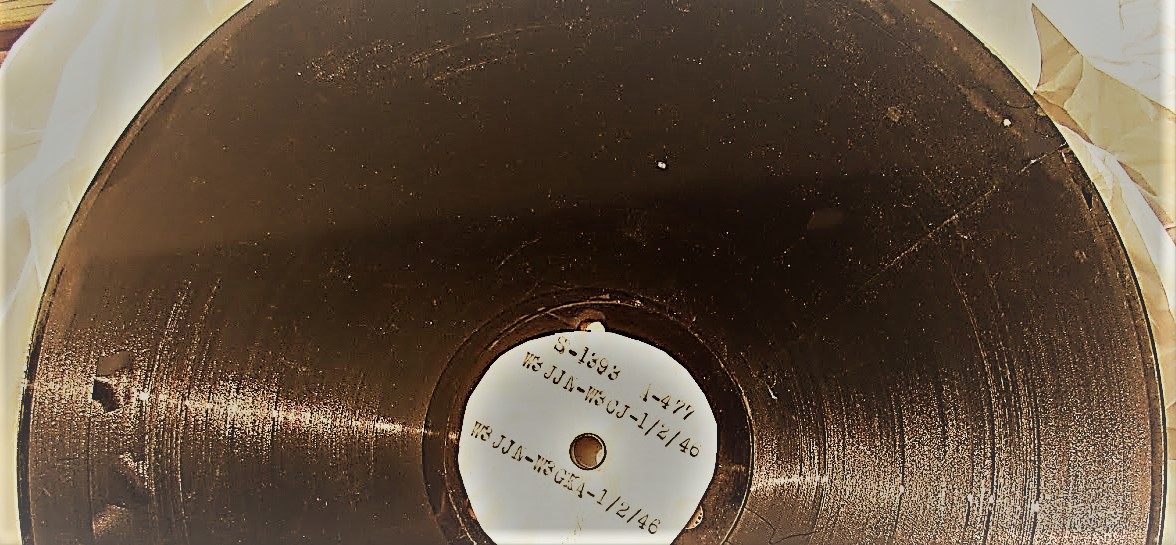
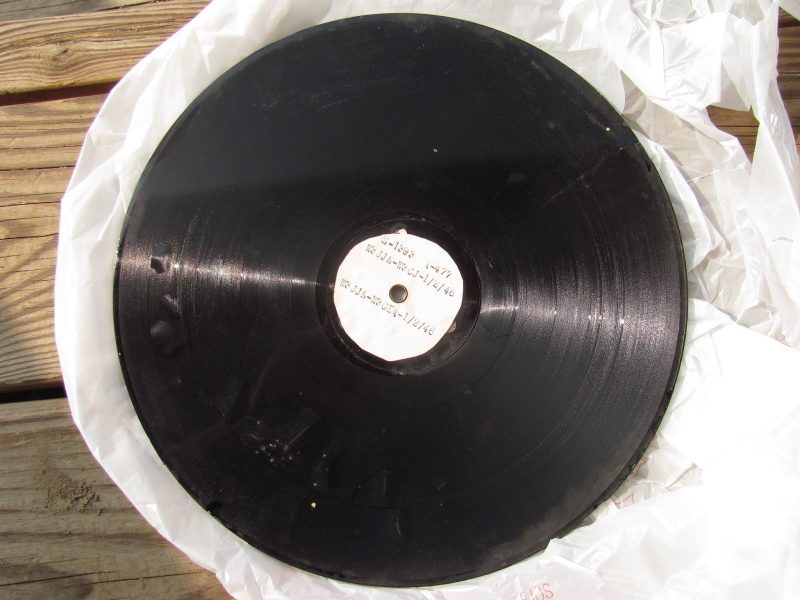
Here’s a photo of one.

They are amateur radio QSOs from W3JJN to a couple of other operators. W3JJN cataloged the discs by side . . . and this was number 477. So, at least 237 other records existed in his homemade record collection at one time. The sides that I have are dated in late 1945 and early 1946. To me, this is an astounding find because I’m not sure how many recordings exist of any amateur radio operations prior to 1950, not to mention that this is still very early in the post-war period.

I did some searching on W3JJN and he was William E. Belz, who lived at that time on 1509 Linden Avenue in Baltimore, Maryland. He was a TV repairman who was born in Duncansville, PA, and died in 1981 after a lengthy illness.

My big problem here is that these records are disintegrating. The plastic layer is cracking badly and separating from the aluminum discs. I guess what I really need is one of the laser turntables that can play back audio from broken discs and won’t damage the grooves. I don’t think I can risk playing any of these on a regular turntable, but I want to recover the audio quickly before the discs degrade further.

Click here to read the full article.

Post readers: Any advice on preserving these recordings? It sounds like using an actual needle to make a digital copy might be a little too destructive.  Are there alternatives?  Please comment if you have any experience or suggestions!

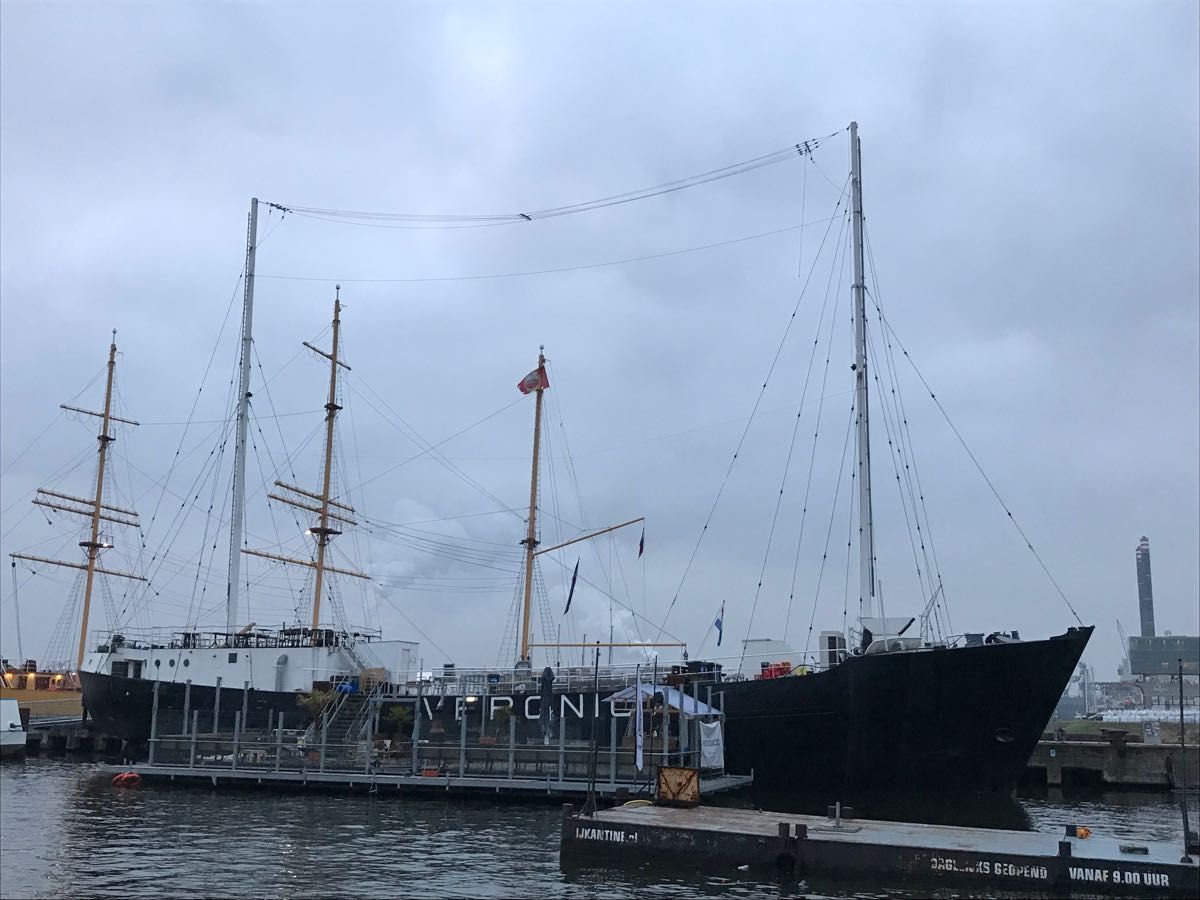
Scott stumbles upon Radio Veronica at the NDSM Wharf

Many thanks to SWLing Post contributor, Scott Gamble, who writes:

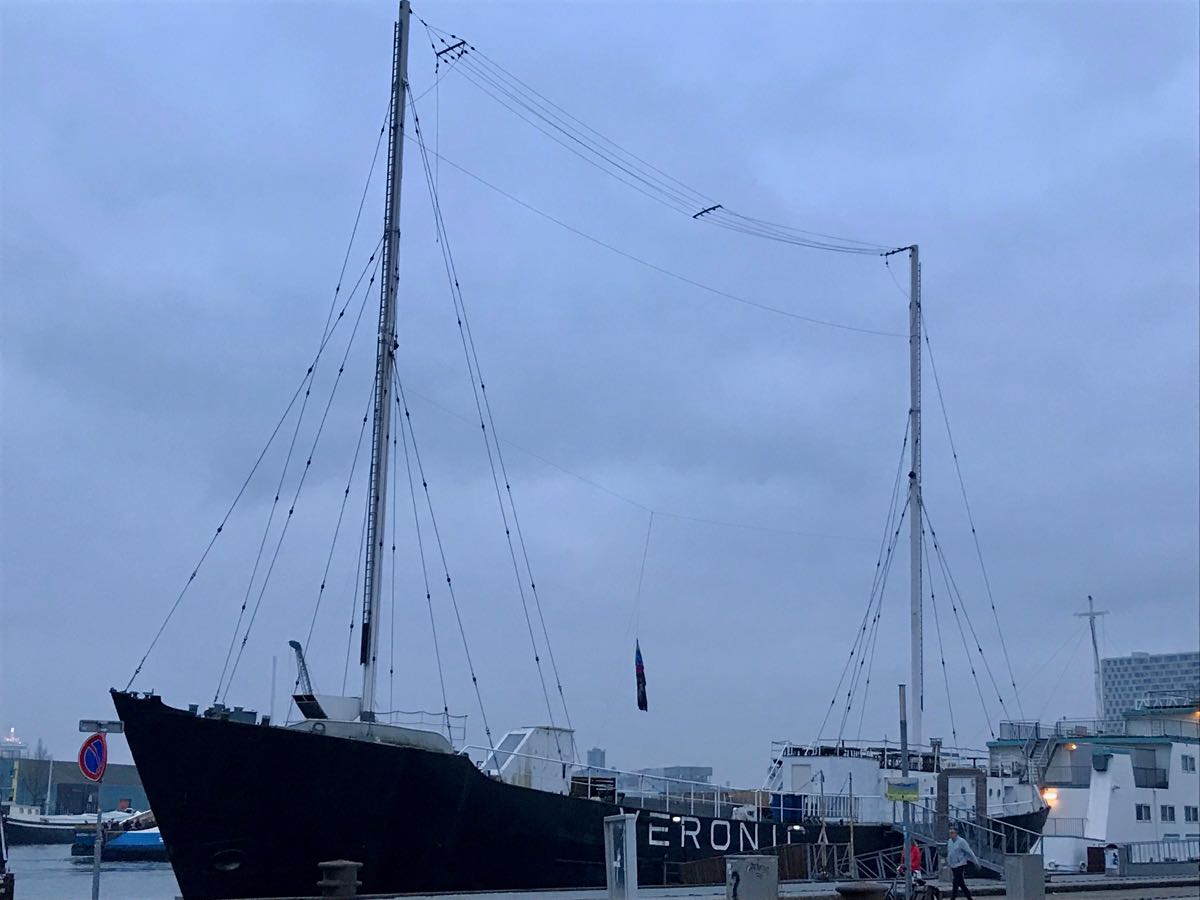
[I was in Amsterdam recently] and was in a meeting over at the NDSM Wharf, and I happened to stumble upon Radio Veronica next to the office where I was meeting.

Never though I’d be so close to it. Such a cool piece of history.

Wow! What a fantastic opportunity to catch a glimpse of the legendary Radio Veronica! Thank you for sharing your photos, Scott.

Check out more info about Radio Veronica on Wikipedia:

Radio Veronica was an offshore radio station that began broadcasting in 1960, and broadcast from offshore for over fourteen years. It was set up by independent radio, TV and household electrical retailers in the Netherlands to stimulate the sales of radio receivers by providing an alternative to the Netherlands state-licensed stations in Hilversum.

Broadcasts began on 21 April 1960. The station announced itself as VRON (Vrije Radio Omroep Nederland; Free Radio Station [of the] Netherlands) but changed to Radio Veronica, after the poem “Het Zwarte Schaap Veronica” — The Black Sheep Veronica — by the children’s poet Annie M. G. Schmidt.

After the station’s closure, some of its staff applied for a broadcasting licence and continued as a legal organisation with the same name.

The original Radio Veronica became the most popular station in the Netherlands. It broadcast from a former lightship Borkum Riff anchored off the Dutch coastline. The ship was fitted with a horizontal antenna between the fore and aft masts, fed by a one-kilowatt transmitter. Most of its programmes were recorded in a studio on the Zeedijk in Hilversum. At the end of the 1960s the studios and offices moved to bigger premises on the Utrechtseweg in Hilversum. Initially advertisers were reluctant to buy airtime, but those that did reported increases in sales and gradually the station’s revenue improved.

For a short time the station also ran an English language service under the call letters CNBC (Commercial Neutral Broadcasting Company). Although short-lived, CNBC was presented by professional broadcasters who were able to give invaluable technical advice to Veronica’s Dutch staff.

Click here to read the full Radio Veronica entry.