Category Archives: Radio History

VOA Museum ‘Rock the Radio’ fundraiser gala September 22

(Source: Southgate ARC via Richard Langley)

Event to be held on 74th anniversary of VOA-Bethany Station dedication

Whether you engaged in dance parties in the 50s, sock-hopped through the 60s, or grooved to music of the 70s, chances are that radio provided the music of the moment.

It also meant a lifeline of accurate Voice of America news, features and music for people living in war-torn or oppressed countries.

The National Voice of America Museum of Broadcasting in West Chester will host its second annual fundraiser, “Rock the Radio” dinner-and-dance party on Saturday, Sept. 22 from 5:30 to 10:30 p.m. at the VOA museum in West Chester. Blue Stone Ivory, Cincinnati’s premier horn-driven classic rock band, will provide music from the Cold War era to help celebrate the 74 th anniversary of the VOA-Bethany Station.

“We’ll have a cocktail reception in the museum, a fabulous dinner and irresistible dance music that will keep people tapping their toes or entice them out onto the dance floor,” said Jack Dominic, museum executive director. “Funds go toward museum renovation to make the first floor accessible to people of all abilities.”

The National Voice of America Museum of Broadcasting gala committee. From left, back row: Greg Stevens, Chris Wunnenberg; Jack Dominic; Karl Ulrich. Front row: Patti Alderson and Melinda Zemper

The evening also includes the official opening of the museum’s new main exhibit hall and a private viewing of a Cold War exhibit supported by the U.S. Coast Guard’s alumni association for the USS Courier. The Courier was a floating Voice of America radio station stationed off the coast of Greece near the Panama Canal Zone from 1952-1964. It was tasked to defeat Soviet jamming near VOA target areas and contained a barrage balloon that held its medium-wave antenna aloft.

“Here in the U.S., we remember radio as entertainment, but it was a crucial way the Voice of America communicated throughout World War II and the Cold War to our troops and allies overseas and to people who lived in countries without a free press,” said Ken Rieser, president of the VOA museum board. “We want to recognize our nation’s commitment to tell the truth in media and educate people in countries where media is censored about what was going on in the world.”

Cost is $150 per person or $300 per couple, with various levels of sponsorship available for individuals, businesses and organizations. Sponsors so far include: Patti and Dick Alderson; Barbara and Larry Kellar; Mr. Mechanic; Oak Tree Communications; Sebaly, Shillito and Dyer; and Greg and Diane Stevens; Gary and Dee West; and Chris and Sandie Wunnenberg.

Sponsorship levels are: Platinum, $10,000; Gold, $8,000; Silver, $5000; and Bronze, $1,000. Sponsor recognition ranges run from free gala tickets, inclusion in the printed program, billing in all public relations and signage, recognition from the podium, logo inclusion on the museum website, and tables for 10 guests.

For 50 years, the VOA-Bethany Station transmitted Voice of America broadcasts to countries worldwide that lacked a free press, first in Europe during World War II and to South America during the Cold War. It was decommissioned by the federal government in 1994.

The iconic art deco building has been developed into the National VOA Museum of Broadcasting with the help of the entire community, mostly with volunteer labor. The Smith Family Foundation recently awarded the museum a $5,000 grant for education, event programming and exhibit development.

The museum is open Saturdays and Sundays from 1 to 4 p.m. at 8070 Tylersville Road. Museum general admission is $5 for adults and $1 for children. The museum recently added three new docents, but is still accepting more docent volunteers.

For more information about gala sponsorships, tickets, or to volunteer, email [email protected] , call Dominic at (513) 777-0027, or go to www.voamuseum.org.

Also, check out this article in Radio World.

Gary seeks information about radio recordings by the Judica Cordiglia brothers

Many thanks to SWLing Post contributor, Gary Wise (W4EEY), who writes with the following inquiry:

Have you (or your subscribers) ever investigated the supposed radio recordings of the Judica Cordiglia brothers of Italy back in the 1960’s?

Two YouTube videos just crossed my path which sparked the question.

The brothers allegedly recorded transmissions from failed Russian Manned Space flights before the successful flight of Yuri Gagarin. I remember reading about these when I was growing up. The second video contains a snippet of a voice recording from a supposed female cosmonaut as she reports rising cockpit temperatures before she died.

Click here to view on YouTube.

Click here to view on YouTube.

Spooky and sad if true – but certainly a part of radio history if it can be documented.

Wow–I have never heard of these recordings and as you say, Gary, this is quite sad if true.

Post readers: Does anyone have more insight about the Judica Cordiglia brothers recordings?  Please comment!

Guest Post: The Days of AM Pop Music in New York City

Dan Ingram (September 7, 1934 – June 24, 2018)

Many thanks to SWLing Post contributor, Patrick, who shares the following guest post:


Dear Thomas,

Thank you for all good articles on the SWLing Post.

After the passing of Top 40 radio disc jockey Dan Ingram of WABC 770 AM and later WCBS 101.1 FM, the golden days of Top 40 radio in New York City, the biggest radio market in the United States has been observed in TV and articles. Since 1988, no major AM station in the New York market plays pop music.

Video: Big Dan Ingram Tribute of YouTube

Click here to view on YouTube.

In 1960 WABC 770 AM changed format top Top 40 with upbeat disc jockeys, taking advantage of its 50,000 Watts clear-channel undirectional transmitter with the possibility to reach distant suburbs even 100 miles away during daytime and large portions of eastern United States and Canada after sunset. Its competitors at time were Top 40 stations 1010 WINS, 570 WMCA and 1050 WMGM but with directional transmitters.

Link: News12: A look inside the WMCA Meadowlands radio tower

http://www.news12.com/story/38678814/a-look-inside-the-wmca-meadowlands-radio-tower

Link: WMCA Transmitter Building in LEGO

http://robbender.blogspot.com/2011/02/wmca-transmitter-building-in-lego.html

Link: Photos of the WMCA Transmitter on Flickr

https://www.flickr.com/photos/docsearls/albums/72157686311013535

In the mid-1960s and on to the 1970s WABC had a long line of radio personalities like Dan Ingram, Harry Harrison, Ron Lundy, “Cousin Bruce” Bruce Morrow, and Chuck Leonard to name a few. Teenagers would enjoy listening to WABC with their transistor radios being popular. In the 1970s WABC was often No 1 or 2 in the New York radio ratings.

However, the Top 40 format was to become less popular in AM with FM stations starting to play hits. WMCA dropped its Top 40 format in the fall of 1970. Despite rivals from FM stations like WXLO 99X, soul station WBLS, album-oriented rock stations like WPLJ and WNEW-FM, WABC stayed on top until 1978 with the only notable AM competitor being 660 WNBC with an adult-leaning Top 40.

But when FM-station Mellow WKTU 92 changed format to disco and became Disco 92, an FM became the No 1 station in New York City putting down WABC to No 2 in December 1978. WABC started to play more disco but the audience became confused. With new management WABC started to aim for an older audience playing more adult contemporary songs. By 1981 WABC played more oldies and started to promote talk shows. In May 1982 it was announced that WABC would become a talk radio station. On May 10, the music ended on WABC and it was in radio called the day music died.

Video: Dan Ingram air check from 1980 on WABC in AM Stereo (Youtube)

Click here to view on YouTube.

Link: AM Stereo – the Kahn system (WNYC)

https://www.wnyc.org/story/am-stereo-the-kahn-system/

Video: The end of music on WABC (Youtube)

Click here to view on YouTube.

Video: Aircheck from WKTU Disco 92 in 1979 (Youtube)

Click here to view on YouTube.

1010 WINS dropped rock and roll music in 1965 and became an all-news station. 1050 WMGM (WHN from 1962) had various music formats until 1987 when it became all-sports.

660 WNBC was the last of the major Top 40-stations to drop music. It had various pop music formats until 1988 when it became all-sports 660 WFAN since WHN/WFAN changed to that frequency. 660 WNBC introduced shock jock Don Imus and afternoon jock Howard Stern.

Videos: WNBC sign-off

(WCBS-TV)

Click here to view on YouTube.

(WNBC-TV)

Click here to view on YouTube.

Many of the disc jockeys, including Dan Ingram, would join 101.1 WCBS-FM, playing oldies with the Top 40 disc jockey upbeat. The classic Top 40 era with double-digit ratings and the nighttime signal reaching hundreds of miles away was gone.

The website Musicradio 77 has a lot of resources and memorial about WABC but also WMCA: https://musicradio77.com

Patrick


Thank you, Patrick, for the stroll down Memory Lane–and thanks for sharing the informative links and videos!

I truly appreciate honoring Dan Ingram as well–no doubt, there are many SWLing Post readers who remember him from WABC. He was and will always be a radio legend.

Post readers: Do you have any memories of AM Pop Music in New York City? Please comment!

Archived radio listings from four major US newspapers

Many thanks to SWLing Post contributor, John Figliozzi, who shares a link to this website which has archived radio listings from four major U.S. cities/newspapers from 1930-1960:

http://www.jjonz.us/RadioLogs/index.htm

As John pointed out, there is some serious nostalgia to be found here!  Thanks for the tip, John!

Tuckerton Radio Tower’s rich history and once record-setting height

(Image: RadioMarine.org)

(Source: The Sandpiper via Richard Langley)

Who knows how many Americans realize that 100 years ago the United States was at war? After all, when about 25 people on the street in Beach Haven in the summer of 2012 were asked for a SandPaper article what war the U.S. had been involved in 200 years previously, very few could answer the War of 1812. There seems to be a flaw in the way history is taught in the U.S., and maybe math as well.

So for those who don’t remember their high school history, in 1918 the U.S. was heavily involved – with well over 4 million troops in Europe – in World War I, the “War to End All Wars,” “The Great War.”

It is easy to imagine that even a world war wouldn’t very much affect what was then a remote and rural Ocean County. But it did, in many ways. German U-boats prowled the Atlantic off the Jersey Shore; nearby Fort Dix (at first Camp Dix) was created and became one of the premier U.S. Army basic training centers in the country for decades.

Nicholas Wood of the Ocean County Cultural Heritage Commission[…]discussed two aspects of Ocean County and WWI in his 75-minute lecture/slide show at the Long Beach Island Historical Museum on Monday evening.

[…]The second half of Wood’s presentation discussed the once-famous but now mostly forgotten Tuckerton Radio Tower, built in 1912 by the German government.

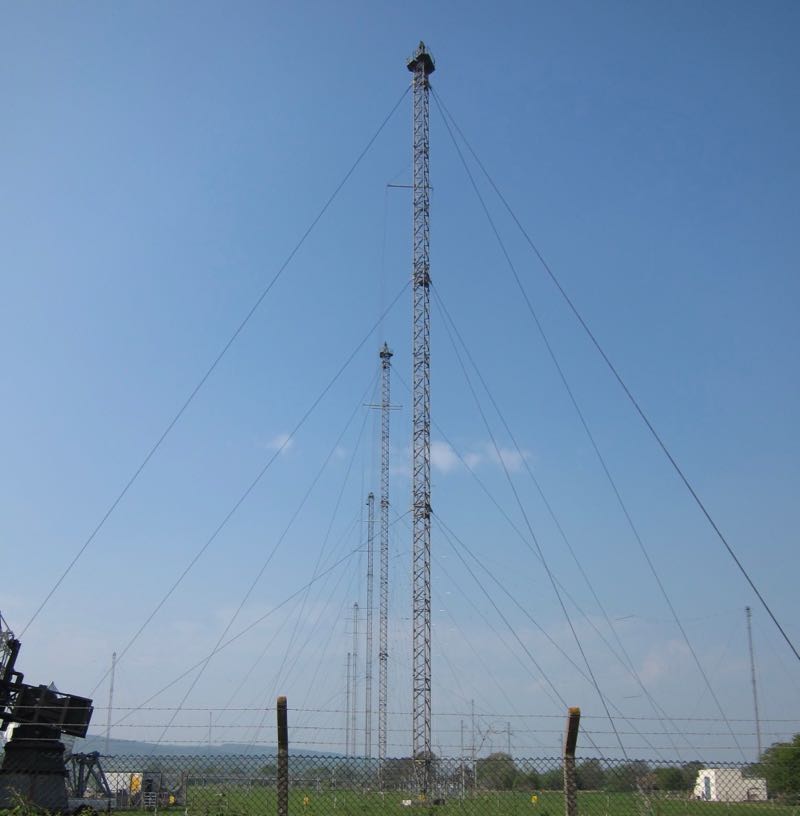
[…]The tower was 820 feet high, making it, at the time, the second tallest structure in the world, behind only the Eiffel Tower. It was one of the first and most powerful transatlantic radio stations ever constructed. It survived until 1955, when it was torn down and sold for scrap metal and today lends its name to Little Egg Harbor’s Radio Road.[…]

Click here to read the full story at The Sandpiper.

“Night of Nights” Returns Tonight!

Chief Operator Richard Dillman at Position 1 (Source: Maritime Radio Historical Society)

Many thanks to SWLing Post contributor, Brian Smith (W9IND), who writes:

The cast may be smaller than in previous years, but the “Night of Nights” nostalgia show will go on. At 8:01 p.m. Eastern Time today (0001 UTC July 13), two maritime CW stations operated by the Maritime Radio Historical Society will begin transmitting Morse code on shortwave and medium wave bands, while the Society’s amateur radio station will be active on four ham bands.

Venerable KPH will reappear tonight in the company of KFS and ham station K6KPH, all transmitting from a century-old Marconi site at Bolinas, California. They’ll be directed from a 1930 RCA station at 17400 Sir Francis Drake Boulevard in Point Reyes National Seashore. Several previous participants will be absent this year, including ship-to-shore powerhouse WLO of Mobile, Alabama, and a quartet of Coast Guard stations.

The annual July 12 event commemorates the date in 1999 when commercial Morse code operations ceased in the United States. One year later, “Night of Nights” debuted in a defiant declaration that maritime CW stations would not go gentle into that good night.

Typically, the two 5 kw coast stations transmit “code wheels” (repeating messages), personal messages, and tributes to long-gone maritime stations and operators, remaining on the air till at least 0700 UTC. And K6KPH will not only be heard, but contacted by fellow amateur radio stations. A list of KPH, KFS and K6KPH frequencies can be found at www.radiomarine.org, including those used by ships. Reception reports go to P.O. Box 392, Point Reyes Station, CA 94956.

The public is welcome to observe today’s event and tour the facility at Point Reyes. Doors open at 3 p.m. local (Pacific) time, and Morse aficionados are invited to operate K6KPH. Whisper the words “true believer” for a peek at the Treasure Room!

https://www.nps.gov/pore/planyourvisit/events_nightofnights.htm

For a comprehensive list of frequencies please click here.

Many thanks for the notice, Brian! We’ll tune in!

Shortwave Radio Recordings: SWL Digest from January 4, 1982

Do you miss Ian McFarland on Radio Canada International?

Yeah, me too.

That’s why I’m always pleased to receive off air recordings from Shortwave Radio Audio Archive contributor, Tom Laskowski.

I’ve just posted his latest off-air recording on the archive and thought I’d post it here as well. Tom note:

Here is another one of my many recordings of Shortwave Listener’s Digest from Radio Canada International, this time from January 4, 1982. This program highlights are: Glenn Hauser with his Year in Review for the previous year of 1981; part 1. Larry Magne with a test report for the Panasonic RF-9000 which listed at $US 3800!!!. The program ends with Glenn Hauser’s second part of his review of the previous year’s highlights. Unfortunately the broadcast suffers from some adjacent-channel interference.

Starting time: 2130 UTC on January 4, 1982

Frequency: 15.325 MHz

Receiver location: South Bend, Indiana

Receiver: Realistic DX-302

Click here to download this MP3 audio.

If you enjoy off-air recordings, check out some of the recent ones on the archive which include:

Thanks again, Tom, and thanks to the dozens of contributors that make the shortwave archive such a treasure trove of shortwave history!