Time on the Beach: Working at NIST Hawaii
The National Institute of Standards and Technology (NIST) has campuses in Maryland, Colorado, South Carolina and Hawaii.
Now, I know what you’re thinking, “Hawaiian campus? How do I get a job at NIST?”
Perhaps calling it a “campus” is a bit of an exaggeration. Ensconced within the U.S. Navy’s Pacific Missile Range Facility on the western Hawaiian island of Kauai (pronounced ka-why-ee), sits one of NIST’s shortwave radio stations, perhaps best known by its call sign, WWVH.
Kauai is a beautiful and remote island with unique climate diversity. In the middle of the island, you have one of the wettest places on Earth, Mount Waialeale (pronounced why-ah-lay-ah-lay), which receives an average of 1,148 centimeters (452 inches) of rain per year. Twenty-five kilometers away, the island’s western coast gets a mere 56 cm (22 inches) of rain per year. This is where you will find the NIST radio station.
WWVH’s main objective is to broadcast Coordinated Universal Time (UTC)—the official time for the entire planet—throughout the Pacific region. Those signals help their audience coordinate, calibrate and synchronize their clocks and equipment, which are vital to telecommunications, internet connections and a whole host of other services.
In addition to accurate time and frequency information, the station also broadcasts weather alerts and space weather reports.
“At the tone …”
From Alaska to Australia and from California to China, if you tune your receiver to WWVH, you’ll hear Jane Barbe speaking to you. If you don’t already know her by name, you may know her voice. It was her recorded voice that in past decades told callers who left their phones off the hook for too long (ask your parents), “If you’d like to make a call, please hang up and try again. If you need help, hang up and then dial your operator.”
Although Barbe died in 2003, her beloved voice lives on.
WWVH actually broadcasts her voice using several frequencies: 2.5, 5, 10 and 15 megahertz. The different frequencies cast a wide net so that users of the broadcast will receive a signal regardless of interference from mountains, atmospheric activity or the time of day. This technique allows users to always have access to the correct time as well as the other information provided by WWVH.
WWVH’s sister station, WWV, broadcasts out of Fort Collins, Colorado. Both stations broadcast on the same frequencies. While WWVH uses Barbe’s voice, WWV uses that of former San Francisco radio host Lee Rodgers, who died in 2013. If the ionospheric conditions are just right, users can hear both stations. In addition to using different voices, WWVH and WWV make their announcements at different time intervals to prevent overlap and confusion.
Why Hawaii?
In 1947, NIST determined it needed to create a second station to supplement WWV and expand its coverage area to the Pacific Rim. The WWVH broadcast station was originally built at Kihei on the Hawaiian island of Maui in 1948. After 20 years, however, the encroaching ocean began damaging the property and equipment. So in 1971, WWVH moved nearly 322 km (200 miles) west to its current home on Kauai. This more-westerly location proved to be ideal, as it allowed the station’s signal to reach even more distant locales.
At one point, there were nine employees at WWVH, including an on-site groundskeeper for the station’s 12 hectares (30 acres). Back then, the station was manned around the clock, but automation has whittled the staff down to four, who are now responsible for all station and land maintenance.
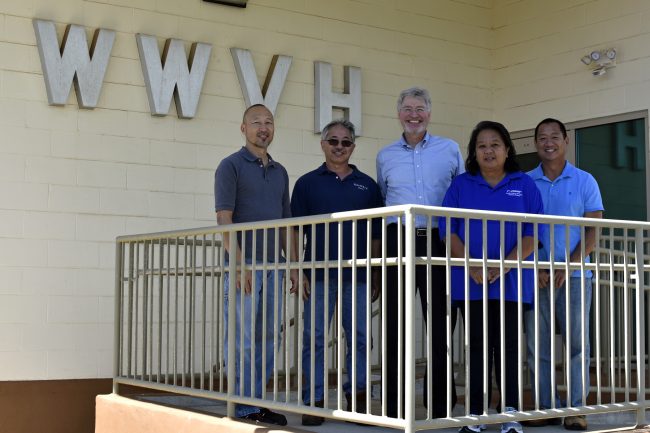
Taken together, engineer Dean Okayama, electrical technician Dean Takamatsu, electrical technician Chris Fujita, and administrative assistant Adela Mae Ochinang, have nearly 100 years of experience operating the facility.
In addition to the staff on location, John Lowe, leader of the Time and Frequency Services Group at NIST’s Boulder, Colorado, campus, manages WWVH and WWV, as well as the long-wave station WWVB, which is also in Fort Collins.
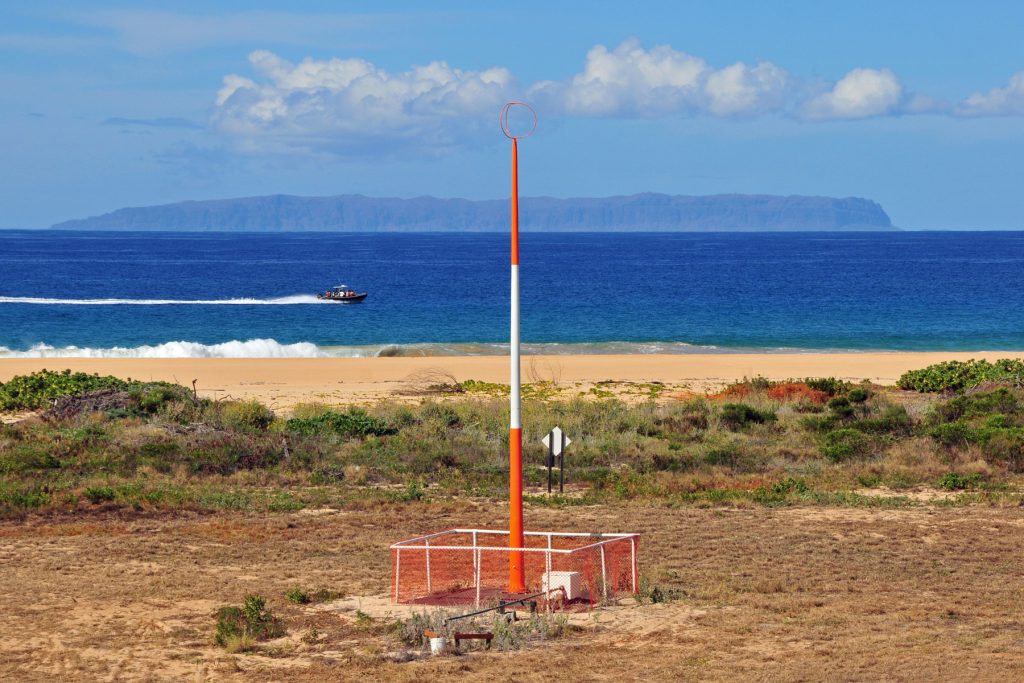
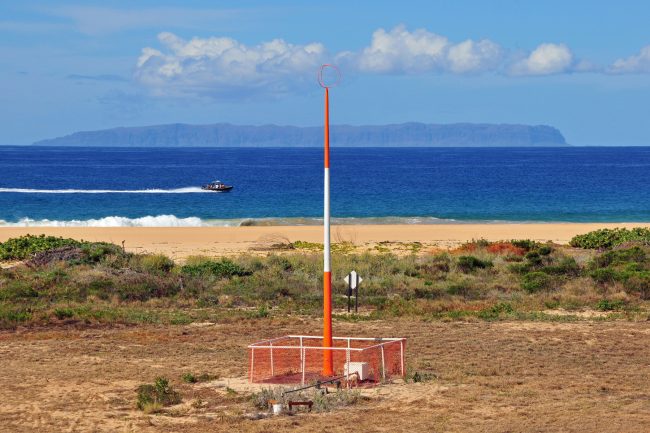
A typical antenna at the station, constructed of fiberglass (to resist corrosion from the salty ocean air) with a copper-wound core. Seen in the distance is the island of Niihau.
Credit: D. Okayama/NIST
The Pros and Cons of ‘Paradise’
“Oh, you’re going to go out to Hawaii. Lucky you, you get the easy work,” is something Lowe has heard often from his fellow NISTers. He says he seldom explains the intense labor he puts in while on Kauai because people don’t believe him anyway. He comes to the station at least once every two years, and the staff capitalizes on the extra set of hands by saving challenging projects for his visits.
In addition to Lowe’s visits, there is a yearly rotation of staff between WWV and WWVH for continuity purposes in case of an emergency. Fujita says the exchange “usually involves more work at the Kauai location than the Fort Collins location due to shorthandedness on Kauai, but nothing a few beers can’t fix after work.”
The marine environment, while great for beach relaxation, poses a constant challenge for the station. The salty air and heat have literally caused the transmitters to catch fire! One time when that happened, the naval base’s fire department was alerted before the radio station staff was. Unfortunately, the firefighters put out the fire with a dry chemical agent, a corrosive material that rendered the transmitter useless. Shortly after replacing that transmitter, its backup failed. Fujita says, “It feels like we’re chasing transmitters. Once you replace one, it seems like you have to replace another.”
Despite all the staff’s projects and problems, they maintain a 98 percent on-air rate, which, according to Lowe, is amazingly good. Someone is always on call, and it’s all-hands-on-deck during inclement weather, such as the April 14-15, 2018, monster storm that deluged the northern part of the island with 127 cm (50 inches) of rain in 24 hours, but which thankfully spared the area around WWVH. Checks are done daily to ensure the broadcasts are in close agreement with the UTC.
For Okayama, these major responsibilities translate into a passion for the job. If Monday is a holiday, he has to be reminded on Friday not to come in.
For the staff, the work is both fascinating and challenging. But what about all the fun that comes with working right next to a Hawaiian beach?
Surf’s up?
When the clock strikes noon, Fujita packs up his gear and walks down to the beach carrying a surfboard to catch some killer waves. He and Takamatsu have been excitedly eyeing the waves since the moment they walked in that morning.
At least that’s what would happen on TV.
The reality is much more in line with what happens at the other NIST locations: You go to the lunchroom to eat your packed lunch. When Okayama is asked if they spend their lunch break on the beach, he laughs. “It’s like asking someone who lives next to Disneyland if they go every day,” he says. “We don’t eat outside and lay under the palm trees. It’s hot and humid. There are bugs flying around.”
You would expect Lowe to soak up some rays during lunch on his occasional visits, but he is adamant that he runs for the air conditioning when the clock strikes noon. He believes it’s a unique place to work, but the blistering sun isn’t exactly comfortable.
Not to say that no one has ever surfed during lunch. Fujita tried it once, but says, “It’s too cumbersome to go to the beach at lunch. To change and get all your stuff ready, walk to the beach, wax the board, maybe get one or two waves, then come back and shower. It’s cutting it close.”
A Visit from the Boss
In its entire history, WWVH had never had a visit from the director of NIST. But that changed on March 7, 2018, when newly minted NIST director Walter Copan and his wife, who were on a long-planned Hawaiian vacation, took the opportunity to stop by the site.
“The WWVH team are truly NISTers, and they are our ambassadors of metrology on America’s westernmost shores,” says Copan. “The WWVH team was also recognized by a 2008 NIST Bronze Medal, now on display in their entrance hallway, for the development and installation of a new antenna array by the employees themselves. Their work is a true example of the NIST values, which include perseverance and inclusivity.”
It was a great experience to interact with the NIST director, says Ochinang. Copan shared with them his vision for NIST’s future and some interesting things about himself, like the fact that he is a trained opera singer.
When asked if they took advantage of the extra body to get more work done, Fujita says, “We did not subject the NIST director to intense manual labor, no. That wouldn’t be good … especially not on his first visit.” Fujita adds that, since the Copans’ vacation was not a government-sponsored trip, “We would have to reimburse him for work performed.”
I guess they’ll have to wait until Lowe is back in town.
The Kauai Life
Outside of work, life on Kauai is generally more laid back than the mainland or even the larger islands of Hawaii.
Although it sounds great, living in a tropical paradise is not for everyone. Many of those who move to Hawaii succumb to “rock fever,” the claustrophobia that comes from being on a small island.
Fujita and Ochinang were both born on Kauai, and though they left for a few years, coming back was easy. Okayama and Takamatsu are both from Honolulu, which is on the island of Oahu, the third largest Hawaiian island. Still, they seem to have acclimated well to life on a tinier island. Kauai reminds Okayama of a quieter Oahu in the 1960s when his family used to camp peacefully under the stars at the beach. Takamatsu’s father was from Kauai, so in a way, it feels like he’s returned to his roots.
The Kauai lifestyle and close working quarters have created a family atmosphere. They all take care of each other and no one wants to leave. Ochinang has been at WWVH for 35 years and doesn’t plan on going anywhere. “Sometimes people joke around,” she says, “but sorry, this is a good place to work and I’m not retiring anytime soon!”
So, if you want a job there, you’ll have to hang up and try again later.
*June 18, 2018, Editor’s note: Public tours of the WWVH facility are not available due to limited staff, but thank you for your interest and keep tuning in!