Category Archives: Schedules and Frequencies

Nova Spaceline shortwave broadcasts to Antarctica

The following information was first shared with me by SWLing Post contributor, Harald Kuhl. As I looked for more details, I discovered the following note in the excellent CIDX Messenger:

From Alan Roe of Teddington, UK, here is information on new transmissions targeting
Antarctica:

According to posting on “Shortwave Airtime” Facebook page:

“Spaceline Ltd and Radio Nova News are to start transmissions to Antarctica for campaign for access of information to the Bulgarian Antractic base. Shortwave is the only media that can reach directly Antarctida at the distance of 13.000 km. Transmissions will start on 1’st of January, 01.00 – 02.00 UTC daily on frequency 11600 kHz. For more information visit www.spaceline.bg”

I couldn’t find any more information at either the Spaceline website or the Radio Nova news
website at https://nova.bg/

However, I received today the following reply (below) from Spaceline:

Hello Alan,

The information on the Facebook page is correct, and Space Line will start the transmissions of Nova News to Antarctica very soon.It was been planned to start the project on January the 1’st, but due to some logistic problems with the base, is postponed for middle or the end of January this year, but there was a test transmission on January the 1st 2017 on 11600 kHz. After the test it appeared that here may be a frequency change from the announced one, due to some propagation anomalies.

The retransmission of Radio Nova News on shortwave is a common project between Nova, Spaceline Ltd. and Bulgarian Antarctic Institute, for reaching the scientists in Bulgarian Antarctic Base on South Shetland Island with fresh news information feed about the social life in Bulgaria.

Stay tuned to the shortwave.airtime FB page for more information about the project.
Best Regards,
Ventsislav Georgiev
Manager R&D
SpaceLine Ltd. | www.spaceline.bg
Mob : +359 888 554 297
E-mail: [email protected]
James Baucher blvd 71, Fl. 6, Office 5,
1407 Sofia , BULGARIA

Thank you Harald and Alan for the tip!

DSWCI archives now online

Many thanks to SWLing Post contributor, Harald Kuhl, who shares the following message sent by Anker Petersen of the The Danish Shortwave Club International (DSWCI):

Dear DSWCI members.

In a few hours the DSWCI exists no longer.

But our webmaster Rolf Wernli has done a tremendous job between Christmas and New Year by changing our wellknown website to an electronic archive with good reading for all members !

If our former website appears, it is because it has been saved in your computer.

Please type www.dswci.org, press Enter and the new website should appear.

Enjoy and have a Happy New Year!

Best 73,

Anker

What a brilliant resource! Thank you, Harald, for passing this information along and many thanks to the fine folks at the DSWCI for sharing their archives with the radio community!

Click here to browse the archives at the DSWCI website.

WRTH 2017: A look inside

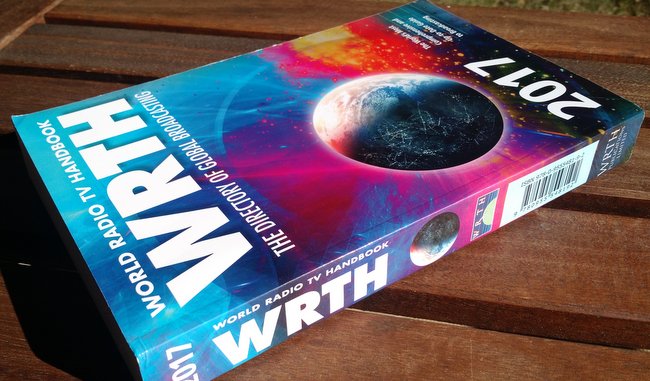
I received my copy of the 2017 World Radio and TV Handbook (WRTH) directly from the publisher last week, just prior to Christmas holiday ravels. As I mention every year, I look forward to receiving this excellent staple radio reference guide–and this is their 71st edition!

WRTH’s team of noted DXers from around the world curate frequencies and broadcaster information by region; while I’m not sure how they orchestrate all of this, the end result is truly a symphony of radio information. In addition to broadcaster listings, WRTH’s radio reviews, feature articles, and annual HF report make for excellent reading.

But the WRTH isn’t just a frequency guide: the publication always devotes the first sixty or so pages to articles relating to various aspects of the radio hobby. Following, I offer a quick overview of these.

The first article always features a WRTH contributor:  this year, WRTH’s International Editor, Sean Gilbert, tells us what sparked his interested in the hobby and what lead to his career with WRTH which started in 2000.

The second set of articles is always my favorite: WRTH receiver reviews.

This year, WRTH begins with a review of the Icom IC-7300 general coverage transceiver.  They also review the Reuter Elektronik RDR55D, and re-visit the SDRplay RSP1. Following radio reviews, they evaluate the excellent Wellbrook ALA1530LNP magnetic loop antenna and the Bonito AAS300 3 way active RF splitter.

The following article focuses on one of my favorite shortwave broadcasters, The Mighty KBC. WRTH contributor, Max van Arnhem traces the broadcaster’s history and gives us a little insight about the people behind this music powerhouse. If you’re a KBC fan, you’re in for a treat!

I was very happy to find that the following feature article explores the world of Remote Reception. No doubt, remote listening is becoming one the most accessible ways many of us discover and enjoy our hobby today–especially as it can be difficult for some of us to fight urban radio interference.

Following this, WRTH writer, Hans Johnson, features an article on CKZN St. John’s Newfoundland.  In this short article, Johnson covers the history and mission of this shortwave relay, dating back to the days when Newfoundland was a British dominion. Looking forward, Johnson notes that the CBC intend to not only continue this service directed at Labrador’s most remote areas, but it intends to replace their 1 kW Elcom Bauer transmitter in the coming years. This pleases me to no end as I’ve always loved snagging this particular relay of CFGB from my home here in North Carolina.

Next, DXer Rob Shepard writes about his travels in South America and the Pacific. Being an avid traveller myself, I love reading about others’ adventures across the globe with radio. Shepard even notes some catches from the Queen Mary II. I’ve never had the chance to do DXing while maritime mobile, but I hope to someday.

The following article features Danish radio enthusiast, Vagn Fentz, who has collaborated with WRTH since one of its very first editions. His radio history starts back when he was a schoolboy in Denmark during WWII, listening to the radio in secret. His story gives us insight into both his own world and that of the WRTH over the years.

Next, Michael Pütz outlines the progress, so far, of setting up an HF disaster relief radio network: the IRDR Project. If you haven’t heard of the IRDR project, this article makes for a great primer and also speaks to the potential future of a radio network that could have major positive impact over vast regions in the wake of disaster.

The final article–a tradition–is the WRTH  HF propagation report/forecast by Ulf-Peter Hoppe. Always an informative read (despite the fact we’re heading into a solar minimum).

The 71st is another fantastic edition of the World Radio TV Handbook. I’ve never been disappointed with WRTH, in truth. Their publishing standards are such that the quality of their reviews, their writing, and (most importantly) their broadcast listings are simply unparalleled.

For DXers who collect QSL cards, you’ll find that broadcaster contact information in WRTH is often more up-to-date than a broadcaster’s own website. When readers contact me asking for QSL information from an obscure broadcaster, the first place I search is the current WRTH. Remember: their information is based on volunteer contributors who specialize in specific regions of the world–the most knowledgeable regional DXers keep this publication accurate.

Purchase your copy of WRTH 2017 directly from WRTH’s publishers, or from a distributor like Universal Radio (US) and Amazon.com (US), Radio HF (Canada), or BookDepository.com (International).

Swedish DX-Federation via Channel 292


(Source: Tom Taylor)

Swedish DX-Federation, Italian Broadcasting Corporation

Swedish DX-Federation via Channel 292 at the following times and frequency:

December 26th at 07.00 – 08.00 UTC on 6070 kHz

New Year’s Day, January 1st 2017 at 17.00 – 18.00 UTC on 6070 kHz

January 6th 2017 at 17.00 – 18.00 UTC on 6070 kHz

Reception reports are to be sent preferably by e-mail to [email protected] but can also be sent by mail to SDXF, Box 1097, SE-405 23 Göteborg. Sweden.

Check out the Transmissions from the IBC: at: http://www.ibcradio.webs.com

Upcoming Slow-Scan TV Images from the ISS

Almost flawless image received from ISS 2016-04-15 1859Z 64 degree pass

Above is a sample SSTV image received during a pass in April 2006 from KC4ALE on ISS Fan Club

An early Christmas gift for space enthusiasts around the world is coming again this year with Slow-Scan TV images from the International Space Station. Reception varies wide;y from location to location, but there are usually at least several passes which will yield good results.

Here is the announcement with pertinent details:

SB SPACE @ ARL $ARLS011

ARLS011 Slow-Scan Television Transmissions Scheduled from ISS

ZCZC AS11

QST de W1AW

Space Bulletin 011  ARLS011

From ARRL Headquarters

Newington, CT  December 6, 2016

To all radio amateurs

SB SPACE ARL ARLS011

ARLS011 Slow-Scan Television Transmissions Scheduled from ISS

Slow-scan television (SSTV) transmissions from the International Space Station (ISS) are scheduled for December 8-9. The SSTV images will be transmitted from RS0ISS on 145.800 MHz FM as part of the Moscow Aviation Institute MAI-75 Experiment, using the Kenwood

TM-D710 transceiver in the ISS Service Module.

MAI-75 activities have been scheduled on December 8, 1235-1800 UTC, and December 9, 1240-1740 UTC. These times correspond to passes over Moscow, Russia. ISS transmissions on 145.800 MHz FM use 5-kHz deviation, and SSTV transmissions have used the PD120 and PD180 formats.

The ISS Fan Club website at http://www.issfanclub.com/ can show when the space station is within range of your station. On Windows PCs the free application MMSSTV can decode the signal. On Apple iOS devices, use the SSTV app available through iTunes.

There are a number of software program available for SSTV reception in addition to the ones mentioned above. It would be interesting to hear from folks who have used SSTV programs with their impressions. Good hunting!

Robert Gulley, AK3Q, is the author of this post and a regular contributor to the SWLing Post. Robert also blogs at All Things Radio.

Radio Romania International Winter Broadcast Frequencies

RRI-RadioRomaniaInternationalMany thanks to SWLing Post contributor, David Iurescia (LW4DAF), who shares a link to RRI’s recently published B16 broadcast schedule:

RRI Winter Broadcast Frequencies
RRI broadcast frequencies valid as of October 30, 2016 to March 26,2017

http://www.rri.ro/en_gb/rri_winter_broadcast_frequencies-2554355

rri-b16-schedule

How to Identify Changes in Station Schedules

The shortwave bands are in a constant state of flux. And radio reception varies with the seasons. As a result, radio stations often need to alter their frequencies and times for best all-year-round reception at the listener’s location. There are two seasonal changeovers: the “A” transmission period coincides with the northern hemisphere summer (March to October), and the “B” transmission schedule for the winter period (October to March). Leading up to these changeovers, broadcasters plan their schedules for the coming season. The B16 transmission season began last weekend.

Want to improve your understanding of shortwave propagation characteristics? Study a few of the strategies employed by broadcast engineers at international radio stations during the twice yearly schedule changeovers. You’ll quickly learn much about how it all works!

Frequency changes by international broadcasters allow you the opportunity to observe the factors that come into play at BOTH the transmitter site and the reception target zone in another part of the world. Broadly speaking, we know that when winter arrives reception of the higher frequencies declines and the lower frequencies provide better reception. The reverse applies in summer – reception on the higher frequencies are enhanced and ionospheric absorption of signals increases at lower frequencies.

In addition, these characteristics change for both daytime and nighttime reception in summer and winter. Furthermore, some interesting reception opportunities occur in certain regions of the world during the summer and winter equinoxes. On top of this, factor in the 11-year sunspot cycle and the current monthly smoothed sunspot number (SSN). So, station engineers have quite a few variables to consider while selecting their preferred shortwave bands when targeting their signals to the listener’s location in some other part of the world! Perhaps one could even consider that these calculations as both a science and an art!

hfcc-big-logo

Next, the engineers representing each station have to sit down with their colleagues (competitors?) from other broadcasters and negotiate suitable frequency allocations in each of the preferred bands. This is why we have the existence of the High Frequency Coordination Committee (HFCC). Working together to find and register suitable frequencies that don’t interfere with other transmissions is an important part of successfully ensuring that everyone “wins”. The HFCC describes its role this way:

The main objective of the HFCC is to provide the representation and services for the promotion of an efficient and economical use of the short-wave radio spectrum, and the improvement of radio reception of shortwave broadcast transmissions worldwide……

HFCC’s main activity is a direct coordination of frequencies among frequency managers and specialists of broadcasters, administrations, transmission service providers and other organisations with the aim to facilitate the resolution or minimisation of mutual interference on short waves…..

Membership of the HFCC is open to all individuals and organisations that provide frequency management and planning for recognised shortwave broadcasters.

And it has to be said that the HFCC does a very good job at trying to resolve potential conflicts and clashes in frequency registration. But we didn’t always have this informal governing body. HFCC was only formed in 1990. Prior to that, there was much “rough and tumble” as stations tried to sort it out for themselves and avoid getting in each others way. Remember also, in the 1970s and 80’s there were many more shortwave broadcasters than there are today, each with very large operating schedules. For younger readers here, imagine the international bands being six or seven times busier than they are today!

Understanding propagation characteristics, frequency allocation, antenna beam headings, different time zones and many other aspects of international broadcasting have been a source of fascination for me, both as a shortwave listener and as an amateur (ham) radio operator.

Here are some things to consider when monitoring the change in transmission seasons:

    • Learn the basics of shortwave propagation and the characteristics on display over a 24-hour period, seasonally, annually, and within the sunspot cycle. It’s a big topic and takes a while to really absorb it all!
  • Familiarise yourself with which part of the spectrum the broadcaster can be expected to successfully utilise during a certain season.
    • When finding a station on a new frequency (NF), try to locate and note down the formerly used frequency. Sometimes, that same station will return to the deleted frequency at the start of the next season (the next half of the year).
    • Noting the deleted frequency often reveals that another station has taken up position on that channel.
    • Check to see if the same transmitter site is used for the NF. With so many stations using a variety of relay sites these days, you cannot just assume that the same relay is being used for the NF as it was for the old frequency.
    • Some station schedules are complicated and can be hard to decipher. Time changes, language changes, an increase or decrease in the number of frequencies the station employs for a particular service, daily broadcasts, weekends only, weekdays only, or only certains days of the week can make it tricky to reveal how the NF relates to the old frequency. Expect that you might sometimes get it wrong!
    • A few stations (e.g. China Radio International or Radio Free Asia) use so many outlets for some broadcasts that it can be too hard to tell what was the replaced frequency. In those cases, I just throw up my hands and move on!
  • Maybe the target location of the broadcast has changed. Checking the transmitter’s azimuth beam headings can help here.

Like other “old dudes”, I have spent many years observing and documenting the schedule changes of shortwave broadcasters. This is a part of the hobby that I personally find quite absorbing. However, I’m aware that it’s probably NOT something that some others might enjoy quite so much!

Since the B16 changes came in one week ago, I have been busy monitoring the bands to find the NFs and the deleted frequencies (the ex’s) and any other variations to the broadcasting schedules of each station.

There are HUNDREDS of changes to discover. But I can’t find them all – I also have to eat, sleep, and get on with life!

However, here is a list of the 93 observations I have made over just the past few days:

NOTE: Frequencies in kHz, Times in UTC
ABBREVIATIONS: NF = New Frequency, ex = deleted frequency, QRM = interference, // = another or parallel frequency used at the same time, As = Asia, SEAs = South East Asia, etc. Af = Africa, WAf = West Africa, etc. Eu = Europe, EEu = Eastern Europe, etc. NAm = Nth America, ENAm = Eastern Nth America, etc. Oc = Oceania
FORMAT: Freq – Country of Transmitter site – Station Name – Transmitter Location – comments.

5885 NTH MARIANA IS. RFA – Tinian. Korean to EAs at 1710, NF and good signal, Nov 4.

5910 OMAN. BBC – Al Seela. S/on 1700 in Dari to SEAs, NF, good signal, Nov 4.

5955 ROMANIA. RRI – Tiganesti. Italian to SEu, 1715, NF (ex 5910) and fair signal, Nov 4.

5965 NTH MARIANA IS. RFA – Tinian. Mandarin at 2030, NF and heavy jamming, Oct 31.

5970 TURKEY. VoT – Emirler. French to Eu, 2035, NF (ex 9635), fair signal Oct 31.

5980 TURKEY. VoT – Emirler. Turkish to Eu 2005, NF (ex 9460), good signal, Oct 31.

5990 ROMANIA. RRI – Galbeni. Romanian to Eu, 2040 to s/off 2100, NF (Believed to be ex 9500), good signal, Oct 31.

6010 CHINA. CRI – Urumqi. S/on 1800 in Amoy (Min Nan Chinese), NF (ex 13700) fair signal but QRM from Korean jamming on 6015, Nov 4.

6025 IRAN. VOIRI – Sirjan. German to Eu at s/on 1720, NF (ex 9660), good signal, Nov. 4

6040 CHINA. CRI – Urumqi. Russian to EEu at 1745 to s/off 1757, NF (possibly ex 11875 for this txer site) and excellent signal Nov 4.

6050 TURKEY. VoT – Emirler. English to Eu at 2015 to s/off 2025, NF (ex 9785), fair signal, Oct 31.

6060 IRAN. VOIRI – Zhaedan. Arabic to NAf at 1802, NF (ex 7285), fair signal, Nov 4.

6070 CHINA. CRI – Beijing. Russian to EEu at 1815, NF (ex 9560), very good signal Nov 4.

6090 OMAN. BBC – Al Seela. English WS to CAs and ME, 1820, NF (ex 7375), good signal and // 6195 also heard via Al Seela, Nov 4.

6100 CHINA. CRI – Beijing. English to Eu at 1800-1900, NF (ex 9600), excellent signal and // 7405 (via Beijing) which is also a NF and well heard on Nov 4.

Click here to continue reading the remaining 78 new frequency observations


2016-shack-part-shot-3

Part of Rob’s shack. Top Row: Two power supplies. Middle Row: Bose powered speaker, Kenwood R5000 receiver. Bottom Row: Kenwood TS2000 transceiver, Yaesu FRG100 receiver.

Rob Wagner, VK3BVW, is the author of this post and a regular contributor to the SWLing Post. He also blogs at the Mount Evelyn DX Report.