Shortwave listening and everything radio including reviews, broadcasting, ham radio, field operation, DXing, maker kits, travel, emergency gear, events, and more
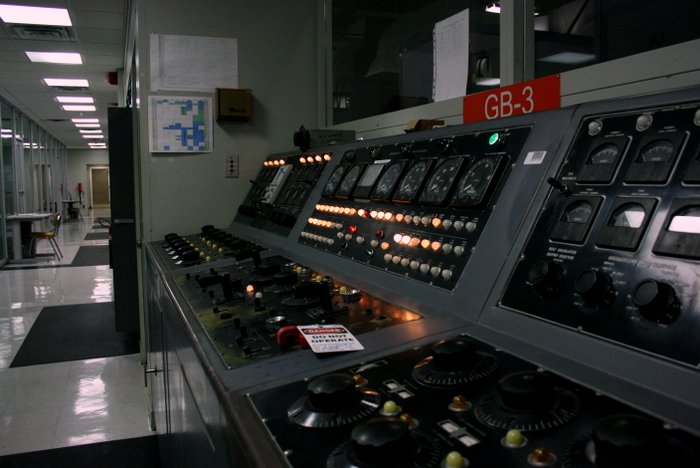
Tuning controls on one of the 500 kW Continental Electronics transmitters at the Edward R. Murrow Transmitting Site. Click to enlarge.
Many thanks to SWLing Post contributor Dan Greenall, who shares the following recordings and writes:
Hi Thomas
As a result of recent actions by the Trump administration, a number of shortwave stations have recently gone silent. Whether or not this will change is anybody’s guess, but the situation is currently looking grim.
I am providing links to some recordings that I have recently uploaded to the Internet Archive of a few of the affected stations. These recordings were made through the use of remote SDR’s in order to provide optimal quality. I used to particularly enjoy the programs of Radyo Pilipinas and Radio Thailand world service. Have a listen here to potential radio history.
Radio Marti February 15, 2025 in Spanish:
Voice of America (Africa) via Botswana transmitter January 19, 2025:
Radyo Pilipinas via VOA Tinang Philippines December 10, 2024:
Radio Thailand via Udon Thani December 17 and 23, 2024:
Many thanks to SWLing Post contributor, Dan Greenall, who writes:
Hi Thomas
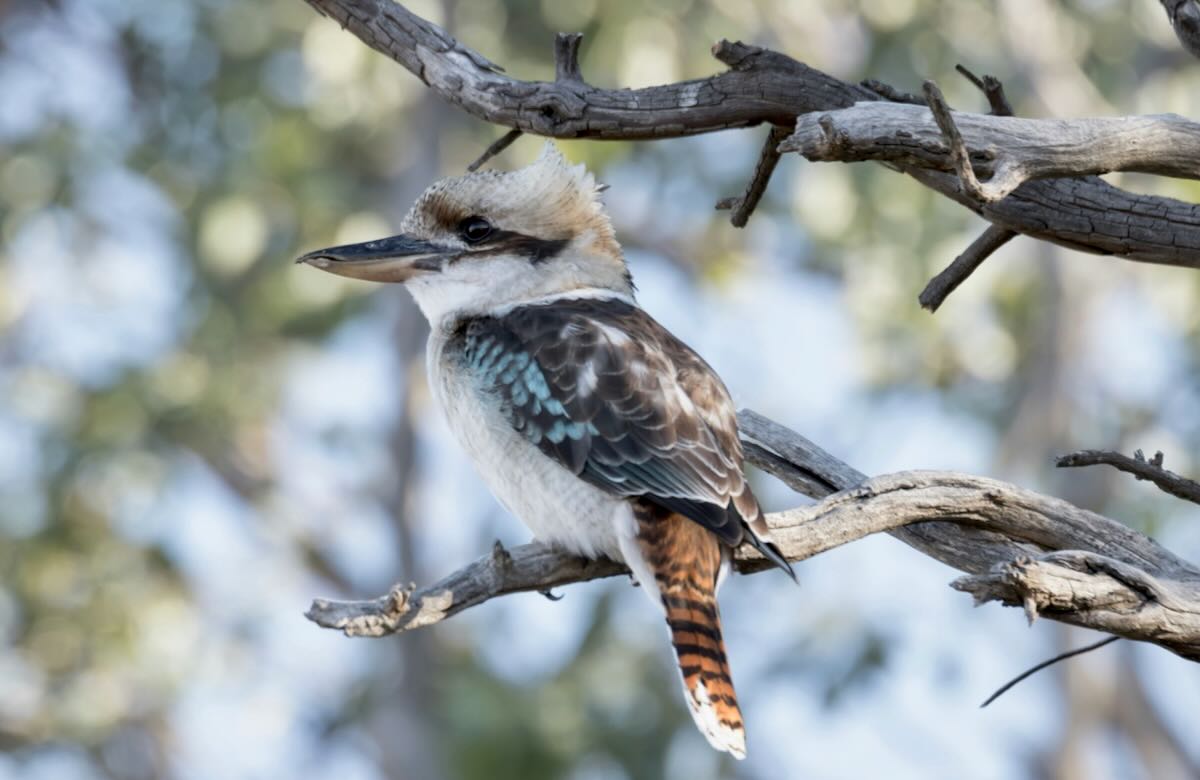
I still have warm memories of tuning into Radio Australia on 9580 kHz at sunrise during my early days of shortwave listening. They would sign on with their Waltzing Matilda interval signal and the sound of the kookaburra bird.
While doing some listening on the SDR of my friend Ken (VE3HLS) who has retired to northern Thailand, I have discovered you can still hear the kookaburra on shortwave by tuning into Reach Beyond Australia. Their broadcast to Myanmar in Burmese from 1500 to 1530 UTC on 11900 kHz can be very well heard on this Kiwi. There is a brief English announcement at sign and sign off, as well as a few seconds of “kookaburra chatter.”
Attached are two recordings, the first at sign on (March 7, 2025) and the second at sign off (December 1, 2024).
Also I’ve included a link to Interval Signals Online where you can find the old Radio Australia sign on.
Many thanks to SWLing Post contributor Dan Greenall, who shares:
Running into an old friend
Hi Thomas
I was doing some random tuning on shortwave this evening using the KiwiSDR at VK2ATZ in New South Wales, Australia, when I came upon a repeating music box-like tune on 13705 kHz that I thought had a familiar sound to it. It was like running into someone who you hadn’t seen in many years and trying to place where you knew them from. Yes, the sound was a bit different, perhaps even a little slower (age does that ?), but then it came to me, could it be Radio Japan, the overseas service of NHK? A quick check at Short-Wave.info revealed this was indeed NHK World Radio.
It felt like I had found an old friend, one that I knew from my high school days over a half century ago. Still recognizable after all those years, and it felt good to know that they are still around.
Attached are two recordings:
Radio Japan, interval signal and bilingual ID, as heard in Ancaster, Ontario, Canada on 9505 kHz in 1970:
NHK World Radio, interval signal and sign on in Thai on 13705 kHz, January 23, 2025 at 2300Z (via VK2ATZ KiwiSDR):
Many of us who are also amateur radio operators, got their start in the hobby through simply listening to shortwave radio, or perhaps, to stations in the AM or FM broadcast bands. I suppose it is then inevitable that these two hobbies are bound to connect with each other from time to time. Here are a few examples of this that relate to my experiences.
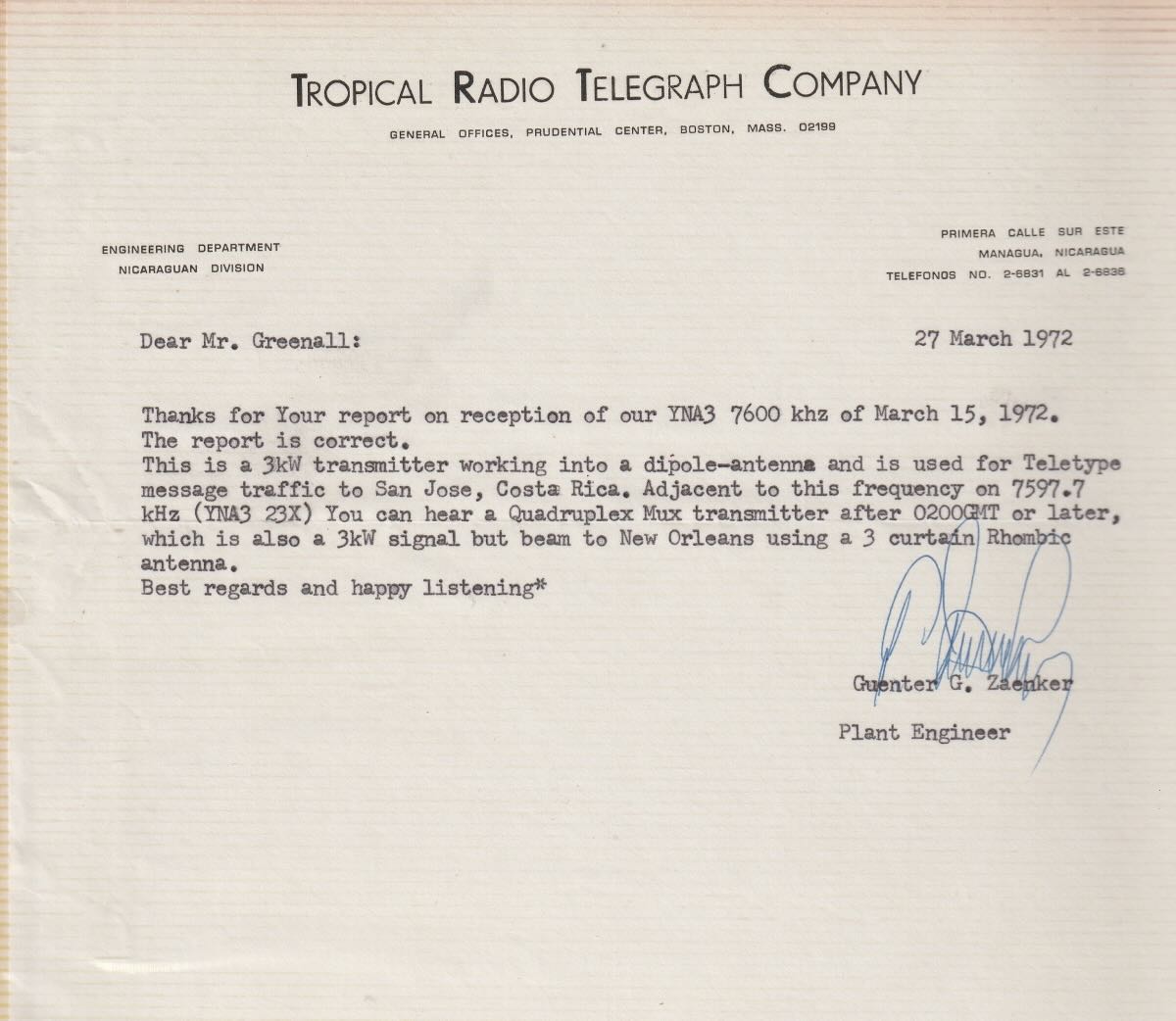
In 1972, while doing a random band scan on shortwave, I came across a point-to-point radio station from Managua, Nicaragua that was transmitting a repeating test message (recording attached below):
The station was operated by the Tropical Radio Telegraph Company and I sent off a reception report in hopes of receiving a QSL from them. As luck would have it, the Plant Engineer, Guenter G. Zaenker, responded with a friendly letter including some details about their transmitter power and antennas used.
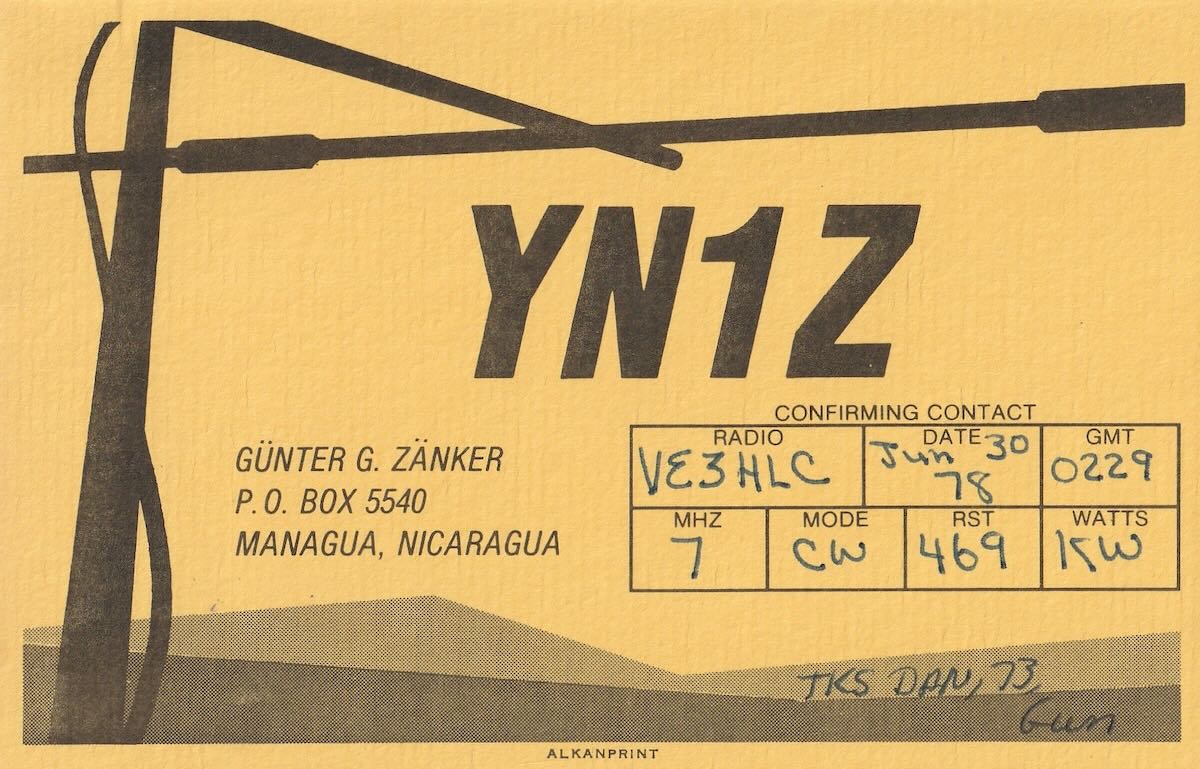
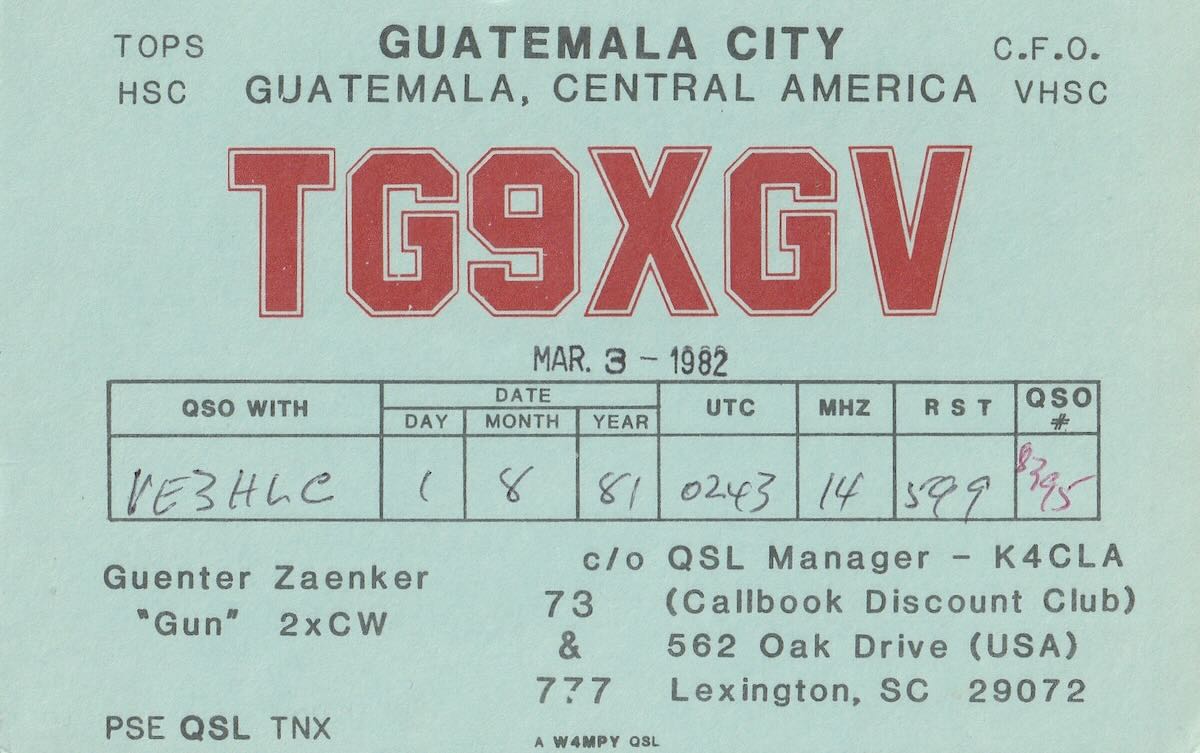
A couple of years later, when I got my amateur radio licence (VE3HLC), my SWL activities took a back seat to ham radio for a while. In 1978, I received a QSL for a contact with station YN1Z in Managua who turned out to be none other than Guenther G. Zaenker.
I worked Guenter for a final time as TG9XGV in Guatemala City, Guatemala. How is that for completing a hat trick!
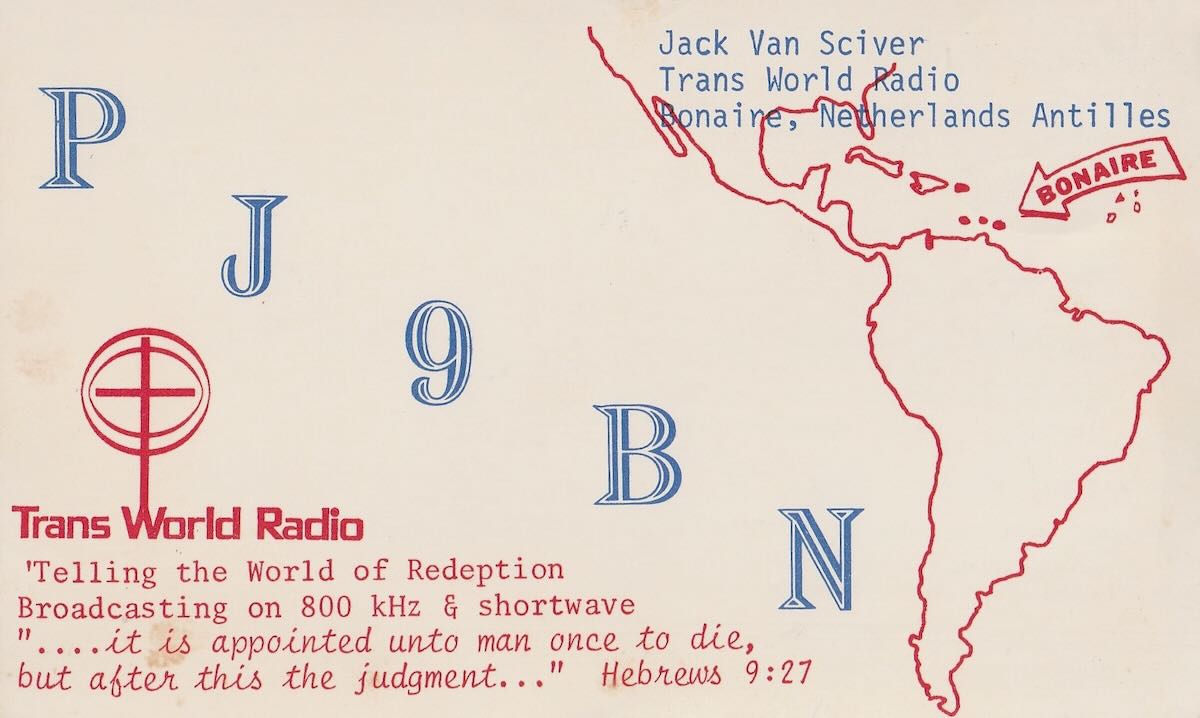
Shortly after receiving my amateur radio ticket in 1974, I made a contact with station PJ9BN, Jack Van Sciver on the island of Bonaire in the Netherlands Antilles.
It turns out he worked at Trans World Radio, a broadcaster I had listened to regularly on the SWBC bands and it was quite exciting to discover this connection. Attached is a link to a recording I made of this station that same year as they were concluding a segment of their popular DX Special program:
It seems that Jack is still going strong as I recently found this link to his current amateur callsign NA3F: https://www.qrz.com/db/NA3F
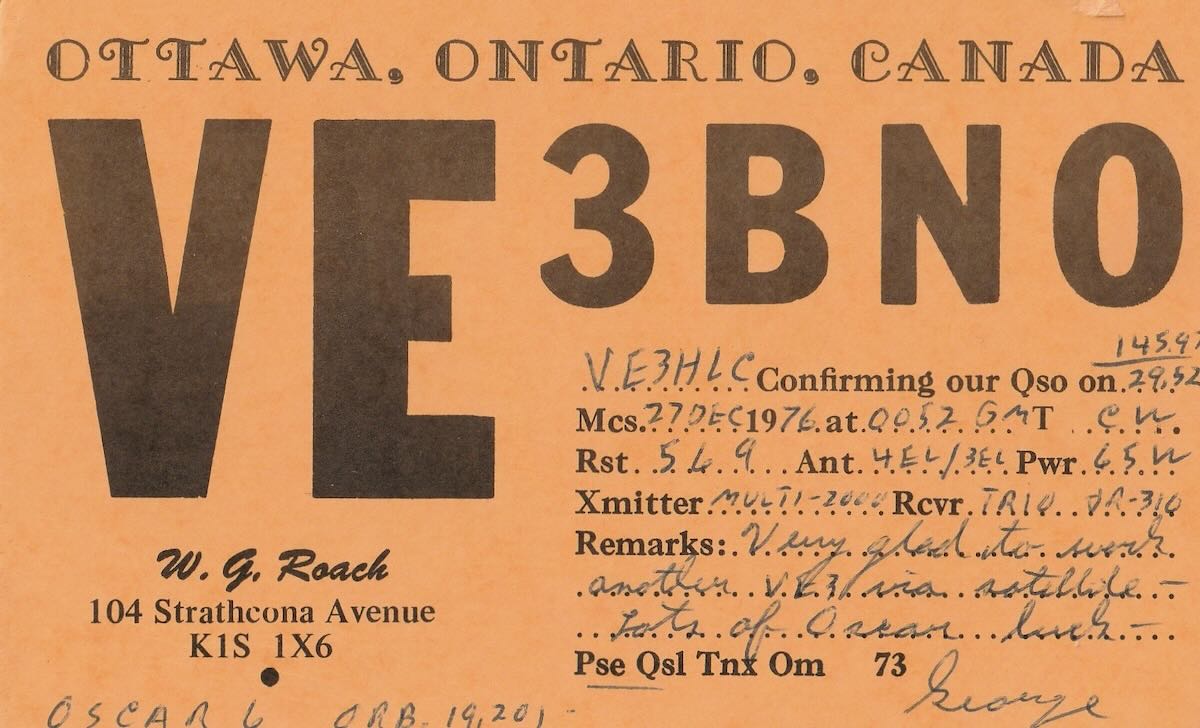
A final note, I had made a 2-way contact through the Oscar 6 amateur radio satellite (uplink on 2 metres, downlink on 10 metres) in 1976 with W.G. “George” Roach in Ottawa, Ontario.
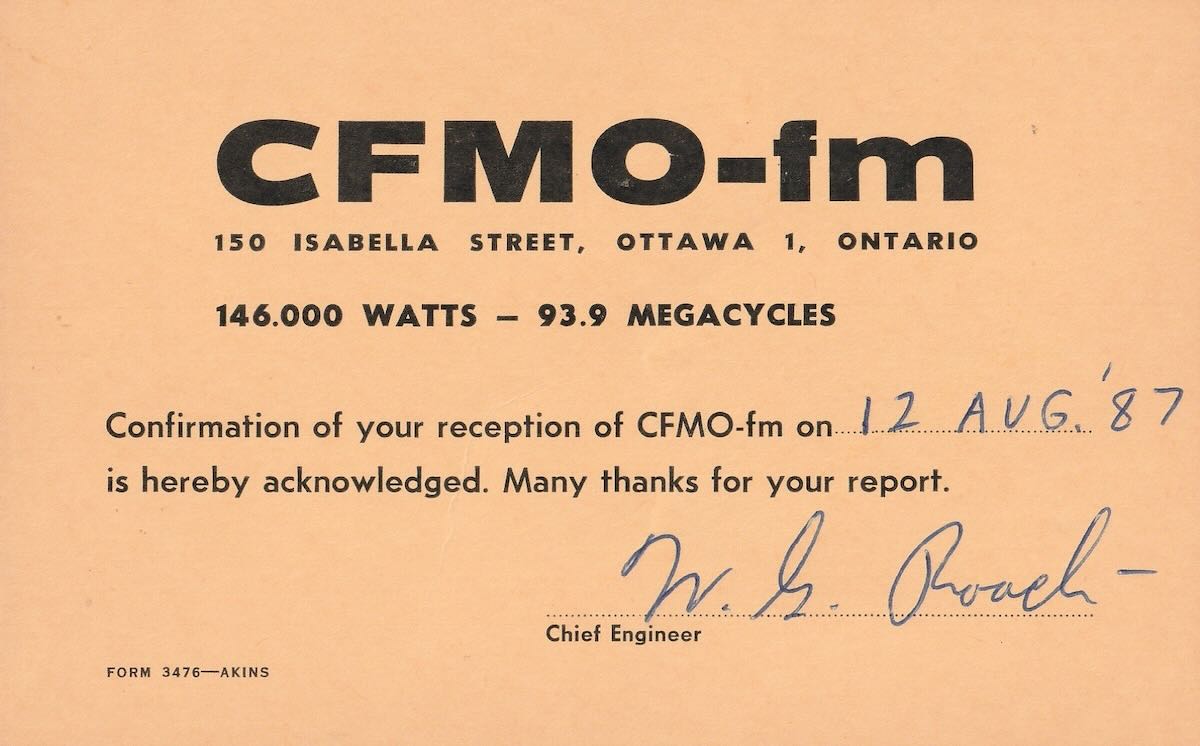
Some 11 years later, I was able to pick up station CFMO FM on 93.9 MHz, over 300 miles away, through some great ducting conditions. When I received a QSL from the station, it was signed by W.G. Roach who was the chief engineer at CFMO FM.
It certainly is a small world! I wonder how many others out there have experiences similar to mine?
Part 15 of the Federal Communications Commission (FCC) rules allows some low-powered radio devices to operate without a license on the AM and FM radio broadcast bands. These devices are subject to certain restrictions, including:
Range: On FM frequencies, the effective service range is limited to about 200 feet (61 meters).
Field strength: The field strength should not exceed 250 ?V/m (48db) at 3 meters.
Detachable antennas: Part 15 rules prohibit detachable antennas on all Part 15 transmitters.
Some examples of Part 15 radio stations include:
Microbroadcasting
Often used by hobbyists, drive-in theaters, or on college or high school campuses.
Talking roadsigns, talking houses, or talking billboards
These transmitters air a repeating loop of information, such as traffic or highway construction. They typically operate on empty channels on the AM broadcast band.
InfOspot
A custom product that can include special audio systems, USB / internet connectivity, cabinets, and antenna mounting styles.
Free-radiate AM radio stations
Educational institutions can use a transmitter without a license if the signal coverage is limited to their property.
5. TIS (Travellers Information Stations)
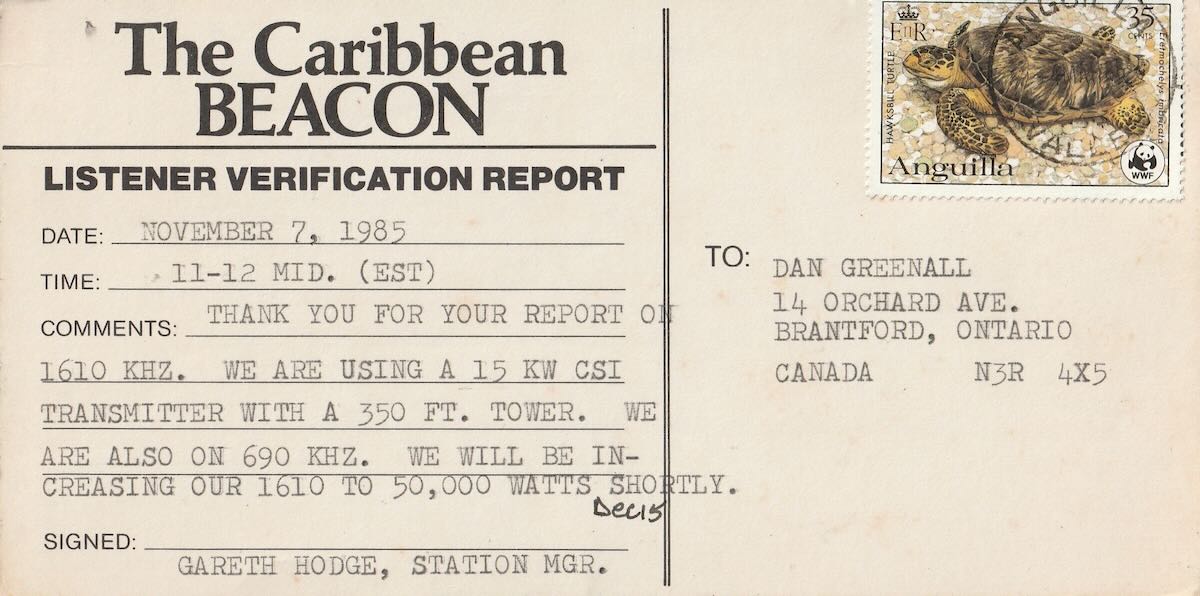
1610 kHz with low power, usually around 10 watts, such as the one I hear near the Blue Water Bridge between Sarnia, Ontario and Port Huron, Michigan
6. Expanded AM broadcast band
Over a quarter century ago, these frequencies began to be used in the U.S. by BCB stations. I still have recordings of a half dozen of these from the early days.
WTDY 1670:
WNML 1670:
WMDM 1690:
KCNZ 1650:
KCJJ 1630:
KBGG 1700:
Also, here is a link to a column in Popular Communications magazine from February 1998.
Many thanks to SWLing Post contributor, Dan Greenall, who shares the following schedule via John at VORW Radio International:
[…]I’ve included an updated radio broadcast schedule below – I have my main broadcasts (which are always new shows) as well as repeat airings throughout the week.
Main Broadcasts:
4840 kHz at 2 AM Eastern every Saturday Morning (New Show)
4840 kHz at 12 AM Eastern every Monday Morning (New Show)
Repeat Airings:
5950 kHz at 7 PM Eastern every Saturday Evening (Rebroadcast)
5950 kHz at 8 PM Eastern every Sunday Evening (Rebroadcast)
15770 kHz at 3 PM Eastern every Tuesday Afternoon (Rebroadcast)
7570 kHz at 6 PM Eastern every Wednesday Evening (Rebroadcast)
9395 kHz at 10 PM Eastern every Wednesday Evening (Rebroadcast)
15770 kHz at 11 AM Eastern every Thursday Morning (Rebroadcast)
9955 kHz at 6 PM Eastern every Thursday Evening (Rebroadcast)