Tag Archives: Ethiopia

Ethiopia on Shortwave – Then and Now

by Dan Greenall

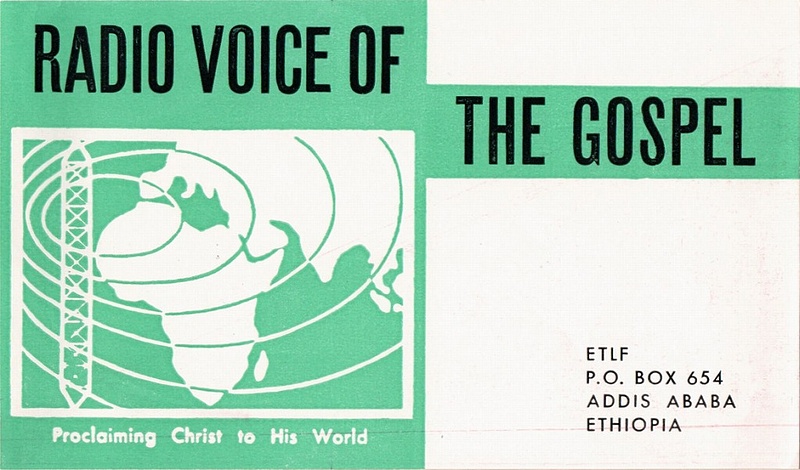
Back in the early 1970’s, Radio Voice of the Gospel, station ETLF, in Addis Ababa was the best way to hear this country, though it was by no means an everyday occurrence here in southern Ontario, Canada. Their distinctive drum interval signal was the first 4 notes of “A Mighty Fortress.” Or perhaps you would be lucky to hear “Elizabethan Serenade” being played prior to the start of their broadcast. Two recordings I have managed to save can be found at the Internet Archive here: https://archive.org/details/etlf-ethiopia-1971

In 1977, the station was nationalized by the Provisional Military Governing Council of Ethiopia and renamed the Radio Voice of Revolutionary Ethiopia.

Later, in the late 1990’s, a couple of Ethiopian stations could readily be heard thanks to their out of band frequencies. The Voice of Tigray Revolution used 5500 kHz and I recorded their signal on February 21, 1999 while at a DX Camp in Coe Hill, Ontario.

Radio Fana used 6940 kHz and I made a recording of them signing on just prior to 0330 UTC also on February 21, 1999 while at the same DX Camp.

Today, a few stations are still listed as broadcasting on shortwave from Ethiopia, namely Radio Oromiya on 6030, Amhara State Radio on 6090, and Radio Fana on 6110 kHz.

When active, they all seem to suffer from low modulation levels and co-channel interference (primarily from Chinese stations). Recently, I was able to discover that Radio Fana is still using the same interval signal as they did in 1999, by listening on a Kiwi SDR in Mombasa, Kenya.
Here is a recording of their sign on at 0300 UTC on April 26, 2026 on 6110 kHz.

They now seem to ID as Fana Media Corporation, even though programming is not in English.

Listen at the 3:05 mark for this. Also, the modulation level jumps up significantly about the 3:28 mark.

Additionally, I have included a recording of their sign off on April 1, 2026 beginning at 2053 UTC and concluding with the Ethiopian national anthem.
Is Someone Refurbing Shortwave Transmitters In Ethiopia?

I think the answer to this is.. YES! I say that based upon my monitoring from here in McGrath, Alaska.

I’ve never ever ever heard Amhara State Radio on 6090khz from my QTH. Now, that doesn’t mean they’ve never been on, but I’ve never even heard a carrier from them and I can’t recall anyone logging them.

Well, Saturday night February 17th (AK time) I detected an initially unknown signal on 6090khz. I noticed it just after 0300 Sun Feb. 18, I heard what was very decidedly African continent sounding music. It appeared to be one long track on a loop, because 2 days later, I had the same melody going for over 15 minutes… so I kept listening on that 3rd day and heard it fade down as it ended and started again.

There was no modulation that 2nd day. But as we look at the 3rd day again, I heard a different track start about 0345UTC or so. About,0352 I heard a guy speak (!!) but the signal started to lose steam quickly. About 0356 which is the listed sign on for Amhara on 6090khz, I heard an actual song start and about 0401 I heard a lady speak with what sounded like music.

Amharic is used on Shortwave by the BBC, Deutsche Welle and the VOA. While I don’t claim to be a language expert at all, what I heard on 6090 did sound similar to what I’ve heard from other broadcasters.

Fast forward to Wednesday night February 21st (AK Time), I detected a signal on 6110khz. To be fair, I’ve had something an “ok-ish”  a few times from my Alaska QTH but with less modulation than Cuba or Iran.  On Feb. 22nd (UTC) on the 0300 hour, I had a GOOD signal with modulation (!!) on 6110khz.

6110’s audio had, again like 6090khz, decidedly African continent  sounding music and lots of speech that sounded like Amharic to me.

6090khz and 6110khz either share a site or are close by. Is someone refurbing their transmitters…. China?  I sent a message to the Amhara State Media Facebook page but haven’t gotten an answer back.

I wonder what’s going on here? Your thoughts and comments are welcome

Paul Walker

Guest Post: Following the Ethiopian war over shortwave radio

Many thanks to SWLing Post contributor and political cartoonist, Carlos Latuff, who shares the following guest post:


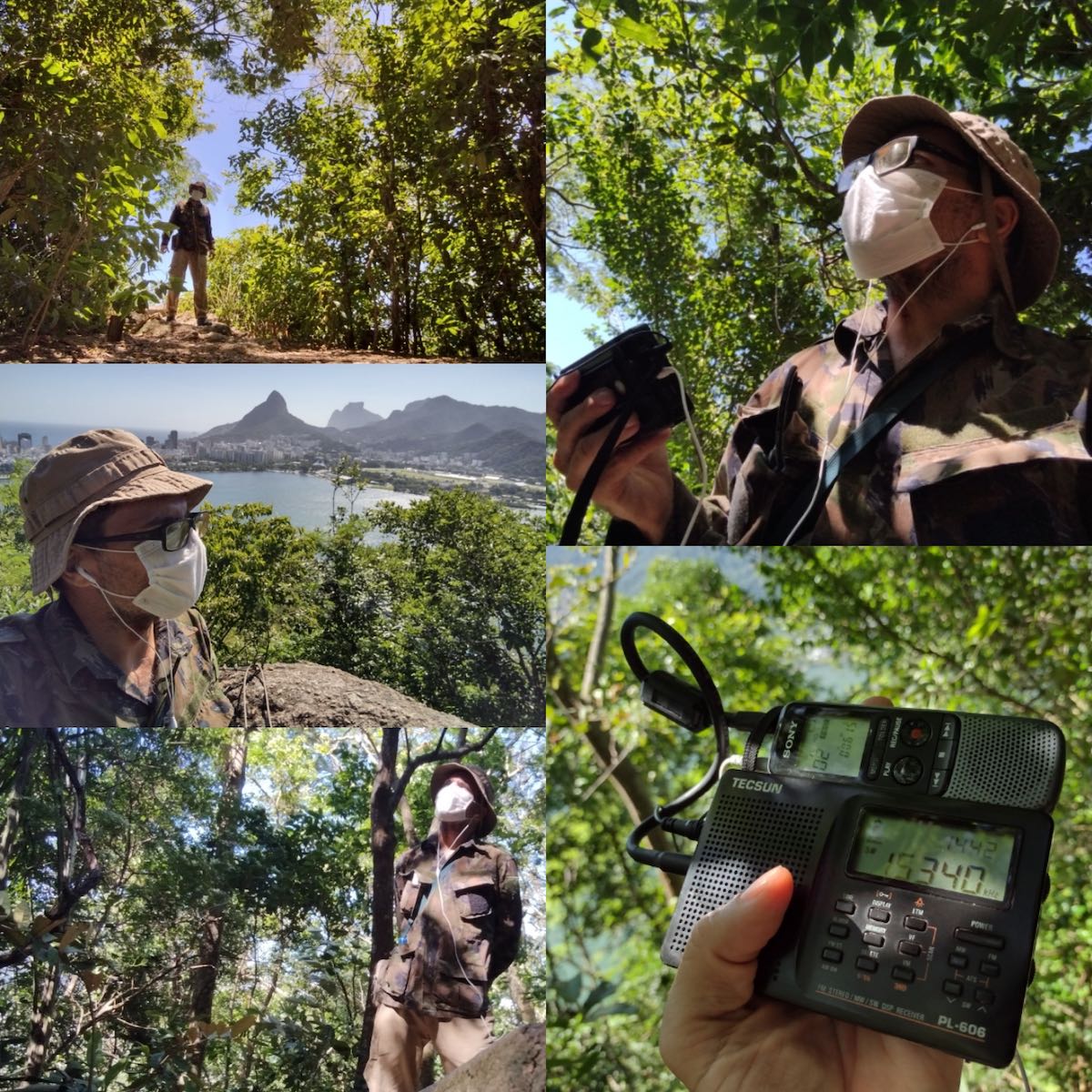
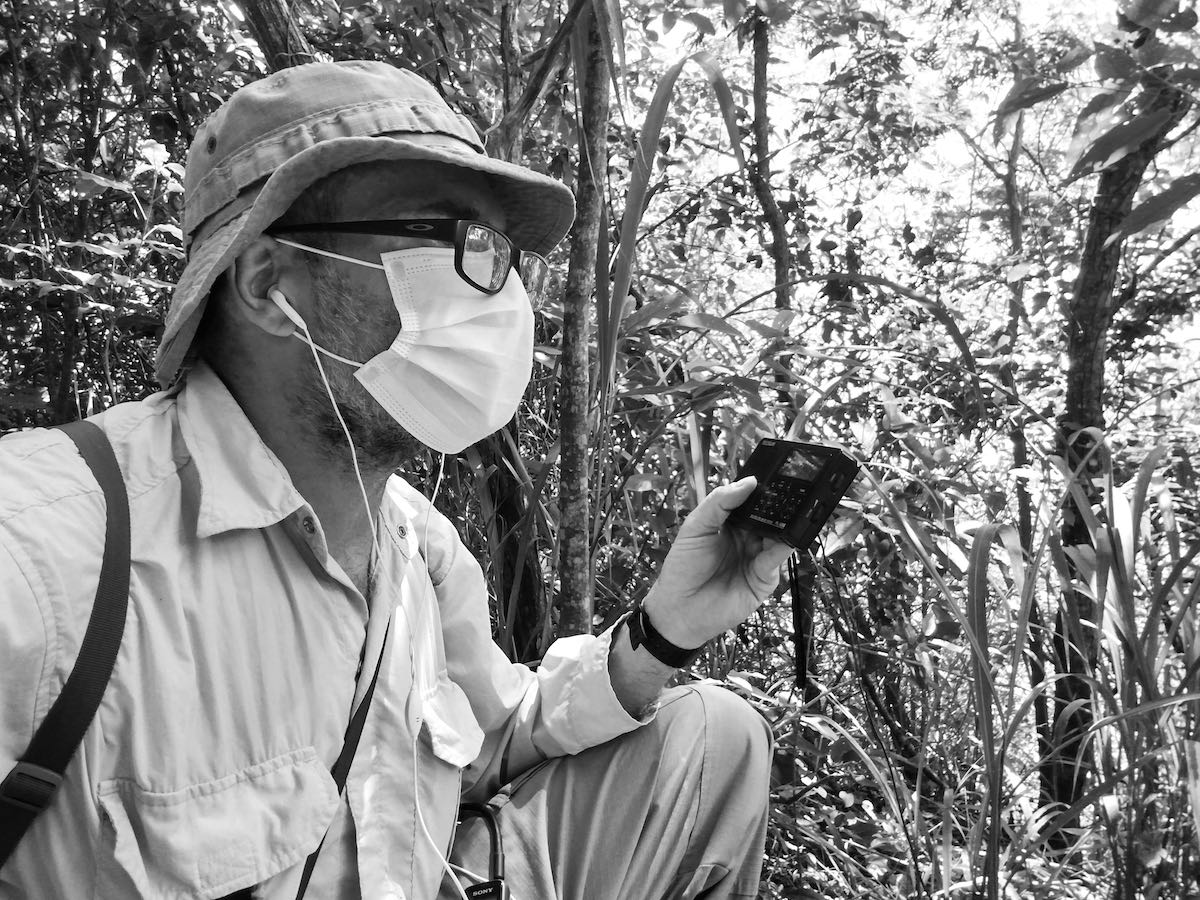
Carlos Latuff at Catacumba Park in Rio de Janeiro, monitoring Ethiopian broadcasts.

ETHIOPIA: A WAR THROUGH RADIO

by Carlos Latuff, special for The SWLing Post

We just entered 2022 and the civil war in Ethiopia has already completed 1 year. On the one hand we have the  Tigray People’s Liberation Front (TPLF) guerrillas from northern Ethiopia and its allies, and on the other hand we have the armed forces of Ethiopian government and its allies. The dead are piling up, accusations of war crimes from both sides, local and international political interests at stake, and no perspective for a peaceful solution. Without going into the reasons for this new war in Ethiopian territory, I’d like to focus on the use of radio waves by both parties of this conflict.

I monitored shortwave broadcasts from Ethiopia and to Ethiopia between October 21, 2021 and January 4, 2022. The receivers were Tecsun PL-606 and XHDATA D-808, using both the telescopic antenna and a long wire. In all cases, listening was carried out in Brazilian cities.

Carlos at Catacumba Park monitoring and recording clandestine Ethiopian broadcasts.

The monitored stations were: Continue reading

Carlos Shares Shortwave Art and Recordings of Ethiopian Jamming and BBC News Tigrinya

Many thanks to SWLing Post contributor and political cartoonist, Carlos Latuff, who has been exploring the world of clandestine radio, documenting the on-going conflict in Ethiopia via shortwave radio. The following are two examples of his radio log art, this time for documenting jamming of Dimtse Wegahta Tigray and BBC News Tigrinya. Carlos shares the following art and recordings:

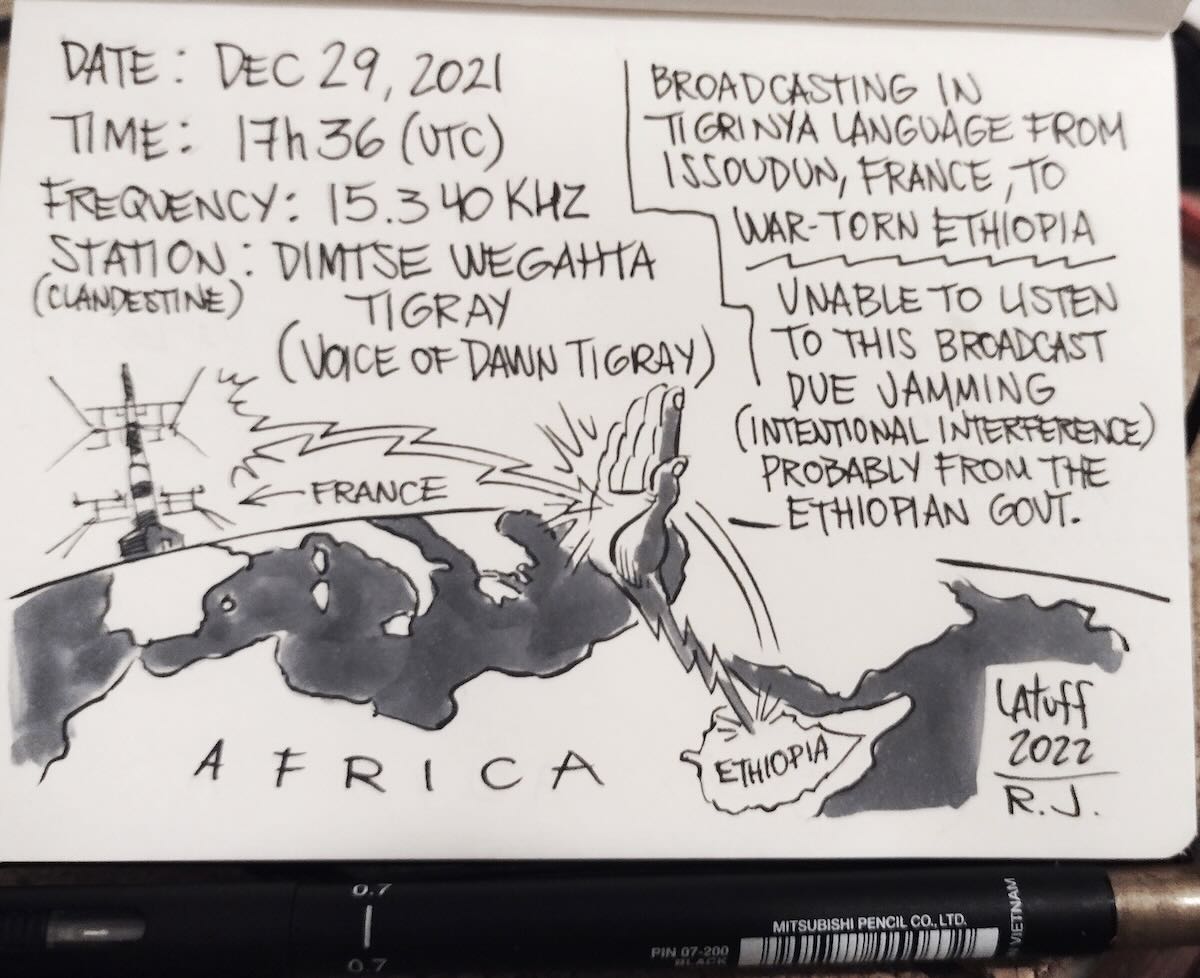
Ethiopian Jamming

Characteristic noise of “jamming” (intentional interference), probably coming from the Ethiopian government, preventing reception of the signal from the clandestine broadcaster Dimtse Wegahta Tigray (Voice of the Dawn Tigray).

Dimtse Wegahta Tigray broadcasts daily to warring Ethiopia on the frequency of 15340 kHz, using the powerful transmitters of the company TDF (Télédiffusion de France) in Issoudun, France.

Captured at Parque da Catacumba, Rio de Janeiro, 12/29/2021, 2:36 pm (local time):

Click here to view on YouTube.

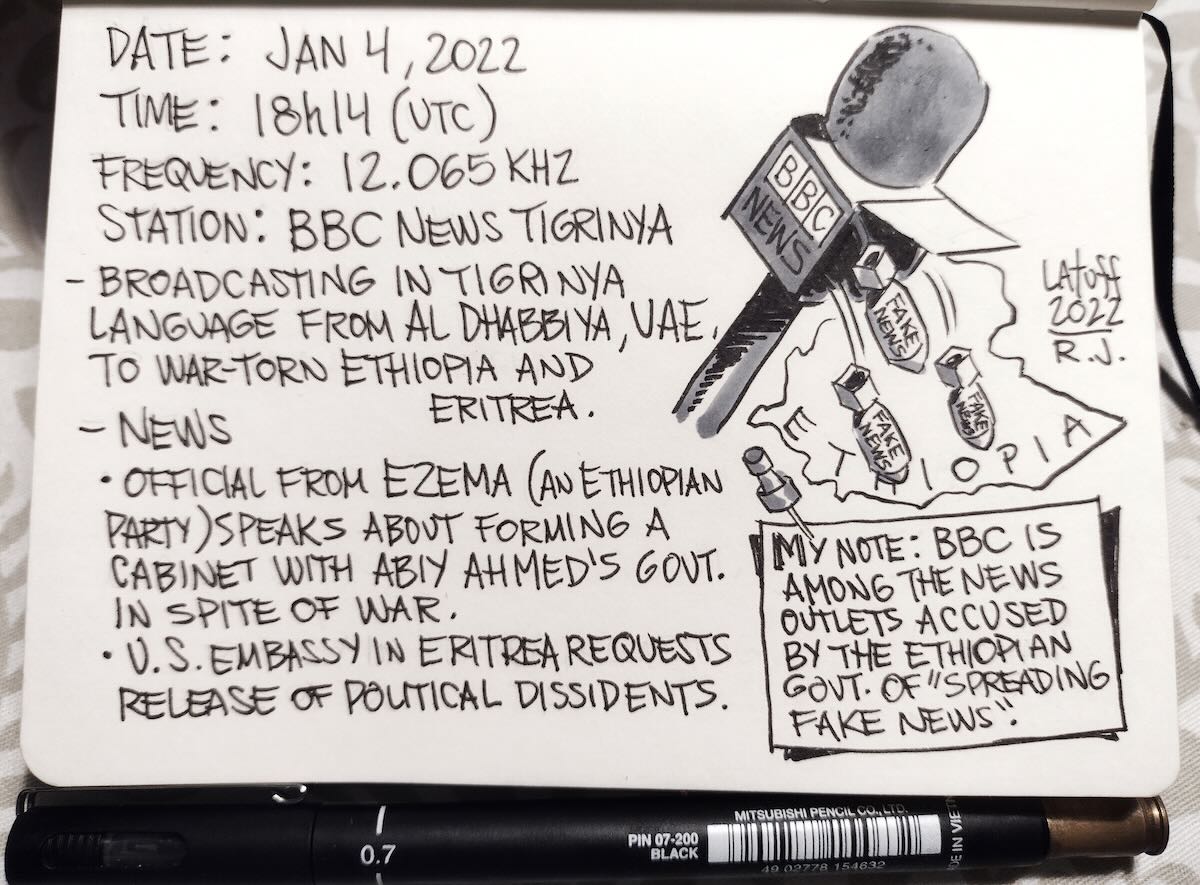
BBC News Tigrinya broadcasting from UAE to Ethiopia/Eritrea

BBC News Tigrinya, 12065 kHz, broadcasting from Al Dhabbiya, United Arab Emirates (UAE).

Excerpt from the news.
– Ethiopian party member EZEMA talks about the intention to form a cabinet in the government of Ethiopian Prime Minister Abiy Ahmed despite the war.
– US Embassy in Eritrea asks that country’s government to release political dissidents.

The BBC is among the news channels that are accused by the Ethiopian government of “spreading fake news”.

Signal received in Rio de Janeiro, 01/04/2022, at 3:14 pm (local time).

Thanks to yaredinho_r9 for the translation.

Click here to view on YouTube.

Carlos’ Shortwave Art and Recording of Raadiyoonii Dirree Shaggar

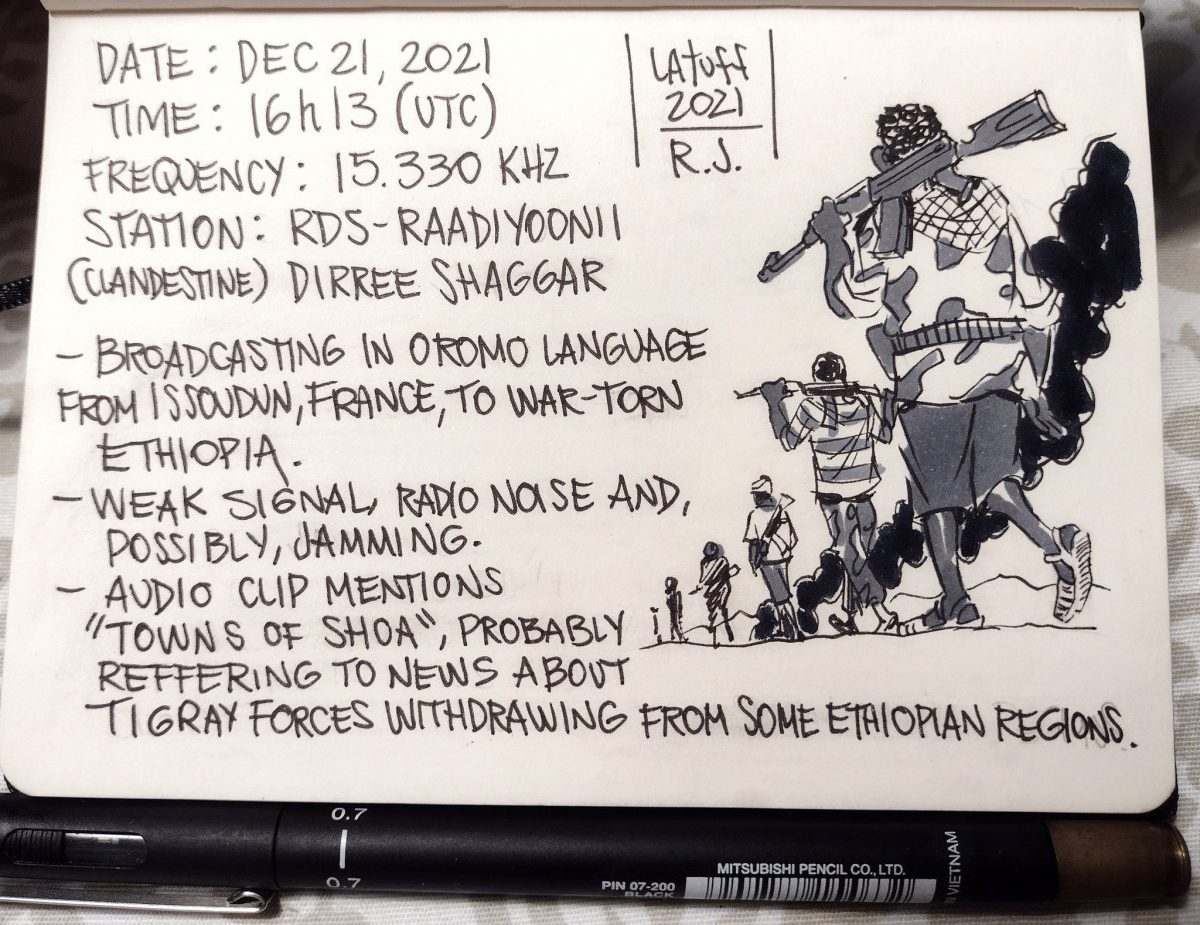
Many thanks to SWLing Post contributor and noted political cartoonist, Carlos Latuff, who shares yet another example of his radio log art, this time for clandestine station, Raadiyoonii Dirree Shaggar.

Carlos notes:

Raadiyoonii Dirree Shaggar, 15330 kHz, clandestine station broadcasting in the Oromo language from Issoudun, France, to Ethiopia.

Weak signal, too much noise and possibly jamming.

Excerpt from the audio quotes “Shoa towns”, probably referring to news that Tigray troops are leaving some regions of Ethiopia. The country has been facing a civil war since November 2020.

Thanks to Hamza Oromo for his kindness in unraveling this audio.

Signal captured at Parque da Catacumba, Rio de Janeiro, on December 21, 2021, at 1:13 pm, local time.

Click here to view on YouTube.

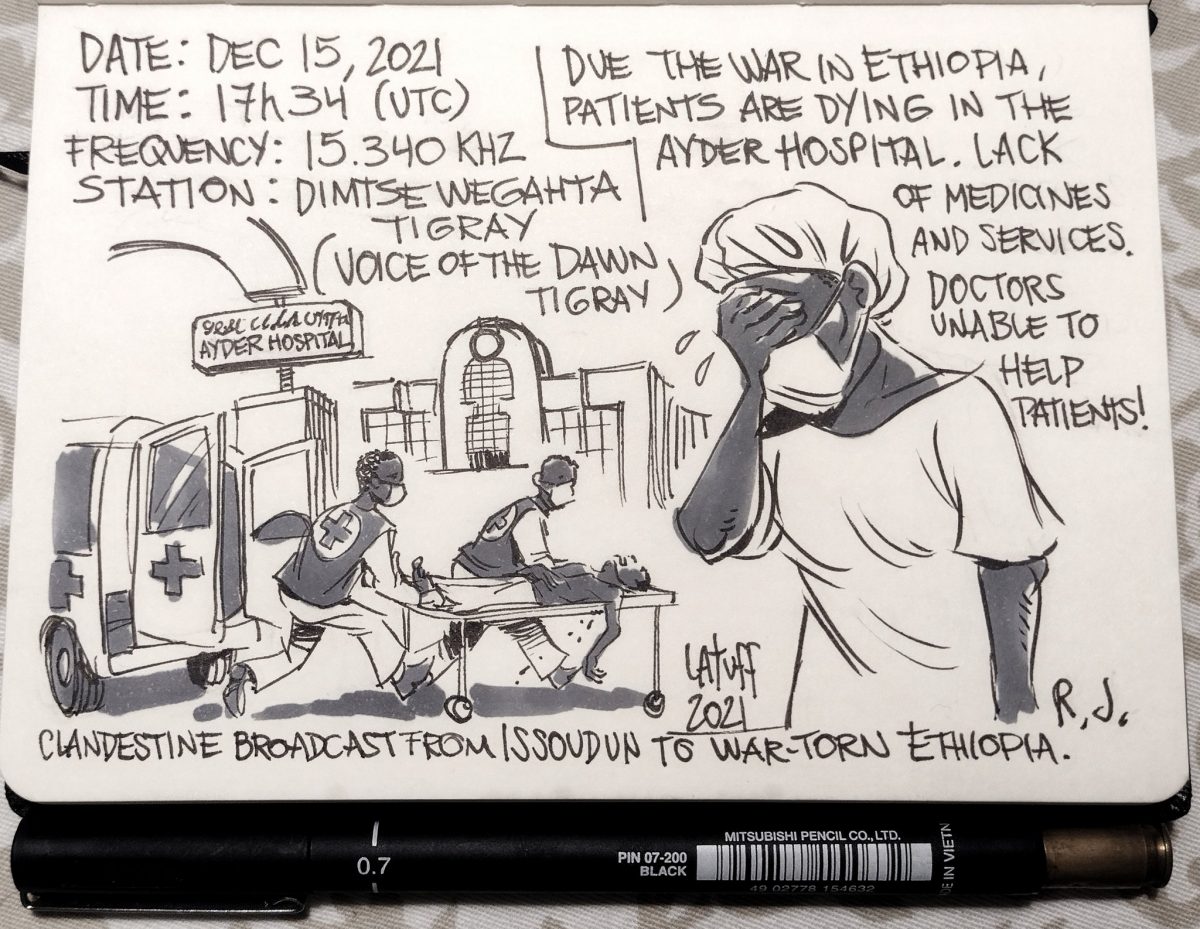
Carlos’ Shortwave Art and Recording of Dimtse Wegahta

Many thanks to SWLing Post contributor and noted political cartoonist, Carlos Latuff, who shares another example of his radio log art, this time for clandestine station, Dimtse Wegahta (Voice of the Dawn Tigray).

Carlos notes:

Dimtse Wegahta Tigray (Voice of the Dawn Tigray), 15340 kHz, clandestine broadcaster broadcasting from Issoudun, France, in Tigrinya, to Ethiopia.

In this excerpt, the presenter informs that, due to the war in Ethiopia, patients at Ayder’s hospital are dying for lack of medicines and services. Doctors suffer psychiatric problems because they are unable to help their patients.

The transmission had several interruptions.

Signal captured at Parque da Catacumba, Rio de Janeiro, on December 15, 2021, at 2:34 pm, Brasília time.

Thanks to Mes~Tigray for the translation.

Click here to view on YouTube.

BBC launches new shortwave services for Ethiopia and Eritrea

(Source: BBC Media Centre via Mike Hansgen)

The BBC is launching new daily radio services which will be aired Monday to Friday in Amharic, Afaan Oromo and Tigrinya. The new language services have been available online since September 2017 when they launched websites and Facebook pages in all three languages.

The new radio services will provide impartial news, current affairs, features and analysis for Ethiopia and Eritrea, as well as regional and international news. There will be a strong focus on culture, health and original journalism from the region. These services are part of the largest investment in the BBC World Service since the 1940s and are funded by the UK government.

The programme will be broadcast on shortwave, satellite – and streamed directly onto each service’s Facebook page.

In addition content produced by BBC Learning English, part of the BBC World Service which teaches English to global audiences will feature prominently across the schedules for all three languages, with daily content as follows:
·
Essential English – Beginners (airs on Monday, repeated on Wednesday)
A functional five-minute audio course presented by an English speaker and a local presenter, which aims to help beginners to learn English. Learners will be introduced to essential chunks of functional language, which will allow them to start having simple conversations in English immediately.

English Expressions – Intermediate (airs Tuesday, repeated on Thursday)
This five-minute audio course focusses on common expressions used in everyday English. An English speaking presenter and a local language presenter discuss the meaning and use a different expression each week.

English Together Advanced (airs Friday only)
This is a bilingual five-minute audio with three presenters (2 English and one local language) discussing a current (safe i.e. non news) topic and examining the language used in the story allowing the user the practise their listening skills and equip them with the grammar and vocabulary needed to discuss the story.

The programmes are broadcast Monday-Friday at the following times:

  • 17:30 – 17.45: Amharic news
  • 17.45 – 17:50: Amharic Learning English
  • 17:50 – 18:05: Afaan Oromo News
  • 18.05 – 18.10: Afaan Oromo Learning English
  • 18:10 – 18:25: Tigrinya News
  • 18:25 – 18:30: Tigrinya Learning English

Programmes will also be streamed via the respective BBC websites and Facebook pages (see links below).

Details of how to listen:

Amharic

Afaan Oromo

Tigrinya

Notes to Editors
The Initial shortwave broadcast to go out at 17:30 GMT/ 20:30 EAT on three transmitters providing coverage across Ethiopia and Eritrea:

  • 7.595MHz
  • 11.720MHz
  • 12.065MHz

Repeat to follow at 18:30 GMT /21:30 EAT

  • 9.855MHz
  • 15.490MHz

Satellite Radio content will go out on the following channels:

  • Arabsat (BADR4) – 11.966GHz, Horizontal
  • Nilesat 201 -11.843GHz, Horizontal
  • Hotbird 13D – 12.597GHz, Vertical

Evening satellite broadcast to go out at 17:30 GMT and will be repeated until 21:30 GMT.

  • The BBC World Service reaches a global audience of 269 million weekly, on radio, TV, and digital.
  • BBC World Service received further funding of £291m until 2019/20 from the UK Government to launch twelve new language services: Afaan Oromo, Amharic, Gujarati, Igbo, Korean, Marathi, Pidgin, Punjabi, Serbian, Telugu, Tigrinya, and Yoruba. This additional funding is not part of the licence fee.

MF

Click here to view thisnews item at the BBC Media Centre website.