Tag Archives: Magnetic Loop Antennas

Marty needs advice as he builds a passive magnetic loop antenna

Many thanks to SWLing Post contributor, Marty Kraft, who asked that I share the following question with our community:

I’m still working on a receive-only passive hula loop magnetic antenna for my Tecsun PL-660.

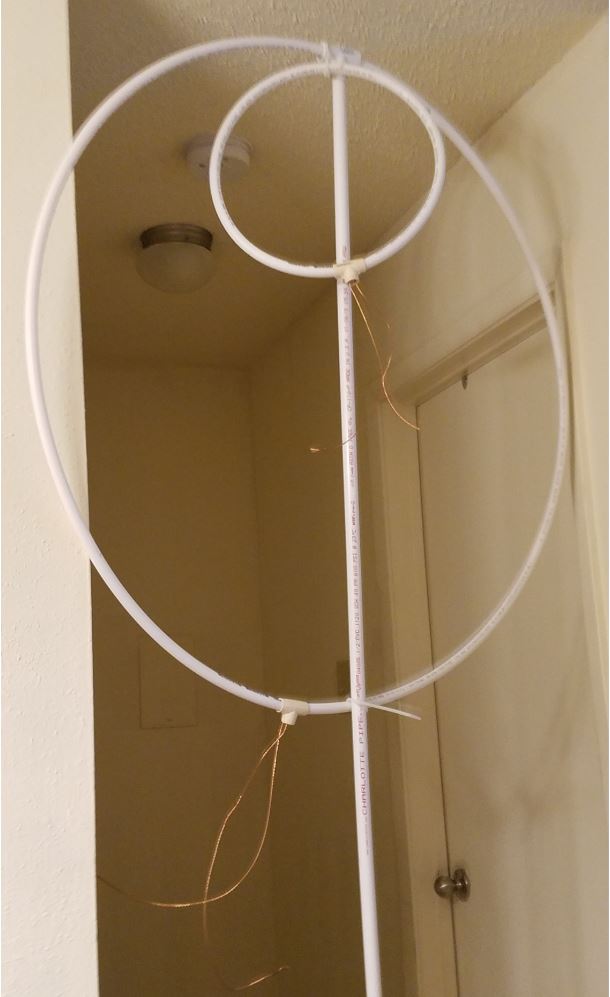
After viewing thousands of YouTube videos (LOL), I built the PVC-pipe structure [you can see in the photo below].

But I need some tech help to finish…

The antenna is 90 inches tall; large loop diameter is 40 inches; and small loop diameter is 17 inches. The wiring is 14 gauge braided.

I plan to put the antenna outside on the porch. Then I’ll run coax from the small loop to the receiver inside and use a 365 pF air variable capacitor to tune the large loop.

My first question is, what’s the best coax to use for the 10-ft run from the small loop to the radio inside? Second, will that 365 pF cap tune the entire 3-30 MHz range?

It’s hot here in Louisiana, so I’d really like to tune the capacitor from inside my apartment, also using coax to connect the cap to the large loop. Will that work? Or does the cap have to connect directly to the large loop?

Any other tips or suggestions? Thanks for the help!

Post Readers: If you have any helpful advice for Marty, please comment!

David reviews and compares the MLA-30 magnetic loop antenna

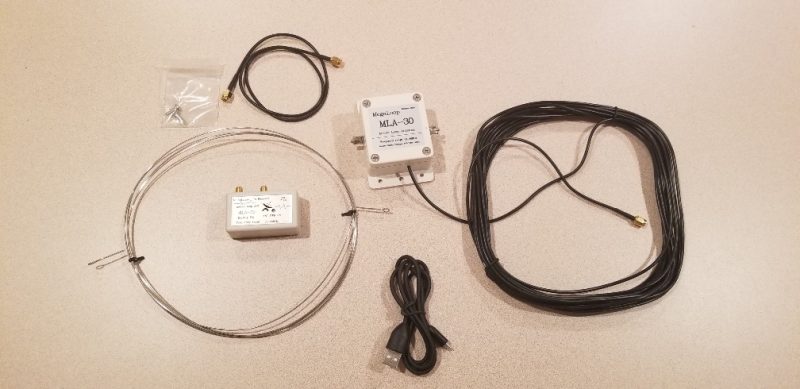
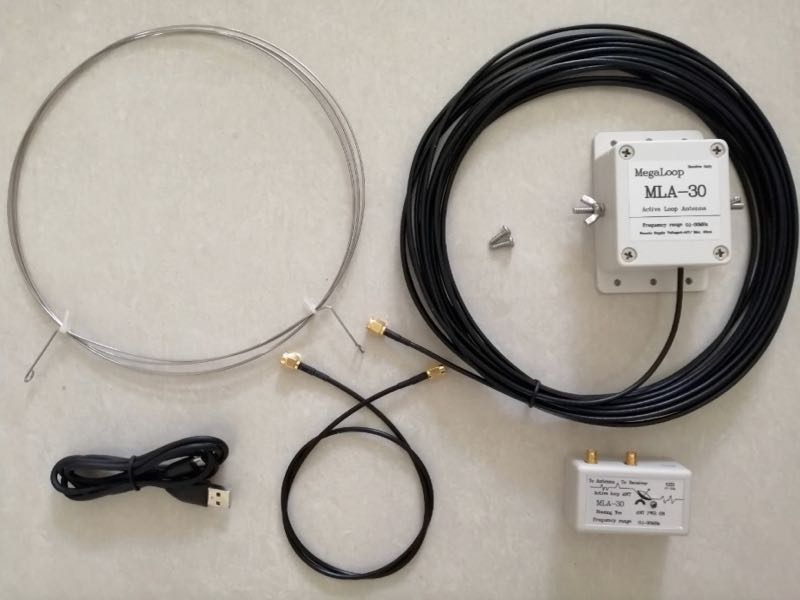
Many thanks to SWLing Post contributor, David Day (N1DAY), who has completed a thorough review of the MLA-30 loop antenna. In this review, he compares the MLA to the Wellbrook ALA1530-LF and a 30 foot square ground loop antenna.

In short, he finds that the MLA-30 performs fairly well on the AM broadcast/mediumwave band, but can’t compete with the Wellbrook otherwise–especially in terms of noise floor. David also noted that “the MLA-30 had a very serious issue with IMD and in some cases, stations that were clearly heard with both the Wellbrook and the ground loop were totally obliterated by IMD when switching to the MLA-30.”.

Click here to read David’s full review on his blog, Ham Signal. 

Click here to view the MLA-30 on eBay.

LZ1AQ Evaluates Impact of the Height Above the Ground on Mag Loop Performance

Source: LZ1AQ

Many thanks to SWLing Post contributor, Harald Kuhl (DL1AX), who shares the following article on LZ1AQ’s website:

Published on: 2018/11/20, Rev. 1.0 July 2018, Rev. 1.1 Nov 2018

Author: Chavdar Levkov LZ1AQ

Setup

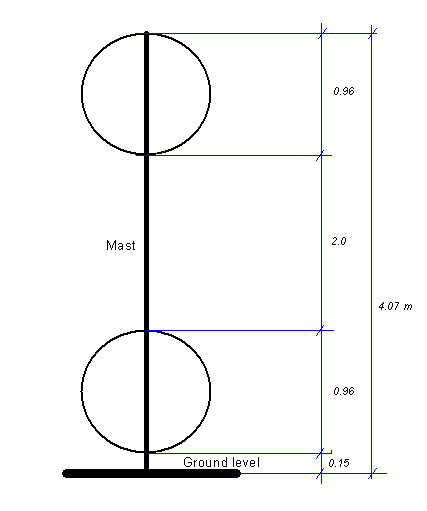
Two identical small loops were placed one above the other according to Fig.1. One of the loops is very low – almost on the ground. The other one is placed at height which usually is used by the loop users. Two AAA-1C wideband active antenna amplifiers were used. Their gain difference was not more than 0.3 dB. The feeder was FTP cable each 20 m long. No cable baluns were used. The outputs were connected through two way antenna switch to a SD RX (Perseus). I used a measurement technique described in – A Periodic Switching Technique to Compare Receiving Antenna Performance in the Presence of Strong Fading. This is a precise method to compare two receiving antennas with real sky wave signals and the resolution can be less than a decibel. The idea is to switch periodically between two antennas and to estimate their difference on a calibrated graphic strength meter of a SD radio.[…]

Click here to read the full article.

I’ve often assumed height had little effect on the performance of an HF loop antenna–this evaluation seems to support that theory. Thanks for sharing this, Harald!

Can someone ID this Singer Eaton magnetic loop antenna found on eBay?

Many thanks to SWLing Post contributor, Dan Robinson, who shares a link to this 31″ Singer Eaton loop antenna found on eBay.

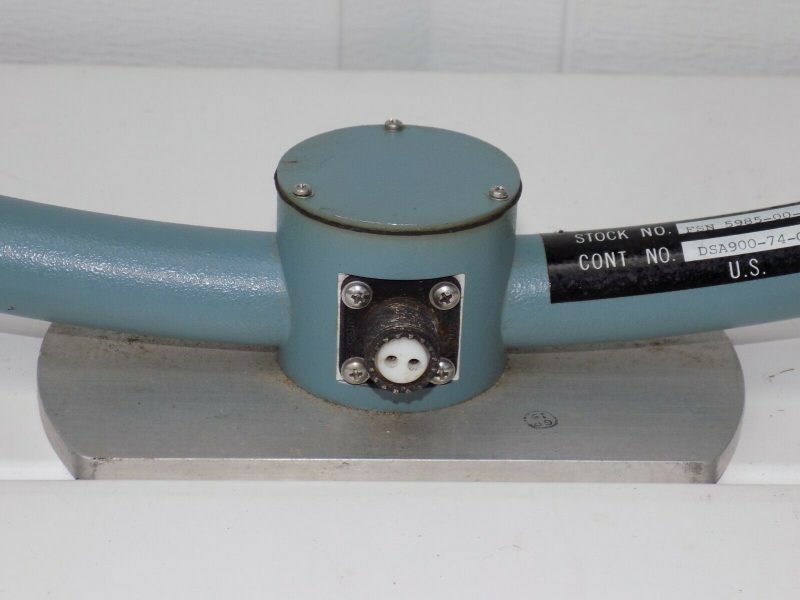
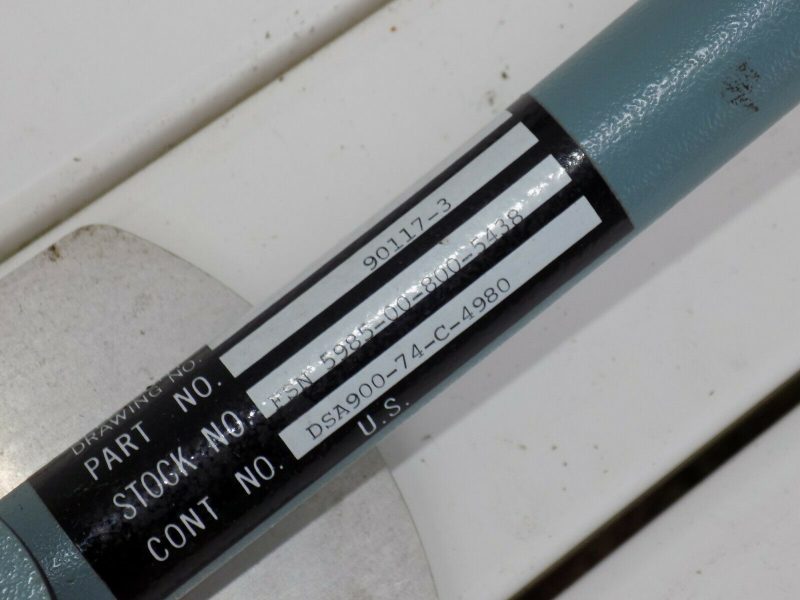
The seller knows nothing about this antenna, but did provide some detailed photos of the connector and product information sticker:

This loop obviously came from US government inventory based on the sticker. It looks to be quite robust and sports one of the balanced antenna connectors found on rigs like the Hammarlund SP-600. I’m guessing this loop might be fixed-frequency as I see no tuning section with a variable capacitor.

Can any SWLing Post readers shed a little light on this loop?  Have you ever used one? Please comment! 

Using amplified loop antennas with portable radios?

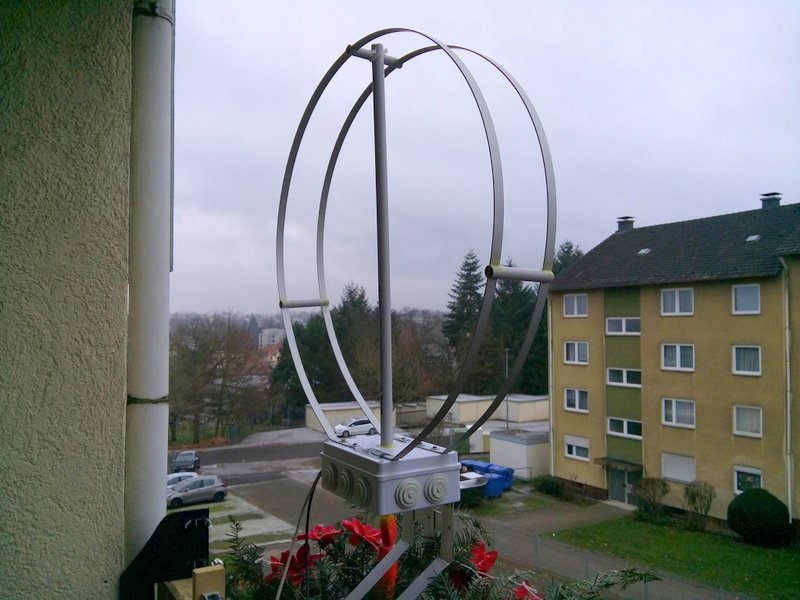
SWLing Post contributor, Klaus Boecker, sports a homebrew magnetic loop antenna on his balcony in Germany.

Many thanks to SWLing Post contributor, Marty, who writes:

I have a question about loop antennas; specifically which type is “better,” passive magnetic loops or active electric loops?

I know, “It depends.”–?

I live in a ground-floor apartment, with a small porch, lots of RFI and restrictions against visible antennas. Also there are no trees within 75 ft of my porch, which faces on a parking lot. My radio is a Tecsun PL-660, which works okay inside with my 10-ft bare wire antenna hidden on the porch.

With a loop antenna, I’d like to mount the antenna on the porch at night and have a remote tuner/control inside because it’s very hot n humid here in Louisiana even after dark.

No doubt there are a number of magnetic loop antennas that could serve you well in your situation, Marty.

To answer your first question, though, you should search for a wideband amplified loop antenna since you’re only concerned with receiving.

Passive loops are great antennas on the shortwave bands–and easy to build–but they best serve ham radio operators who wish to transmit. Passive loops typically have a very narrow bandwidth that requires the operator to constantly tune the antenna when they tune the radio a few kHz. Most amplified wideband loops need no separate tuning mechanism.

Last year, I posted an article about choosing the right loop antenna for situations like yours where one has limited installation options.

Click here to read : Shortwave antenna options for apartments, flats and condos

Portables and amplified loops?
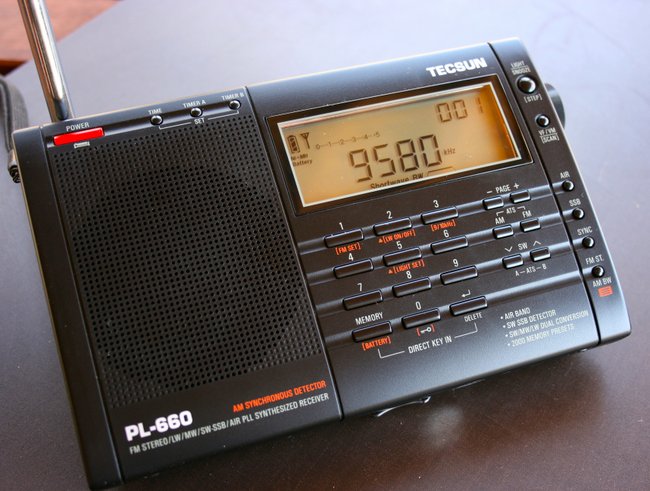
I do hesitate to encourage you to invest in an amplified loop antenna when your only receiver is a Tecsun PL-660. Some portables don’t handle amplified antennas well–they can easily overload and I imagine you can even damage the front end of the receiver.

I’m well aware, however, that there are a number of readers here who do couple their portable radio to an amplified loop. I have connected a number of portables to large wire antennas and found they could easily handle the extra gain, so I imagine an amplified loop would perform as well; the Sony ICF-SW7600GR, Tecsun S-8800, and Sangean ATS-909X come to mind.

But the PL-660 is a hot little receiver even with the built-in telescopic antenna–I’m not sure if amplification would help or hinder.

Please share your experience

This is where I hope the amazing SWLing Post community can pitch in and help us out here!

Does anyone here regularly connect their PL-660 to an amplified loop antenna? If so, what model of antenna are you using? Are there other portables out there that you regularly connect to amplified loops? Please share your notes, thoughts and experience in the comments section.

Thank you in advance!


Do you enjoy the SWLing Post?

Please consider supporting us via Patreon or our Coffee Fund!

Your support makes articles like this one possible. Thank you!