Tag Archives: Nostalgia

WI2XLQ: Brian Justin’s annual longwave broadcast

Canadian Reginald Aubrey Fessenden in his lab believed circa 1906 (Source: Radio Canada International)

(Source: ARRL News via Harald Kuhl)

The Canadian inventor, experimenter, and entrepreneur Reginald Fessenden has been credited as the inventor of radiotelephony. Fessenden claimed to have made his first voice — and music — broadcast on Christmas Eve in 1906 from Brant Rock, Massachusetts, although his account is disputed. As he has done each December for the past few years, Brian Justin, WA1ZMS, of Forest, Virginia, will transmit a program on 486 kHz, under authority of his FCC Part 5 Experimental License WI2XLQ ito commemorate Fessenden’s accomplishments.

Justin will transmit for at least 24 hours starting at around 2000 UTC on December 24, with a repeat transmission on New Year’s Eve likely, “keeping in step with what Fessenden was reported to have done on both nights in 1906,” Justin explained.Fessenden’s transmitter was most likely a high-speed “dynamo” or alternator — a predecessor to the later Alexanderson alternator — modulated by placing a carbon microphone in series with the antenna feed line to create an amplitude modulated signal. Fessenden a few years earlier had limited success making voice transmissions using a rotary spark gap transmitter. Fessenden fed his signal into a substantial antenna system erected in Brant Rock for his experiments. Accounts say on Christmas Eve 1906, he transmitted recordings of two pieces of music and read a verse from the bible.

Justin will use somewhat more modern equipment — a home-brew master oscillator, power amplifier (MOPA) transmitter based on a classic design from the early 1920s. It uses a UV-201 oscillator tube driving a VT-25 tube — a modern equivalent to a UV-202 — to generate “a few watts” on 486 kHz. His modulator consists of another VT-25, which uses a large inductor in the RF amplifier’s plate supply to serve as a Heising modulator. The audio program comes from a laptop computer.

“Heising modulation was used in World War I as an easy way to achieve AM in rigs such as those used in aircraft,” Justin said. “My particular Heising modulator can deliver only around 60% modulation, so an audio processor is used to help boost the average volume level ahead of the modulator tube.”

Justin uses far more modern technology to boost “the few watts” of modulated RF to drive a modified Hafler 9505 solid-state 500-W audio amplifier. “The idea for the amp came from W1TAG and W1VD,” he said, “and information on using such an amp on the 630 and 2200-meter ham bands can be found on the web.” After a multi-pole low-pass filter, the carrier output is 150 W.

Justin’s antenna is a Marconi T, crafted from a 160-meter dipole some 60 feet above ground and fed with open-wire line, which is shorted at the transmitter end. A homebrew variometer — constructed from 14-gauge wire wound on a piece of 4-inch diameter PVC pipe — is placed in series to resonate the antenna, which is fed against an extensive ground system. “Most of the RF is lost due to the ohmic losses of the ground system, but at least 15 W ERP is possible, depending on the dampness of the soil. Damp soil helps lower the ground losses,” Justin said.

Click here to read the full article on the ARRL News.

Listener reports may be sent to Brian Justin, WA1ZMS, at his QRZ.com address.

If you would like more information about Brian Justin and WI2XLQ, check out our interview with him in 2013. Indeed, I successfully heard the 2013 WG2XFG broadcast and posted this audio clip on the Shortwave Radio Audio Archive.

Additionally, SWLing Post reader, George Stein has a very personal connection with radio pioneer, Reginald Fessenden: click here to read his story.

1961 Film: “Tuning In Radio Sarawak”

Many thanks to SWLing Post contributor, Adid, who writes:

Hi Thomas, I just watched this very interesting DX film about RADIO SARAWAK.

It’s a behind the scenes look at radio in the tropics, with great vintage gear.

I don’t think it was FM as it’s was much expensive and coverage is limited. But on the other hand we don’t see the large MW antennas

What do you think?

Click here to view the film at the Imperial War Museum website.

Good question, Adid. The FM band wasn’t widely included on radios until the late 1950s and early 1960s. Since this film dates from 1961, I imagine some of those new transistor/valve radios could have included FM, although I imagine mediumwave was the choice band for regional broadcasts.

Hopefully, an SWLing Post reader can shed some more light on Radio Sarawak’s history! Please comment!

The radio man of Kumartuli

Set against this unlikely backdrop, Amit Ranjan Karmakar’s little shop is easy to miss. In his mid-60s, the ‘radio man’ of Kumartuli sits surrounded by radio sets of all sizes and vintages. (Express photo: Shashi Ghosh)

Many thanks to SWLing Post contributor, Kim Elliott, who shares a link to this short but fantastic photo pdoc about Kumartuli’s radio man, Amit Ranjan Karmakar.

Click here to view at The Indian Express.

RSGB Archives Film: Field Day 1947

Many thanks to SWLing Post contributor, Kris Partridge, who shares the following film from the archives of the Radio Society of Great Britain (RSGB):

Click here to view on YouTube.

Wow!  Thanks so much for sharing this film, Kris.  What an amazing number of classic rigs. Hams back then needed some serious muscle to take their gear to the field!

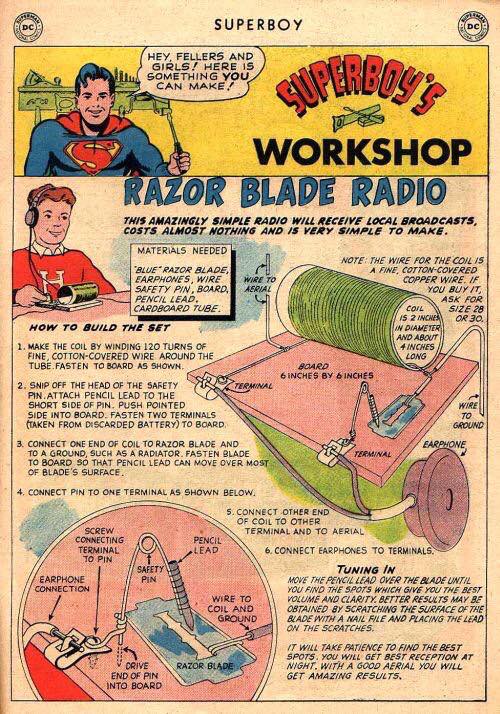
Back when Superboy encouraged kids to build radios with razor blades

Talk about hitting all of my nostalgia points! Hat tip to SWLing Post reader, Mitch, for sharing this ad from a 1960s comic book:


Do you enjoy the SWLing Post?

Please consider supporting us via Patreon or our Coffee Fund!

Your support makes articles like this one possible. Thank you!

Fred Jacobs on “Rekindling Our Fading Romance With AM Radio”

Many thanks to SWLing Post contributor, Dennis Dura, who shares the following article which appeared in Jacob’s Media Strategies on Dec 31, 2018. I’ve pasted an excerpt below, but you’ll want to read the entire piece by clicking here:

Rekindling Our Fading Romance With AM Radio

I know I may sound like a relic from another era, but chances are if you’re a Baby Boomer (or gasp – even older), you were inspired by AM radio as a kid growing up whether it was in a big city or a small town.  If you’re a member of a younger generation, you may not even know that AM – or amplitude modulation – has a magic power.  At night when the clouds are just right, AM signals have the ability to “skip” across geography, unlike frequency modulation (FM) which is line of sight.  “Clear channel” stations had an even easier time being heard beyond their metro confines – often covering many states during the nighttime hours.

Many of us radio veterans remember those nights, lying in bed, where your trusty bedside AM clock radio pulled in signals from all over the U.S. As a boy in Detroit and not especially well-traveled, I learned how to pronounced Des Plaines (Des-planes) and Touhy (2E) by listening to Chicago radio stations like WBBM and WLS.  Tuning in KYW in Philly (which came in “like it was next door”), I learned how to spell the quirky town of Conshohocken from listening to Phillips Ford commercials.  It was from a jingle that got in your head (CON-SHO-HO-CKEN).  At least, it got in mine.

It didn’t matter if you lived in Dallas or Des Moines, or a small town in Delaware – you were able to pick up big AM radio stations from faraway.  And if you talk to today’s broadcasters on the other side of 50, many will tell you their careers were likely inspired by these booming, exciting blowtorches on AM radio that provided a soundtrack for our teens.

AM radio was where we first heard the Beatles, the Supremes, the Stones, Stevie Wonder, and even the Doors.  Big AM Top 40 stations of the day – KHJ, WABC, CKLW, WLS – played all these cool rock songs, right next to Herb Alpert & the Tijuana Brass, Elvis, Bobby “Boris” Pickett, and the Singing Nun.  And even though the fidelity of amplitude modulation is obviously technically inferior to that of FM, there was something very different and even romantic about hearing all those songs first on AM radio.[…]

Continue reading the full piece at Jacob’s Media Strategies.

Thanks for the tip, Dennis! I think this piece speaks to so many of us radio listeners–especially this one who prefers the “fidelity of amplitude modulation” over so many other mediums.