Tag Archives: RTI

RTI: One-Hour English Broadcast from Taiwanese Students to Norway

Many thanks to SWLing Post contributor Paul Jamet, who shares the following tip: 

Dear Thomas,

This morning I received a message from Meg Wang, Head of the French Service at Radio Taiwan International. Although this message is intended for listeners of RTI’s French and German services, I think it may be of interest to all DXers, especially English-speaking DXers:

Dear listener,

As part of an exchange between Yilan Senior High School and the municipality of Vardø in northeastern Norway, RTI is going to broadcast a one-hour program in English produced by Taiwanese high school students for listeners in Vardo. Tune in to 15150 kHz to listen to this shortwave program on January 22, from 08:00 to 09:00 UTC, which corresponds to 09:00 to 10:00 local time in Norway.

The transmission will be broadcast from the Tamsui transmitter site in northern Taiwan, on 15150 kHz, with a power of 300 kW and a beam heading of 325 degrees.

RTI invites listeners of the French and German services to send us an audio recording of the program as received at your location, which we will pass on to the Yilan students.

For every recording sent, you will receive a mobile phone shoulder strap and a pad of sticky notes featuring the Formosan blue magpie, along with the RTI logo.

Thank you for sharing this information around you.

Thank you in advance!

RTI French Service.

RTI’s English service is expected to publish an announcement on its Facebook page: https://www.facebook.com/RadioTaiwanInternational/

Have a nice day. Best regards.

Paul JAMET

RTI’s Spanish & Japanese programs ranking among shortwave broadcasters

Many thanks to SWLing Post contributor David Iurescia, who shares this article from Radio Taiwan International highlighting how RTI’s Spanish and Japanese shortwave programs have placed in global listener polls, with the Spanish service especially popular across dozens of countries and the Japanese service recognized at Japan’s largest amateur radio event. Read the full article here: https://www.rti.org.tw/en/news?uid=3&pid=186281

Paul shares a special QSL card from RTI’s German service

Many thanks to SWLing Post contributor Paul Jamet, who writes:

Hello Thomas,

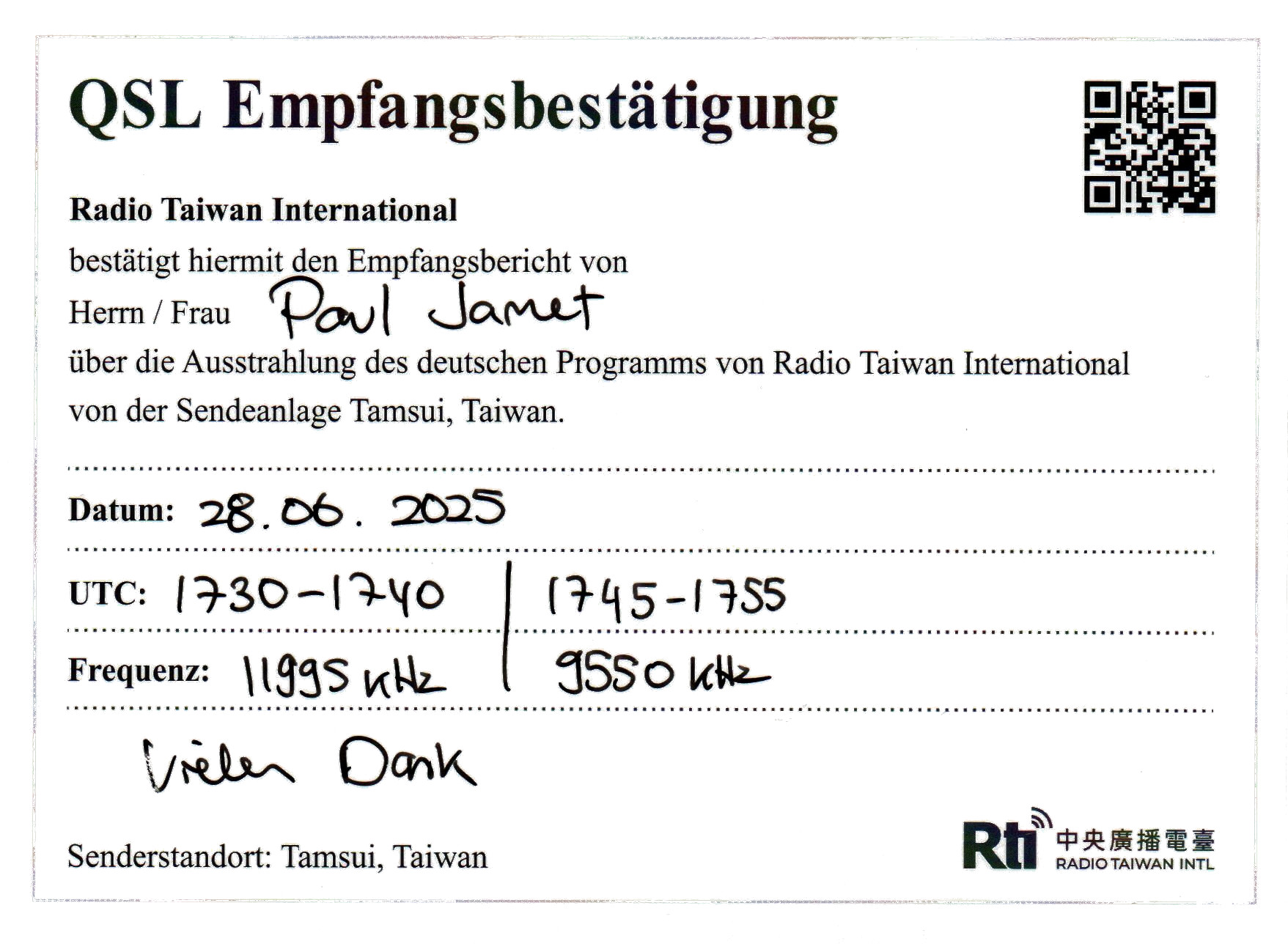
Yesterday, I received two QSL cards from the German RTI service. These cards confirm my recordings from June 28, 2025, made during transmission tests from Tamsui.

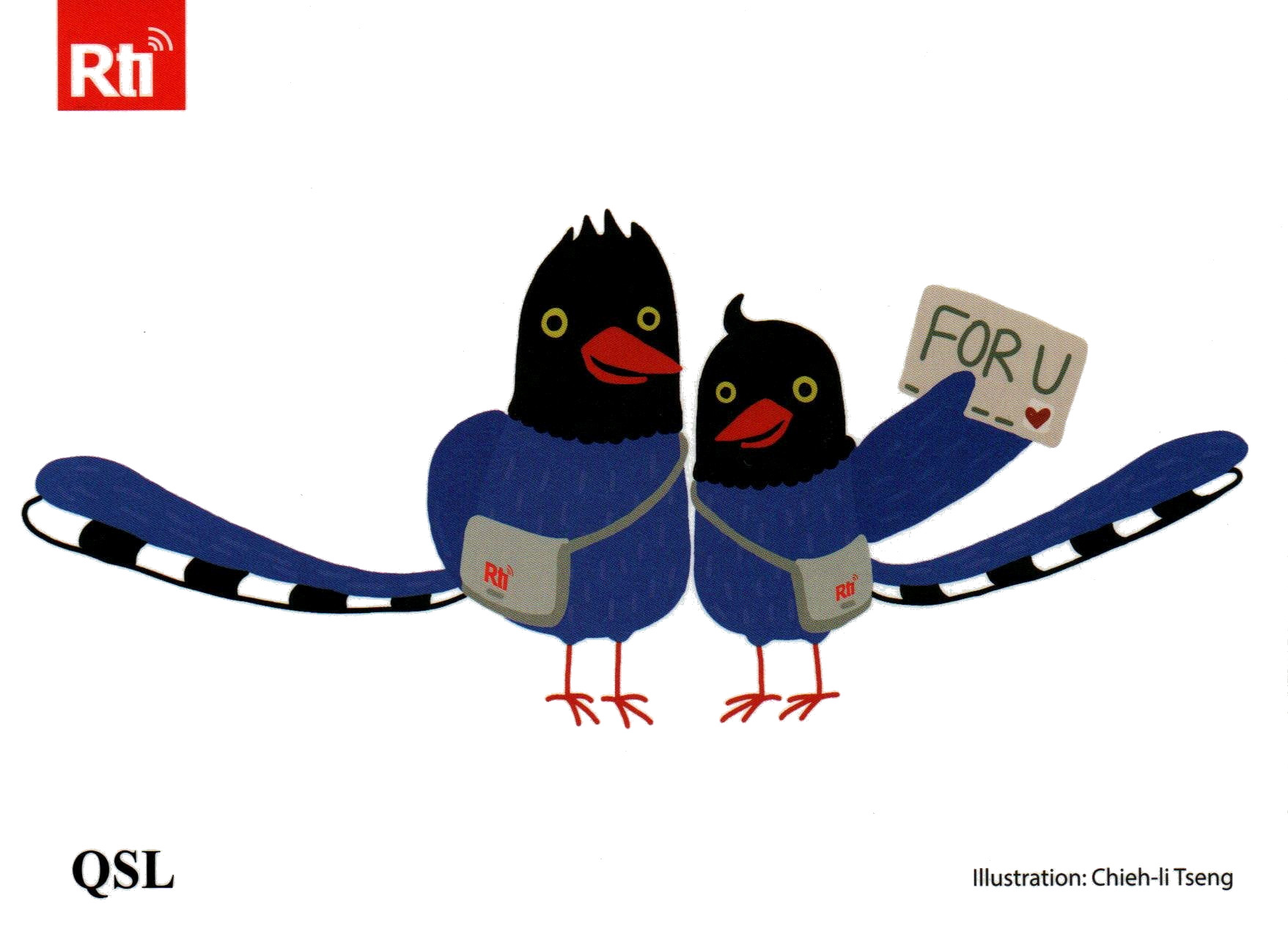
For your information, I am sending you a copy of the front and back of one of them. According to Wikipedia, the bird depicted on this QSL card is The Taiwan blue magpie (Urocissa caerulea), also called the Taiwan magpie, Formosan blue magpie, or the “long-tailed mountain lady”, is a bird species in the crow family. It is endemic to Taiwan.

Have a nice summer.

Paul JAMET

Thank you for sharing this card, Paul!

Radio Waves: WNYC to Test Digital AM, RW Letters, and 2025 RTI Audio Calendar

Radio Waves:  Stories Making Waves in the World of Radio

Welcome to the SWLing Post’s Radio Waves, a collection of links to interesting stories making waves in the world of radio. Enjoy!

Many thanks to SWLing Post contributors Dennis Dura and David Iurescia for the following tips:


WNYC(AM) 820 Set to Test All-Digital AM in December (Radio World)

New York Public Radio and NAB will observe co-channel interference and MA3 performance in an urban setting

820 WNYC(AM) plans to conduct an all-digital MA3 test of AM HD Radio next month.

The test is pending FCC approval, but its owner, New York Public Radio, expects to receive the go-ahead.

NAB is supporting NYPR’s effort, and its Vice President of Advanced Engineering David Layer says all-digital AM is becoming a more viable piece of technology for broadcasters. He cited the increased presence of HD Radio in the marketplace. Fifty-eight percent of new cars in North America ship with the technology, according to Xperi. [Continue reading…]

Letters: Radio Quality, ITU, SDR (Radio World)

Our readers weigh in on recent articles

Here is a sampling from the Radio World reader mailbag.

Is Anyone There?

Ken Deutsch wondered “Why Is Radio So Hard to Listen To?”

He asked, “Is there no one in the building actually listening to the station?” That answer would be no.

Not long ago I went back to help a cluster in Louisville that was missing its chief engineer. It was my first visit in more than 20 years.

When I’d been there last, more than 100 folks worked at six stations in the building. On my return, there were approximately five full-time — the general manager, the operations manager, three sales people. [Continue reading…]

The Sounds of Taiwan (Radio Taiwan International)

Rti has carefully selected the sounds from everyday life in Taiwan, including folk festivals, travel, and the island’s rich cultural and natural heritage over the years. To celebrate Rti’s 97th anniversary, we proudly present our first-ever audio calendar. Let the warmth of Taiwan’s people and the unique local sounds accompany you as you explore the freedom and beauty of this land, welcoming each wonderful day of 2025 together. [Check out the audio calendar at RTI…]


Do you enjoy the SWLing Post?

Please consider supporting us via Patreon or our Coffee Fund!

Your support makes articles like this one possible. Thank you!

Radio Waves: RTI Receives Top-Rank, Vatican Radio interview, and the Complications Communicating with Voyager I

Radio Waves:  Stories Making Waves in the World of Radio

Welcome to the SWLing Post’s Radio Waves, a collection of links to interesting stories making waves in the world of radio. Enjoy!

Many thanks to SWLing Post contributors David Iurescia and Mike Robinson for the following tips:


Rti secures top ranking in global popularity among Japanese-language shortwave broadcast (RTI)

Radio Taiwan International (Rti) has been recognized in the 2024 JARL Ham Fair by securing first place in both the popularity ranking for shortwave stations and the best regular Japanese language broadcasting service.

The JARL Ham Fair is an annual event held during the summer, celebrating radio and broadcasting activities. Rti’s top rankings in both categories mark a major shift from its pre-pandemic standing, where Rti consistently ranked third.

Rti’s President Chang Jui-chang , who led a delegation to Japan last month to foster bilateral exchanges, expressed that this victory not only reflects Rti’s continuous efforts to improve its Japanese-language programming but also underscores the long-standing support and affection from its Japanese listeners.

One of the key developments this year was the resumption of the Double Ten National Day shortwave broadcast in Japanese, which further enhanced Rti’s service to its Japanese audience. Chang stressed that listeners are the lifeblood of any radio station, and Rti will continue its commitment to excellence in its Japanese programming to strengthen Taiwan-Japan ties and deepen mutual friendship.

Vatican Radio, a reference point for international broadcasting. History, facilities and broadcasts (exclusive interview) (FM-World)

Designed personally by Marconi, Radio Vaticana has been a key player in international broadcasting since the early 20th century, particularly in terms of technology. FM-world discussed this with Costantino Pacifici, who was Technical Director of the station for many years.

As the centennial of the radio approaches, the director of this publication asked us to do a quick overview of amplitude modulation stations. We had the opportunity to interview Centrale Milano, AM Italia, and OMItaliane.

But we immediately had the idea to talk about the most prestigious of all European radio stations: the station of Radio Vaticana.

With the help of RAI, we managed to secure a direct contact that led to this exclusive interview, focusing on the peak “broadcast” years of Vatican Radio: when broadcasts from the Holy See were joined by those from Santa Maria di Galeria, and when stereo transmissions began on 96.3 MHz. Here’s the report of the interview with Dr. Costantino Pacifici, which took place in mid-October 2024. [Continue reading…]

NASA is now talking to Voyager 1 with a radio that hasn’t been used since 1981 (BGR)

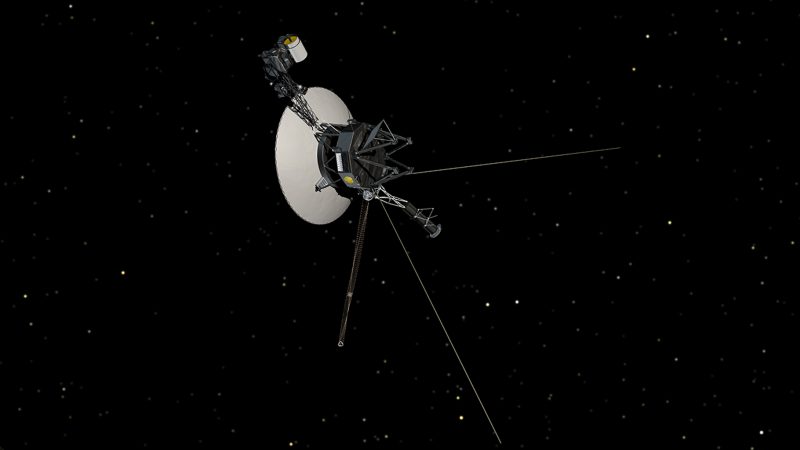
NASA can’t catch a break when it comes to Voyager 1, apparently. That’s because the US space agency has now revealed that the only thing keeping Voyager 1 communications running at the moment is a radio that hasn’t been used since 1981.

If that sounds like a bit of a nightmare, well, you aren’t wrong. But, it also isn’t the first stop that NASA has had to make on the nightmare train that has been its attempts to keep Voyager 1 working as optimally as possible over the past year.

In fact, this is just the latest in several Voyager 1 communications hiccups. The last hiccup began to show its ugly head in December 2023, when NASA revealed that Voyager 1 was sending back garbled data in its daily communications. That issue persisted for months, with some even believing that Voyager 1 was lost to us as far back as February. [Continue reading…]


Do you enjoy the SWLing Post?

Please consider supporting us via Patreon or our Coffee Fund!

Your support makes articles like this one possible. Thank you!

Carlos’ Illustrated Radio Listening Report and Recording of Radio Taiwan International (October 31, 2024)

Many thanks to SWLing Post contributor and noted political cartoonist, Carlos Latuff, who shares illustrated radio listening report of a recent Radio Taiwan International broadcast.


Carlos notes:

Part of Radio Taiwan International news bulletin (in Spanish) about super typhoon “Kong-rey”. Enhanced audio. Listened at UFJF, Juiz de Fora, Brazil.

Click here to view on YouTube.

Radio Waves: SWLtools App for the Belka, DAB+ Receivers To Wake Up, New RTI Arabic Podcast, and Re-archiving the National Library of Norway

Radio Waves:  Stories Making Waves in the World of Radio

Welcome to the SWLing Post’s Radio Waves, a collection of links to interesting stories making waves in the world of radio. Enjoy!

Many thanks to SWLing Post contributors Stefano Rampazzo, David Iurescia, and Paul for the following tips:


SWLtools App for the Belka receiver

Many thanks to SWLing Post contributor, Stefano, who writes:

I am a proud owner of a Belka receiver and I really love it.

The Belka is small, it is simple, it works very well outdoors with its short antenna that outperforms my desktop receivers with long wire antennas

Its size allows you to put it in your pocket, take it on a trip, on vacation, anywhere.
I have often sat in my garden at night with my Belka, away from the electrical noise of the house, and made some really good listening. In these situations I realized that I needed to record my dx. I thought about buying a mini-recorder, but since I always have my iPhone with me I decided to develop an app to record the audio of my Belka. After some time I am happy to let you know that my new app SWLtools is available on the Apple AppStore.

SWLtools allows you to record, play back and share your best listening. Also, since Belka also has an additional output where the IQ signal is present, I also added a function to the app to display the spectrum and spectrogram (waterfall).

As you know, modern smartphones do not have analog inputs and outputs, so to use SWLtools it is mandatory to have a USB audio device.

I bought a cheap USB dongle with a line input and output. Its sampling rate is 44.1 kHz, it is very low, but it is enough for minimal viewing.

SWLtools is available for free on the Apple AppStore (and it is also ad-free).

DAB+ receivers to be woken up in crisis situations (World DAB)

From next year, new DAB+ receivers will have better audio and text alerts in crisis situations. The current standard for alerts is called AAS (Alarm Annoucement Switching) and was introduced in 2020. In a crisis situation, receivers will switch to the station responsible for crisis information and the screen will also provide short text information. DAB+ also allows for the creation of temporary radio channels in crisis situations, which was used during the Brisbane floods in 2011. Over the past two years, the new Automatic Safety Alert (ASA) standard has been developed by WorldDAB and Digitalradio Deutschland in co-operation with chip manufacturer Frontier Smart Technologies and electronics manufacturers such as Technisat and JVC Kenwood. Among other things, receivers with ASA can be switched on automatically in emergency situations.

Click here to check out this note and more at World DAB.

Rti to launch Arabic podcasts on September 30 (RTI)

On Wednesday, Radio Taiwan International announced that it will launch its new Arabic podcasts on International Podcast Day on September 30 at the 2024 Rti Arabic Day Forum.

Rti’s president Chang Jui-Chang (???), speaking at the event titled “Rti Arabic Day: Taiwan Steps into the Arab World – Taiwan-Arab Cultural Exchange Forum,” remarked on the historical context of Rti’s Arabic programming, which began in 1950 but was halted in 2005 due to budget constraints. It was only on Eid al-Fitr in May 2021 that Rti re-initiated its outreach to Arab audiences through social media, achieving significant success over the past three years.

The forum featured several experts, including Representative Mr. Adel Fahad Althaidi of the Saudi Arabian Trade Office in Taipei, Scholar Ouyang Wen-chin (????), Assistant Professor Tsung Pei-chen (???), Lecturer Fu Yi-hsuang (???) from National Chengchi University’s Arabic Department, and former Associate Professor Hsu Cheng-hsiang (???). Fu highlighted that Taiwanese cinema serves as a window for the Arab world to understand Taiwan, noting the frequent cultural festivals, such as film, music, and dance festivals hosted abroad by the Ministry of Foreign Affairs to promote cultural exchange. [Continue reading…]

Rearchiving 2 million hours of digital radio, a comprehensive process (National Library – Norway)

The National Library is in the process of a major overhaul of its 2007 bit-repository, replacing it with a contemporary digital preservation system. This new solution is based on an in-house developed system called DPS (Digital Preservation Services), which uses IBM-HPSS as the underlying bit repository for data storage. This transition, which is expected to span over a couple of years, is necessary to ensure the long-term preservation and accessibility of the National Library’s digital collection.

Transition to a New Preservation Solution
In 2023, all new data archiving was transferred to the new DPS preservation solution. At this time, the old bit repository contained over 14 Petabytes of digitized and legally deposited historical material, which needs to be re-archived into DPS. A key part of this process involves analyzing and repackaging the historical data to meet the new DPS requirements.

Historical Legally Deposited Radio
Among the materials to be re-archived are 2.2 million hours of digital radio, equivalent to 2.5 million files and a total of 1 Petabyte of data. This includes both born-digital and digitized radio programs from the period 1993-2022.

In 1993, there were four radio channels delivering 16,500 hours of radio. By 2022, the number of radio channels had increased to 30, collectively delivering 150,000 hours of radio. With the phasing out of the old bit repository, it became necessary to move this data to the new preservation solution.

DSM to DPS: A Thorough Process
DSM (Digital Longterm Storage) has been the National Library’s internal management system for legally deposited radio for the past 20 years. The data has been stored in an Oracle HSM bit-repository in three instances (disk, tape, tape), and the radio material was fetched daily from various broadcasters. Some radio broadcasts were stored as mp3 and wav files, with accompanying checksum files. Other broadcasts were only stored as mp3. [Continue reading on the National Library blog…]


Do you enjoy the SWLing Post?

Please consider supporting us via Patreon or our Coffee Fund!

Your support makes articles like this one possible. Thank you!