Shortwave listening and everything radio including reviews, broadcasting, ham radio, field operation, DXing, maker kits, travel, emergency gear, events, and more
Saturday night, I had a chance to record three pirates on 6925 kHz: North Woods Radio, Captain Morgan Shortwave, and Undercover Radio. For tagging, I’m posting each individually.
The first station I recorded Saturday night was North Woods Radio.
North Woods was broadcasting in the upper side band starting around 00:55 UTC on May 13, 2012. The signal was weak at first, but got better toward the end. You can listen to the entire broadcast in the player embedded below, or by downloading the mp3 here.
[…]Martyn Williams, who writes the blog NorthKoreaTech.org, said that the government’s intense use of its scant resources and electricity to jam foreign news broadcasts reflected its concern about the impact of outside media.
North Korea targets between 10 and 15 frequencies used by international short-wave broadcasters, such as U.S.-funded Radio Free Asia and stations operated by South Korea’s government, for up to 18 hours a day, and on major occasions like the April centennial, it jams radio signals around the clock, Williams said.
The North appears to have recently installed more sophisticated transmitters acquired from a Chinese company, although jamming operations have been up and down this year, likely because of technical problems or power shortages, he said.
Read the full article, the bulk of which deals with social media and mobile phones, on the Times Union website. Obviously, North Korea feels that shortwave radio is a threat to those in power. They should be afraid–shortwave radio signals easily cross their fortified borders. This article will be filed under why shortwave radio.
On Friday’s edition of The Link, Mark Montgomery spoke with Amanda Pfeffer about how international radio is being cut around the world and, more specifically, Canada. They discuss how this happened, who is aware of it and if there is any way to save the service.
It’s an informative segment (though see my correction below).
Since this is one of several features in the show, I’ve recorded this specific segment and posted it for listening below.
Please note that Amanda is a little mis-leading about the bureaucratic structure of US international broadcasting. It is rather confusing.
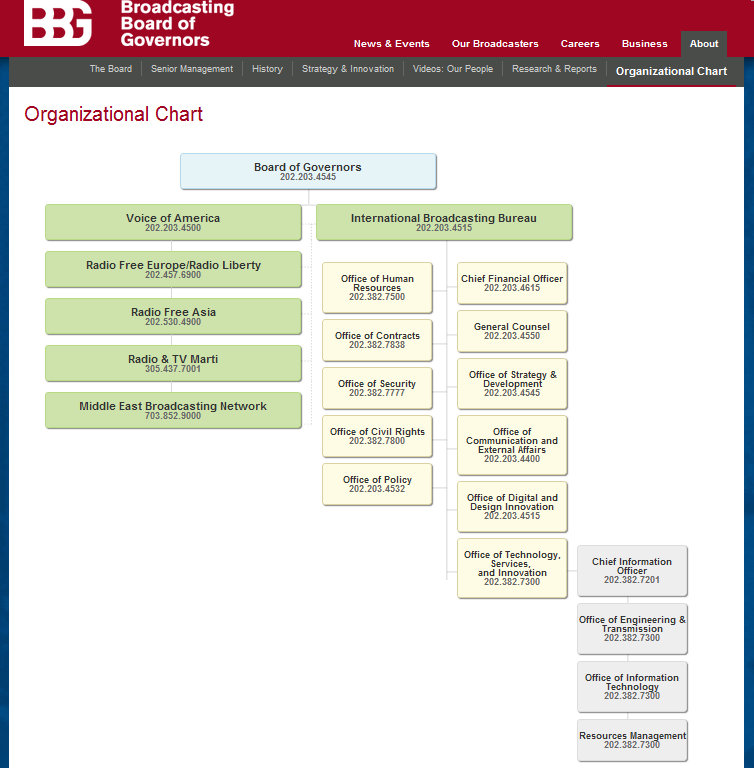
The BBG (Broadcasting Board of Governors) is the governing body of US international Broadcasting. The IBB (International Broadcasting Bureau) is over all of the broadcast/transmission facilities, engineering functions, human resources, finances and other agency support services. To be clear, the Voice of America, Radio Free Asia, Radio Free Europe, Radio Marti and the Middle East Broadcasting Network all take direction from the BBG, not the IBB.
The organizational chart (below) can shed some light on this.
The BBG Organizational Chart as of May 2012 (Click to enlarge)
The World Radio TV Handbook (WRTH) A12 schedules updates file is now available to download, free of charge, from the WRTH website. This is a comprehensive update and supplement to the printed 2012 WRTH.
(Source: Sean Gilbert, WRTH)
The WRTH Editorial team is pleased to announce that the Summer/’A’ season broadcasting schedules file is now available to download, free of charge, from the WRTH website – click on http://www.wrth.com/ and follow the link “Latest PDF Updates”.
The file is in PDF format (you will require the free Adobe Acrobat reader to open this file. If you do not have the Acrobat reader, please visit http://www.abobe.com/ to download and install it). The 86 page file is approximately 4500kB in size and contains the following information:
Summer / ‘A’ Season broadcasting schedules for over 200 international and Clandestine/Target stations;
Frequency listing of the above stations to facilitate band scanning;
Broadcasts in English, French, German, Portuguese and Spanish;
International DRM broadcasts.
Please feel free to pass this information on so that we may reach as many SWL’s, DX-er’s and professionals as possible.
For contact details, transmitter sites and much more, please refer to the printed WRTH, which is available to order from the website.
We hope you find this a useful accompaniment to the printed WRTH.
On behalf of the publisher and editorial team at WRTH, happy listening!
73,
Sean D. Gilbert,
International Editor – WRTH (World Radio TV Handbook)
Videos of the event have now been posted on the BBG Watch website, including this one, which features the original dedication of the site in 1963:
Local CBS affiliate, Channel 9, provided raw video feeds from the event, which are also posted. Of particular note is the footage of Governor Victor Ashe’s speech and the tour of the station.
Victor Ashe:
Station tour:
As I previously mentioned, in December 2012, I had the honor of receiving a five-hour tour of the Edward R. Murrow Transmitting Station. Following that marvelous tour, I wrote a piece for the March 2012 issue of the Monitoring Times in which I describe the day’s experiences; the article has already received many kind comments (thanks!) and continues to draw interest to the station. I think this may be one of the best articles I’ve ever written, and the clear reason for this was my sheer delight in the tour, a dream come true for me. Moreover, I had early information about the re-dedication of the site, and was immensely pleased that those who work there should receive such well-deserved accolades.
BTW: While I have a busy travel schedule this summer, I intend to publish some items of interest in my absence that I’ve been saving for the purpose. This will include the article I wrote for the MT–the full, un-cut version–along with dozens of hi-res photos from the site. It’s quite long, thus will be posted in manageable sections; each post will be tagged: VOA Greenville. Keep an eye open for those!
But if you just can’t wait, you can always download an electronic version of the March issue on the MT’s website. Hope you enjoy it…!
And to our good friends at VOA Greenville: thanks again, and congratulations!
Shortwave listening like a fishing expedition Trading clicks for turns, clarity for static … and really loving it
It starts with a high-pitched squeal followed by a burst of static.
[…]We’re living in the richest time the world has ever known when it comes to the availability of information from around the globe. But much of it arrives filtered – downsized into sound bites and a few seconds of video carefully selected and massaged by an editor. Almost everything you see and read has been interpreted and edited by professionals.
But when I spin the dial on my shortwave I travel to the source. Perhaps it’s the voice of an airline captain over the Atlantic reporting his position to an operator in New York. Or I may happen on music from a country I couldn’t even begin to spell. At other times I’ll come across news broadcasts from around the world — news that is told with the built-in biases and prejudices of the originating country. It’s all unfiltered, all coming to me as it happens. It’s such a random smorgasbord of information that there would be no way to duplicate it with a television or computer.
Unlike TV or the Web, shortwave listening is a lot like fishing. You never know what you’ll catch. Those who try it for the first time often find satisfaction and even excitement as they troll these waters and make their own catches for the first time.
On Friday, May 4, 2012, during Allan Weiner Worldwide (8pm US eastern time, 0000 UTC), we will be presenting an experiment in the transmission of text messages in digital formats. During the show, we will transmit a brief message in MFSK64 format. This message consist of text that listeners can save to a file with an .htm suffix, then open and view it in a web browser.
The message can be decoded using a variety of free software packages. One such package is FLDIGI, which can be found at http://www.w1hkj.com/Fldigi.html.
Thanks to Kim Andrew Elliott, audience researcher at the International Broadcasting Bureau, for coordinating this test.
You can find Allan Weiner Worldwide on 5,110, 7,490 and 9,330 kHz tonight (Friday, May 4th) at 00:00 UTC (20:00 in Eastern US)

 Saturday night, I had a chance to record three pirates on 6925 kHz: North Woods Radio, Captain Morgan Shortwave, and Undercover Radio. For tagging, I’m posting each individually.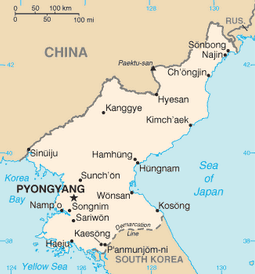
 The World Radio TV Handbook (WRTH) A12 schedules updates file is now available to download,