Tag Archives: Shortwave Radio

“If Memory Serves Me Right, . . .”

Many thanks to SWLing Post contributor, Bob Colegrove, who shares the following guest post:


If Memory Serves Me Right, . . .

By Bob Colegrove

The radio in my ’61 Ford Falcon came with memory.

Memory features on portable radios have become increasingly popular in recent years.  I would say the subject ranks up there with antennas and batteries in many discussion groups.  Memory is really a matter of convenience; that is, the quick and easy recall of favored frequencies.

Mechanical Memory

Memory-capable radios are nothing new.  My very first multi-band radio was a Howard Radio Company Model 308 radio-phonograph console.  It was manufactured sometime in the late 1930s and came with four memories.  These were in the form of pushbuttons, which when pressed, quickly accelerated rotation of the variable capacitor to frequencies of local interest.  The radio even came with a set of call letter stickers for AM stations all over the country.  Memory in car radios goes back almost as far.  It was convenient when you were driving.

During daylight hours it wasn’t hard to find stations in the nearby radio listening area, so you could just twirl the tuning knob in the usual manner until you got to the desired station.  In lieu of push buttons, my mother marked the dial of her kitchen radio with red fingernail polish, WXLW, WIBC, WIRE, WFBM, WISH.  At night it was quite another problem, when the great ionosphereic mirror in the sky began to reflect radio signals from hundreds of miles away.  That’s when the buttons really became useful.  Being a mechanical system, you had to be careful; a hard press of a button would cause the mechanism to overshoot the frequency.

Digital Memory

The digital age brought with it the capability of adding electronic memory to the product, as well as much more precision.  My next experience with radio memory came in the mid-eighties with the Sony ICF-2010.  This radio has a matrix of 8 x 4 = 32 dedicated keys on the front panel, each key recalling one stored frequency.  Further, in the case of SW, the single-sideband and bandwidth settings can be saved.  I found the feature very useful and managed to keep many of the 32 memory locations occupied a good deal of the time, honestly never giving much thought to the need for more memory.

Memory matrix on the Sony ICF-2010.  In conjunction with the SHIFT key,
many buttons have a secondary function for scanning or band selection.

But today’s small multiband portables do not have the available real estate for a large matrix of memory buttons on the front panel.  It’s now done with a sequence of key presses or possibly rotation of the tuning knob.  Since the Sony ICF-2001/2010, there has been a race among manufacturers to include more and more memory capacity in their radios.  “If you build it, they will come.”  Below is a sample of the total memory locations in some popular portable radios.

I am reminded of a passage in Life on the Mississippi in which Mark Twain speculated about the continual shortening of the Mississippi River due to new channels flooding across its bends.  According to his extrapolation, in 742 years Cairo, Illinois will be joined with New Orleans.  Similarly, we may soon reach the point where memory capacity of a multiband radio exceeds the total number of available channels.  But memory is cheap these days.  I suppose it’s already on the chip, so why not make it available and tout it as a feature?

As a result of this large memory capacity, recalling a saved station can quickly become a problem.  First, if you have band-specific paging, you must ensure you are on the appropriate band.  On page memory radios, it requires that you first recall the page number and button on the number pad where you have saved the frequency.  In any event, you navigate through the stored locations mentally correlating location numbers with frequencies.

There is no standard by which manufacturers implement memory.  On the Skywave SSB 2, D-808, and ICF-SW-7600GR, the number pad defaults to memory tuning.  For direct frequency tuning, you must first press FREQ on the SSB 2 and D-808.  The Tecsun radios on the other hand have toggling VF and VM modes, and you best be careful which one is active.  To recall memory on the PL-330, you can either spin the tuning dial to the channel or key the channel on the number pad if you can remember it.

To directly enter a frequency Sony ICF-SW7600GR, there are two extra key presses:
DIRECT before the frequency and ENTER after.

At this point I must ask, at what point does it become more convenient just to directly key in a 4- or 5-digit frequency?

One of the things to remember about radio memory, even the old push-button kind, is that it stores frequencies not stations.  If another shortwave station is broadcasting on a frequency you saved, that may be what you will hear when the frequency is recalled.  With some extra effort, the Sangean ATS-909X will allow you to record a memo (i.e., station call or name) with frequencies you have stored.  Just remember, this may not be the station you thought you saved.

As an aside, the C. Crane Skywave SSB 2 can scan the first page of AIR band storage (10 frequencies).  If you don’t have 10 frequencies of interest, simply duplicate some of them to fill out the page.  This is also a good way to prioritize a favored frequency.

ATS

If you use the auto tune system (ATS) the computer searches and memorizes all detectable signals for AM, SW, FM or possibly AIR – each band separately.  When it’s done, you’ve caught a net full of fish, and are then confronted with a memory bank full of frequencies, many of which you may not be interested in, but must tune through in much the same way as with conventional tuning.  Finally, there is no easier way to destroy a meticulously hand-programmed memory page than to hold a button down too long and inadvertently activate ATS.  How do I know that?

Keep in mind, ATS requires a broad-band antenna to keep the playing field level during the scan.  The whip is generally all I need.  In the dense population of FM stations along the US East Coast, a completely retracted whip is often best.  I find the Tecsuns best for adding or deleting frequencies after the ATS scan.

Enhanced Tuning Mode

Tecsun has introduced ETM in recent years.  It is interesting and useful.  The most recent incarnation is called Enhanced Tuning Mode (ETM+), and the manufacturer has dedicated 3 ½ pages of the PL-330 manual to explain it.  In essence, it operates on each band much like auto tuning storage (ATS), but protects whatever you have in the radio’s main memory, and allows you to store time-specific sets of frequencies in separate ETM pages.  This expands the total memory to whatever extent on-air stations are detected during each time period.  I haven’t been able to put a number on it.

This Tecsun PL-330 display indicates the radio captured 45 frequencies
on an ETM scan of international broadcast bands made during the 00 UTC hour.

ETM is a quick way to find out what’s currently on SW international broadcast bands.  ETM logs SW broadcast stations to memory and reports the total number of stations captured at a given time (think of it as a separate page).  The total number could be used to determine SW reception conditions by comparing it with a previously calculated average for the same period.  For AM and FM, the feature can be used to store stations at a travel location without affecting main storage.  Regardless of how you use ETM, there is a learning curve, as well as a need to be continually alert to what you are doing.

Virtual ETM

For any other radio with page memory, you can still have many of the advantages of ETM, as well as avoid the likelihood of accidentally wiping out your carefully programmed frequencies.  Here’s how.

ATS on most radios begins saving frequencies on the lowest numbered page.  Note that the lowest page on the SSB 2 is 1, while it is 0 on the D-808, and the first station on each page is at button 0 (bottom).  My experience in the highly congested AM and FM bands on the US East Coast is that an ATS scan will likely take up no more than four or five pages of memory.  Likewise, ATS for SW is limited to AM stations on the international broadcast bands and will not require many pages, even at night.  By manually programming your favorite frequencies beginning on the sixth page of a 10-page memory arrangement they will likely be out of reach of an ATS scan and your manually-saved frequencies will still be there when you want them.

The travel benefit also applies to virtual ETM.  An ATS scan performed at a different location using the lower pages will quickly put you in touch with local stations in that area and preserve your manually saved frequencies at home.

As an aside, I would also suggest that sideband frequencies be kept together on separate pages, as the SSB function must be engaged separately to detect them.  With SSB engaged, the C. Crane Skywave SSB 2 will recall the saved LSB or USB mode, but you may have to switch from one to the other on the XDATA D-808.

Example of virtual ETM for D-808 on the shortwave band.
Skywave SSB 2 would be similar.

Virtual ETM is not perfect.  This method does not provide all the time-specific paging that the Tecsun PL-330 has.  Also, there is a danger if your radio has an auto-sorting feature which might be inadvertently activated.  Lock the buttons on your radio when you turn it off or pack it up.

Conclusion

Apart from simply listening to the radio, it’s still entertaining to press buttons and see what they do – something like an electronic Rubic’s Cube.  I will go as far as to put a half dozen favorite AM and FM stations into memory.  I may enter a DX frequency or two I want to check out periodically.  That said, there are a limited number of storage locations beyond which memory ceases to be convenient, and for me the number is well short of what is generally available.

On the other hand, ETM or virtual ETM opens some useful possibilities if you take one of these small portables on travel or want to do a quick scan to see what’s currently on shortwave.

No radios were harmed in the preparation of this blog.

An interview with Glenn Hauser

Glenn with his wrist-mounted altazimuth DX-398 for MW direction-finding.

By Jock Elliott, KB2GOM

Since he was in grade school, Glenn Hauser has had the itch to receive broadcasts at long distance, and that interest, continuing throughout his lifetime, has led him to become one of the most respected authorities in the world of radio.

SWLing: How did you get started in radio?

GH: I started with TV DXing, trying to pick up Albuquerque 100 miles away, but often getting sporadic E skip stations more than 1,000 miles away. I also started tuning around medium wave. I was 8 or 9 years old.

SWLing: How did you get started with shortwave radio?

GH: In 1954, the family moved to Oklahoma City. By 1957, I acquired a Hallicrafters S-38E and was listening to shortwave using a longwire antenna, sending off for QSL cards. I was still doing TV DXing.

Then in 1961 the family moved to Enid, better for TV DXing, away from all those local stations, also radio DX. I acquired a Hammerlund HQ160, which was quite an improvement.

SWLing: Were you professionally involved in radio?

GH: In college, I worked on the campus radio station and also at a classical music station, KHFM. My BA was in broadcast journalism. After college, I continued to work on classical musical stations as programmer and announcer. I was very interested in foreign languages, learned phonetic schemes of various languages and learned to pronounce them. Radio Budapest was particularly helpful with Hungarian, which some announcers find difficult. I spent my professional career working for classical music stations.

I spent a year in Thailand, working for the American Forces Thailand Network. I was a newsman on the air in 1969 and 1970.

I had the HQ160 and a small TV in a footlocker, and in my spare time, DXed TV from as far as South Korea and the Philippines and medium wave from Europe.

After four years in the USAF, I resumed classic music radio, notably at WUOT, Knoxville.

By then I was contributing to various DX programs on SW stations, clubs, and eventually started my own program World of Radio. You can find out when to hear my program on the Schedules page at www.worldofradio.com . One of the main places to hear it is on WRMI in Florida. I was SW columnist for Popular Electronics, and later, Monitoring Times. Also published my own magazines, Review of International Broadcasting, and DX Listening Digest; at first on paper, then online.

SWLing: How did you get involved in logging SW radio stations?

GH: It was a natural outgrowth of enthusiasm for hobby; I was a regular contributor to DX Jukebox on Radio Netherlands (monthly) and Radio Canada International’s DX/SWL Digest (weekly).

SWLing: What sort of equipment do you use?

GH: A JRC NRD 545 and an Icom R75 for shortwave and medium wave. For antennas, I use a Wellbrook loop, a 100-foot random wire oriented east-west outside, and some shorter random wires inside the house. It is noisy where I live, and I’ve been trying to get the local electric company to fix line noise radiation.

Here in the town, my property is limited in space for antennas. I’ve been known to hook on to a wire fence in the country as a de facto Beverage antenna.

SWLing: How many hours a day do you monitor?

GH: It varies. Because of my program and my logging reports, I have made myself a nexus for information, so a lot gets sent to me. As a routine, I am always tuning around at bedtime, as well as various times during the day. At random times, I may do a band scan to see what’s happening.

SWLing: What are you most memorable moments listening to SW?

GH: Certainly one was October 4, 1957, hearing Sputnik on 20 megahertz.

SWLing: Any tips, tricks or advice you would care to offer to SWLs or DXers?

GH: Become as well informed as possible by participating in groups such as https://groups.io/g/WOR . Be aware of various references online such as the big 3 SW frequency listings, Aoki, EiBi, and HFCC, among those linked from my homepage http://www.worldofradio.com . In addition, scan the radio bands until you are familiar with what’s there, so you can notice something new or different.

Midway Island Radio Terminal 1971: Digging up the past and a mystery signal…

Many thanks to SWLing Post and Shortwave Radio Audio Archive contributor, Dan Greenall, who shares the following post:


Midway Island Radio Terminal 1971 – digging up the past

It was a brief “military style” transmission on approximately 14.85 MHz shortwave, logged sometime during 1971. And I still had a recording of it!

Recording:

I wondered if there was any chance of confirming what exactly I had heard way back then, so I recently decided to try a little bit of detective work. My first contact was with Nick England, K4NYW, who runs a “hobby” website about U.S. Navy communications in the 1950’s and 1960’s. He was good enough to put me in contact with a Midway navy vet, Charles E. “Chuck” Kinzer, who writes:

“…it could be a “long count” test for one of the transmitters at the Naval Communication Unit transmitter site where I worked.

When I was there (1966-1968) they installed two log periodic fixed antennas, one pointing generally east (Washington DC) and the other generally west (toward Vietnam).

Each was connected to an AN/FRT-39 10 KW transmitter. And for the most part, always connected to the same two transmitters. (We had an antenna patch panel and could mix and match most any transmitter to most any antenna.) It is my understanding that they were used by the Security Group on Eastern Island (one of the two Midway Islands which are Sand and Eastern). They were set up for single sideband voice. (Most of the other AN/FRT-39s were set up for multiplexed TTY tones on both sidebands with suppressed carrier. 16 channels on each sideband.)

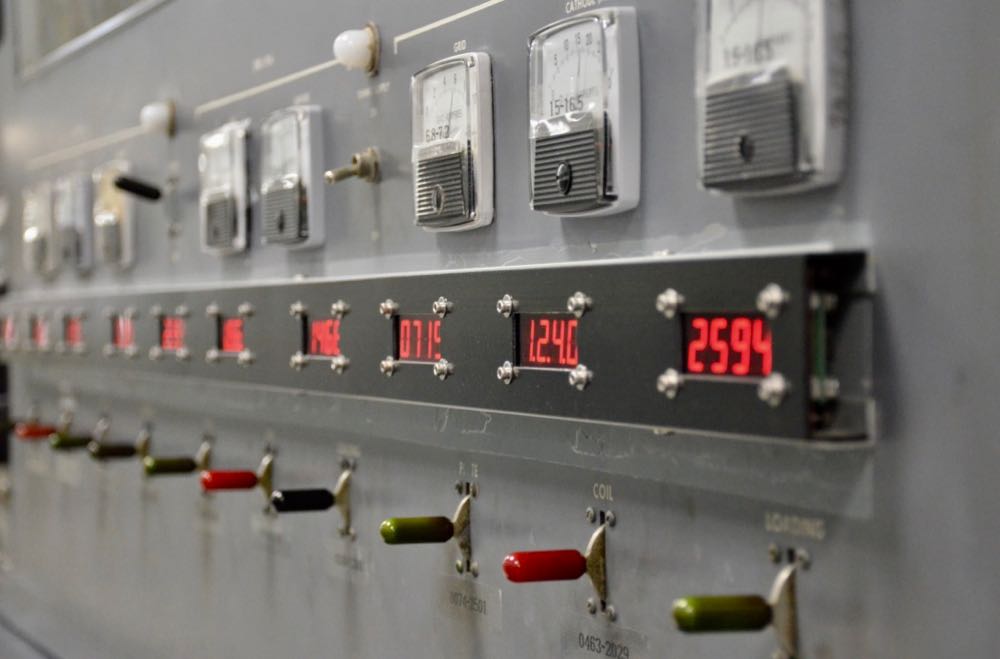
From time to time, they would tell us they wanted to do a “long count” and we would set the power level of one of the transmitters. As they did the count, we would set the power level of the peaks of the voice close to the maximum transmitter power. You could see the various meters flail up and down to near maximum along with the voice. This would be mainly the “PA Plate Current”, “PA Plate RF”, and PA Output” meters on the 10 KW final.

We couldn’t hear the voice, just see the meter activity. It would help if the person knew the frequency. If it was NOT an amateur radio frequency, it might have been one of those long count tests on one of those Navy transmitters. ….”over 50 years ago” sounds reasonable for that exercise. I assume the usage of that particular transmitter/antenna setup lasted to the end of the Vietnam war, at least.

Incidentally, when this was first set up, we had instructions to put X transmitter on Y antenna and so forth when they started testing the two new antennas. They would ask to do a “long count” test where we would set the power levels. Then shortly after they would start shouting into the microphone raising the power level too high and the transmitter would trip off. We asked them exactly what they were trying to do and, for secrecy I guess, they would not tell us. After a while, they figured out they were using the two antennas backwards. For example, they were trying to transmit east off the back side of the west facing antenna. These were VERY good antennas and very little power was wasted in the envelope going backwards.

I don’t know if this helps. Rather amazing that there is a recording existing like this. You never know what is going to pop out of the woodwork.”

Chuck later added that he might ask someone else for a little help. In the 1970’s, I used to own a guide to utility stations by Joerg Klingenfuss, that had lots of great frequency information, but sadly, I decided to part with it a number of years ago.

Please listen to the audio file of the transmission above from 1971, maybe some readers might weigh in with their thoughts on this? Please feel free to comment.

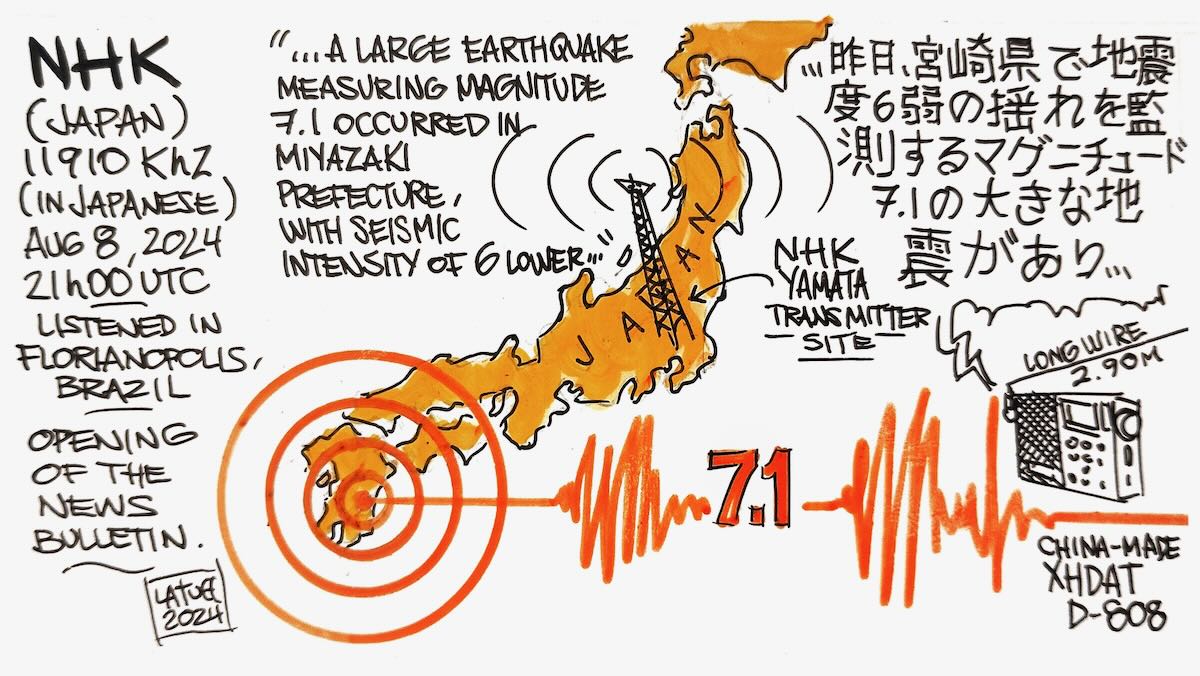
Carlos’ Shortwave Art and recording of Radio Havana Cuba (October 14, 2023)

Many thanks to SWLing Post contributor and noted political cartoonist, Carlos Latuff, who shares his radio log art of a recent RHC broadcast.

Carlos’ goal is to vividly illustrate the broadcaster’s message in his own unique artistic style and is not a reflection of his own beliefs or those of the SWLing Post. His objective is for his artwork to add historical context and put a visual with the news, reporting, and broadcast content:


Carlos notes:

Extract from the news bulletin of Radio Havana, Cuba, with the position of the Cuban government regarding the Palestine and Israel conflict. Heard in Porto Alegre, Brazil.

Click here to view on YouTube.

Canadian Content Radio Returns To The Airwaves!

Many thanks to SWLing Post contributor, Fred Waterer, who shares the following announcement:

Back by popular demand, starting Thursday, August 17th 2023 at 8:00 PM Eastern Time (North America) and every third Thursday of the month thereafter, Canadian Content Radio returns to the shortwave airwaves via WRMI, Radio Miami International on 9395 kHz in the 31 meter band.

The one hour, monthly program was first aired as part of the Radio Angela experiment on WBCQ in 2022 and gained a world wide following as one of RA’s more popular programs. During its hiatus, Canadian Content Radio host and producer Sean Welsh, has been retooling to the program to offer a more eclectic mix of Canadian music, songs with a Canadian connection, commentary, insights, and an expansion of the “WILT” feature (What I’m Listening To) featuring different styles of music from around the world.
Your requests, comments and all feedback are always welcomed via email at: [email protected]

Radio Waves: FCC Comments on Shortwave Trading, QTC eBook, Golden Years, and SDRconnect Demo

Radio Waves:  Stories Making Waves in the World of Radio

Welcome to the SWLing Post’s Radio Waves, a collection of links to interesting stories making waves in the world of radio. Enjoy!

Many thanks to SWLing Post contributors Ron Chester, Benn Kobb, Chuck Rippel, Pietschman, Dennis Dura, and Dave Zantow for the following tips:


“Market Makers” Want to Expand Their Use of Shortwave (Radio World)

The FCC seeks comments on a proposal to use HF spectrum for financial data

The FCC is taking public comment on a proposal to revise the rules governing the frequencies above 2 MHz and below 25 MHz.

The Shortwave Modernization Coalition thinks the 2-25 MHz band is underused and wants to use it for the long-distance transmission of time-sensitive data from fixed stations. The users would be companies working with certain kinds of financial transactions; the proposal would prohibit voice transmission and mobile operations.

The firms in the coalition are “market makers and liquidity providers” for exchange-traded financial instruments.

This high-frequency trading industry has in fact been using shortwave links for several years to send trading data between U.S. and foreign exchanges, but it has done so under experimental authorizations. [Continue reading…]

QTC: I Have a Message for You (Archive.org)

Many thanks to Bill Pietschman who notes that the book “QTC: I Have a Message for You” has now been published on Archive.org for all to read and download free of charge. Bill writes:

I knew Ray Redwood, and besides being a Professional radio operator, he was indeed a Ham’s Ham. You will find here not just the story of radio, but a detailed analysis of the Titanic, from a radioman’s point of view. Part documentary, part autobiography, and part technical, it’s a great read. I’m so glad that his work has been preserved here. Future radio historians will, I am certain, find it to be a valuable record of the Ship Radio Officers Era, and Ray’s insights at the dawning of the Global Maritime Distress and Safety System as we have today which utilizes satellite technology.

Click here to check out QTC: I Have a Message for You on Archive.org.

The Golden Years of Shortwave Listening (YouTube)

There was a time, some 50 years ago when cell phones didn’t exist and computers were only owned by large corporations, that people learned of the world around them by listening to shortwave radio. This is a journey back to that time to hear the sounds and see the correspondence from shortwave stations from all over the world. Sit back, listen and enjoy!

SDRplay and SDRconnect – The Update! – Dayton Hamvention (YouTube)

Steve Brightman (KI5ENW) from SDRplay demonstrates the new updates to SDRconnect to Ham Radio Outlet’s Julian Frost (N3JF).


Do you enjoy the SWLing Post?

Please consider supporting us via Patreon or our Coffee Fund!

Your support makes articles like this one possible. Thank you!

BBC Kranji shortwave relay station to close July 16, 2023

Many thanks to a number of SWLing Post contributors who have reached out about a report on AWR Wavescan regarding the closure of the BBC Kranji relay station in Singapore.

I contacted AWR Wavescan host, Jeff White at WRMI, and asked for any details he might have since I could not locate any press release from the BBC or Encompass.

Jeff shared the following notice from AWR Wavescan:

Another shortwave station is about to go off the air for good also. Encompass TV reports that the BBC relay station that Encompass operates in Kranji Singapore will cease operation as of July 16th, after many decades of service. This will result in a reduction of BBC English transmissions to South Asia. Some transmissions from Kranji will be moved to other shortwave transmitter sites.

Many thanks for the info, Jeff.

We’ll post more details about the closure as they become available.