Tag Archives: Shortwave Radio

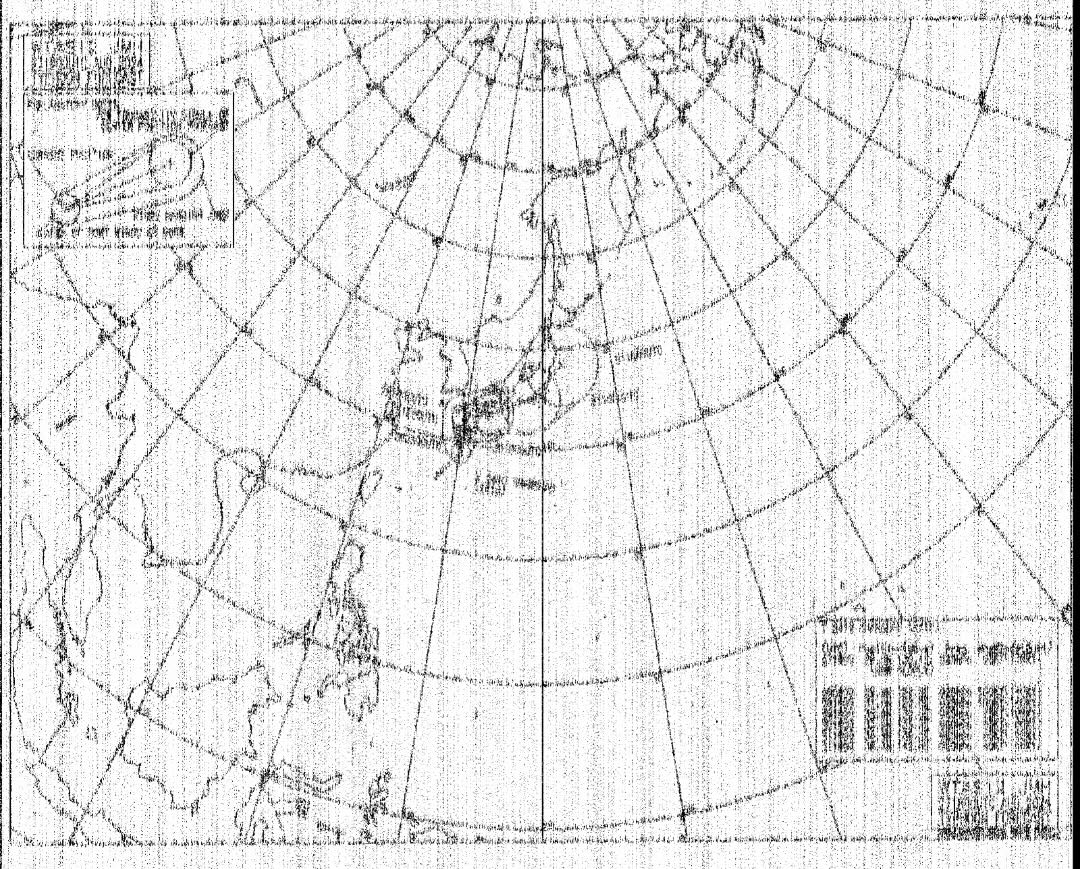
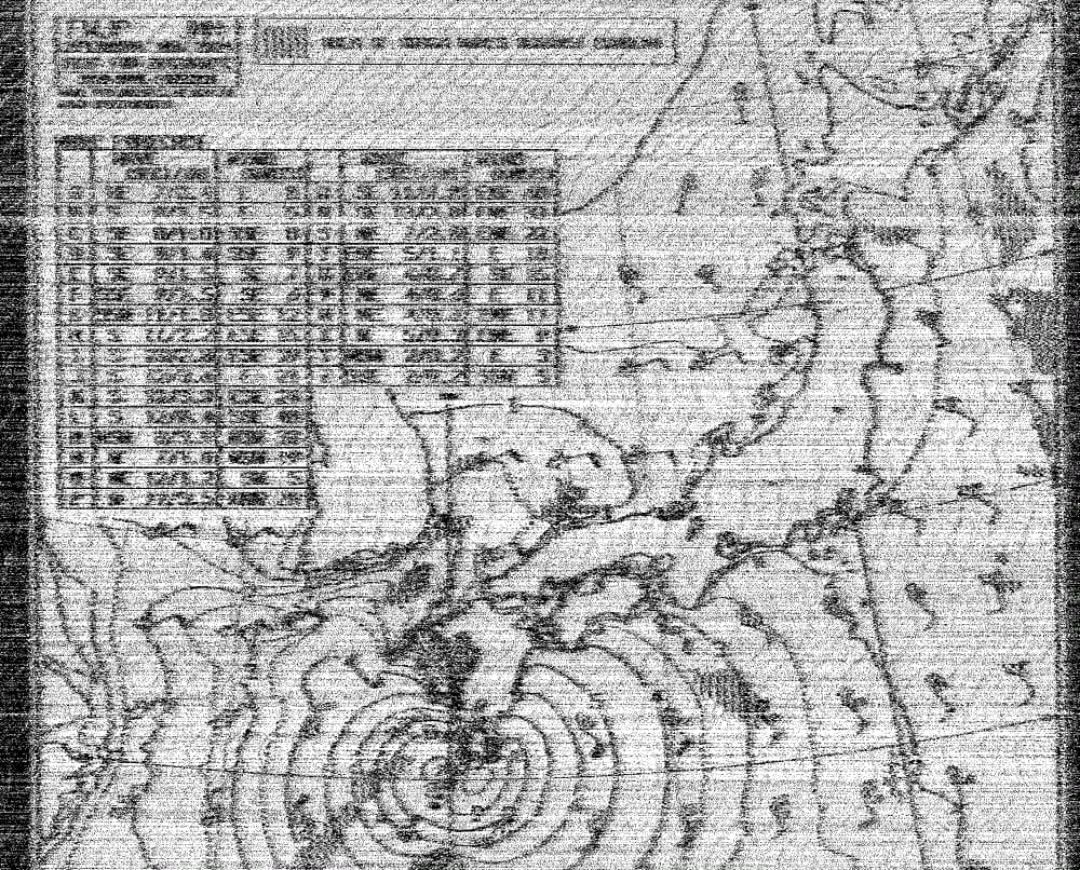
Carlos’ Shortwave Art and recording of NHK World (November 22, 2022)

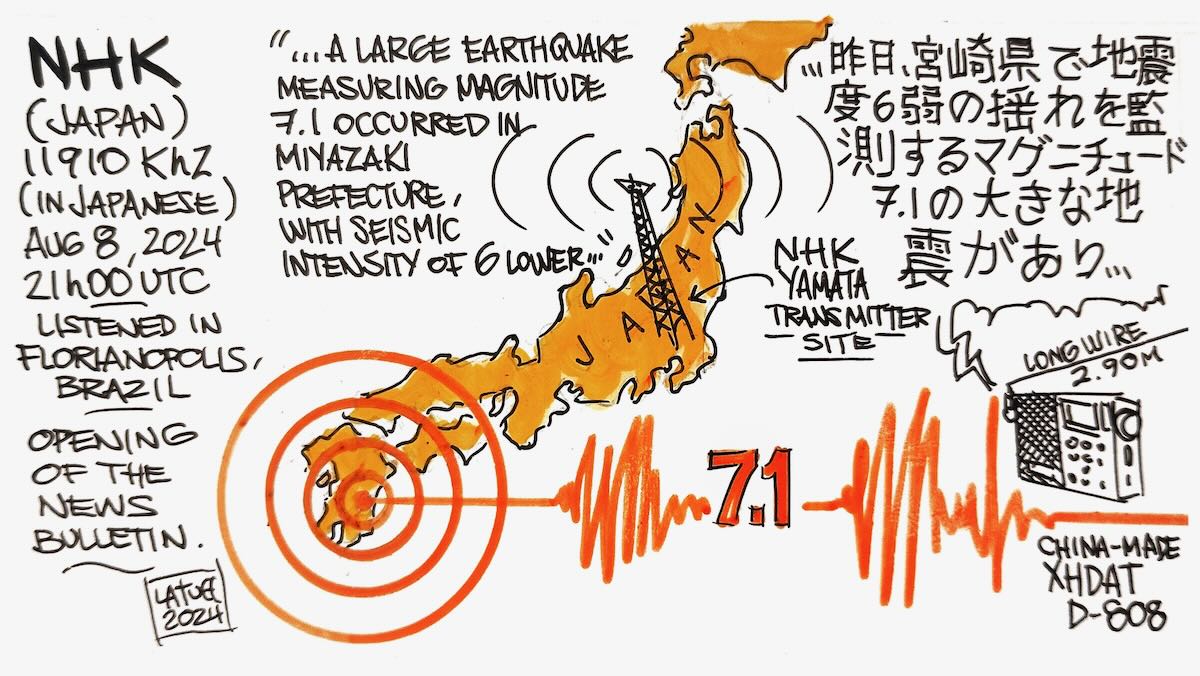
Many thanks to SWLing Post contributor and noted political cartoonist, Carlos Latuff, who shares his radio log art of a recent NHK World broadcast.


Carols notes:

News about the strong earthquake that hit Cianjur, West Java, Indonesia, more than 200 people dead.

Broadcasted by NHK World Japan radio in Indonesian via shortwave frequency of 13705 kHz, and listened in Porto Alegre, Brazil.

Click here to view on YouTube.

Video: Giuseppe tests four classic receivers on three different antennas

Many thanks to SWLing Post contributor, Giuseppe Morlè (IZ0GZW), who shares the following:

Dear Thomas and Friends of SWLing Post,

This is Giuseppe Morlè from Formia, central Italy on the Tyrrhenian Sea.

I want to share with you this test with 4 old receivers with 3 different antennas:

    • Yaesu FRG-7
    • AOR 3030 – MINI WHIP antenna on the roof
    • Kenwood R-1000INTERNAL CROSSED LOOP antenna
    • Yaesu FRG-8800 – VERTICAL NAVAL

I tuned the 7,390 kHz frequency of Radio New Zealand at 14:10 UTC on November 16 on the 4 receivers. I used the narrow and wide filter on each receiver.

I state that a storm was in progress in the area, the afternoon signal was very discontinuous with a difference on the 3 different antennas.

Surprising the result of the internal cross loops which I use a lot when there are thunderstorms in the area to listen to anyway; their behavior is definitely very good despite being inside my shack.

The Mini Whip is excellent on long and medium waves but gets worse above 7 MHz. In fact I only use this antenna for medium and long waves.

A good signal also from the external naval vertical of 8 meters with a “soft” listening on the Yaesu FRG-8800.

Judge dear friends your comments are welcome!

I wanted to compare these 4 “glories” that have accompanied most of my life and that I still consider excellent.

Attached the link tot he video on my Youtube channel:

Click here to view on YouTube.

I wish everyone a good listening …
73. Giuseppe Morlè iz0gzw.

Thank you so much for sharing this, Giuseppe! We love your videos and demonstrations especially since they so often involve antennas that you have home brewed. Your cross loop antenna is truly amazing!

Radio Waves: AU2JCB Special Event, 1 Million Watt FM Tower, 3ZZZ Breaches Rules, Australia Calling, WWII KGEI, and EV Charger QRM

Icom IC-756 Pro Transceiver Dial

Radio Waves:  Stories Making Waves in the World of Radio

Welcome to the SWLing Post’s Radio Waves, a collection of links to interesting stories making waves in the world of radio. Enjoy!


AU2JCB Special Event Station (Nov 25 – Dec 13, 2022)

Many thanks to SWLing Post contributor, Datta, who shares the following announcement:

AU2JCB is a special event call-sign to commemorate the birth date (30 NOV) & to pay homage & to tell about the great INDIAN scientist Acharya JAGADISH CHANDRA BOSE who is recognized as the “Father of Wireless Communication” by the scientific community of our world &IEEE.

I, VU2DSI, have been operating with this call sign for the last 17 years since 2005 & operate AU2JCB from 25 NOV 2022 to 13 DEC 2022.

The Details of operation —-

Period: 25 NOV 2022 to 13 DEC 2022

Frequencies:

  • 10 M: 28545, 28510,28490
  • 21 M: 21235, 21310, 21350
  • 20M: 4210, 14250, 14310
  • 40 M: 7040, 7150
  • 80 M: 3710
  • 6M in FM mode 50800, 51500
  • 10 M: 29700

Preferably the operation will be on higher bands according to propagation conditions.

QSL— Direct to VU2DSI, “SURABHI” MEHERABAD. AHMEDNAGAR.414006. INDIA.

FOR DX STATIONS PLEASE SEND 2IRC’s—–IF POSSIBLE— as many many DX stations are requesting QSL’s.

I will appreciate the GOOD number of used postal stamps instead of IRC as I love collecting stamps.

About

Aacharya J.C.Bose is well known as the “Father of Wireless Communication”.

Acharya Bose’s demonstration in 1895 & 1897 predates all.

Bose transmitted wireless signals to a distance of a mile. Popova in Russia was still trying remote signaling at this time & the first wireless experiment by Marconi was not successful until May 1897.

Bose is a pioneer in microwave optics technology.

Bose’s invention of 1-centimeter to 5 millimeters radio waves is being used in radars, satellite communication& remote sensing.

Bose’s concepts from his original 1897 papers are now incorporated into a new 1.3 mm multi-beam receiver on the NRAO (National Radio Observatory) 12 Meter Telescope.

Bose anticipated the use of P-type& N-type semiconductors & hence 60 years ahead of his time. Bose developed the use of GALENA crystals for making receivers.

In Bose’s presentation to the Royal Institution in London in January 1897, he speculated on the existence of electromagnetic radiation from the sun. This radiation from the sun was not detected until 1942.

Video: Exploring a 1 MILLION Watt FM Tower (YouTube)

My Dad and I took a road trip to tour the 1 MW FM community tower in Crestwood, MO, serving the entire St. Louis metro area combining 10 FM radio signals into two antenna systems.

Special thanks to the Audacy engineers who allowed us to take a peek at their (very clean!) transmitter rooms and equipment!

Click here to view on YouTube.

3ZZZ breaches community radio broadcast rules in its coverage on Ukraine (ACMA)

The Australian Communications and Media Authority (ACMA) has found Melbourne-based community broadcaster 3ZZZ in breach of community broadcasting rules in its coverage of the invasion of Ukraine by Russia. Continue reading

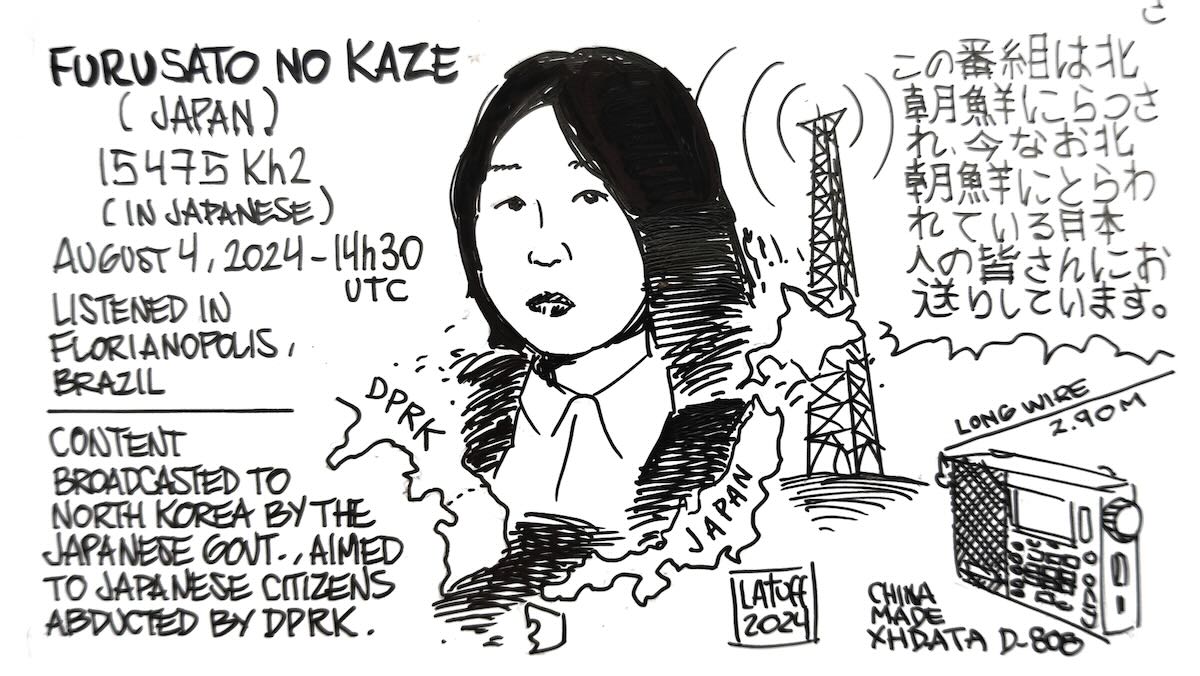
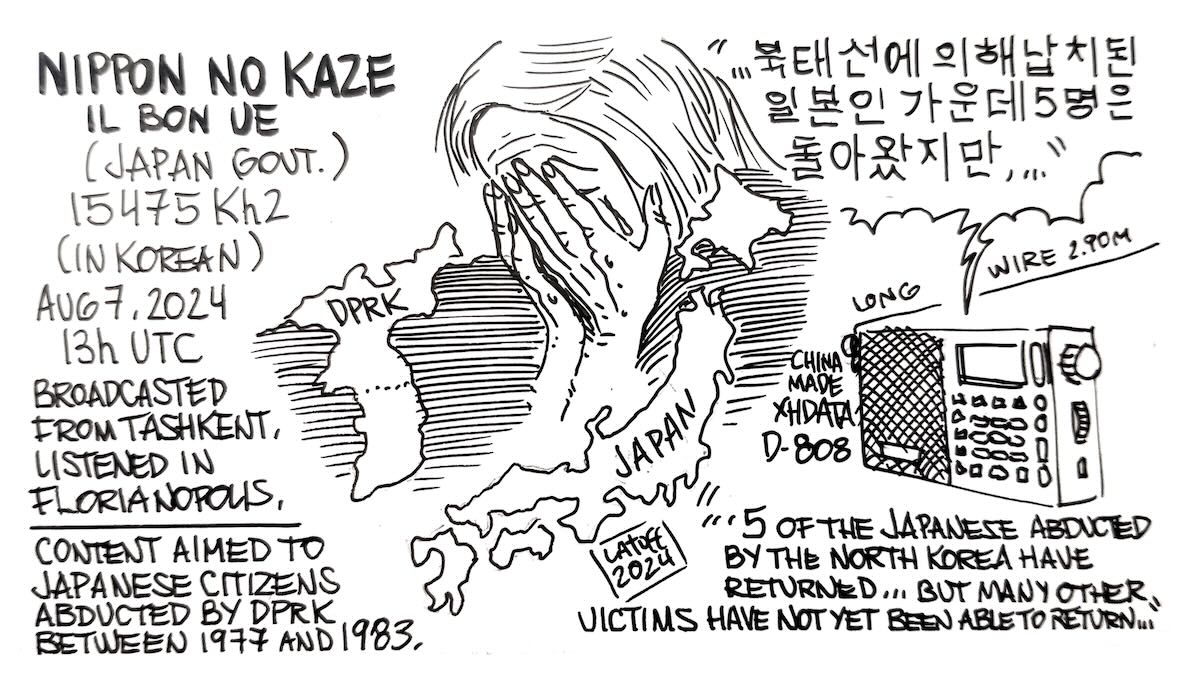
Carlos’ Shortwave Art and recording of KCBS Pyongyang and the Voice of Korea (November 20, 2022)

Many thanks to SWLing Post contributor and noted political cartoonist, Carlos Latuff, who shares his radio log art of a recent Voice of Korea broadcast.


Carlos notes:

Announcement of the launch of an intercontinental ballistic missile (ICBM) by the DPRK, via KCBS Pyongyang, domestic radio service from DPRK, broadcasting in Korean, listened in Porto Alegre, Brazil, shortwave frequency of 11680 kHz.

Click here to view on YouTube.

Announcement of the launch of an intercontinental ballistic missile (ICBM) by the DPRK, via Voice of Korea, broadcasting in English from Kujang, North Korea, listened in Porto Alegre, Brazil, shortwave frequency of 12015 kHz.

Click here to view on YouTube.

Announcement of the launch of an intercontinental ballistic missile (ICBM) by the DPRK, via Voice of Korea, broadcasting in Spanish from Kujang, North Korea, listened in Porto Alegre, Brazil, shortwave frequency of 12015 kHz.

Click here to view on YouTube.

Alan Roe’s B22 season guide to music on shortwave (version 1)

Many thanks to SWLing Post contributor, Alan Roe, who shares his B-22 (version 1) season guide to music on shortwave. Alan provides this amazing resource as a free PDF download:

Click here to download Music on Shortwave B-22 v1 (PDF)

Thank you for sharing your excellent guide, Alan!

This dedicated page will always have the latest version of Alan’s guide available for download.

Carlos’ Shortwave Art and recording of the Voice of Korea (November 17, 2022)

Many thanks to SWLing Post contributor and noted political cartoonist, Carlos Latuff, who shares his radio log art of a recent Voice of Korea broadcast.


Carlos notes:

News excerpt from Voice of Korea, broadcasting from Kujang, North Korea, 12015 kHz.
North Korea raising the tone yet more against provocations by the US, South Korea and Japan.

Click here to view on YouTube.

Frank reports on the Deshibo RD1860BT portable shortwave receiver

Many thanks to SWLing Post contributor, Frank, in Germany, who shares the following guest post and review of the Deshibo RD1860BT:


Deshibo RD1860BT report

Hello Thomas,

Today I would like to report on a new portable world receiver. Unfortunately, new devices have not been found on the shelves of electronics retailers for a long time, but now in the depths of the world wide web. And that’s how I came across the Deshibo RD1860BT.

Deshibo is certainly known to many from their GA450 loop antenna. But Deshibo has also produced several radios, including the RD1780L, which is probably a little better known. New to the segment is the RD1860BT, which initially seemed like an old friend to me. An Eton Elite Executive? Yes, there are external similarities, but also differences.

Many months ago I had an Eton Elite Executive for a short time. I had heard of its excellent reception properties, which I can confirm, but the design is reminiscent of older receivers from the 80s, is relatively heavy, operation is sometimes a bit cumbersome, the protective cover does not protect properly. I find the device to be portable overall difficult. We didn’t become friends, so I sold it on to a Swede, who in turn became a friend.

I still missed the Eton. RDS on VHF is not found in any Tecsun , nor are there memory banks that can be written on.

Then I discovered the RD1860BT and couldn’t resist. First of all: the Deshibo is only labeled in Chinese for important function keys. But the friendly dealer on eBay provided me with an English manual before I bought it. That was the deciding factor, because I was sure that after a little use , the Deshibo could be operated blindly.

However, some questions have arisen in the user manual. Some things didn’t seem quite right, others were completely missing from the description. That’s why I decided to write my own manual on a journey of discovery of the new Deshibo. And so that it might also help others who might be interested in radio, I wrote it in English and attach it here.

Click here to download Frank’s version of the RD1860BT manual (PDF).

The Eton’s somewhat unsorted manual was very helpful, but I also added my own drawings. For example, I added an English-labeled keyboard as a back cover, so that the keys can be assigned without a long search.

Here you can already find the first differences to the Eton: the keyboard layout is a bit more orderly. Also, the Deshibo doesn’t have a metallic speaker grille (which frankly I don’t like about the Eton). The display, not the writing, is backlit in orange on the Deshibo . Most importantly, the Deshibo is a lot lighter than the Eton ( around 500g if I researched correctly). And that means: the structure of the Deshibo must be different. Continue reading