Tag Archives: Why Shortwave

RFA suspends in-country operations in Cambodia

(Source: Radio Free Asia)

WASHINGTON – Libby Liu, President of Radio Free Asia (RFA), today issued the following statement about RFA’s decision to suspend in-country operations in Cambodia:

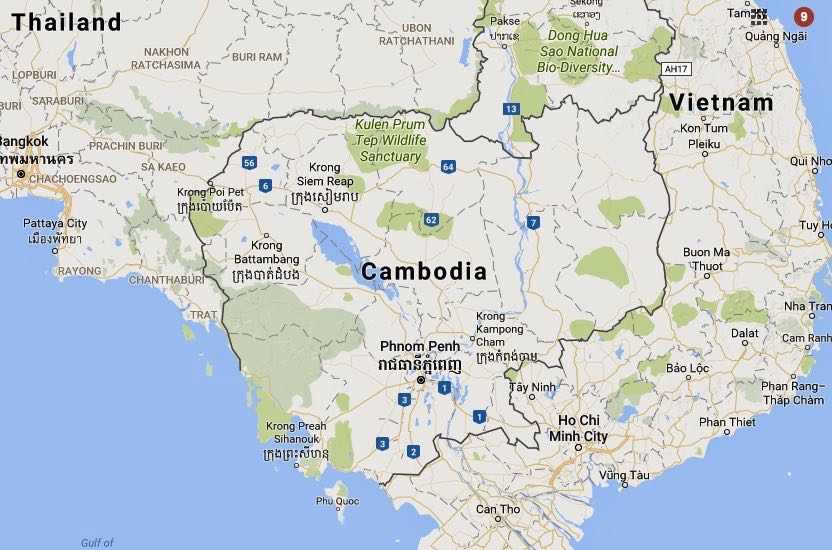
After almost 20 years of bringing the Cambodian people independent, reliable and trustworthy news and information from inside the country, Radio Free Asia has regrettably been forced to close its Phnom Penh bureau. The government’s relentless crackdown on independent voices in recent weeks has made it impossible to keep the bureau open while guaranteeing the integrity of RFA’s journalistic mission.

It has become increasingly apparent that Prime Minister Hun Sun has no intention of allowing free media to continue operating inside the country ahead of the 2018 elections. The government has instead seized on every opportunity to go after critics, political opponents, NGOs, and independent media committed to reporting the truth. Using a thin pretext of tax and administrative violations, authorities have closed independent radio stations carrying RFA, Voice of America, and Voice of Democracy. The government has forced The Cambodia Daily newspaper to close due to an extreme and punitive retroactive tax bill and has kept its manager, Mr. Steele, from leaving the country under threat of criminal charges. Authorities have been employing these same tactics against RFA, despite our full cooperation at every step to comply with all requests and our sincere efforts to register as a licensed media company. Nevertheless, they have resorted to false statements and increasingly threatening and intimidating rhetoric about RFA, made mostly through leaked documents on government mouthpiece media and random statements from different ministries.

Facing down intimidation is nothing new for RFA. Our journalists and commentators have been threatened, jailed, and forced to leave the country to avoid arrest or worse. But recent developments have intensified to an unprecedented level, as Cambodia’s ruling party shamelessly seeks to remove any obstacle or influence standing in its way of achieving absolute power.

Through the years, Cambodian journalists working for RFA have risked their lives to report on corruption, illegal logging, forced evictions, bribery, labor disputes, and rights abuses, among other important stories largely ignored by state-controlled media. Their hard work has helped to build the foundation of RFA’s investigative, in-depth journalism from the ground up and has earned us the trust of the Cambodian people — to whom we also owe our heartfelt gratitude. The sacrifice and support of staff and audience alike reinforces the need for RFA to keep Cambodia’s citizens informed, so they possess a more complete and accurate picture of what’s happening in their neighborhoods, their towns, and their villages. We hope that the government will not persecute the individual brave Cambodians who worked with us in retaliation for RFA’s efforts to bring reliable free press to their countrymen and women.

RFA stands resolved to stay true to its vital mission in Cambodia, now more than ever, to go forward shining a light even in the darkest of hours. RFA will keep reporting on the most important and censored issues and events inside the country — and we will continue to broadcast and publish our programs, reports and content on shortwave radio, social media, and on our website.

As history has shown, dictators may rise and force their will on nations, but the people will always seek truth in pursuit of freedom.

Guam to California: CTF 75 successfully tests HF communications system

Electronics Technician 2nd Class Anthony Juarez and Electronics Technician 3rd Class Codie Flanagan, assigned to Naval Mobile Construction Battalion (NMCB)1, adjust frequency codes on a GRC-234 high-frequency base station at Naval Base Guam July 27, 2017. (Source: DVIDS)

(Source: Defense Video Imagery Distribution System)

NAVAL BASE GUAM , GUAM
08.04.2017
Story by Petty Officer 1st Class Torrey Lee
Commander, Task Force 75
Subscribe 5

Commander, Task Force (CTF) 75 successfully completed communications systems tests using high-frequency (HF) radio waves to broadcast voice and data 6,050 miles from Naval Base Guam to Port Hueneme, California, July 27, 2017.

The assessment tested the capabilities of expeditionary forces to use HF waves to deliver data over the Pacific. HF has become a viable alternative for military forces when more common forms of communication, such as satellites, are unavailable.

“In this particular back-up plan, we tested our ability to talk, and we were able to send text to one of our units that is across the Pacific Ocean,” said Lt. Cmdr. Timothy Carmon, a communications planner temporarily assigned to CTF-75. “The transmissions and receptions are not as fast as IP services, however we were still able to communicate in a timely manner with the distant end.”

Utilizing the assets of CTF-75’s Naval Mobile Construction Battalion (NMCB) 1, the command configured its antennae to broadcast to California. Once a successful voice transmission was received, communication directors at Navy Expeditionary Combat Command Pacific requested that CTF-75 try to send a data file.

“These data files allow us to save time,” said Electronics Technician 2nd Class Anthony Juarez, a communications supervisor assigned to NMCB 1. “We can send general diagrams, fire plans and points of interest. Instead of trying to verbally describe something, they [the recipient] have a graphic or a picture that gives them a better idea of the situation.”

Common communication devices used by the U.S. military incorporate satellites. CTF-75 has been testing HF systems in the case of satellite communication failure. HF is a frequency wave broadcast that is transmitted around the curvature of the Earth. Unlike other forms of frequencies, such as very-high frequencies and ultra-high frequencies, the transmission is not distorted by terrain or physical obstructions.

“We may not always have access to operational equipment or the latest assets, but as communicators we should have a backup plan that is ready to be executed,” said Carmon.

Guam is located in the western region of the Pacific. Having an HF range of 6,000 miles is equivalent to broadcasting from Japan to the U.S., or oppositely, from Japan to the middle of Africa. During this most recent test, CTF-75 was also able to establish communications with Mobile Diving and Salvage Unit 1 in Hawaii.

“We can hop our communications from island to island,” said Juarez. “This test gave us the opportunity to know we can push our system to the absolute max from Guam. There are definitely different systems out there, but our system is really efficient at long-range HF. As new radios are incorporated in the Navy expeditionary community, I have no doubt it will get faster, more reliable and easier to set up.”

CTF-75 is currently testing its communication abilities with subordinate commands which include Seabee units, riverine squadrons, cargo handlers, explosive ordnance disposal technicians, and expeditionary intelligence forces.

“This achievement was an important step in an effort to increase our capabilities to be prepared to execute missions in austere locations around the globe,” said Carmon. “Our expeditionary commanders may never need to communicate over a few thousand kilometers, but if the need arises our communicators will be able to provide the connection for that commander.”

CTF-75 is the primary expeditionary task force responsible for the planning and execution of coastal riverine operations, explosive ordnance disposal, diving engineering and underwater construction in the U.S. 7th fleet area of operations.

Read the full article at the DVIDS hub…

DW: South Sudan blocks access to independent websites

(Source: Deutsche Welle)

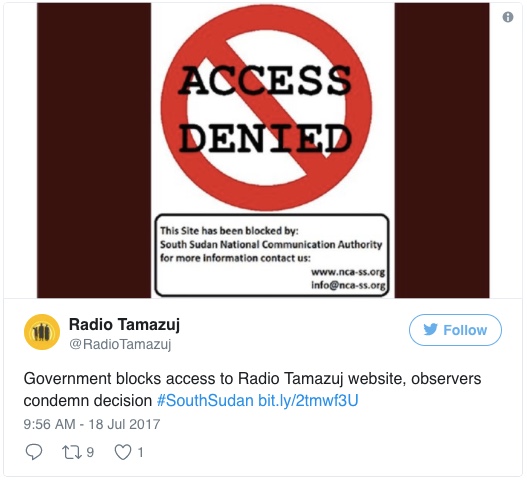
Internet and mobile phone users in South Sudan are not able to access the websites of at least four independent media outlets. The government has grown increasingly hostile to the media since civil war began in 2013.

The South Sudanese government has blocked access to the websites of Dutch-backed Radio Tamazuj, as well as the popular news blogs Nyamilepedia and Paanluel Wel. Internet users said that the website of the Paris-based Sudan Tribune was also affected on some mobile phone and Wi-Fi networks.

Radio Tamazuj and the Sudan Tribune are reputable sites which have been critical in their coverage of South Sudan’s government, which has grown increasingly hostile towards the media since civil war broke out in 2013.

The government is justified in blocking the websites to protect citizens from outlets that “disseminate subversive material,” South Sudan’s Minister of Authorities Michael Makuei Lueth told the US-based Committee to Protect Journalists (CPJ).[…]

Continue reading at Deutsche Welle online.

Fortunately, the South Sudan communities I’ve worked with through Ears To Our World have access to shortwave radio which is not affected by an Internet block.

No doubt, shortwave radio is the ultimate free speech medium, as it has no regard for national borders, nor for whom is in power (or not in power) at any moment.

Shortwave radio may be a sunsetting technology, but it’s also the most accessible and effective vehicle of the free press. What other technology can thoroughly blanket the globe with news and information yet can also be be received with a simple $20 battery-powered portable device?

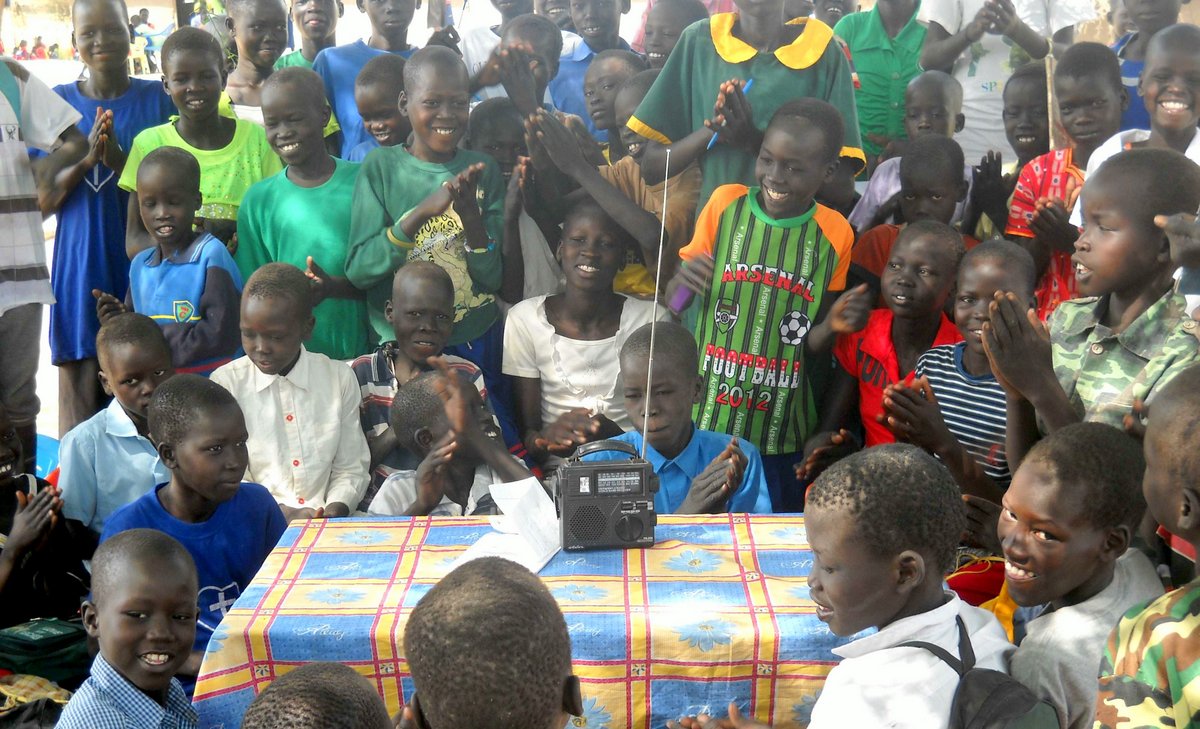
This photo was taken in South Sudan, after Ears To Our World distributed radios in this rural community for the fourth year running. We’ve been distributing radios in South Sudan through our partners there since 2009.

Check out these recent comments from the head of DW regarding the importance of international broadcasting. Thanks for the tip, Rich!

Radio Erena: “a symbolic lifeline” to Eritrea

(Source: The Guardian)

[Radio Erena founder, Biniam Simon, writes:] “You have to understand: Eritrea is completely closed. No information is available there at all, about the outside world or what is going on internally. So if you’re an Eritrean journalist, and you make it to a place where so much information is available, the first thing you think is: why not tell people all this? It was the obvious thing to do.”

[…]The station broadcasts a two-hour programme in Arabic and Tigrinya seven days a week, repeating it several times a day, giving listeners inside Eritrea multiple opportunities to listen (they may do so, in the privacy of their own homes with the shutters closed and the sound turned down, only when electricity is available – which it often isn’t). As well as news about what the regime may be up to, it provides a detailed picture of what is happening to the refugees who are travelling to Europe – when a boat carrying 360 Eritreans capsized off Lampedusa in 2013, a correspondent was immediately dispatched to Italy – as well as features about diaspora success stories, footballers and athletes among them.

It runs smoothly. There is always a lot to tell. Making sure it can be picked up in Eritrea, however, remains a constant struggle. In 2012, the government managed to block it – seemingly unbothered by the fact that in doing so, it also blocked its own television channel (both broadcast on one satellite frequency). It has also successfully jammed it on shortwave, and on at least one occasion has hacked into the Radio Erena website, destroying it completely. “It’s a nonstop challenge,” he says. “We’re constantly fighting them, and it’s getting harder and harder because they are now employing new experts from China and Indonesia.”

But if this is exhausting, it’s also hugely encouraging: “It means that what we’re doing is working. We know this because the government wants us to stop.”[…]

Readers: this is only an excerpt from this excellent article in The Guardian. Click here to read the full article.

RadioWorld: Radio Reaches Blocked Countries

(Source: RadioWorld via Southgate ARC)

International radio remains the most reliable, robust source of information for people in some nations

North Korea is rated as the second most censored county in the world after Eritrea, according to the Committee to Protect Journalists.

North Koreans who are caught accessing information not approved and disseminated by the government can be sent to brutal prison camps for extended terms, or face execution.

Yet such is the human hunger for reliable outside information, that many North Koreans brave these risks by tuning into international radio and cross-border TV broadcasts wherever practical.

Many also watch banned South Korean TV programs on black market DVDs, SD cards, and USB sticks; plus computers and mobile phones smuggled in from China. (South Korean movies and soap operas are hugely popular in the North, according to the New York Times.)

The conclusions they draw from this content are subsequently shared with other North Koreans by word-of-mouth; despite the fact that such sharers can get in serious trouble with the Kim Jong-Un regime.

Read the full RadioWorld article:
http://www.radioworld.com/global/0007/radio-reaches-blocked-countries/339993

PRI: How a shortwave radio network is helping to counter Boko Haram

GSM Bohnso School, Cameroon (Photo courtesy of ETOW partner, EduCare Africa)

(Source: PRI)

It’s easy to overlook the power of radio, when being hit by a firehose of apps, websites, video and social media. But when you’re out in the sticks, especially if there’s crisis or unrest, radio saves lives.

“In crisis situations, information is very, very important. Sometimes more than food, you need information,” says Faruk Dalhatu, managing director of Dandal Kura Radio International in the northeastern Nigerian city of Maiduguri, a former Boko Haram stronghold. “Because, if you’re on the run, you need to know which direction is safe, before you even think of close family members that have been separated from you.”

What’s more, you don’t need to know how to read to listen to radio. You don’t even need to own a radio; you can just listen to someone else’s. And if you’ve got a cellphone — and many people even in remote parts of Africa do — you can call in and have a voice.

Click here to listen via PRI.

ABC News: Portrait of a devoted shortwave radio listener

(Source: ABC News)

Saying goodbye to Radio Australia on the shortwave after 37 years

Kevin De Reus has lived in the same 24-kilometre-radius his whole life.

Born and raised in Iowa in the US, Kevin now calls his grandfather’s farm — just 12 kilometres from where he grew up in central Des Moines — home.

He is married, has five children and has worked at the same company for 20 years.

And while he admits he has not travelled much in his 52 years, it hasn’t stopped Kevin from listening to the news from Australia since 1980 — with the help of a shortwave radio.

Listening from the other side of the world

Even half a world away, he says the broadcast was one of the clearest of the stations he listened to.

“Radio Australia always held a special place in my heart just because it was in the South Pacific and I didn’t know much about that area — and the signal was always good from that part of the world,” he says.
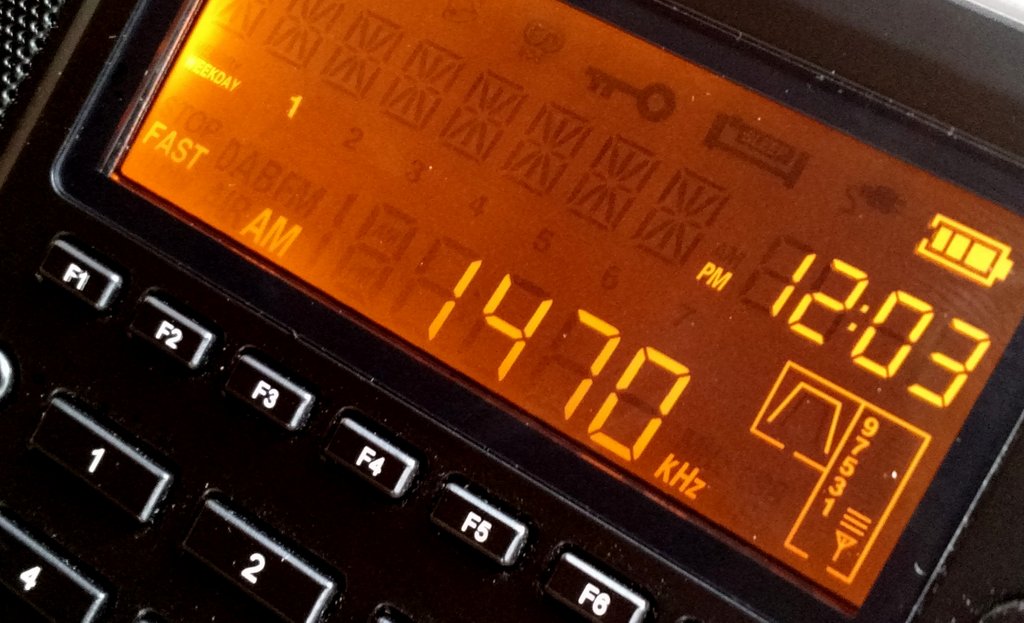
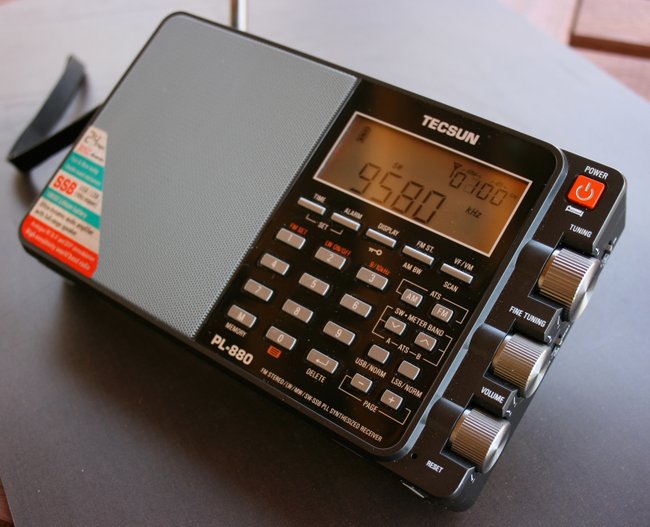
“Most recently, over the last two to three years as I was listening in the morning hours here on 9.580, the signal was so good. It really was about the only English broadcaster at that time of the day that had news and information.

“Most mornings I would get up and turn on the shortwave radio at 7:00am (local time) and listen to the news from Australia and then I would drive to work.

“So many of the stations just aren’t on the air anymore. BBC doesn’t broadcast to North America anymore. I can’t even hardly hear the Voice of America in English anymore to tell you the truth. So Australia had the strongest signal.

“That’s why it was hard for me to hear [Radio Australia] was going to go off the air.”[…]

Click here to continue reading the full article on ABC News.

I believe Kevin De Reus did a fine job explaining the appeal of being a shortwave radio listener.

Though I gather a lot of international news these days with a WiFi radio (especially since Radio Australia left the shortwaves), I still prefer listening to shortwave.

It’s just how I’m wired.