
 By 13dka
Following up on the article I recently wrote about the MLite-880, I still had a comparison with a reference radio on a proper antenna on my to-do list. I wasn’t in a hurry because I got pretty fascinated with exploring what I can get out of various magmounts on my car with this radio, which is quite a lot and it never gave me the feeling of missing out on something. I was also a bit hung up on the idea of comparing the MLite with the Belka because, you know, same price level and all, but that’s a bit iffy with my little passive splitter and 2 different input impedances.
Then a claim was made on the interwebz that the MLite-880 would be just a mediocre radio that would not stand scrutiny without its outstanding noise reduction, to summarize that in my own words. My experience is obviously very different and it made me curious how much truth could be in this claim. So I just took the ingenious Icom and the mediocre MLite to the dike to slip in a little shootout and then maybe give the loser a Viking funeral on a little raft I improvised out of flotsam and jetsam while making a lot of recordings to give my findings a whiff of evidence.
Both radios were connected to my lazy 10m/33′ monopole antenna via a Diamond SS-500 splitter and 15m double-shielded and common-mode choked coax. Both were recording to their own SD cards, but unfortunately, the recorded audio from the Icom does not represent the live audio off the radio on AM recordings because it records to an SD card with an 8 kHz sample rate, and that limits the audio bandwidth to at best 4 kHz. The deciding thing to listen to in these recordings is the noise and sometimes the pure existence of a signal, though, and lower bandwidth is almost an advantage in this context.
oznorWO
Sensitivity Test
Since the question is really the practical sensitivity and, therefore, how dependent this radio is on its noise reduction to get good results, I’ll start with the IBP beacons, which were recorded without NR, of course. To spot and quantify SNR/sensitivity differences you can use the four -10dB stepped (100W, 10W, 1W, 0.1W) dashes the IBP beacons transmit after their callsign.
The most grassrootsy first: OA4B in Peru (10,800km/6,700mi) on the 17m-band. MLite first, then the Icom. Both radios receive the second (10W) dash as faintly as the 100W dash, but with too little SNR left.
5Z4B beacon in Nairobi, Kenya (6,600km/4,100mi with a 3rd dash = 1W!) informing a silent 15m band about the opportunity around sunset. MLite starts again, then the Icom. The latter has the 3rd dash faintly but clearly and the former leaves some more ambiguity about that. Demonstrates again the minuscule difference.
5Z4B again, but on 20m with a 4th dash to count, whether or not the last one is really from 5Z4B or just interference doesn’t matter; what counts is that both radios heard it. The 1W dash was clearly received by both, starting with the MLite.
Here’s one where only the MLite heard an interference, and I’m not sure it imagined it (absolutely unavoidable pun) – VK6RBP in Australia for the 10,000 miles bragging rights.
I think the conclusion here is that we could probably agree on “same ballpark”, right? I don’t know about you, but imagine my surprised Pikachu face!
The AF SNR difference, which is probably all that counts in sensitivity tests, is within 3dB between the two, not to be confused with RF power decibels (but reflected on the RF side in comparably small amounts). For the interested:I did take day/night variations of the noise floor above 10MHz into consideration, with a decreased noise level around midnight on 21MHz, the MLite still matches the Icom, which is all that counts in this comparison (not absolute measurements) context.

The magic button
Another claim was made about the noise reduction, that it would only work with signals of a certain strength. While it is technically correct that it needs a minimum SNR to improve upon, my experience is that it is effective with almost any remaining SNR, provided the signal is fed into the NR with sufficient levels, and it exceeds all my expectations at that. Here are a few recordings of CHU demonstrating both points:
CHU 14670 kHz in Ottawa (5,800km/3,600mi) in bad enough conditions. The same announcement from the IC-705, then the MLite with NR at ? of its range. Note how difficult the French announcement at the end of the transmission is for both radios. I will miss that station. The noise, not so much.
This is just the announcement a minute earlier, when the signal dipped below the noise floor. Nothing gets really recovered, but nothing gets lost either, and what’s left stands out more:
However, if you only look at its inability to cheat physics, you could be missing the point of a good noise reduction in this particular “shortwave radio” context. Restoring fidelity, removing masking noises and generally increasing the SNR and thus ease of listening is having a massive impact on how at least I can enjoy programs or conversations and there’s more: After a few decades many of us (particularly 2-way) radioheads have gotten their auditory cortices hardwired to make a connection between noise and signal strength and then pushing this NR button might feel like witchcraft when it makes a bloke driving around on the other side of the globe sound like he’s just passing your local highway intersection.
In the following sound clips you will hear both radios taking turns in 5-second chunks as if I switch forth and back between them, in some of them I will play the same bit of transmission twice, first from the one, then the other radio so you can e.g. make out differences quite precisely.
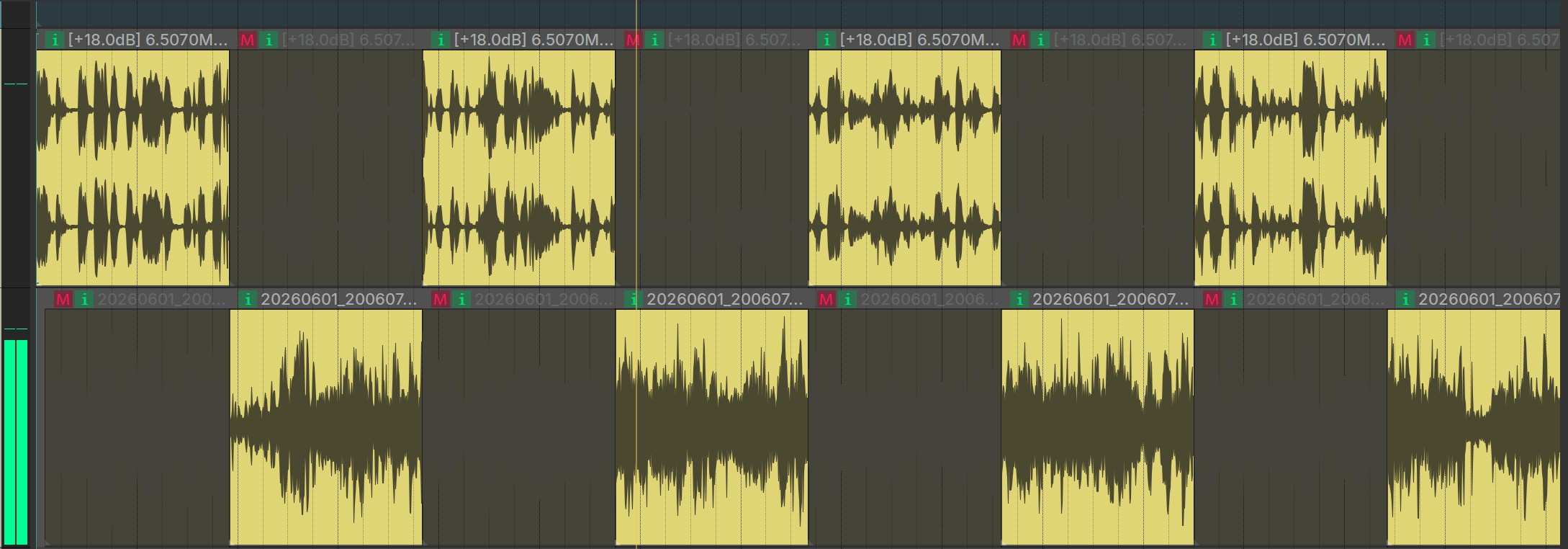
Let’s check some more distant or otherwise skinny voice signals with the Icom and what difference the NR makes on the MLite:
This is one of the most hopeless DX targets in my neck of the woods: ZKAK aka “Auckland VOLMET” in New Zealand on 13282 kHz with its mumbly, monotonous modulation. You usually only hear that it’s there but hardly understand a word unless the condx are really outstanding. The radios take 5s turns and the Icom starts, the MLite responds without NR.
Same as above with the MLite’s NR turned on and showing its limits with all the racket going on on that channel in the first half of the clip. The second half is better, but with that modulation, it’s still hopeless.
PY2ERC (from Brazil) replying to a call from an UNID station, on the Icom and the MLite without NR. The second part shows the Icom again and the same passage on the MLite with NR on.
German special call DF40ABF from 300km south received with some backscatter or something, DXing with European stations, 5-second chunks with the Icom as reference and the MLite’s NR making Europe sound as transparent as it should be.
VMW Wiluna Radio in Western Australia, with the Icom and the MLite in 5s turns, is notoriously weaker than VMC in the East, which is following next:
VMC Charleville with the Icom and an almost fully quietening MLite.
This clip has the Icom throwing its NR into the ring. In comparison, it sounds more like it’s just painting the noise in random, darker colors, and the loss of treble range is hurtful. Icom, are you listening?
Some of the louder broadcast stations I recorded for the comparison. Please refer to the other article for more NR examples with broadcast signals; they’re just without the Icom as a reference.:
Radio Exterior de España in the 16m-band with a fairly loud and nicely consistent long path echo (around 160ms, that really went around the globe). First, the Icom and 5s, later the MLite without NR, from there it’s the Icom again and the MLite with NR. This may be “only” Spain in 2,000km distance but the echo went more like 40,000km.
WRMI on 15770 kHz: Commercials on shortwave are a completely new thing to me, and I find this one strangely out of touch. But it had a nice groove to it to compare the same verses received on both radios, starting with the Icom
Radio New Zealand on a somewhat unstable 19m frequency, 15720 kHz. This one starts with the MLite without noise reduction, followed by the Icom, and then they take turns with the MLite and NR at “20” or so. RNZI is another station frequently coming in “long path” and “short path” simultaneously here, and it does a little in this clip.
What about the noise?
As I wrote in my first article about this radio, I found it a bit on the noisy side compared to my Belka, not really bad, but it was noticeable. Yet nothing seemed wrong with the performance of the radio; it animated me to use it a lot, and the noise reduction made it easy to forget that noise all the time. How can one radio have the same sensitivity and appear noisier than the other at the same time?
Radio France Internationale from Issoudun with fluttery fading on 16m, first the Icom and the same passages again with the MLite.
Too bad the Icom’s recordings have everything above 4kHz cut off, including all of the hiss every radio has there. But the MLite does indeed have some more noticeable hiss than the Icom in the upper mids, and the speaker characteristics make that even more prominent, not to mention that the first tests were on the whip and its preamp, adding more noise, so my first impression was a bit as if a cute little puppy wagging its tail had jumped on my lap with muddy paws. The actual difference assessed in direct comparison with the Icom shows that it’s just a bit of dust, though. I hope I have sufficiently demonstrated that any extra noise doesn’t seem to have its origin in the input stages. Of course, you’re never stuck with any extra noise; you can fix that with just minimal doses of NR:
The same, but with the MLite gently dusting off the signal with NR Level 10 or less.
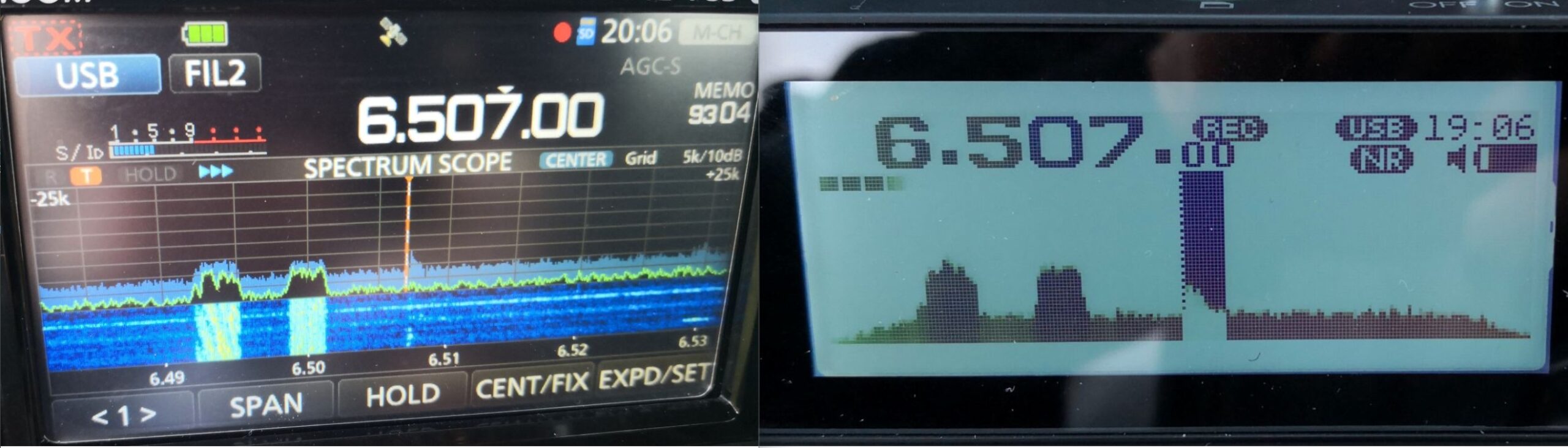
VMC Australia’s 6 MHz channel
Now the IC-705 is not the very best receiver in the world and only the second best in the “portable transceiver” category, but it lives among the current top-performing ham transceivers (they’re all SDRs) and compares pretty well to more expensive radios in terms of sensitivity and noise floor. Two Russian channels have measured the MLite’s sensitivity around or better (auto-dubbed from Russian, sigh) than 0.2 microvolts, and I’m happy to confirm that this is not made up, it’s close to the Icom’s specs (0.16microvolts).
As for the noise reduction and what it can do and what it can’t – this little miracle and the good sensitivity may explain the strange attraction (not only) I seem to have to this radio: It already made listening to SW broadcast programs a thing for me again after 40 years, because hearing the stations popping out so undisturbed reminds me of ye olde happy days with comparatively insensitive and chunky radios and nothing but blowtorch transmitters filling the bands. When the gross inverter noise at home dies off a little in the dark I can at least listen to parts of MW, 40 and 80m in full comfort and enjoy it almost more as if my QRM situation would be still on pre-pandemic levels. I found very few situations in which it wasn’t at least a bit of a help and I don’t mind having it on all the time.
25m band scan with directly recorded audio and one-third noise reduction. Antenna is a magmount CB antenna on the car roof. There’s a little demonstration of how the noise reduction can help make offset tuning a viable alternative to SSB/ECSS reception (because tuning away does not increase the noise) at the end of the video.
Barring LW/MW, I already found this radio a surprisingly competent portable on the whip, but I didn’t expect the outcome of this comparison. It may not mean much for everyone, but I adore well-made and well-performing things in general, and I was asking myself what a radio like my IC-705 could do with a noise reduction that good, and there I have my answer: It would make me love it, and that’s exactly what it does!
73, Ollie (13dka)
Oh my word, someone finally answered Mangosman’s prayers: FW 1.6 will apparently bring direct DRM decoding. The first “proper” (enthusiast/hobbyist grade) radio with DRM built-in is something, particularly when I consider that it’s also the first radio of this kind with a “proper” DNR to make DRM almost a moot point, and one of the first non-geek-grade SDRs out there utilizing the superior principles in a rather utilitarian format. I think it becomes hard to deny that this radio has some milestone character. 🙂
Gonna cancel my inquiry about the vaporware Grove N-88 ?
Thanks Ollie,
a fantastic description and recordings for those of us who love to listen…
I don’t have the Mlte yet, but I intend to buy one after your experiment…
Best regards and happy listening, dear friend.
Giuseppe Morlè from central Italy on the Tyrrhenian Sea in Formia.
Thank you Giuseppe! I have to run so many more tests with different antennas because the odd input structure of this radio (with the low impedance and ‘high impedance with preamp’ inputs) and its gain reserves seems to make it particularly apt to play with very lossy antenna designs. 🙂
FW 1.5.8.:
Most if not all conventional radios with “selectable sideband” sync detectors switch to the narrow filter or SSB filter slot, which may be one of the ways how the (mostly!) myths about sync recovering weak signals came into existence – reducing the bandwidth means increasing the SNR.
The MLite just applies the same bandwidth (you used for both sidebands) to the remaining sideband, which has the big advantage of the sound staying absolutely the same. The downside is in theory that the SNR does not improve this way, so you’d have to switch to a narrower filter maybe if you want that. Of course, the MLite has the noise reduction so you really don’t need to lose treble frequency content and sacrifice intelligibility to get a better SNR, which you certainly noticed is a pretty harsh contradiction.
The new RADIO SET menu item page 2 item [5] “Activity timer” may appear a bit scary for the faint-hearted: When the radio turns itself off it is supposed to go into some kind of battery-saving coma. It does, and that coma is so deep that I have to turn off the mechanical switch and count calmly to 20 before I can turn it back on. Apparently there’s still enough juice in the system that the watchdog circuit doesn’t die for a while in which the owner may think he has a bricked radio that doesn’t turn on anymore. 🙂
FW 1.5.8. also brought a few new bugs:
– The airband frequency synthesis is no longer processing the 8.33 kHz channel spacing correctly
– The convenient “long press” logic of the [B] and [C] keys is broken, it still takes you to the menu items but it also toggles SQL or NR off and requires you to hit the menu key [5] or [4] after that anyway. I know that people had problems understanding the previous logic (long press only while the function is activated) but this new logic does not provide much of a shortcut anymore.
13dka,
It is a pity it does not have DRM decoding for Radio New Zealand
Alan
Hi Alan,
Thank you for your comment, I was thinking a lot about this one, tbh I’d be quite curious about the outcome of a shootout between an appropriate DRM rig (maybe the AirSpy?) and the MLite being able to keep the signal clear until it really drops below the sensitivity threshold. I think that could be a case of “careful what you wish for” but of course that doesn’t mean the capability to receive DRM wouldn’t be a nice thing to have. 🙂
Hello Ollie, thank you very much for this extremely detailed comparison 🙂 This took a LOT of work. Absolutely fantastic! I am now convinced and will order the MLite. I mean, I really try hard to constrain my Gear Acquisition Syndrome. But I haven’t found the perfect radio yet. The Belka (at least my Belka V3) has too many birdies and recently, I have also found out that it has mirror signals at the higher shortwave frequencies. Today, I have received 5 signals with clean audio on the 11m broadcast band that don’t exist there. And I was just using a 5m vertical antenna, so that should not overload the front end. Despite the Belka’s weaknesses, my current favorite combination is to use the Qodosen DX-286 for AM broadcast and the Belka V3 for SSB ham bands and utilities. I do not have a Icom IC-705 but I have a Xiegu X6200 and an Elecraft KX2. But the Xiegu has horrible software/firmware and the Elecraft has mediocre AM implementation. I was thinking about buying a IC-705 or a Yeasu FTX-1. Or just always carry a laptop and an Airspy HF+ Discovery. But I am listening to shortwave at least 95% outdoors in locations specifically selected for their low noise floor (there are some nice locations for this in Emsland area). And I want/need a lightweight setup that I can easily carry because I do not always take the car but go by bike or by foot. Carrying a laptop is not preferred unless I go by car. And it seems the MLite could actually fit very well for this use case.
Thank you, Sebastian. Putting up antenna and everything for 2-3 hours until radio and the software drained the laptop battery was why I bought the Icom. 🙂 The MLite seems to be like a no-brainer if you already have 2 TRX but of course it has a few issues too – I think I already mentioned the birdie on 18144 and there are still occasional hiccups that require a restart of the radio, like when the 40m ham band is suddenly 9 meters longer and on 6 MHz. 🙂
Sorry to hear about your issues with the Belka. I have to admit I haven’t used the v3 much on external antennas even though I always use it on my walks, at least 1-2 hours every week when the weather permits and for that I often tune to something on 40 or 80 where I usually don’t even need to extend the whip more than 2 or 3 segments on these bands.
Sometimes, when the conditions are elevated things can get a bit crazy even on the whip here at the dike tho, like some imaging on the upper 20kHz of the 40m band but that belongs to a general problem I encountered with any radio at the dike and my first RSP really struggled with that when I still ran wires at home – when 49, 41 and 31m bring some extra fat signals from Romania, Turkey and China and everyone else beaming towards Europe in the evening, intermodulations appear on some days and only for that peak in being the broadcast target so it may last for 1-3 hours only, That’s what attenuators were invented for and makes the lack of one in the Belka hurt a little. 3 resistors in a little BNC adapter would fix that, or coiling up 3 of the 5 meters of wire. 🙂
Short list of actual, permanent birdies found with the 3.5mm adapter plugged into the antenna jack (to turn off the whip):
4824
12000
18144
17550
24000 (USB clock)
Of course I may have missed one or more, and that doesn’t include a few very weak birdies that will drop under the noise floor as soon as an antenna is connected. Weak and pseudo birdies seem to show up more towards the lower end of the coverage range but what happens in many cases is demonstrated f.e. on ~2537 kHz, the birdie shows up there strong…while you’re tuned to 2539 or so but it disappears when you actually tune down past that frequency.
Hi Ollie, thank you very much 🙂 This is a pleasently short list of birdies 🙂 Currently still waiting for the MLite-880 to arrive 🙂
Yes another excellent article thanks. What is notable about the MLite is the rapidity with which firmware updates are coming. Credit to the Malahiteam for doing this — a bit more of a delay if one waits for the Elecevolve team to assess and formally post updates.
Thank you Dan! Yes I’m looking forward to 1.5.6. or whatever it will be that brings sideband sync. Sync , NR and the steep filters are making this quite a beast of a broadcast receiver.
I have a mixed record with firmware upgradable devices tho, teaching me that it’s always best to buy stuff for what it can do now and not for what I think it should be able to do by next Tuesday, and sometimes your pet peeve never gets fixed. The start with this one is very promising tho! 🙂
Thank you, Thomas!
I think many of us may have had a moment playing with some noise reduction doodah when the stars and all the parameters aligned well and you thought “yeah that’s nice”, fully knowing that this was just a fluke and wishing it could be always like that. Even if you had that kind of “vision”, you may still have no idea what that means until you actually experienced it. The only radios with the capability to demonstrate that so far were the regular Malahits and they definitely impressed their owners as you can tell from the reactions but it feels a bit like few people are perceiving that as a game changer.
A lot of it has likely to do with bad experiences, distrust and simply habits, I guess. I tend to be conservative about innovations myself but if it is an integral part of the radio and capable of actually improving it on the “wrong end” for the right reasons, it is maybe something that everyone including the rest of the industry should know about. I’m an audio engineer by trade, I’m into music synthesizers and the physics of sound and music and that’s probably giving me a different view on the significance of a NR that more or less just works. But I think everyone in communications will understand that it’s a win when that one station you like to talk to coming in with S3 stops having the tiring noise giving you a headache after an hour. Yet many people have no idea that losing that noise is even an option and I had no idea there is something out there that’s not a headache in itself and that could do that without turning the signal into a complete mess. You know, something that works in the level range between “too strong to ignore” and “too unpleasant to listen to for long” you find in any kind of radio coms.
That is something one could politely ask their favorite radio makers to aim for as well, and then hope they outdo their competition in that. 🙂
73s my friend! 🙂
Ollie
Another tour de force, Ollie! Thank you for taking the time to put together your thoughts, your audio clips, and your full assessment.
I agree that it would be brilliant if the ‘705 possessed a stronger, more capable, and adaptive NR feature. It’s funny, but I feel like NR these days on ham radio gear is almost an afterthought…perhaps a feature they know is needed (since the competition has it), but not one they actively work on as they do with other types of filtering innovations.
I’ve yet to buy an Mlite, but I know I will. I’ve been so heavy into the ham radio QRP side-of-things, I simply haven’t had the time to take on the Mlite. It’s funny, but in comparison (and your reviews are proof of this, in my book) receiver reviews are three or four times more difficult to prepare than a transceiver review. Comparisons are nuanced and so many factors make it difficult to make apples-to-apples comparisons. I must say, though, that you are very much a pro at this and I truly value all of the time and effort (and fun!) you put into this!
Thank you, Ollie!
Cheers,
Thomas
Sigh, one of these days I will learn how to use the comment function properly. Or a keyboard. 🙂