Author Archives: Thomas

Our New Shortwave Radio Index

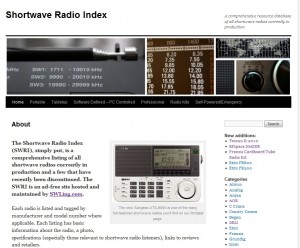
The Shortwave Radio Index contains over one hundred shortwave radios currently in production.

We’re delighted to announce a new website in the SWLing.com family: The Shortwave Radio Index (SWRI).

The SWRI is a comprehensive database featuring all known shortwave radios available on the market today. Each post contains a photo of the receiver, links to retailers, links to reviews, specifications, and a brief summary of the featured radio’s capabilities. What’s more, each radio is tagged and categorized so that it is easy to find and compare to similar models.

Keep in mind, the SWRI is a work in progress; as new models appear on the market, we will be adding them.  If you become aware of a review or retailer not included in our database, please contact us to share this information.

Happy browsing!
The new RFspace NetSDR–limited availability Feburary 10

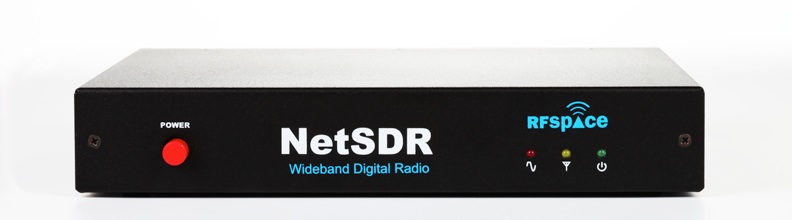
The RFspace NetSDR wideband receiver

The new RFspace NetSDR has been announced on the RFspace website and Universal Radio is already accepting orders. According to RFSpace, they will have limited availability on February 10th 2011.

Based on the NetSDR’s specs, it appears that this will be a very robust and high-performance SDR. RFspace is touting that it’s fully plug and play and designed to be integrated with your home network and the internet.

We will post all updates about the NetSDR here and on our new Shortwave Radio Index website  (click here for the RFspace NetSDR entry).  When available, we will also link to relevant reviews in the SWRI entry.

RNW adding more shortwave broadcasts to Egypt

Radio Netherlands Worldwide has announced that it is increasing shortwave and satellite broadcasts into Europe after Egyptian authorities shut down internet and mobile services.

The new shortwave times/frequencies are:

  • 0600-0700 UTC on 9830 kHz
  • 1600-1700 UTC on 5955 kHz + 9750 kHz
  • 1730-1830 UTC on 11615 kHz + 11655 kHz

For the full story, please read RNW Media Networks’ post.

BBC World Service budget cut by 20%

The BBC Bush house

This is a sad week for fans and listeners of the BBC World Service.

According to news reports, the British Foreign Office has cut BBC’s World Service budget by 20%, resulting in sweeping reductions in their shortwave service. As many as 650 jobs will be lost by 2014 and cancellation of shortwave service in five languages and several countries. It appears they are cutting SW service to China, Cuba and the Balkans, instead relying on mobile phone & internet access (note that according to Keith Perron, the BBCWS Chinese site has been blocked for 10 years and in Cuba less than 1% of the population have access to the internet).

My real fear is that listeners who rely on the BBC WS via shortwave–those who live in rural, impoverished countries, for example–will have no voice to express the loss of a lifeline of information to them. It’s quite easy for us to forget that the internet and mobile technologies have not yet penetrated these “markets” and that shortwave radio is the most effective and affordable means to receive high-quality news and information.

As The Guardian put it, the BBC WS will be “eclipsed” by Voice of America. I certainly hope that the VOA can give its markets better service stability.

More on the BBC World Service cuts:

Thanks to Kim Elliot, Keith Perron and BernieS for their commentary.

Radio As A Force For Peace

Jocelyne Sambira

In many countries ravaged by war and violent conflict, radio is sometimes the only way of getting information. In most of these regions, there is little or no infra- structure and when people are on the run, it is sometimes the only link to the world they have left behind.

This inspiring article written by journalist, Jocelyne Sambira for we_magazine shows how radio broadcasts and journalism, in general, bring listeners clarity in the midst of chaos.

Read “Radio As A Force For Peace” at we_magazine’s website.

Radio Slovakia International to continue shortwave broadcasts to Caribbean and Latin America

(Source: Southgate Amateur Radio Club)

A last-minute agreement between Radio Slovakia International and Radio Miami International (WRMI) will permit the international radio station of Slovakia to continue its shortwave transmissions in English and Spanish to the Caribbean and Latin America.

Radio Slovakia International had announced that its shortwave broadcasts would end on 31 December 2010. However, WRMI will be broadcasting RSI’s programme in English at 0130-0200 UTC Tuesday-Saturday and RSI’s Spanish programme at 0330-0400 UTC seven days per week. Both of these transmissions will be on 9955 kHz with 50 kW of power from Miami using a beam of 160 degrees directed to the Caribbean and Latin America.

“We are glad to be able to help Radio Slovakia International continue its shortwave transmissions to this part of the world,” said WRMI General Manager Jeff White. He added that listener reports will be appreciated and will be verified with a special WRMI QSL card commemorating the Radio Slovakia International relay.

Reports may be sent to Radio Miami International, P.O. Box 526852, Miami, Florida 33152 USA, or by e-mail to [email protected].

2011 WRTH: A Look Inside

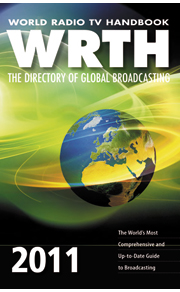
Last week, I received a copy of the 2011 WRTH, and enjoyed a most welcome read over the holiday weekend.

I always look forward to the newest edition of the WRTH. I find that, even in an internet world, and especially now in the absence of the much-mourned Passport To World Band Radio, WRTH’s radio reviews, feature articles, and HF report make for excellent reading.

This year, for example, WRTH reviews several ultralight radios (the Tecsun PL-310/380, Kchibo KK-D6110 and the Kaito/Degen 1103), as well as the AOR AR5001D, the Flex 1500, the Winradio Excalibur (hint: they really like this one), the Medav LR2 and they also take a look a look at several classic pro receivers. They offer their digital update, articles on QSLing, a feature on the worthy radio charity, Ears To Our World, and much more.

But, of course, the reason we all buy WRTH is for their in-depth comprehensive radio schedules for the upcoming year. Personally I can’t do without it–it’s never more than an arm’s length away from my shortwave.

Purchase your copy of WRTH directly from WRTH’s publishers, or from a distributor like Universal Radio (US) or Radio HF (Canada).

If you’re new to WRTH, note that they regularly update changes to their schedules throughout the year:  go to their website to download these updates.

If you would like to know more about using WRTH’s schedules, please see our previous post.