Shortwave listening and everything radio including reviews, broadcasting, ham radio, field operation, DXing, maker kits, travel, emergency gear, events, and more
Many thanks to SWLing Post contributor, Eric (WD8RIF), who notes that the 29th episode of TX Factor was recently released. Here’s the show summary:
Welcome to our new episode!
TX Factor Calling – TX date 8th July 2023
We’re beaming (almost) live across the airwaves with microwatts of broadband energy to bring you the long-awaited show 29 of TX Factor. In this programme we increase the power to a few tens of Watts when Bob, Dave and Noel head to the Wiltshire hills with a pair of Icom IC-905 all-mode transceivers to see what can be achieved.
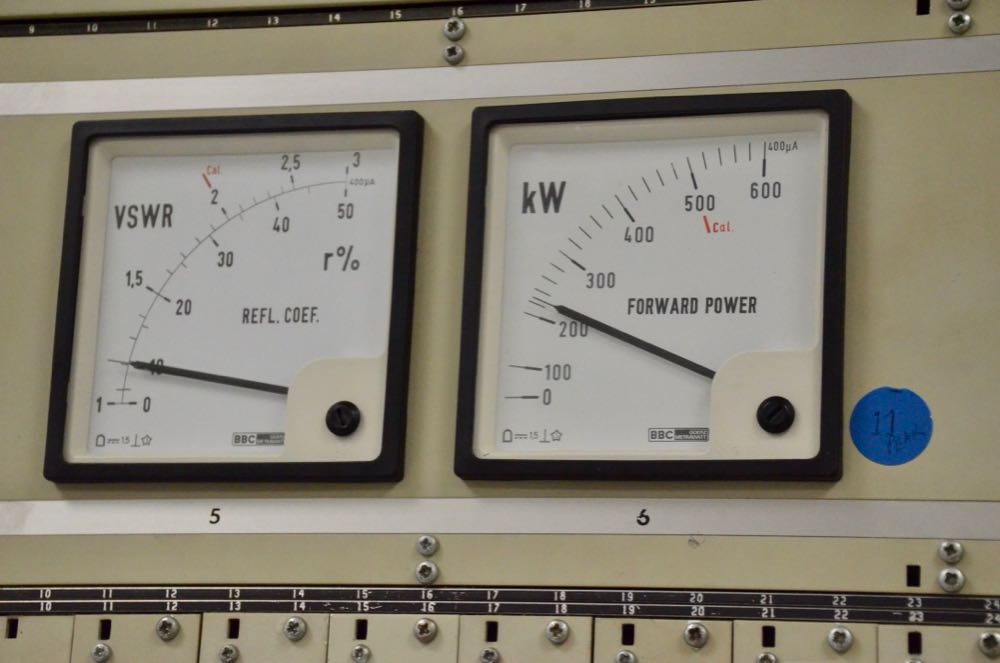
Bob takes the TX Factor cameras to the heart of England to the UK’s last remaining shortwave transmission station and ramps up the power to a staggering 250 kilowatts. Woofferton, near Ludlow, is the home to some venerable Marconi senders from the 1960s still beaming programmes across the globe.
Oh, and there’s a free-to-enter draw – details below.
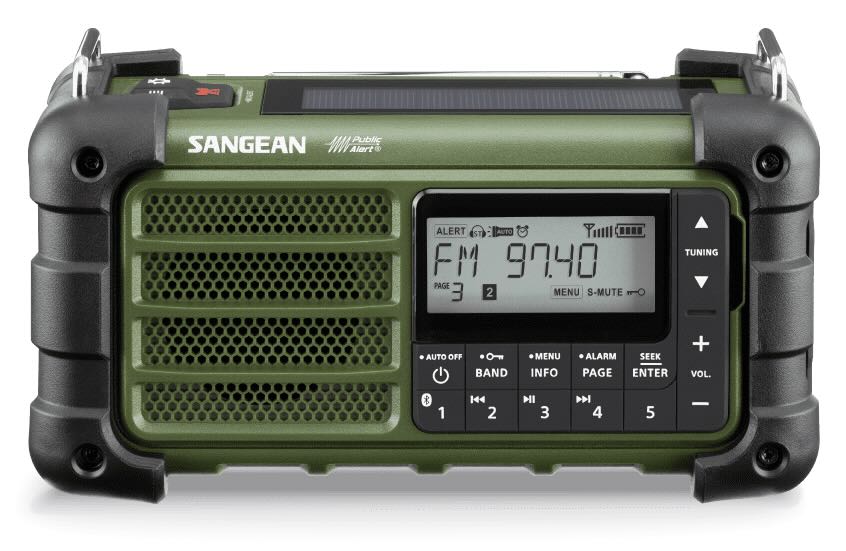
Sangean MMR-99 which is the UK version which is AM in the MF band for 9/10 kHz channel spacing No Low Frequency (LW) band.
Sangean MMR-99 DAB which is interesting because it is typically DAB+/FM no AM or Weather Band.
Your posters around the world may wish to review this radio which is available on line and in retailers.
Thank you for the tip! Impressive that MMR-99 is IP55 rated and ruggedized. I like the fact they’ve also made regional variants of this radio even including DAB.
Many thanks to SWLing Post contributors, Troy Riedel and Jock Elliott, who share the following news items from Spaceweather.com:
RADIO AMATEURS HACK A NASA SPACECRAFT:Ham radio operators are picking up a strong signal from space. It’s NASA’s STEREO-A spacecraft returning home after 17 years.
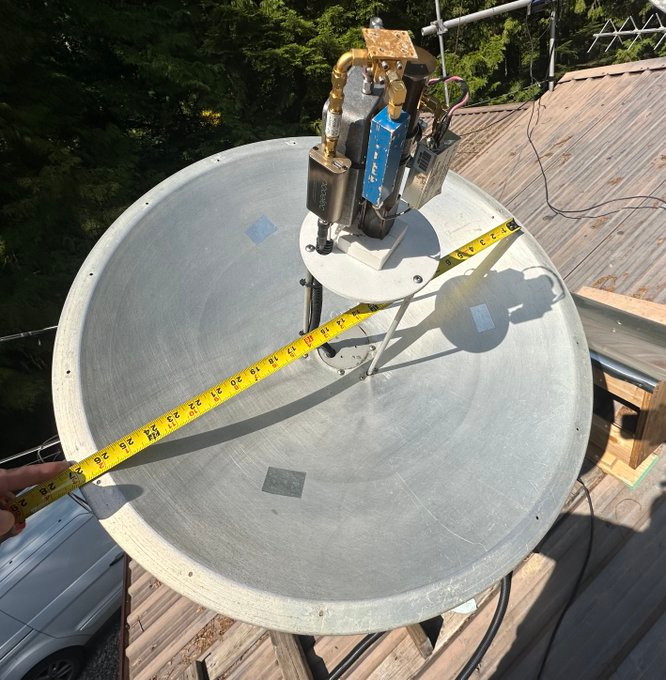
“I’m having fun with STEREO-A,” reports Scott Tilley (VE7TIL) of Roberts Creek, British Columbia. “The spacecraft is coming close to Earth this summer, and I can now receive its signal using a small 26-inch dish in my backyard.” Here is what he picked up on July 2nd:
“We caught an X-flare in progress,” Tilley says. “Naked-eye sunspot AR3354 was really crackling.”
STEREO-A left Earth on Oct. 26, 2006, launched from Cape Canaveral with its sister ship STEREO-B. Both spacecraft were on a mission to the far side of the sun. Over the years, they would circle behind behind the sun, beaming images back to Earth so scientists could make 3D models of solar activity. In 2014, STEREO-B failed and was not heard from again. STEREO-A kept going, and now it is on its way back. [Continue reading at Spaceweather.com…]
Also…
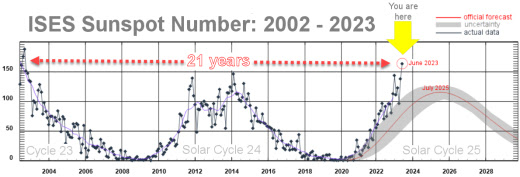
SUNSPOT COUNTS HIT A 21-YEAR HIGH: The sun is partying like it’s 2002. That’s the last time sunspot counts were as high as they are now. The monthly average sunspot number for June 2023 was 163, according to the Royal Observatory of Belgium’s Solar Influences Data Analysis Center. This eclipses every month since Sept. 2022:
Solar Cycle 25 wasn’t expected to be this strong. When it began in Dec. 2019, forecasters believed it would be a weak cycle akin to its immediate predecessor Solar Cycle 24. If that forecast had panned out, Solar Cycle 25 would be one of the weakest solar cycles in a century.
Instead, Solar Cycle 25 has shot past Solar Cycle 24 and may be on pace to rival some of the stronger cycles of the 20th century. The last time sunspot numbers were this high, the sun was on the verge of launching the Great Halloween Storms of 2003, which included the strongest X-ray solar flare ever recorded (X45), auroras as far south as Texas, and a CME so powerful it was ultimately detected by the Voyager spacecraft at the edge of the solar system.
Reception reports will be confirmed again with a special QSL card.
Reception reports can be sent by e-mail to [email protected].
via the online form https://de.rti.org.tw/index/content/id/8
or by mail to: Radio Taiwan International, German Service, P.O. Box 123-199, Taipei 11199, Taiwan
Many thanks to SWLing Post contributor, Benn Kobb, who shares the following announcement:
The FCC has opened for public comment the Petition for Rulemaking of the
Shortwave Modernization Coalition.
The proposal would bring new private, non-broadcast digital stations to
the high-frequency spectrum.
As covered in Experimental Radio News, the Coalition members have
performed HF experiments over the last several years. Favorable FCC
action on the proposal would open the field to regular commercial
operations.
The FCC has assigned the petition number RM-11953. Comments are due in
30 days.
DW is now broadcasting a 30-minute daily Arabic-language radio program entitled “Sudan Now” on shortwave, Hotbird and SES-5 satellites and via the DW Arabic website.
As an unbiased radio program, “Sudan Now” will provide listeners in the target region with unbiased coverage of current issues in the region and will promote political, social and cultural dialogue through interviews, talk shows and reports.
Given the lack of independent information sources in Sudan and the limited ability of established media to broadcast due to internet outages and ongoing fighting, “Sudan Now” was specifically designed to be broadcast on shortwave and via the Hotbird- and SES-5 satellites. The satellite broadcast enables listeners in the target region to receive the program via their TV sets.
DW Managing Director Programming Dr. Nadja Scholz: “The conflict in Sudan is ongoing and has far-reaching effects on the entire region. It is absolutely necessary to provide the people there with a dedicated program that enables them to access independent, current and in-depth information. With shortwave radio, we further increase our ability to reach as many people as possible.”
Manuela Kasper-Claridge, DW editor-in-chief, said: “The humanitarian situation in Sudan remains catastrophic. There is a lack of everything – including free, independent information. This Arabic-language radio program is therefore urgently needed.”
The program broadcast will begin on Monday, June 26, 2023. It will air daily from Monday to Friday at 2:30 pm (local time, GMT+2) for a duration of thirty minutes. A repeat of the radio program will air daily at 8:30 pm.
“Sudan Now” can be heard in the afternoon on shortwave 15275 kHz/17800 kHz and in the evening on shortwave 15275 kHz/17840 kHz.
In addition, all broadcasts will be available on the DW Arabic website.
[…]Radio Ink: When Justin Sasso briefly mentioned KLMR’s story at Hispanic Radio Conference, it piqued the room’s interest. That’s a powerful AM story. How did this come to pass with you both?
Dan: So about a year ago in late July, KLMR was blown off the air from a micro-downburst. The previous owners couldn’t fix it and they were in danger of losing the license. When I saw the building, half the roof was gone and the antenna was dangling in the wind.
I’ve been in the radio business in Colorado for 40 years, with the last 20 in Colorado Springs, but I’ve never owned a radio station. And so when this opportunity came about, I reached out to Kirk. We had talked about possibly buying a company in Lamar previously. He’s not just the mayor, he’s my brother-in-law, but it was great that the mayor wanted to get involved in it too. So we’re off and running.
Radio Ink: For a mayor to step up and say, “This AM station is so important to my community that if nobody else will save it, I will,” is a huge testament to AM radio’s power and value.
Kirk: It’s vital. That’s what I had mentioned to Justin in that meeting about AM. When we look at rural Colorado and the ag market there, there’s a necessity for that. [Continue reading…]
The number of satellites whizzing by over our heads at any moment is staggering, and growing at a rapid rate as new constellations are launched. But sometimes it’s the old birds that are the most interesting, as is the case with some obsolete but still functional military communications satellites, which thanks to a lack of forethought are largely unsecured and easily exploitable. And all that’s needed to snoop in on them is a cheap ham radio and something like this simple and portable satcom antenna.
As proof of the global nature of the radio hobby, the design in the video below by Brit [Tech Minds] borrows heavily from previous work by Italian ham [Ivo Brugnera (I6IBE)], which itself was adapted to use 3D-printed parts in a German blog post a few years ago. [Continue reading…]
Many thanks to SWLing Post contributor, WD3C, who shares the following announcement:
RADIO PIRATE: The return of Big L Radio London on 1206 kHz, 24 hours a day, from July 29th to August 14th. Back with, in my pocket, a temporary license issued by OFCOM. This time Big L will be broadcasting not from a ship but from studios in a double decker red bus installed in Felixstowe’s Spa Pavilion car park on the seafront. This is an initiative of Ray Anderson, RadioFab and the Spa. Radio Caroline will no longer be the only pirate to have boarded for the 17 days of this special broadcast which will also broadcast all the hits of the years “Pirate Radio” with many famous DJs of the past!
On August 12th, catch “Roger “Twiggy” Day’s Pirate Radio Hits Show” on stage at the Spa
Pavilion Felixstowe with Dave Berry, Vanity Fare and Chris Farlowe.
Many former DJ’s from pirate station are participating in the event. August 14 marks the 56th anniversary of the adoption of the “Maritime Offenses Act”. This will be, once again, the last day of broadcast of this ephemeral radio on 1206 khz.