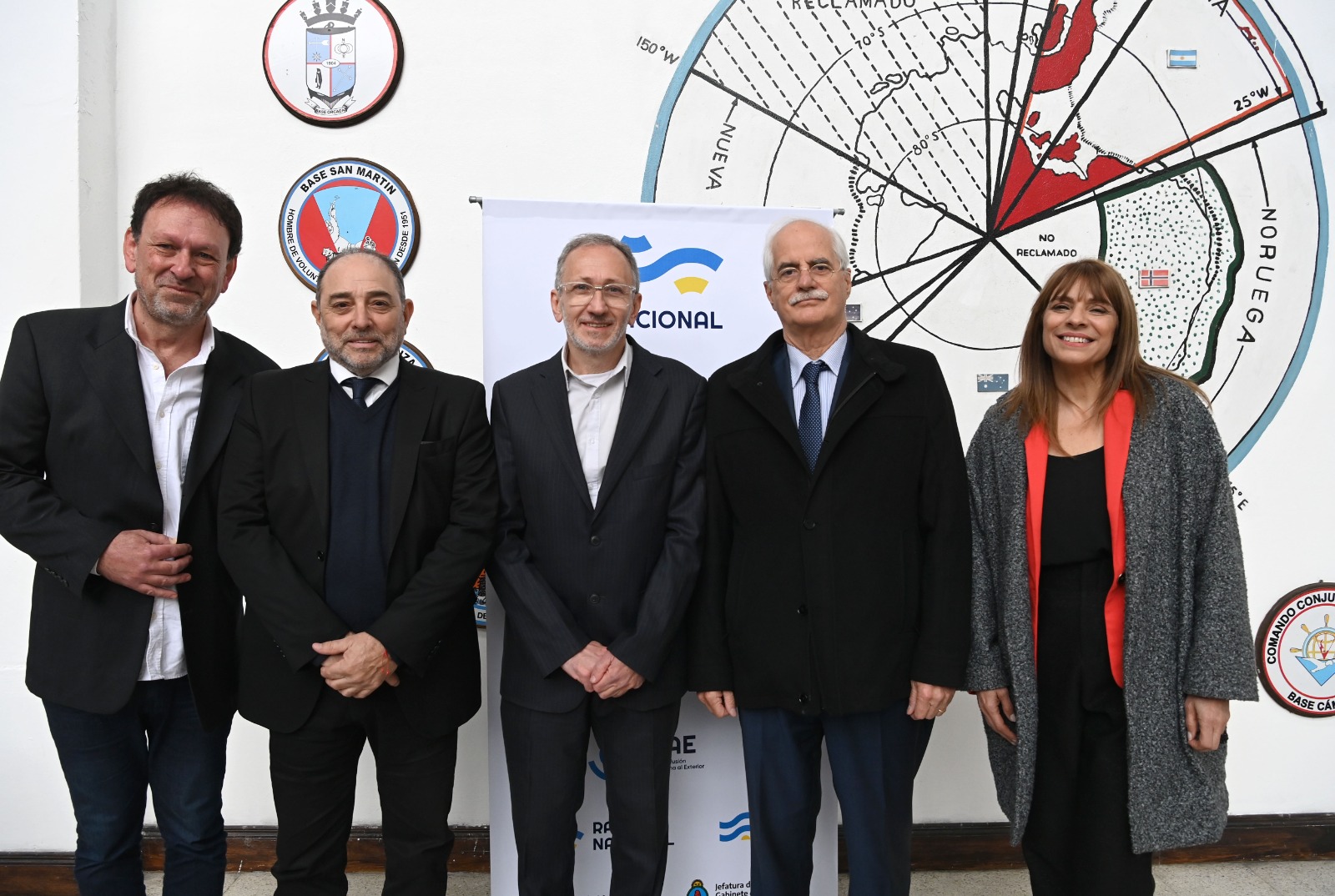
In the Photo: Adrian Korol , RAE Director , Alejandro Pont Lezica , Executive Director of Radio Nacional Argentina, Javier Gratz, donor of shortwave transmitter, Jorge Taiana, Minister of Defense Argentina Republic, and Lic. Rosario Lufrano, head or RTA (Radio and TV Argentina) during the ceremony.
Many thanks to SWLing Post contributor, Adrian Korol, who shares the following press release from RAE and LRA 36 [note that this article has been machine-translated into English]:
New Short Wave Transmitter for LRA 36 Radio Nacional Arcangel San Gabriel
Defense Minister Jorge Taiana, together with the Joint Antarctic Commander, Brigadier General Edgar Calandín, the head of Radio y Televisión Argentina SE (RTA), Rosario Lufrano, and the Executive Director of Radio Nacional, Alejandro Pont Lezica, headed a ceremony on the donation of a shortwave transmitter to radio LRA 36 “Arcángel San Gabriel”, located at the Antarctic Base Esperanza.
This action – which is part of a new collaboration between the Joint Antarctic Command (COCOANTAR) and public media entity RTA – will allow the station to significantly improve its coverage and signal’s quality, thus keeping its international reach and fulfilling the objective of disseminating the work of the Armed Forces and the scientific personnel stationed in Argentina’s Antarctic bases.
“This is an act of generosity, of solidarity with the Argentine people as a whole… it is also an act of patriotism, because it will make it possible for all of us to listen to radio broadcasts from Antarctica”, said Taiana.
For the Minister, “it is important for all Argentine men and women to have present, in their minds and hearts, that there is a part of our territory down there, and that there are Argentine men and women working hard in that continent”.
On his part, Lufrano said: “We have always said that our National Radio and Public TV must be broadcast by land, by sea, by air, and we are fulfilling that mission. It has been an honor to bring this piece of equipment on board of icebreaker ARA “Almirante Irízar” so that they could listen to all our programming, listen to our radio and watch our public television”.
In his turn, Brigadier General Calandín said: “For us it is a joy, an enormous satisfaction, to be able to show all that Radio Nacional and the Ministry of Defense have done to contribute to Argentine sovereignty in Antarctica”.
And he pointed out: “This transmitter will allow us to spread Argentine culture, all that Argentine culture means for Argentine sovereignty in Antarctica…this is essential to us”.
Javier Gratz, the donor of the transmitter, was present at the event and he stressed that the piece is entirely manufactured in Argentina.
The donation was preceded by a technical survey carried out at the Joint Antarctic Base Esperanza by Alejandro Petrecca (Head of Radio Nacional’s Transmission Plant in Pacheco) and Engineer Alejandro Alvarez, and promoted by the relationship they have with RAE (RadioDifusión Argentina al Exterior).
The event was broadcast by AM 870 and the entire public radio network throughout the country. The special program was attended by the director of Radio Nacional, Alejandro Pont Lezica; RAE director Adrián Korol; journalist Marcelo Ayala (who was in Antarctica earlier this year broadcasting from there) and hosts Mario Giorgi and Federica Pais.
LRA36 began transmissions on October 20, 1979 and since then has been operating non-stop from the Esperanza Base in Antarctica, Argentina. It is one of the most sought after stations by shortwave listeners from all over the world, and its signal has been picked up in places as distant as Alaska, Iceland, Japan, most European countries, and Latin America.
It is the only public radio station that broadcasts from Antarctica on shortwave, a characteristic that, added to the fact that it is operated by personnel of the Joint Antarctic Command, makes it unique in relation to the other stations of Radio Nacional, such as RAE.
In 2022, and for the first time, the entire LRA36 team was integrated by women only. The same happens this year and in 2024, as well.
Radio Nacional staff, teachers from the Universidad Nacional de Quilmes, RAE and the Antarctic Joint Command, under the coordination of Juan Carlos Benavente, all take part in the training of the station staff as well as in the general coordination.
Being a radio station of international scope, its goal is to disseminate Argentine culture, but above all, the work of our Armed Forces in the Antarctic bases, the scientific research work and, fundamentally, the long-running historical claim of Argentine sovereignty over this portion of Antarctic territory.
The transmitter will have a power of 10 kw and is expected to be working effectively during the Antarctic Campaign 2024.

 Many thanks to SWLing Post contributor, Ivan (NO2CW), who writes: