Author Archives: Thomas

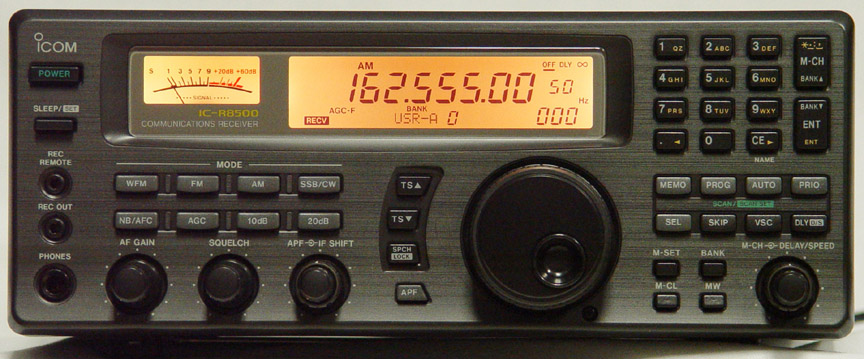
New-In-Box Icom IC-R8500s on eBay

Many thanks to SWLing Post contributor, John (KC8RZM), who writes:

Hi Thomas,

Don’t know if this is relevant to SWLing but maybe there’s others out there that might be interested in the following.

I always kicked myself not picking up one of Icom’s IC-R8500 receivers before Icom discontiued it. I know this wideband receiver has excellent reviews regarding its performance and this model was about the last of the old analog/superhet design before everything started to go SDR.

Previously, I’d thought about buying a second-hand unit, but have always been wary not knowing its past usage and prefer to buy new gear.

So was surprised to see sellers on ebay the other day listing new and unopened IC-R8500s.

One unit was listed at $2,000.00 but the seller reduced it to $1,800.00 so I snapped it up for my collection.

I think $1,800.00 is about the original price when Icom was still producing this model.

I noticed another seller offering new IC-R8500s for $2,000.00 and apparently has more than 10 available as I type this:

https://ebay.us/iUZGn5

Maybe some other SWLing readers might still wish to own a new IC-R8500 before they disappear for good. As I said, it’s the last in a long line of distinguished Icom superhet-based radios before the SDRs took over.

Best wishes,
John
KC8RZM

Many thanks for sharing this, John. I have never owned an IC-R8500, but I’ve heard it’s an excellent wideband receiver. The seller seems to offer a 30 day warranty and does indeed have a number of these in inventory. Looking through the seller reviews, they have a 97.6% rating with 1310 reviews; only one negative review in the past year. It seems they are based in Israel, but shipping is free (with normal custom delays, etc.). 

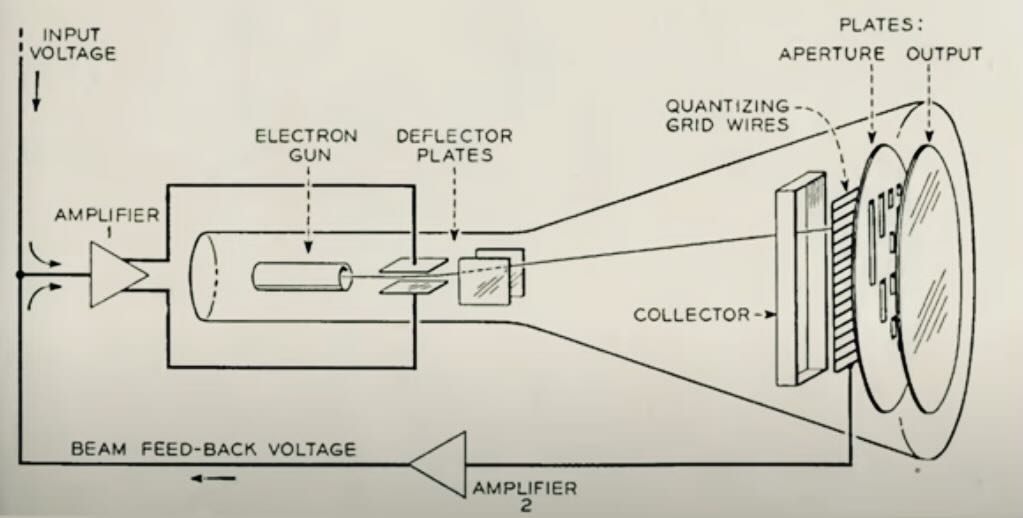
High Speed A/D Conversion in 1965, with a Vacuum Tube!

Many thanks to SWLing Post contributor, Mark (AE2EA), with the Antique Wireless Museum who shares the following:

This isn’t a SWL, or even a ham radio story, but it’s a nice technology story about a vacuum tube at the beginning of the digital age and near the end of the tube age, that I thought you might be interested in:

Click here to view on YouTube.

Kostas explores an alternative to Morse Code that’s been used in prisons, with roots in ancient Greece

Many thanks to SWLing Post contributor, Kostas (SV3ORA), for sharing the following guest post which originally appeared on his radio website:
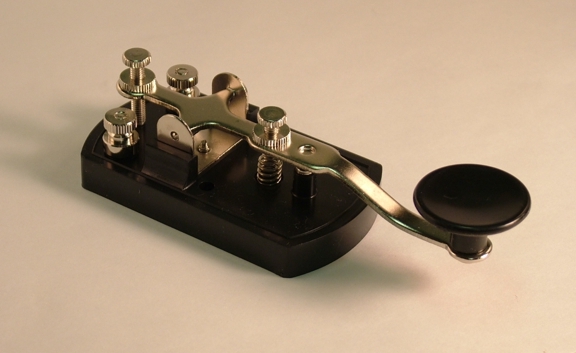

TAP: A Morse alternative mode for the HAM, with no need for training

by Kostas (SV3ORA)

Introduction

The thinking of this new mode, came to me when someone posted that he quit the HAM hobby because he did not learn Morse code and he did not want to use computers to do the job for him. Some time I faced a similar situation and I believe many do one day or the other. So I thought that I had to do something about it. It is too bad people quit the hobby or missing the fun of the KEY operation, because of the obstacle of Morse code. No matter what CW operators that already learnt Morse might say, the fact is that Morse requires patience, continuous practice and most importantly time. After all military had dedicated courses on it in the past, so it must be more than true. These are things not all people can, or are willing to do. An alternative that gives the same pleasure like Morse and operates with the same techniques, but requires no training and time must exist. Meet the TAP mode!

Mode description

This mode has its roots to ancient Greece. You may read the article in Wikipedia for more information on the Polybius square. A form of it, was used in the previous century in was times, for in-prison communication. A modified version is presented here by me, that fits perfectly the HAM radio. This modified TAP code scheme, is dedicated to HAM radio and includes the numbers and the letter “k”.
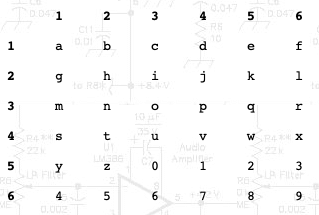
This is all you need to know in order to send and receive TAP. It is easy to follow and easy to generate on paper. This is a 6 by 6 table, with the first six alphabet letters placed in the first line, the next six in the second and so on. After the alphabet ends, the numbers are put in the same manner. Thats it!

Sending TAP

It is better to describe the sending procedure with an example.
To send the letter “i” you send two dots (“i” is on the second row), wait a bit and then send 3 more dots (“i” is on the third column). In other words, you first count the number of rows where the letter exists, then wait a bit and then you count the number of columns where this letter exists. Before sending the next letter, leave a bit of more time, so as to distinguish that this is a separate letter and not the time between rows and columns. Thats it!

Try it now without any transceiver! Write the TAP table on a piece of paper (you do not need to write the row and column numbers), or read it from the website. Tap on your desk with your finger and send some words to the colleague near you. See how easy it is?

There are actually four spacings involved. The spacing between adjacent dots, the spacing between the row and the column, and the spacing between letters and the spacing between words. Follow the PARIS spacing, like Morse code does, if you intent to write a software for it. However, in practice, manual operators would need to consider just two spacings, the spacing between rows and columns and the spacing between letters. These are the most important. Just make the one bigger than the other and communication should be achieved without problems.

Receiving TAP

It is better to describe the receiving procedure with an example.
To receive the letter “i” you listen two dots (“i” is on the second row), then a short scilence time and then listen 3 more dots (“i” is on the third column). In other words, you first listen for a number of dots (this is the row where the letter exists), then sense the scilence and then you listen for the next number of dots (this is the column where the letter exists). The scilence time between two letters is greater than the scilence between rows and columns and this can be distinguished easily. Thats it!

Try it now without any transceiver! Write the TAP table on a piece of paper (you do not need to write the row and column numbers), or read it from the website. Put your coleague to sent you some TAP words and you should be able to decode them by counting the rows and columns in the TAP table.

A programmer that may need to implement the mode in software, should follow the PARIS spacing to distinguish the different parts of the code, as described above.

TAP advantages

Here are some advantages I can think, of TAP in comparison to Morse.

  • No training is required, start using it imediatelly, even by non-HAM people and kids. This probably is the greatest advantage and this is why most would want to use TAP in HAM radio.
  • The encoding/decoding square can be drawn easily, it is very easy to remember how to draw it.
  • Decoding by hardware or software means, becomes very easy, as there are no dashes to account for. Dot lengths can be anything and can be even varying from dot to dot, it does not matter.
  • All you count, is how many ON-states (taps) there are and the rough timing between them, to decide between a row-column or a letter. Because of this intependency from dashes, the code can be used on any means, radio, light, pipes, walls, desks etc.
  • If dot lengths are kept very short (up to the point where channel noise allows it), RF amplifiers can be pushed beyond their limits (due to limited duty cycle), or otherwise run cooler within their limits. There are some mediums, like light communication, where bright pulses of light can be produced easily (eg. xenon tubes), but not kept for duration and TAP is ideal on them.

TAP disadvantages

Here are some disadvantages I can think, of TAP in comparison to Morse.

  • Speed limit issues probably. TAP beginners achieve for sure faster speeds than Morse beginners. However, a trained Morse HAM, can achieve greater speeds with Morse.
  • Learning the table by heart, can be tricky in comparison to Morse. However war prisoners had tricks to learn by heart the 5×5 TAP  square.
  • Not known (yet) among the HAM community, like any new mode. Why not change that by let HAMs know about it?

TAP common points to Morse

There are some common points shared between TAP and Morse code.

  • Both are relatively slow modes.
  • Both are ON/OFF keying modes, efficient class-E amplifiers can be used.
  • Both share the same channel bandwidth and noise-related characteristics.
  • Both are human-oriented, although TAP does not require training. Both share the PARIS timing when implemented in software.
  • Both allow for the “joy of the KEY”. You send TAP with the same equipment as Morse.
  • Both are ideal for homebrew QRP, due to efficiency and transceivers simplicity.

Introducing the new SWLing Post Message Board!

Friends, I’d like to share some good news with you!

The short version:

I’ve created an SWLing Post discussion board that anyone can join, free of charge, at SWLing.net.

My hope is that this will be a spot for community members to get quick answers to questions and connect with other like-minded operators.

Everyone is welcome and this board is already populated with a number of moderators who will make sure that all questions–no matter how simple–are welcome. Trolls and rude people will be weeded out.

I would encourage you to create an account and check it out: http://swling.net

The long version:

In the past, I’ve mentioned in posts that email from readers and subscribers (of both QRPer.com and the SWLing Post) has increased to a point that I can no longer keep up with them. It became very evident when I went camping in West Virginia last month and came back home to find no less than 60 messages in my inbox. These 60 messages were all ones needing some sort of reply or acknowledgement–they didn’t include notifications and SPAM.

I take pride in replying to each and every message I receive, but sadly I can no longer keep up with the volume. Sadly, I don’t have enough time especially with my busy family life.

In fact, I realized recently that replying to emails is actually taking a large bite out of the time I have to do content creation. I can’t let that happen, because that could quickly lead to burn-out. Both of my sites are pure labors of love and I enjoy them immensely. Continue reading

A little off-line, off-grid camping

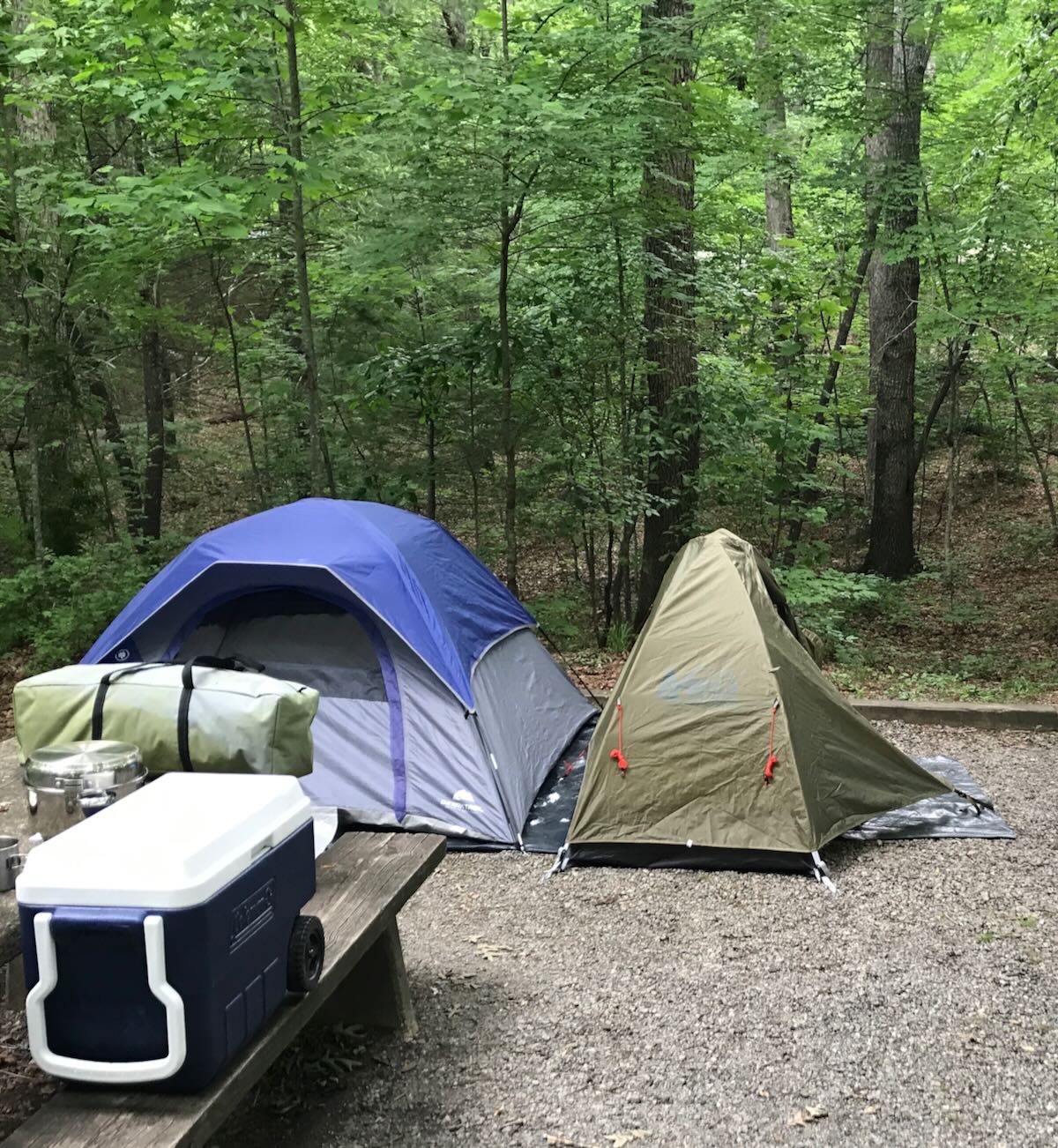
You might have noticed a lack of posts this weekend and that would be because I was completely off-grid and off-line, camping with two good friends in Pisgah National Forest.

It was brilliant, actually. I got to hang with friends I’ve known for over 30 years, test my new one person backpack tent (a.k.a. the “Bear Burrito”–the one on the right above), and of course I played a bit of radio.

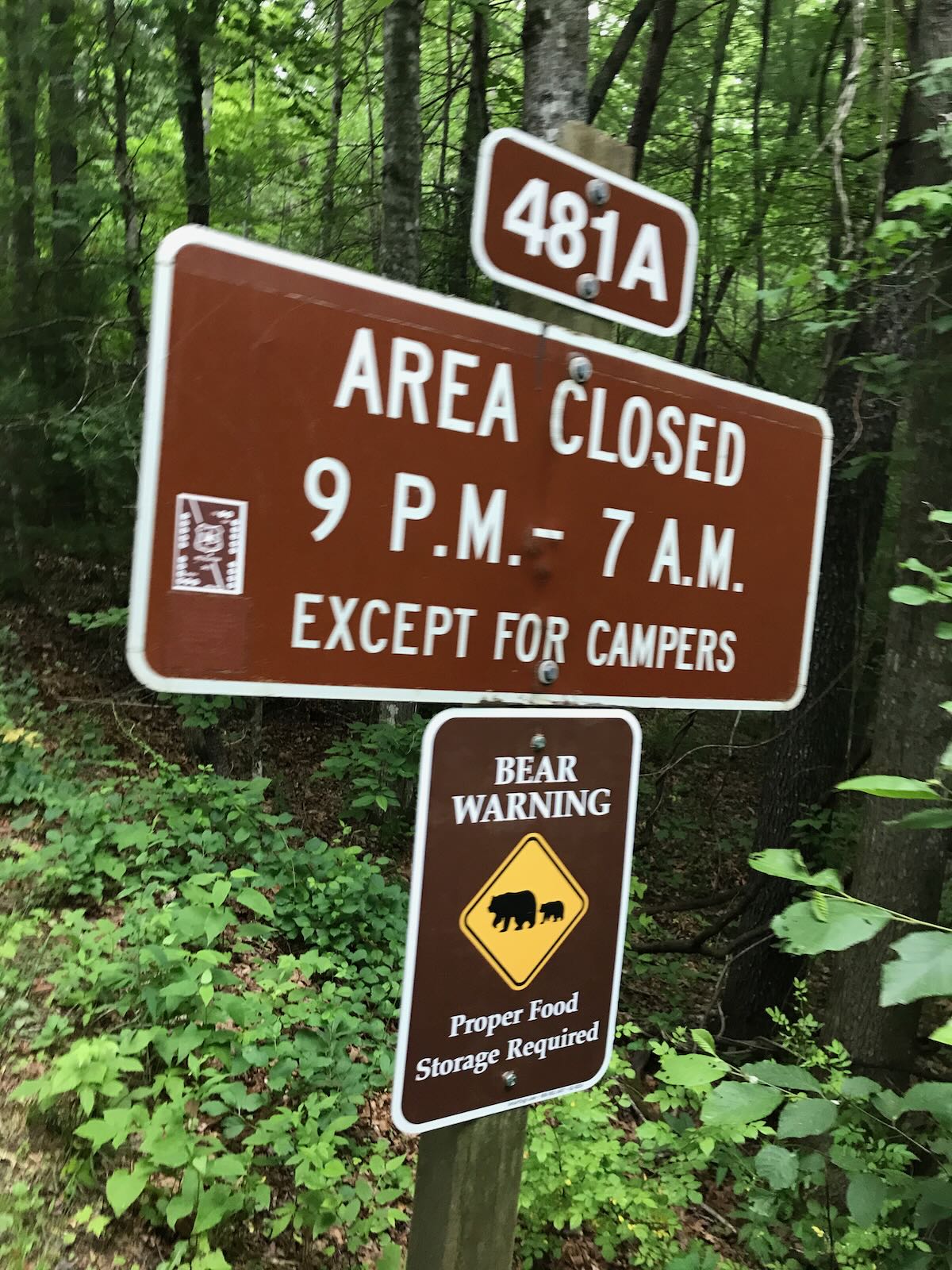
Black bears are a fact of life here in the mountains of western North Carolina and we spotted three hanging out within 25 meters of our campsite.

By the way: the trick when camping with bears? Don’t put food in your tent, else that whole “bear burrito” thing becomes a reality.

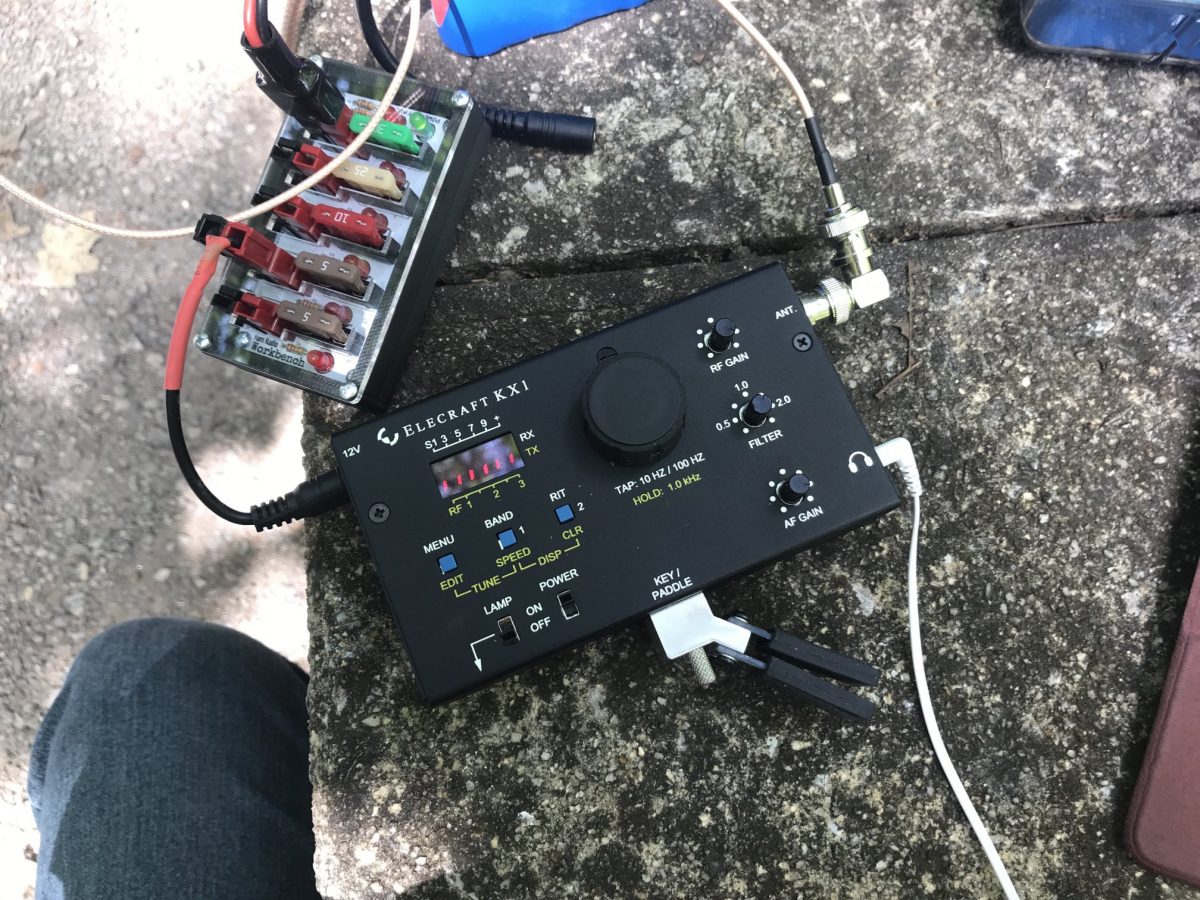
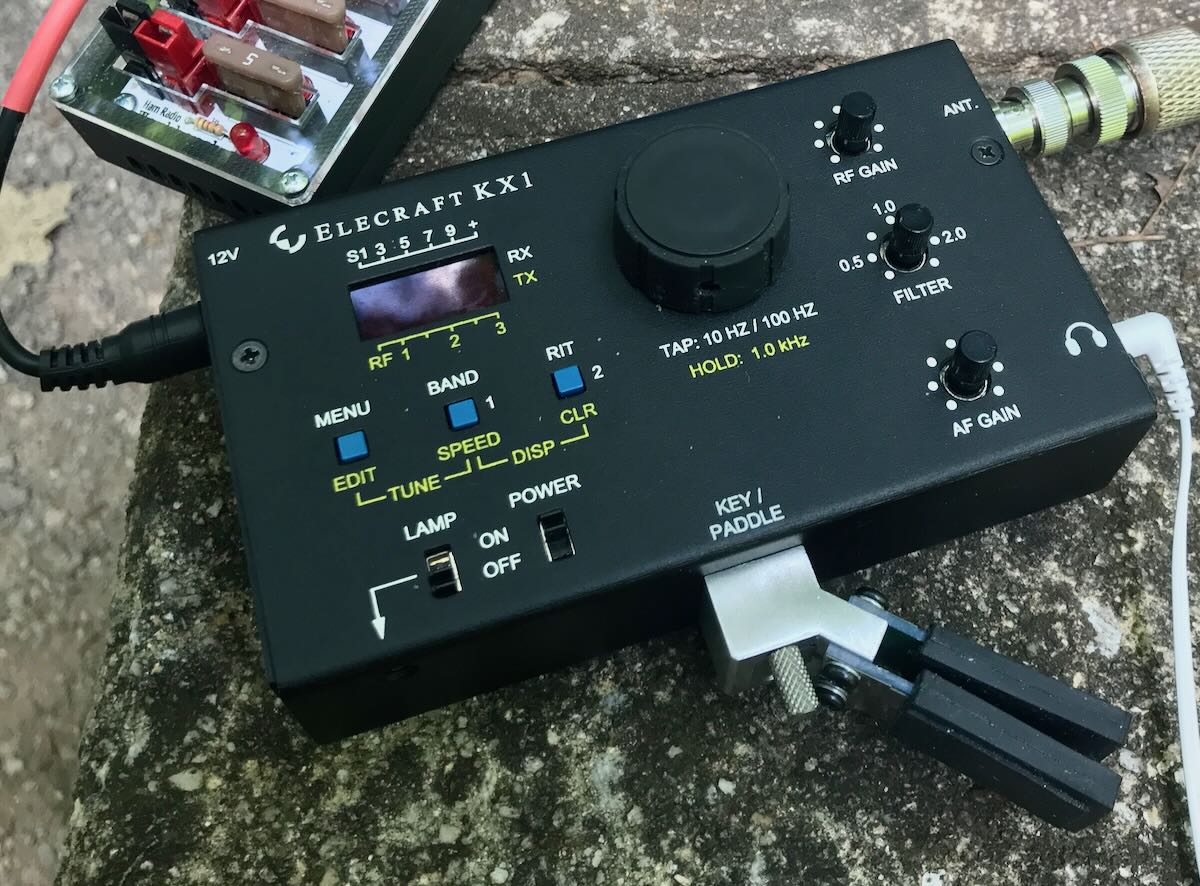
I had a fabulous time putting my Elecraft KX1 “Ruby” on the air. I made perhaps 15 contacts in CW (Morse Code) with 3 watts of power.

One of the cool things about the KX1 is you can change the mode to SSB and actually tune through several shortwave broadcast bands (if you have the three or four band version of the KX1). Of course, I had to do a little SWLing.

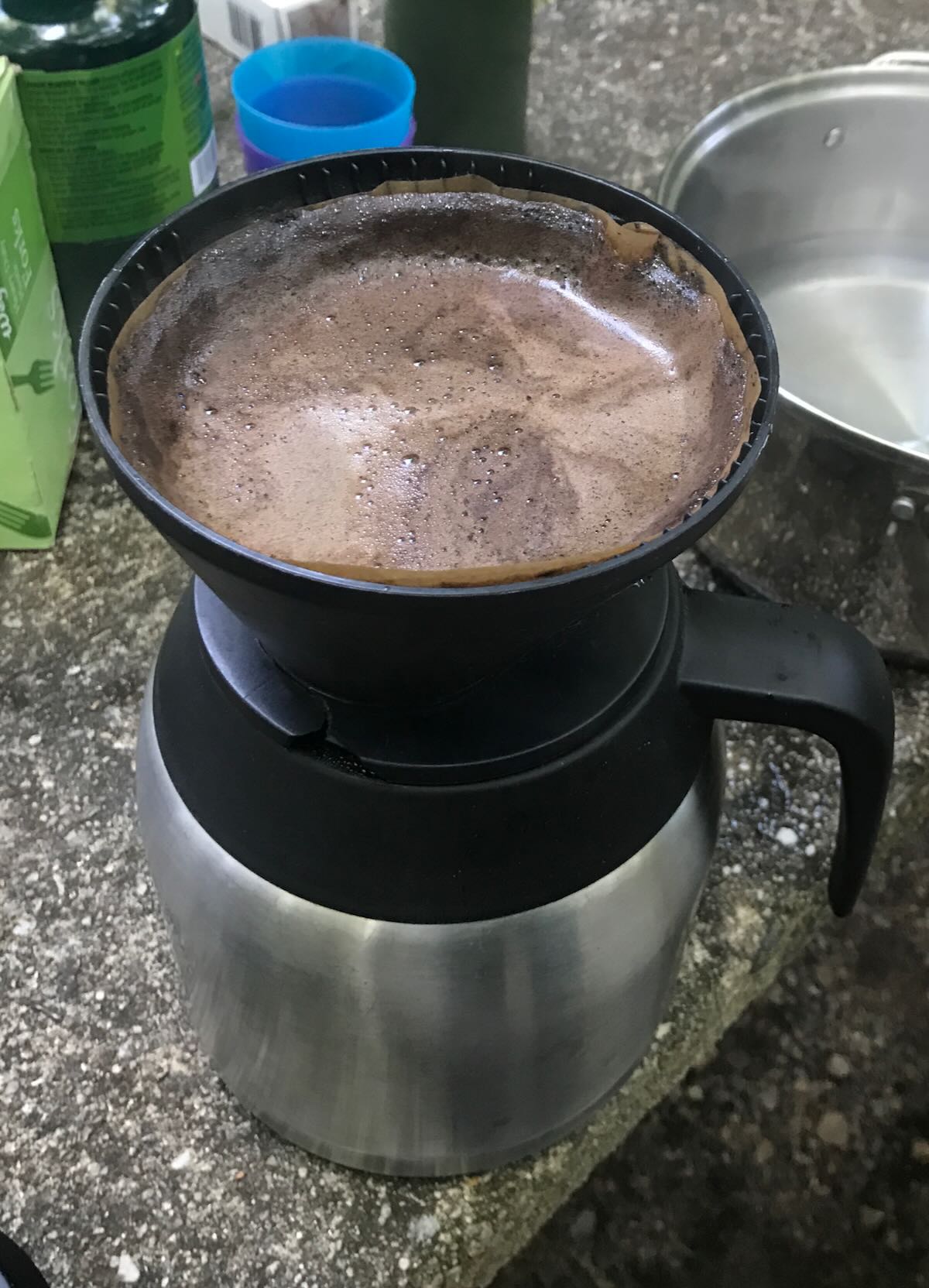
As I mentioned in my previous post, I’m also a proper coffee snob and I firmly believe coffee tastes better when brewed outdoors. Yesterday morning, I brewed a pot of Rock Creek French Roast.

Off-grid, off-line camping recharges my internal batteries and it’s for this reason, I’ll be doing a lot more this year with my family.

It’s is also a brilliant way to experience an environment without any forms of radio interference (QRM or RFI). If you want to do some proper DXing, take your radio on some primitive camping experiences. It’ll remind you what life was like before switching power supplies ruled the world!

Shortwave Coffee

This morning, I was searching hundreds of half-finished articles I’ve accumulated on the SWLing Post over the years looking for a particular note. During my search, I stumbled upon the following post from September 2020 that I thought I published but had not. There’s no time like the present, right? Here you go:


A couple weeks ago, a package arrived at the post office and I noticed that the return address was from friend and SWLing Post contributor and Patron, Scott Gamble.

Scott knows me pretty darn well because, frankly, we’re a lot alike: we’re radio geeks and coffee snobs.

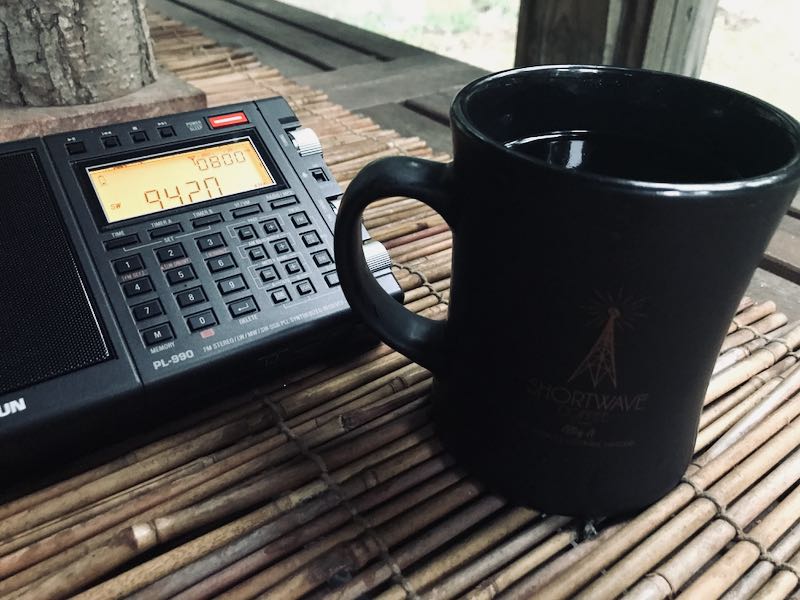
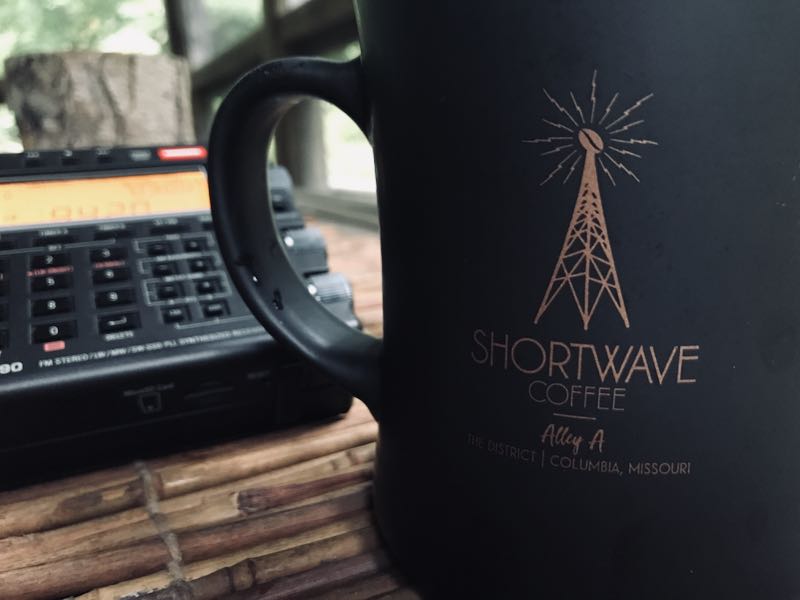
The confirmation was in the box. A Shortwave Coffee mug:

Turns out, Scott discovered Missouri-based coffee roaster, Shortwave Coffee. He shipped me one of their branded mugs and it has become a favorite here at SWLing Post HQ.

Next time I’m anywhere within driving distance of Shortwave Coffee, you’d better believe I’m stopping by for a cauppa!

Thank you, Scott!


Fast-forward to the present day and, as I type this, I’m sipping a nice Rock Creek French Roast in my Shortwave Coffee mug. Thanks again, Scott!

I should add that my buddy Troy Riedel also sent me a shortwave coffee mug–one he actually designed–nearly a decade ago. It lives in our travel trailer so I enjoy it during each of our family camping trips!

Here’s wishing everyone an amazing weekend filled with shortwave and coffee!

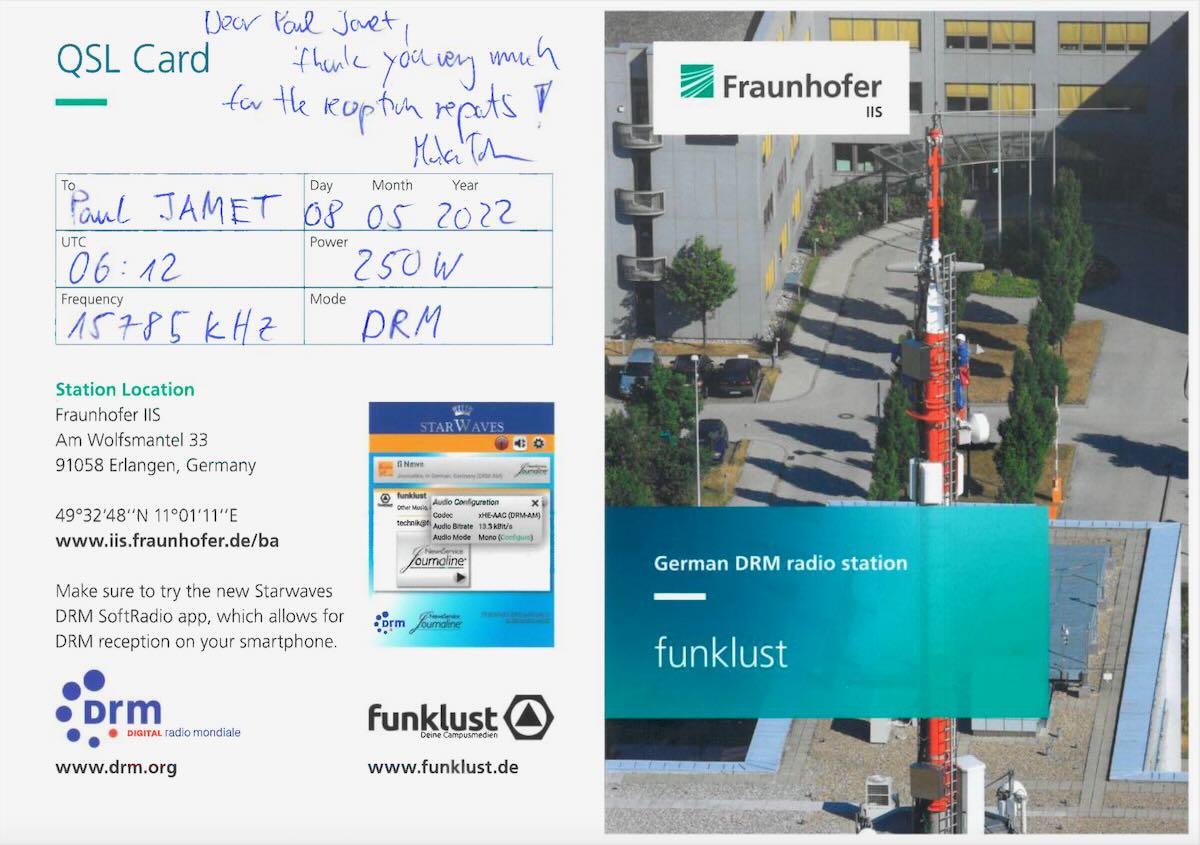
Paul receives a Funklust DRM QSL

Many thanks to SWLing Post contributor, Paul Jamet, who writes:

Hi Thomas,

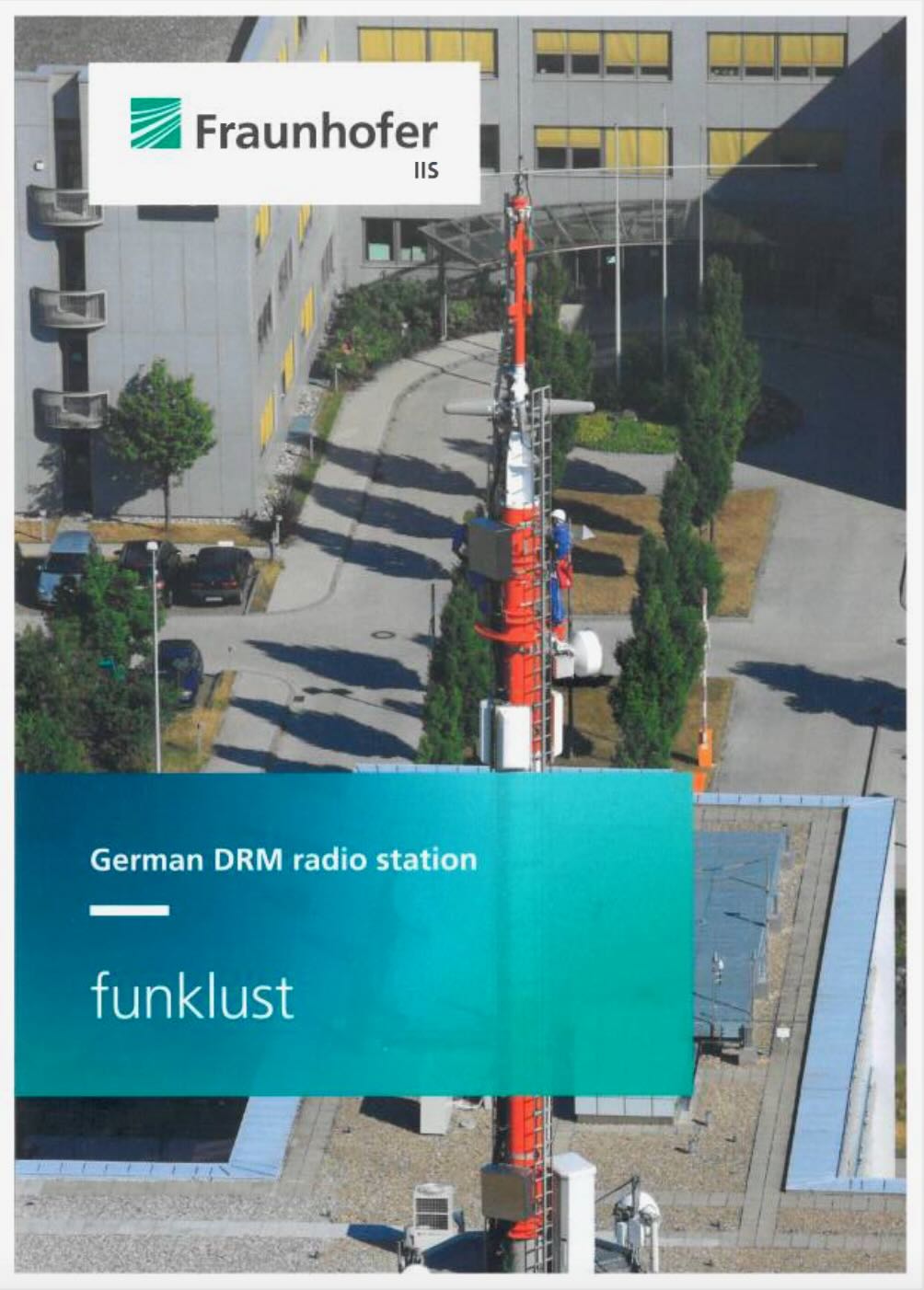
I am reacting to the latest Radio Waves news items on the SWLing Post:  Funklust is back on air with a boost

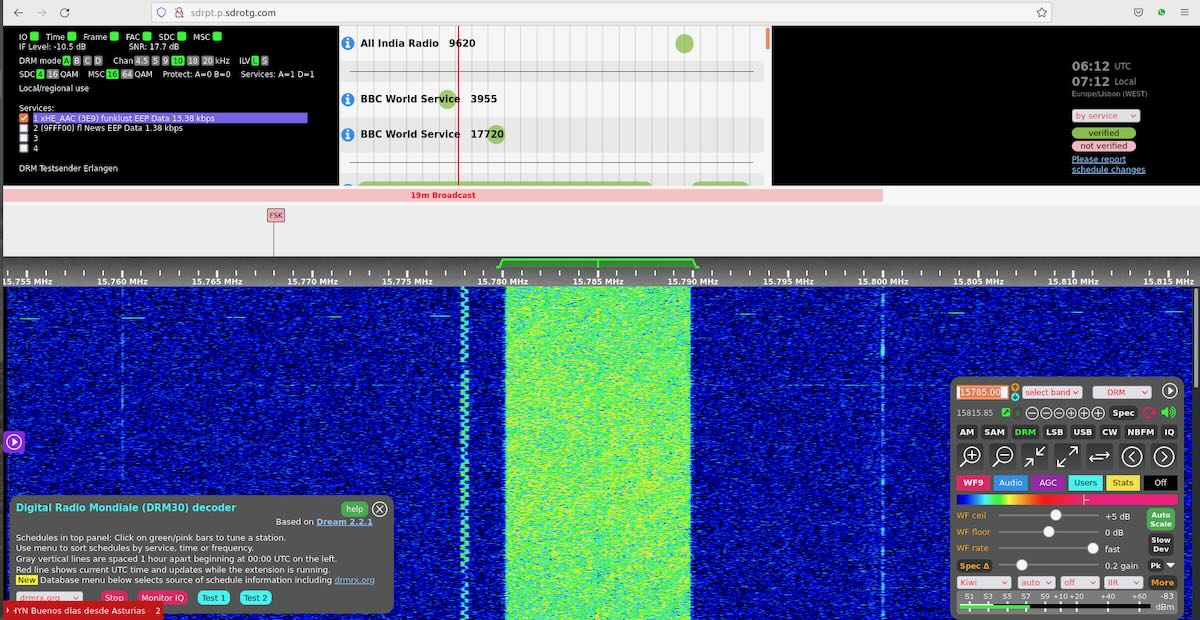
Connected to a Kiwi SDR installed in Portugal, I listened to this experimental station on its 15785 kHz DRM frequency and sent a listening report (in the form of an audio recording and a screenshot) to the Fraunhofer Institute in Erlangen, Germany:
[email protected]

I received a nice QSL!

Audio File:

KiwiSDR Screenshot:

The signal was picked up as far as New Zealand one told me. I think reception reports from all over the world would be very much appreciated …

Have a nice day. Best regards.

Paul JAMET
Radio Club du Perche

That’s brilliant, Paul. Thank you so much for sharing the recording and QSL info. Hopefully, they’ll continue to receive reports from across the globe. It might be fun, in fact, to see just how far one could DX this DRM broadcast via the KiwiSDR network. Frankly, good copy of Funklust’s 250W DRM signal in Portugal is pretty impressive!