Many thanks to SWLing Post contributor, Jaap de Goede, for the following guest posts:
Operating the TECSUN PL-330 without an English manual
by Jaap de Goede
Introduction
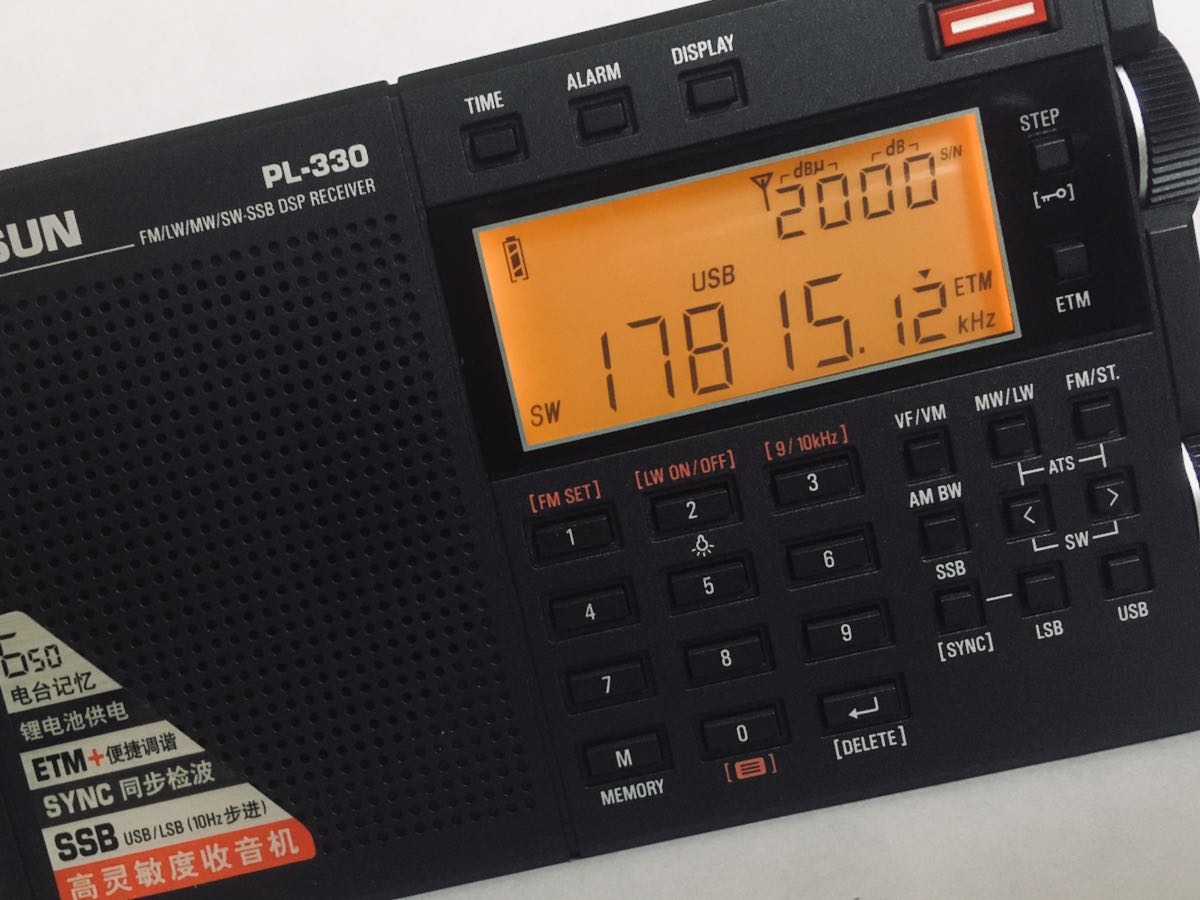
Inspired by my father, I like listening to radio transmissions for the last 60 years. That includes listening to shortwave transmissions. In my collection there are a number of radios including computer based SDR-receivers. The TECSUN PL-330 is a shortwave portable radio with SSB and digital readout.
I’d like to share my operating experience of the PL-330 and throughout I will now and then compare this radio to similar radios in my collection: Eton Satellit, XHDATA D-808 and CountyComm GP5-SSB (AKA Tecsun PL-365).
To be clear the PL-330 used here is a Chinese domestic version, probably manufactured in July 2020. An English manual was not available at the time of writing. In the meantime, the English manual of the Tecsun PL-990 helped to figure out a number of the features of the PL-330. Newer manufacturing batches might contain other firmware and that could change the way of operating.
Size and sound
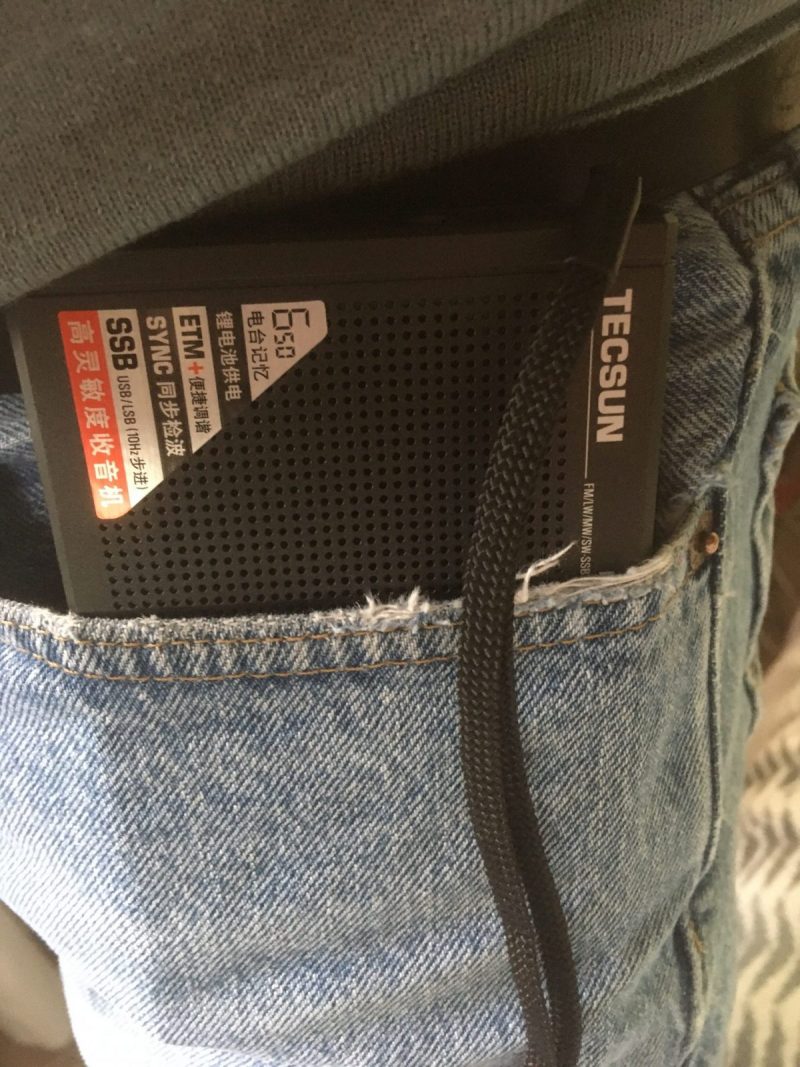 With a volume of about 18 cubic inches the PL-330 is less than 20 cubic inches. It easily fits the pocket of my jeans. 20 cubic inches (unofficially) classifies it as an Ultralight DX radio. The smallest radio of the four is the GP5-SSB with 14 cubic inches. The Satellit is the largest of the four and the size of these radios can be determined by the eye but by the ear as well.
The PL-330 has digital VOLUME control and the volume level is indicated on the display. In contradiction, the three other radios have analog volume control. All radios have a 3.5 mm socket for a stereo headset. A nice feature of the PL-330 is that the FM stereo decoder only works with a plugged-in headset. Else FM remains in mono. I think that’s a very clever feature because why would the stereo decoder degrade the mono-sound through the speaker in case of poor FM stereo reception?
Personal audio quality ranking from best to worst:
- Satellit
- PL-330 and D-808
- GP5-SSB
Power and Batteries
The PL-330 is supplied with a BL-5C battery of 1000 mAh. The battery can be charged in the radio through though a micro USB port. The display permanently shows battery status, regardless whether the radio is on or off. USB makes it very easy to charge from any external USB charger or an external USB battery. Here a quick comparison of the powering of the four radios:
| Radio |
Battery |
Charging Port |
| Tecsun-PL-330 |
1 x BL-5C |
Micro USB |
| CountyComm GP5 |
3 x AA NiMH |
Mini USB |
| XHDATA D-808 |
1 x 18650 |
Micro USB |
| Eton Satellit |
4 x AA NiMH |
Bus |
I don’t have runtime figures. I just charge when indicated on the radio’s display and carry a spare USB battery to charge the radio in case.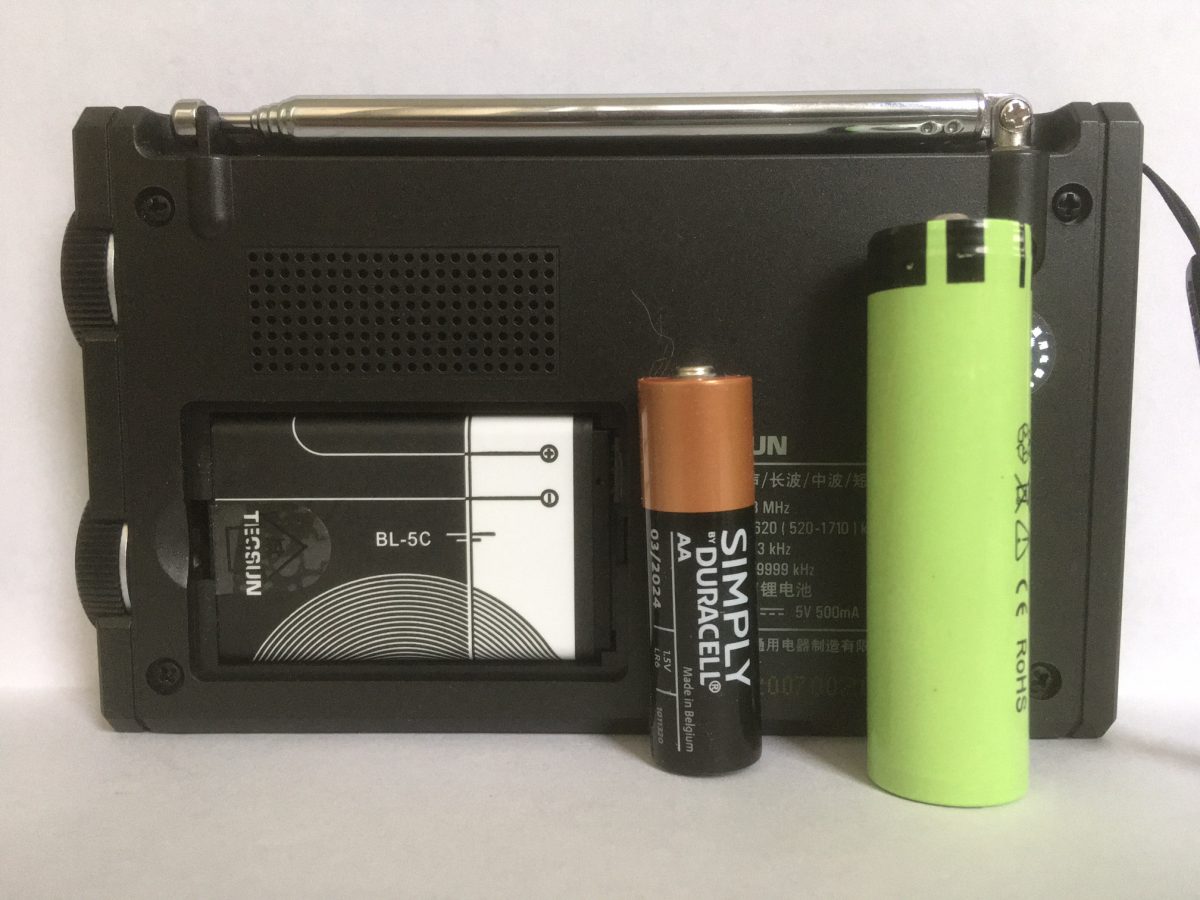
Antenna and Backlit
All four radios have an extensible whip antenna (what else would you expect). Also, all four radios have a 3.5 mm socket for an external antenna. The only radio with an antenna attenuator switch is the Satellit.
All four radios have backlit. But a feature that none of the other radios has is the ability with the PL-330 to toggle the backlit between “always on” or “automatic off”. Just hold and press the 5 button to toggle between the two modes. For comparison, the Satellit has the nicest illuminated display of all four, while the D-808 is way too bright.
Supported Radio Bands
The PL-330 supports the following radio bands:
- Long Wave (153-513 kHz)
- Medium Wave (520-1710 kHz or 522-1620 kHz)
- Short Wave (1711-29999 kHz)
- FM broadcast (64-108 MHz)
Radio Band and Demodulation Selection
To enable or disable the LW-band you must long press the 2 button when the radio is powered off. When the radio is powered on and LW has been enabled you can select between LW and MW by short press of the MW/LW button.
The American or Rest of World MW-band plan can be toggled by long press the 3 button when powered off. When the radio is powered on you can select between MW by short press of the MW/LW button.
To select the regional FM-band plan you should long press the 0 button when the radio is powered off. When the radio is powered on the FM-band can be selected by short press FM/ST. button.
When the radio is powered on the SW-band can be selected by short press < or > button.
In LW, MW and SW bands de-modulation can be AM, SSB and AM synchronous (SYNC). A short press of the SSB button toggles between AM and SSB. A long press of the SSB button toggles between AM/SSB and AM synchronous mode.
A nice feature within the SW band is that you can quickly skip to pre-determined broadcast or HAM bands. In AM and SSB mode you can skip to the desired band by pressing < or > button. The following bands can be selected and indicated in the display:
- AM (broadcast) bands: 120m, 90m,75m, 60m, 49m, 41m,31m25m, 22m, 19m, 16m, 13m, 11m
- SSB (HAM) bands: 160m LSB, 80m LSB, 60m, LSB, 40m LSB, 30m USB, 24m USB, 20m USB, 17m USB, 15m USB, 12m USB, 10m USB
Manual Tuning and Step Sizes
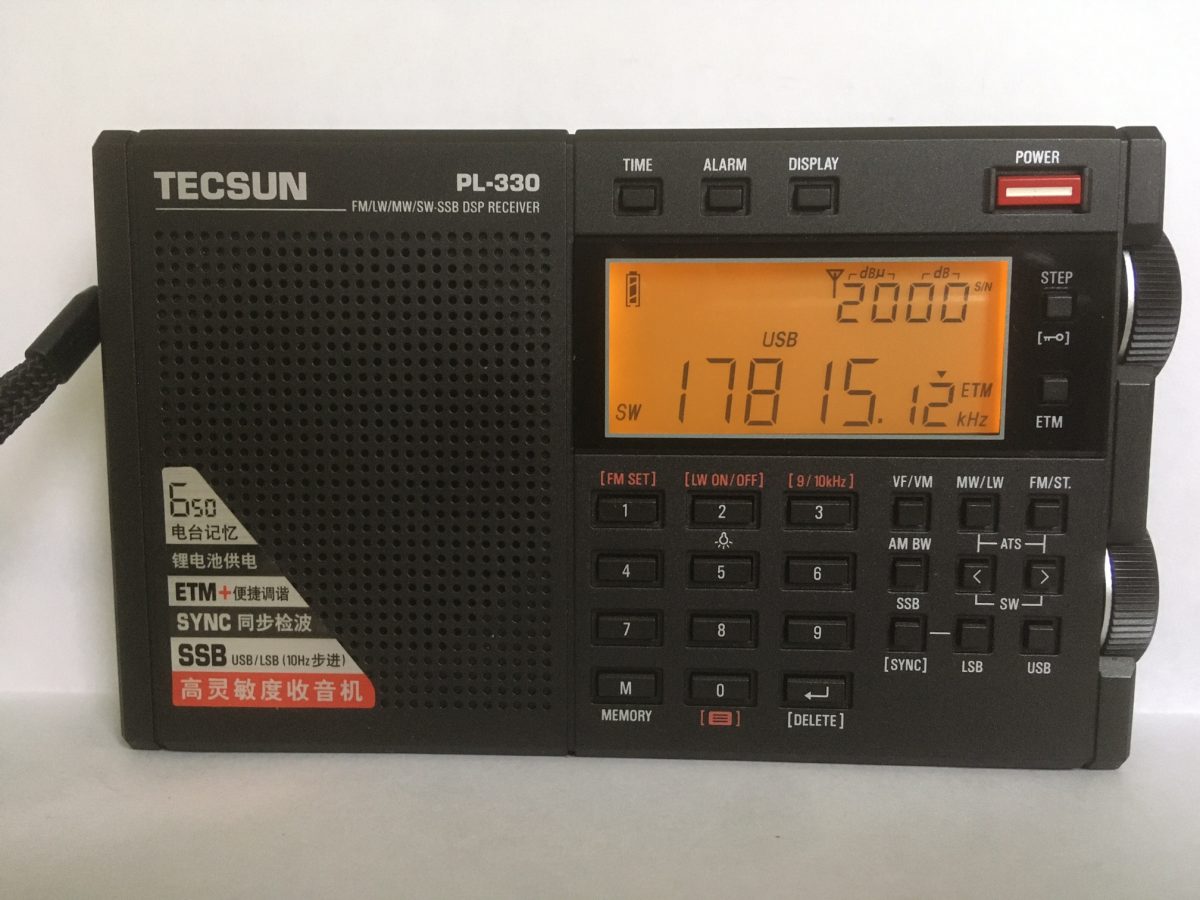
There is one (digital) TUNING dial for all tuning operation in any radio band. It only tunes up and down the bands and has no other function. (That makes tuning with the PL-330 so easy compared to the other three radios with multifunction dials.) Depending on the selected band and de-modulation the tuning steps can be altered by the STEP button.
In the LW and MW bands for AM demodulation the step size can be toggled between 1 kHz and 10/9 kHz by short press of the STEP button.
In SW for AM demodulation the step size can be toggled between 1 kHz and 5 kHz by short press of the STEP button.
In the SW band for SSB and synchronous mode the step size can be toggled between 10 Hz, 1 kHz and 5 kHz by short press of the STEP button. My other three portable radios, but only plus or minus 1 kHz of the actual frequency in steps of 10Hz. The PL-330 has continuous fine tuning in SSB; you can tune the entire SW band up and down in steps of 10 Hz. However, I noticed that the step size can change from 10 Hz to 50 Hz in case you turn the TUNING dial fast.
In the FM band the step size can be toggled between 100 kHz and 10 kHz by short press of the STEP button.
Bandwidth Settings
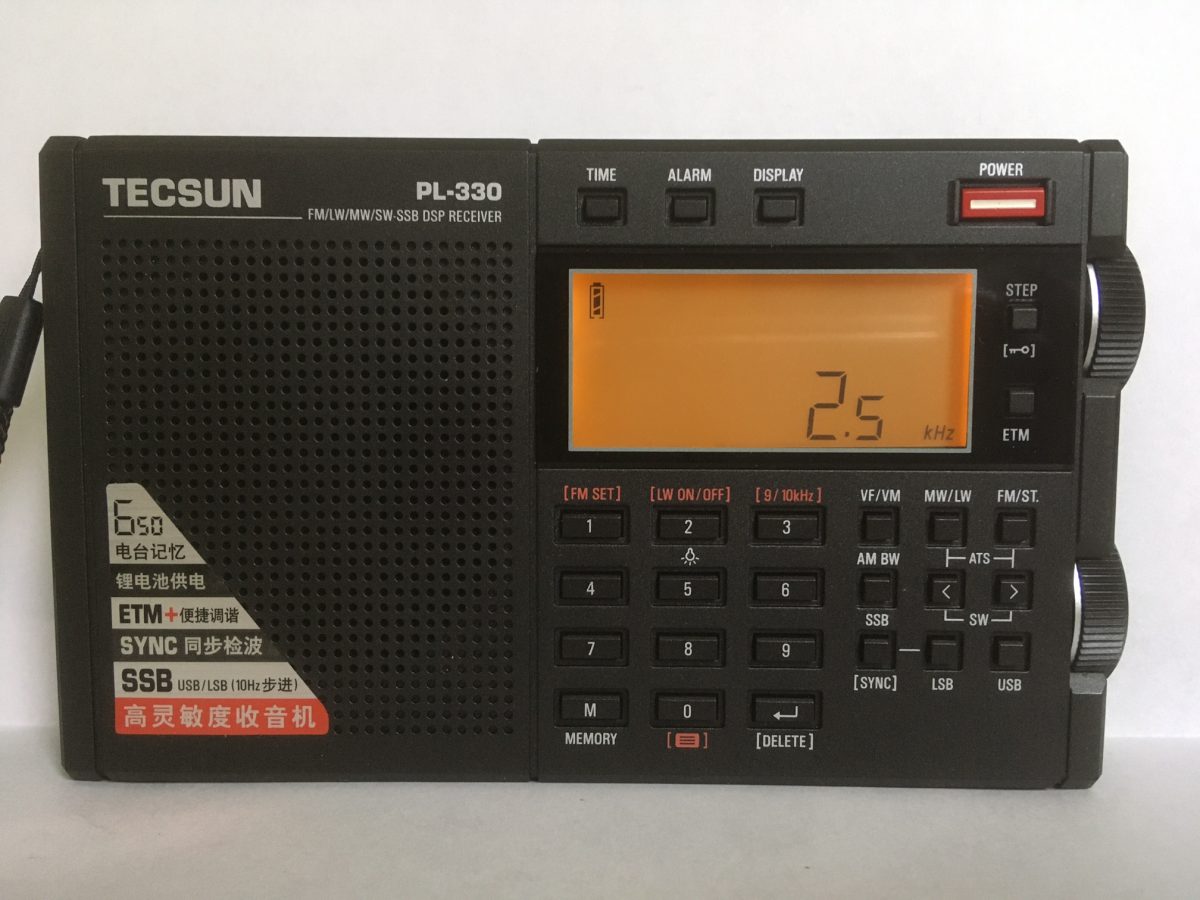
For AM and SSB you can change the bandwidth by pressing the AM BW button, turn the VOLUME dial to the desired bandwidth and press the AM BW button again.
- LW/MW band, AM bandwidth selection: 2.5 kHz, 3.5 kHz, 5.0, 9.0 kHz kHz
- SW band, AM bandwidth selection: 2.5 kHz, 3.5 kHz, 5.0 kHz
- SSB bandwidth selection: 0.5 kHz, 1.2 kHz, 2.2 kHz, 3.0 kHz, 4.0 kHz
Easy Tuning Mode or ETM and Memories
I decided to purchase the PL-330 because of my good and bad experience with the GP5-SSB (PL-365). The PL-365 is super portable and I think ETM is great for occasional shortwave listening. However, without direct frequency entry the GP5-SSAB is a nightmare to operate just now and then. Now the PL-330 has an enhanced version of ETM: ETM+. No other radio has such a feature and I think ETM+ is fantastic.
ETM + provides 24 ETM banks that are chosen automatically based on the hour. Every hour you can press and hold the ETM button to initiate a (new or renewed) shortwave scan. It will display “E” plus the hour in 24 hours format like E00 to E23 depending on the time. When you quick press the ETM button it recalls the memory bank according to the time. As an example, when you quick press the ETM button at 15:24h it will recall bank E15. Then you can select the memory locations stored in the bank by turning the TUNING dial.
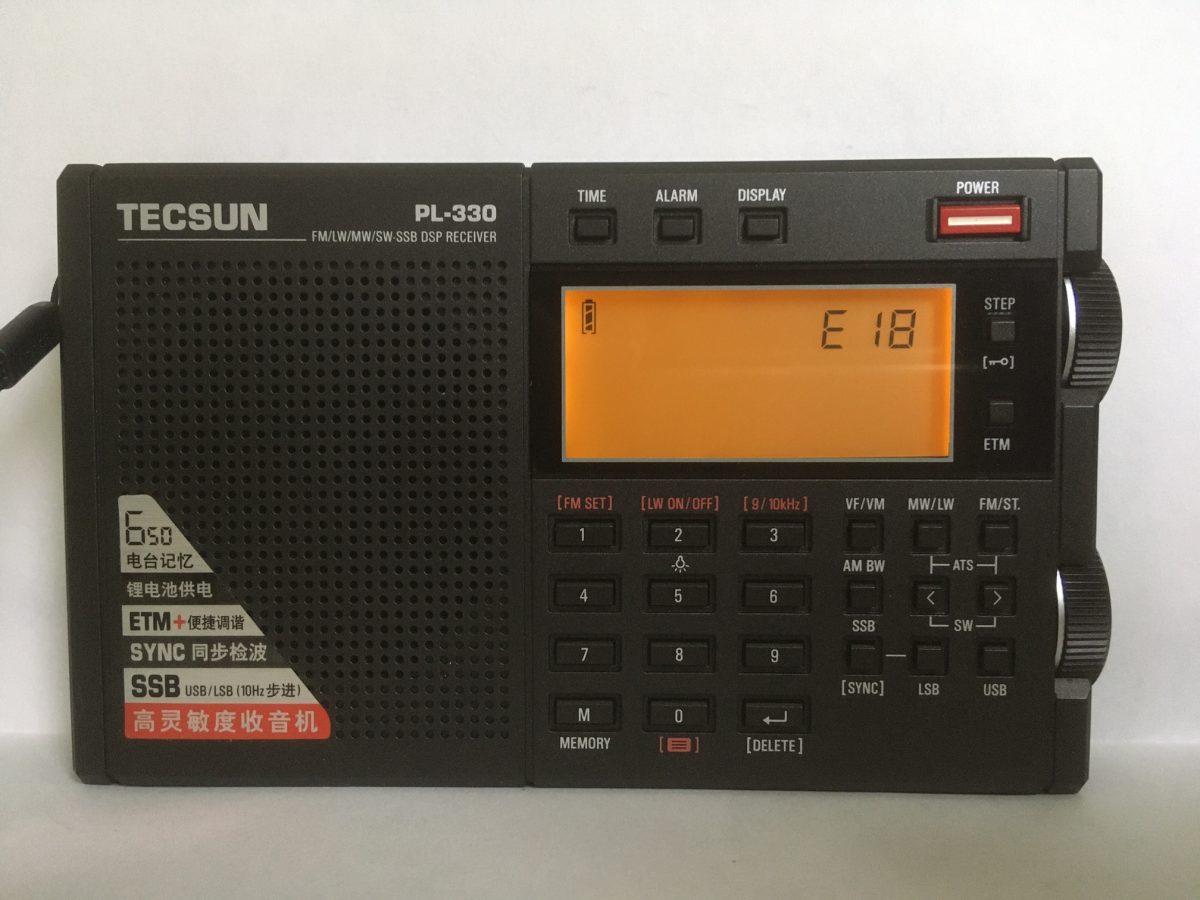 To toggle between ETM and Tuning mode press the ETM button.
In addition to ETM memories, the PL-330 has a lot of memories but lacks alpha tags. I really have difficulties remembering what I put in those memories. I hardly use them. The only one of the four that has alpha tags is the Eton Satellit, that makes things a lot easier.
Memories can be automatically populated in a bank separate from the ETM banks by using the Automatic Tuning and Storage (ATS) function. All four radios have ATS and I think it’s only convenient for FM. It works like:
- Press FM/ST. to select FM Band
- Press and hold FM/ST. to start ATS
- Use the TUNING dial to select from the stored FM stations
To toggle between Memory and Frequency tuning mode simply press the VM/VF button.
Bugs or Features
With the DISPLAY button you can change the upper right part of the display between:
- Signal strength
- Clock
- Preset (only in VM Mode)
- Alarm time
The display always returns to signal strength after a few seconds. Except if time is chosen with a long press of the DISPLAY button. Nevertheless, the display returns to signal strength after applying any operation, including volume change. I’m not sure if this is a feature or a bug.
When using a headphone and changing volume, sometimes the sound is cut off. By changing the volume again, it comes back. Seems like a bug, not a feature.
I tried AM synchronous mode. It works like on the Satellit: poor. I would recommend to make this mode hidden or make it work well.
Universal Serial Bus
When connecting the radio with an USB cable to a PC, its operating system does not show any connection information. If the radio would have USB logic apart from charging, connection information would have showed up. I assume there is no way to update firmware via USB.
Hidden Features
Without an English manual, and maybe even with a Chinese manual I couldn’t understand all functions.
When the radio is powered off:
- Press and hold VF/VM shows all items of the display.
- Press and hold 8 toggles display clock in “HH:MM” and “HH:MM: SS”
- Press and hold 3 in MW/LW band toggles between internal ferrite and external whip antenna
- Press and hold Enter shows “dEL ALL”, probably delete all (except what is all)?
- Press and hold M shows numbers, no idea.
- Press and hold 0 shows “PO []”, no idea.
There seems to be a combination to show the firmware version.
Missing Features
RDS display would be welcome. Even though the PL-330 shares the radio chip with the D-808 and the Satellit, the PL-330 does not display FM Radio Data System (RDS) on its display. Backlit buttons would be a welcome for operation in the dark. (Although you’ll quickly get used to the button layout.)
Features I didn’t miss
None of the four radios has DAB+ or HD radio. For DAB+ reception I use a Sony XDR-S41D and I can’t receive HD radio in Europe. DAB+ and HD radio could make the radio way more expensive and I prefer good SW performance anyway.
The possibility to upgrade firmware would be convenient. But I understand constraints of costs and the liability of bricking the radio.
The Satellit and D-808 support the Air band (108-135 MHz). That is ok for occasional listening to one single channel, but forget about channel scanning. I have my Bearcat UBC XLT125 VHF/UHF scanner for that purpose.
Conclusion
Like I started, I’m an occasional shortwave listener. I couldn’t really tell the difference in radio performance between the four radios. Of course, the best radio is the one you have with you. And because of its size, easy operation with a single tuning dial and features like ETM+, the PL-330 is probably the best portable shortwave receiver at the moment (for me ?). Thanks to Tecsun!
Jaap de Goede
October 2020
Many thanks, Jaap, for taking the time and care to put together this excellent overview of the Tecsun PL-330! This will serve nicely as an operation manual. Your father would be proud of you! 🙂
Readers: Please note that you can also download Jaap’s PL-330 guide as a printable PDF document by clicking here. The PDF has even better formatting as Jaap has used operation manual styled fonts to indicate button labels and functions.

 Apologies in advance, but I need to brag a bit…