Author Archives: Thomas

Bob’s Radio Corner: Where are the Broadcasters?

Source: NASA

Where are the Broadcasters?

As posed by Bob Colegrove

Whenever I ask myself that question, I can’t help thinking of a couple analogies.  Let me explain one.  In the mid-80s, there were three contenders for the home computing market: IBM, Apple, and Commodore.  There were others, but those were the main ones.  It was not uncommon for entrepreneurs to rent out halls and host fairs at which vendors for all three platforms would display the latest peripherals and software.  The IBM PC was incompatible with the Apple IIe; each, in turn, was incompatible with the Commodore 64.  Most of the software came at premium prices.  Why?  I was told that developers had to recoup their cost from the existing group of owners of each specific platform.  Being the early days of home computing, these groups were relatively small, and consequently, this determined the cost of software.  This situation was euphemistically known as the “installed base” ? an existing population of users who owned computers for the targeted software.

Applying this to radio, is there an installed base to warrant more international shortwave broadcasting?  From all appearances, there are more shortwave radios being marketed now than I can ever recall.  I searched for “shortwave radios” on Amazon, hoping to get a reasonable model count, but soon gave up.

Without getting into the politics of the issue, the Chinese are the dominant player in shortwave use today.  They are making most of the shortwave radios and doing most of the shortwave broadcasting.  The targeted audience is both domestic and international.  The radios they make are marketed around the world, apparently quite successfully.  An AI inquiry on the Internet can’t put a number on it, but states that there has been a resurgence of interest in shortwave, particularly since the COVID-19 pandemic and subsequent global conflicts.  Isn’t it reasonable to assume there is now a sizeable installed base of potential shortwave listeners?

If I may be allowed one more analogy, in 1950 the physicist Enrico Fermi asked the cosmic question, “But where is everybody?”  He was referring to the scope of the universe, the real probability that there are enough other habitable planets such that some others should support life.  His paradox is that we have not yet heard from anyone else.

Again, translating this to radio, given the proliferation of shortwave radios and listeners, where are all the broadcasters?  Hasn’t the quality, performance, reasonable cost, and availability of shortwave radios been the seed to start the resurgence of shortwave broadcasting?

The well-worn argument is that times have changed.  We now have the Internet and cell phones to instantaneously bring us an incomparable mass of information and entertainment, all of this on demand. Why contend with noise, interference and weak signals?  Why wait for desired content to be available on a certain day at a certain hour?  Further, and just as important, public broadcasting is costly in terms of production and delivery.  To put a face on it, shortwave radio does not permit one to fasten a $200 GoPro to the front of his bicycle, video his ride, post it on YouTube, and garner thousands of likes.

All of that is strong poison.  On the other hand, radio waves are an immutable form of electromagnetic radiation.  The medium is not going away.  With a high degree of certainty, it will eventually be repurposed, possibly in digital form or with some method of modulation which is yet unknown.  The content may be commercial, military, private, or public.  Someone is going to figure out a way to use it.

In the meantime, why can’t we use it just the way it is?  One advantage of radio is real-time broadcasting – talk radio, spontaneous news reporting, and emergency information.  While this is possible on the Internet, its implementation has been tangential.  For example, I can go for a live cab ride with a truck driver, watch trains run around Horseshoe Curve, or listen to a techno-specialist field viewer questions – all live it’s true, but still not quite the same thing.  Perhaps it is just a matter of time for the Internet to catch up.

The Internet is better for drawing maps and ordering products for home delivery.  Ultimately, however, it fails to engage the imagination.  Instead, the world is presented to us in vivid color leaving no detail in question.  With radio, the listener’s faculties are permitted much wider freedom.  One is allowed to color between the lines, “a fiery horse with the speed of light, a cloud of dust…”  Even the fading or hollow aural echo of a distant shortwave signal can stimulate further vision. That is radio’s ace in the hole.  It just needs the initiative of one visionary to give the ball a push and start it rolling.
Carlos’ Illustrated Radio Listening Report and Recording of the IRIB World Service (February 13, 2026)

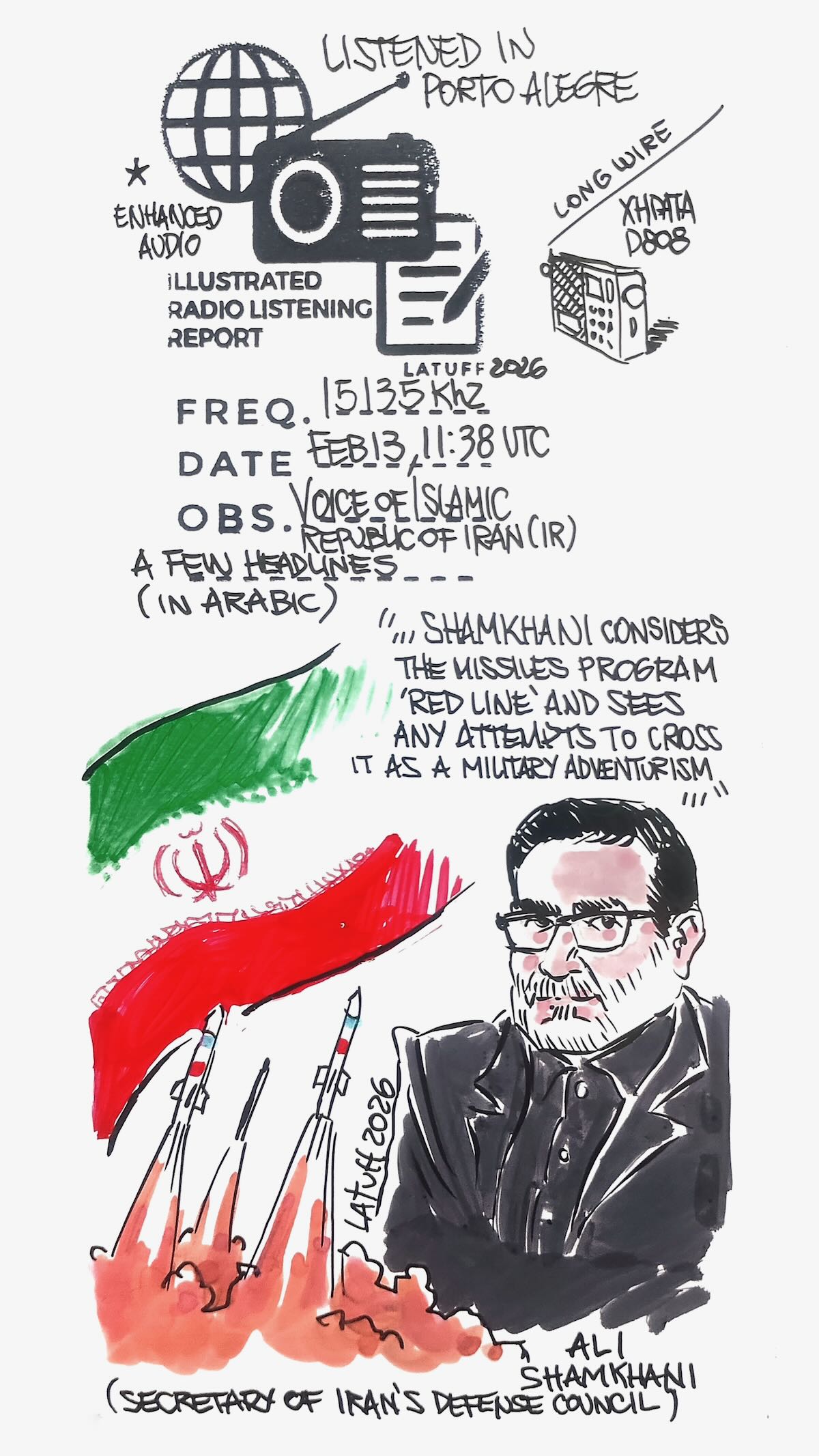
Many thanks to SWLing Post contributor and noted political cartoonist, Carlos Latuff, who shares the following illustrated radio listening report of a recent Voice of Islamic Republic of Iran broadcast.


Carlos notes:

Shamkhani: Our missile capabilities are non-negotiable. Voice of the Islamic Republic of Iran, 15135 kHz

Click here to view on YouTube.

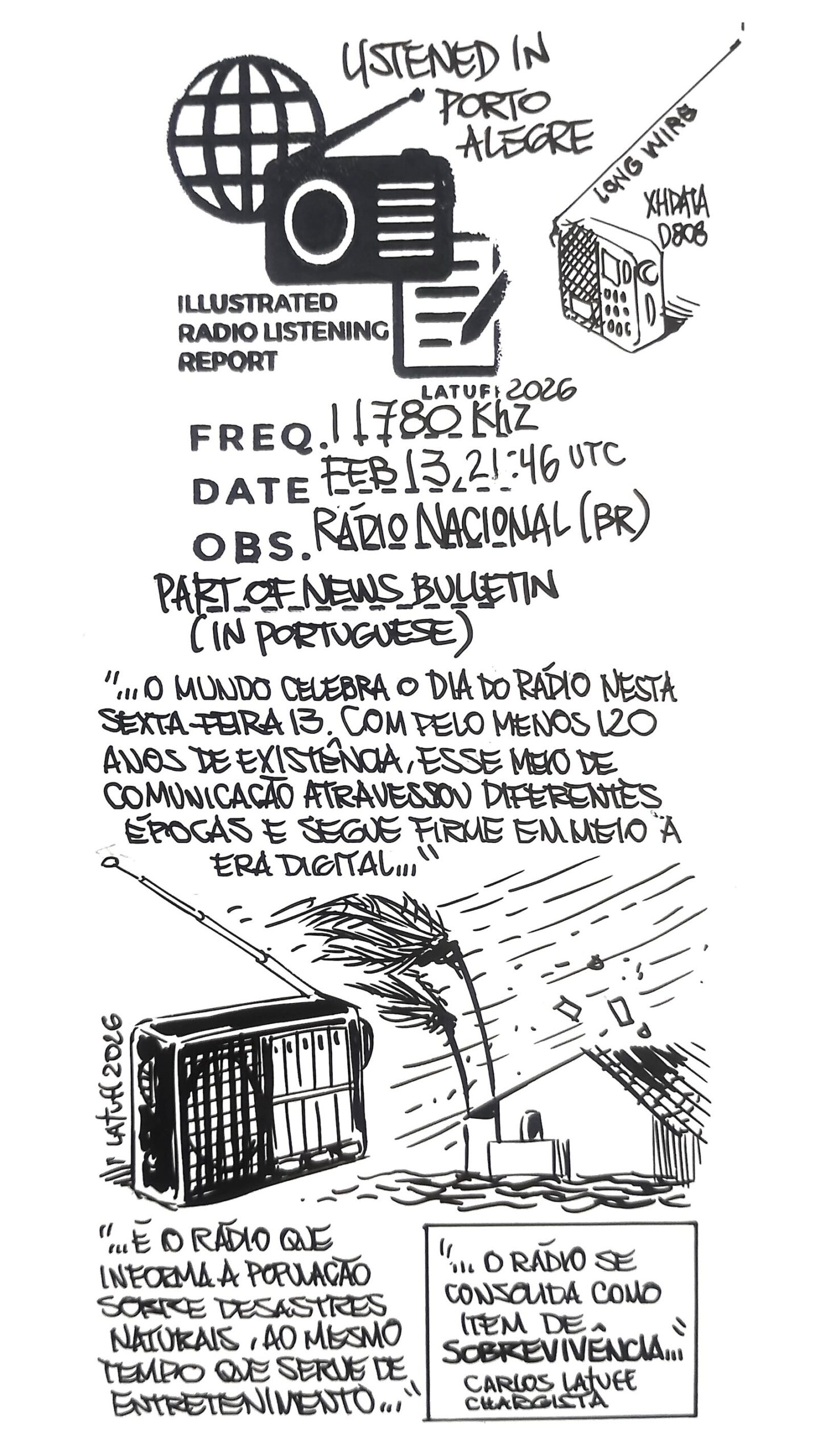
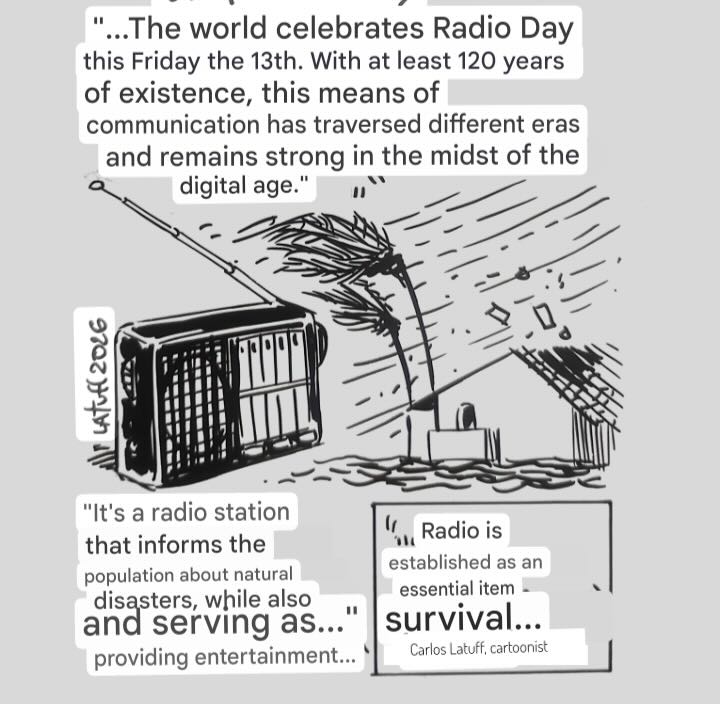
Carlos’ Illustrated Radio Listening Report and Recording of Rádio Nacional (February 13, 2026)

Many thanks to SWLing Post contributor and noted political cartoonist, Carlos Latuff, who shares the following illustrated radio listening report of a recent Rádio Nacional broadcast.


Carlos notes:

World Radio Day, Rádio Nacional, 11780 kHz

Click here to view on YouTube.

Ukraine’s Radio Culture: When Radio Is the Only Voice Left

(Source: Radio Prague International via Paul Jamet)

Everywhere – even under Russian occupation – radio waves still find their way

To mark World Radio Day, Radio Prague International spoke with Iryna Slavinska, Director of Radio Culture – the third channel of Ukraine’s public broadcaster Suspilne. What role does radio play in war-torn Ukraine? And what can a station focused specifically on culture contribute?

Iryna Slavinska joined Radio Culture in 2018. A philology graduate, she also brings extensive experience in education and cultural work, and is fluent in French.

“For me, radio remains something very powerful, very influential and very transparent. Radio has no borders,” she describes.

This has become particularly evident since the full-scale invasion in February 2022, when, as Slavinska notes, radio often became the only Ukrainian media outlet accessible to people under Russian occupation. [Continue reading…]

Happy World Radio Day 2026: Celebrating 80 Years Since UN Radio’s First Broadcast

Many thanks to SWLing Post contributor Carlos Latuff, who shares a reminder that today — February 13 — marks World Radio Day, celebrated each year on the anniversary of the moment United Nations Radio first went on the air 80 years ago.

This UN News article highlights radio’s enduring role as one of the world’s most accessible and resilient media platforms — capable of crossing borders, reaching remote communities, and delivering trusted information in times of crisis.

From conflict zones to rural villages, radio continues to inform, educate, and connect people in ways few other media can match. The article also reflects on the legacy of UN Radio and the broader importance of public-interest broadcasting in an increasingly fragmented media landscape.

For those of us in the SWL, amateur, and radio enthusiast communities, of course, none of this comes as a surprise. We know firsthand that radio is more than just a technology — it’s a lifeline, a cultural bridge, and often a quiet but powerful force for understanding across borders.

You can read the full UN article here:
https://news.un.org/en/story/2026/02/1166947

Click here to check out the 2026 World Radio Day homepage.

Happy World Radio Day, friends!

World Radio Day: Kentucky’s Real People Radio

A new documentary from the BBC, produced by SWLing Post friend and contributor David Goren and presented by Maria Margaronis, is now available to listen to online.

Kentucky’s Real People Radio, from The Documentary Podcast, visits WMMT in Whitesburg, Kentucky, a small community radio station known locally as “Possum Radio,” which serves coalfield communities in Appalachia and now faces an uncertain future amid potential cuts to public funding. The programme explores why community stations like WMMT matter more than ever, providing trusted local information, emergency alerts, and a rare platform for voices often unheard in national media.

You can listen to the full documentary, with embedded audio, on BBC Sounds here:
https://www.bbc.com/audio/play/p0n0g9f2

Update: If you don’t have a BBC account and can’t access the recording above, they also make the recording available via this link, which I’ll also embed below:

World Radio Day: Vatican Radio Celebrates with 7 Multi-Language Programs

Many thanks to SWLing Post contributor David Iurescia, who shares the following news from Vatican Radio:

On 13 February 2026, on the occasion of World Radio Day (WRD), Radio Vaticana – Vatican News has organised a special initiative in seven languages with seven radio programs that will become themed podcasts dedicated to the future of radio, public service, innovation, and the relationship between media, society, and artificial intelligence.

The initiative comes the day after the 95th birthday of the Radio of the Popes: 12 February 2026. Founded in 1931 at the behest of Pope Pius XI and created by the father of radio, Guglielmo Marconi, the Pope’s broadcaster is one of the oldest in the world, born to connect the Holy See with every part of the planet and to speak to diverse peoples, cultures, and languages.

Read the full article at Vatican Radio by clicking here.