Shortwave listening and everything radio including reviews, broadcasting, ham radio, field operation, DXing, maker kits, travel, emergency gear, events, and more
Many thanks to SWLing Post contributor, Troy Riedel, who shares the following announcement:
New Program: ALT UNIVERSE TOP 40
Written and produced by Indie Rock veteran John McMullan of The Trend, Alt Universe Top 40 is a genre-hopping weekly radio countdown that combines real-life chart achievements with “good-hearted adjustments that time and taste demand.”
With each hour-long show, the listener learns a few tidbits about familiar songs, and is gently introduced to music that SHOULD be familiar. In John’s world, The Beatles are still the “toppermost of the poppermost,” but, not far behind the Fab Four are deserving underground rock acts such as Good Question, Fools Face, and a number of other bands that turned in amazing records that were not exactly commercially successful.
Each show begins with a song that, at some point, was perched at number forty on one of the three major American charts, or in England or Australia. As the countdown continues, the musical selections include a song that should have made the Top 20, but did not; a single that charted at #11 in real life; a “should have been” Top 10; a Number 9, number 9, number 9…; something that is “modern and great” and should have reached number 8; a Little Slice of Heaven at Number 7; and the rest of the countdown filled out with bonus hits, a 3 from “Way Downtown,” and a Hall of Perfection Track.
Having designed the program specifically for Shortwave, McMullan draws inspiration from a variety of sources. He composed the opening fanfare and vocal jingles throughout the show by changing the lyrics to the chorus of the Trend classic he wrote in 1982, “Mama Thought You Were a Nice Girl.” The stories are usually trivia for chart nerds, but, with his music days never too far from his mind, McMullan throws in personal memories from time to time. There are AM hits, FM album hits, and jazz & blues selections that are only heard these days on public radio. Give Alt Universe Top 40 a listen, and you will certainly, as he says each week, “Keep on smiling through the static!”
You can hear Alt Universe Top 40 Saturdays at 10 pm Eastern Time (currently 0200 UTC Sunday) on 9455 kHz, and Sundays at 9 pm Eastern Time (currently 0100 UTC Monday) on 9395 kHz.
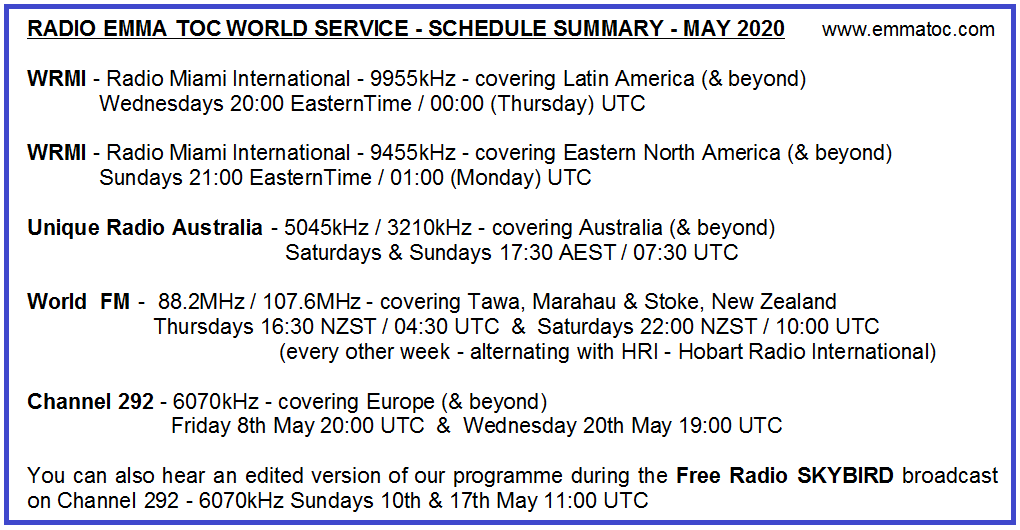
Many thanks to SWLing Post contributor, Jim Salmon–with Radio Emma Toc World Service–who shares the following updated shortwave radio schedule for May 2020:
Jim notes:
Happy listening! If you are outside the transmitter coverage areas, why not listen via the broadcasters’ online services. Website details for the above stations are listed on our own website here – www.emmatoc.org/worldserviceschedule
If you don’t have access to receivers & aerials you can try using an online SDR receiver – ve3sun.com/KiwiSDR – experience the enjoyment of tuning around shortwave from worldwide locations online – it’s almost real!
We are happy to issue eQSLs for reception reports sent to – [email protected] – & will gladly include for online reports. If using an online SDR, please give us the SDR location.
Finally if any stations wish to relay our programme a download link is available on our website. Please advise us of times & dates for our schedule.
Thank you!
Jim Salmon – Radio Emma Toc
Many thanks for the update, Jim! Brilliant job making the Radio Emma Toc WS broadcasts widely available!
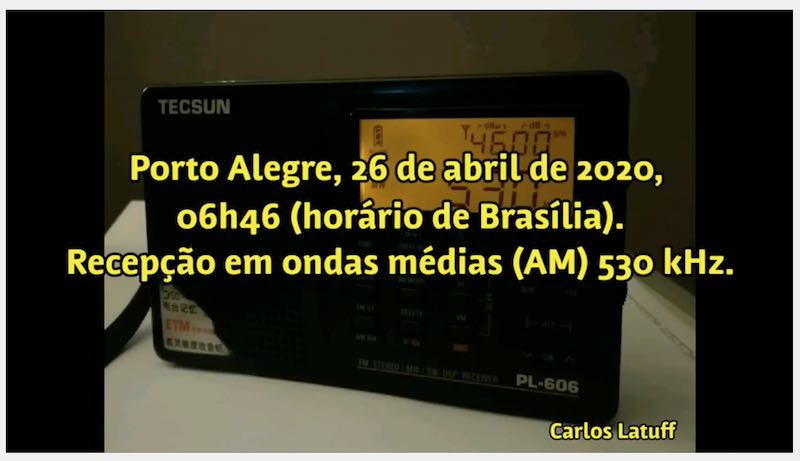
Many thanks to SWLing Post contributor, Carlos Latuff, who recently shared a video clip of a Spanish language station he received in Porto Alegre, Brazil. Carlos is curious if it could possibly be Rádio Rebelde in Cuba. He said he received this station early in the morning (local) on Sunday, April 26:
If you can help Carlos ID this station, please comment!
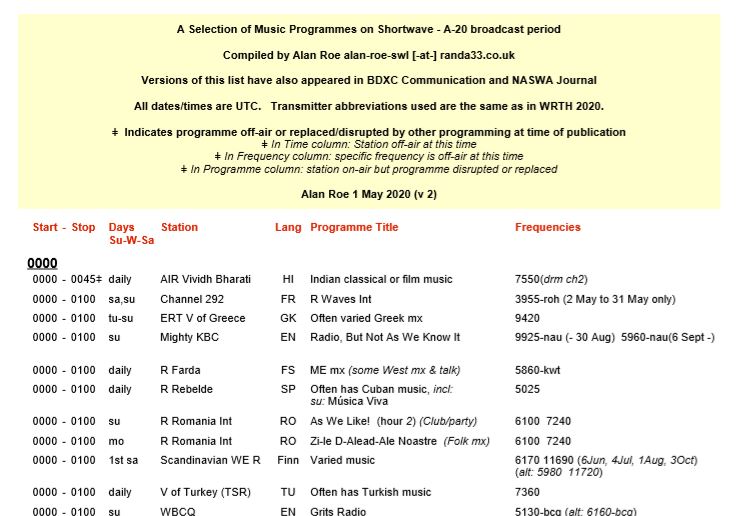
Many thanks to SWLing Post contributor, Alan Roe, who notes:
I attach a copy of my “Music Programmes on Shortwave” PDF file for the current A-20 broadcast season which I hope you will find of interest, and for you to upload to your SWLing webpage if you wish.
Alan, thanks so much for keeping this brilliant guide updated each broadcast season and for sharing it here with the Post community! As I say with each update: I always keep a printed version of your guide at my listening post!
Radio Waves: Stories Making Waves in the World of Radio
Because I keep my ear to the waves, as well as receive many tips from others who do the same, I find myself privy to radio-related stories that might interest SWLing Post readers. To that end: Welcome to the SWLing Post’sRadio Waves, a collection of links to interesting stories making waves in the world of radio. Enjoy!
Many thanks to SWLing Post contributors Dennis Dura, Mike Terry and the International Radio Report for the following tips:
Streaming means we can tune into breakfast shows, travel bulletins and local gossip on every continent – and revel in radio’s ability to create a sense of community
I’d missed the joke about the three-legged chicken. It was causing a stir.
“That one about the chicken with three legs you told yesterday,” said a presenter on Ireland’s Midwest Radio’s afternoon show, “apparently Ronald Reagan told it first.”
“Did he, now?” the co-host replied.
“Yes. You stole a joke from Ronald Reagan.”
Jeez, I’m going as red as a tomato here.”
The conjunction of tripedal fowl, the 40th president of the United States and two men in a studio in Ballyhaunis, County Mayo, will never make a list of great radio moments but it was enough to coax me from between my four walls, even if it was via the imagination.
Radio has never been more popular: it’s seen off challenges, from television to the internet, to become stronger than ever. In 2017, according to industry ratings body Rajar, nine out of 10 people in the UK listened to the radio every week. Perhaps it succeeds because we have to conjure up our own pictures of events and places beyond our immediate surroundings. As a bored, lonely boy growing up in an anonymous south-east London suburb, I’d spend most evenings in my bedroom jamming a coathanger into the back of an old radio and scanning the airwaves, awestruck by the range of languages and music bursting out of the night through skirling static; each voice sending tantalising reassurance of a world beyond the dispiriting confines of my own.[…]
The BBC has said it will have to “think hard about every pound” it spends on new programmes because of financial pressures during the current lockdown.
Delays to a new licence fee regime for people over 75 and problems collecting fees are among the challenges cited.
Staff have been told the BBC will have to find £125m savings this year.
Senior leaders will take a pay freeze until August 2021 and all non-essential recruitment will be put on hold as part of the cost-cutting measures.
Staff will also be invited to work part time or take unpaid leave if they find it “helpful” during the lockdown.
In a briefing on Wednesday, director general Tony Hall said other reasons behind the cash shortfall were a delay to a plan to cut 450 jobs, and uncertainty around commercial revenues.
Other broadcasters have been badly hit during the crisis, with ITV last month cutting its programme budget by £100m and Channel 4 cutting £150m from its programming.
On Wednesday, Channel 4’s director of programmes Ian Katz said the broadcaster would have to cut back on drama and produce “lower tariff” shows.[…]
With the passing of Ronan O’Rahilly in April 2020, a colossus of radio broadcasting has left a legacy that will stand the test of time and has made a massive impression on radio broadcasting in Ireland. While his beloved Radio Caroline was a familiar sight off the South East of England, its influence on both radio and music in 1960’s Britain cannot be underestimated. It forced the British Government to enact new legislation outlawing the almost a dozen pirate radio ships that blasted pop music into Britain and it forced the BBC to reorganise and compete with the opening of a dedicated pop channel in 1967, BBC Radio One. In the month when Ronan passed onto the afterlife, both BBC Radio One and Radio Caroline still broadcast today. But while Caroline’s history focusses mainly on its influence on Britain, Ireland has played a key role in that colourful history and this is that story.
At the helm of Radio Caroline was Ronan O’Rahilly. He was born in Clondalkin, Dublin in 1940, his father Aodogan was a well-known and wealthy businessman, regarded as an influential ally of Eamon DeValera, while his grandfather Michael O’Rahilly was better known as The O’Rahilly, sacrificed his life during the 1916 Easter Rising having been shot dead while leading a charge on a British position at the end of Moore Street.[…]
ARISS News Release No. 20-03
April 28, 2020 —Amateur Radio on the International Space Station (ARISS) is pleased to announce the first use of a concept called Multipoint Telebridge Contact via Amateur Radio, allowing school contacts for Stay-At-Home students and simultaneous reception by families, school faculty and the public.
During the last several weeks, efforts to contain the spread of the COVID-19 virus have resulted in massive school closures worldwide. In addition, the Stay-At-Home policies invoked by authorities, initially shut down opportunities for ARISS school contacts for the near future.
To circumvent these challenges and keep students and the public safe, ARISS is introducing the Multipoint Telebridge Contact via Amateur Radio concept. First operation of this experimental system will occur during a contact scheduled with a group of Northern Virginia Students located in Woodbridge, VA on Thursday, April 30 at 13:35 UTC (9:35 EDT). During this event, an ARISS telebridge radio ground station will link to the astronaut on the International Space Station (ISS) ham radio station and each Stay-At-Home student and their teacher will be individually linked to the telebridge station. Under the teacher’s direction, each student, from their home, takes a turn asking their question of the astronaut.
Quoting ARISS Chair Frank Bauer, “This approach is a huge pivot for ARISS, but we feel it is a great strategic move for ARISS. In these times of isolation due to the virus, these ARISS connections provide a fantastic psychological boost to students, families, educators and the public. And they continue our long-standing efforts to inspire, engage and educate student in STEAM subjects and encourage them to pursue STEAM careers.”
ARISS is inviting the public to view a live stream of the upcoming contact at its new ARISS YouTube Channel: https://youtu.be/Cu8I9ose4Vo.
During the contact, participants will ask as many of the following questions as time allows:
1. What does the sun look like from outer space?
2. How comfortable is it to sleep in space?
3. What is one thing you want to eat when you get back to earth?
4. I’ve heard that stars are red, yellow and blue. Can you see those colors in space when you look at the stars?
5. Besides your family, what do you miss most while being in space?
6. What are your thoughts on our Covid-19 situation right now? Does the Earth look differently over the last 3 months now that many people are inside and not creating pollution?
7. How often do you get to go out of the ISS? Have you been on any space walks?
8. Who makes the rocket that takes you to the ISS?
9. What does it feel like to float all the time?
10. Do you use flashlights on space walks?
11. How do you exercise in space?
12. How do you get out for space walks safely without the air from the ISS coming out into space? How does it feel to walk in space?
13. What do you wear in the space station?
14. How did it feel when you first got to space?
15. How is space different from Earth?
16. What do you study in school to become an astronaut?
17. What do you like the most about being in space?
18. Were you nervous when you launched into space?
19. How do you communicate with loved ones while you are in space?
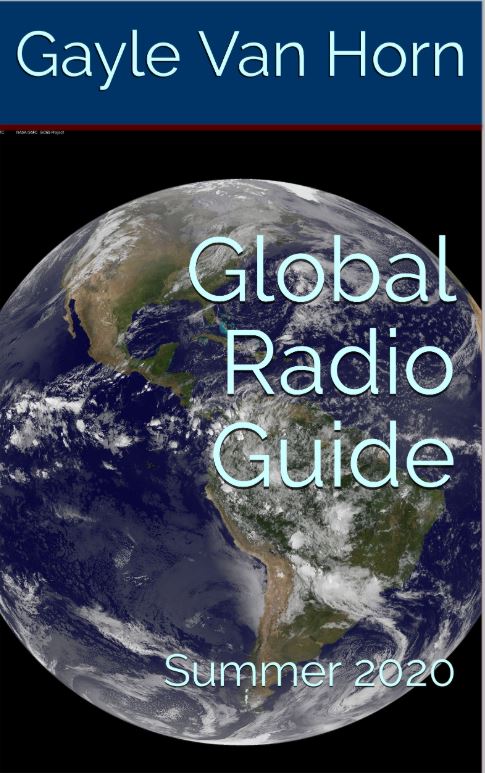
During times of emergency and crisis, radio hobbyists worldwide turn on their radios and tune to the shortwave radio spectrum for context, perspective, and insight into what is happening around the globe. As tensions heat up in the world’s hotspots, you can follow these events on radio, and you need an accurate and comprehensive radio guide to hear the action.
Teak Publishing is proud to announce the release of that all-important radio resource – the Global Radio Guide (GRG), 14th edition (Summer 2020) e-book, by Amazon bestselling author Gayle Van Horn, W4GVH. The book was formerly known as the International Shortwave Broadcast Guide.
Teak Publishing co-founder and GRG author, Gayle Van Horn, says that for this 14th edition, they have brought back the popular SDR Buyers’ Guide and expanded their coverage of SDR information, by popular demand.
“Based on the responses from our readers of the 13th edition of the GRG, we have expanded the coverage of SDRs in this 14th edition”, says Van Horn. “SDRs are truly the future of our hobby and DXers need a source they can trust for information on this booming industry.”
SDR coverage in this edition includes direction finding HF stations using the SDR.hu network of radios by Mike Chace-Ortiz. Tom Witherspoon takes an AirSpy HF+ Discovery into the field and shows us how we can truly operate a portable receiving station. There is also an introductory article on Software Defined Radios, an updated SDR buyers guide, and an in-depth equipment review on the new SDRPlay RSPdx SDR.
[…]You can find this edition of the Global Radio Guide, along with all of our titles currently available for purchase, on the Teak Publishing Web site at www.teakpublishing.com
The price for this latest edition is US$8.99. Since this book is being released internationally, Amazon customers in the United Kingdom, Germany, France Spain, Italy, Japan, India, Canada, Brazil, Mexico and Australia can order this e-Book from Amazon websites directly servicing these countries. Customers in all other countries can use the regular Amazon.com website to purchase this e-Book.
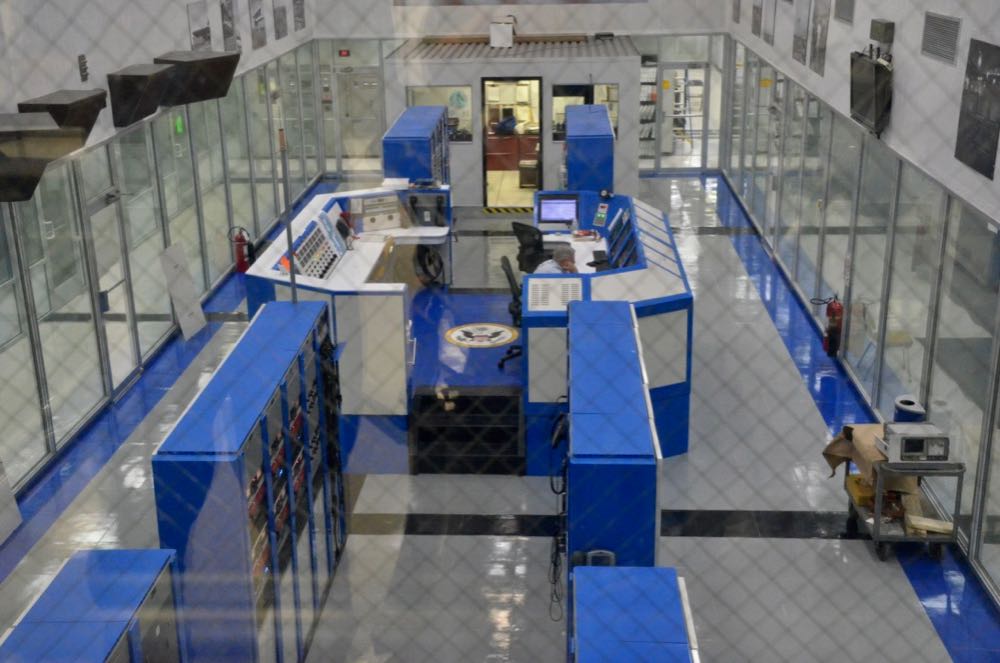
Control room at the Edward R. Murrow Transmitting Station near Greenville, NC.
Many thanks to SWLing Post contributor, Dave Porter, who shares the following news item from Glenn Hauser’s World of Radio:
Radio Marti has cancelled all programming via Greenville between 0400 and 1000 UTC effective from 2 May. During this period the only transmission left from Greenville is 0600-0630 VOA French on 9885. This may be the beginning of the end for Greenville. (Glenn Hauser WOR)
Thanks for sharing this, Dave. Sad news, indeed. The Greenville site has stared shutdowns in the face a number of times in the past and survived. This year, in particular, could be a challenge with Covid-19 affecting broadcasting budgets across the globe and with the current US administration not showing much love for the VOA.
We’ll follow this closely and post updates when available.