Shortwave listening and everything radio including reviews, broadcasting, ham radio, field operation, DXing, maker kits, travel, emergency gear, events, and more
An icom M802 package can be had for less that $3k… but the installation may run up anywhere up to $5k hence the OP’s ~$8k cost and request for alternatives. The bulk of cost (for pretty much anything in a boat) is always in installation…not the cost of electronics, as boats have unique issues regarding their ground.
As a sailor, when faced with a budgetary issue of installing a marine SSB radio system, IMO the answer is most definitely not “get a ham radio and your license”…the answer is most definitely “get a good SSB portable with an external antenna input”.
To get valuable weather resources such as Chris Parker (www.mwxc.com), weatherfax and eavesdop on atlantic nets, a quality portable SSB receiver is all that is required, provided that some sort of external antenna is used.
In my case, in the Bahamas, a 25ft length of wire semi permanently rigged to the flag halyard presented a strong and clear enough signal to reliably get the morning weather, and any weatherfax data I needed (along with the laptop).
My radio back then was the Satellit 800, and this year that behemoth will be replaced with a Tecsun PL-880… such a setup is ALL that is required.
Thank you for your input, Ian! It’s been seven years since we originally posted that article about HF receivers and transceivers on boats and yachts. I’m curious if any other readers might have suggestions they would care to share. What has works for you? Please comment!
Many thanks to SWLing Post contributor, Dan Robinson, who shares the following guest post:
An Initial Review of the Belka-DSP Shortwave Receiver
by Dan Robinson
A few weeks ago, during daily online excursions, I ran across the Belka-DSP receiver. This is not really a new receiver. Demonstrations have appeared on You Tube going back into 2019.
The Belka has a price of only about $120 U.S. I felt this was a fairly easy purchase, so I went to the website of Alex Buevky (EU1ME).
The receiver has a tuning range of 1.5 – 30 MHz – note that this is a revision from the description on the Belrig site, which still had a range starting at 3.5 mhz as of the time I am writing this.
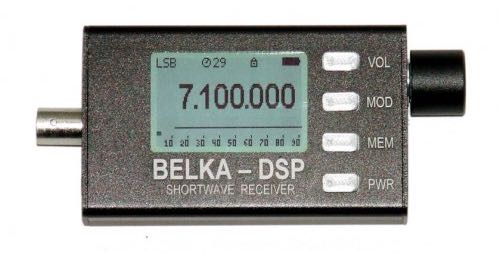
The Belka is contained in a small heavy duty metal box – the size reminds one of a few boxes of matches put together – 85x50x20 mm with weight of about 100 grams. Indeed, the diminutive size is quite striking.
While the menu system appears to be a bit confusing, once you start using the receiver you get used to the logic of it. From the description of the SDR:
“It is possible to adjust the frequency band both from above, from 2.4 to 4.7 kHz, and from below from 50 to 300 Hz. In telegraph mode, the frequency band is constant, about 300 Hz, and its center is regulated from 500 Hz to 1 kHz.
The settings of the favorite radio stations can be stored in any of 32 memory locations.
The receiver does not have a built-in speaker, but there is a rather powerful VLF bridge that provides sufficient volume when working with an external speaker, speaker or headphones.
The built-in LI-Ion battery lasts for 24 hours of total operating time on the headphones.
In addition to the built-in battery, the receiver can also work from an external DC voltage source of 5 V.”
The Belrig site is English and Russian, which makes ordering easier. However, be aware that when you hit purchase using a major credit card you may receive a security alert from the card company. Once I confirmed, the process completed and I received a verification email from Belrig – quite quickly and efficient.
Communications with Alex has been excellent – he is very responsive to suggestions and input.
The SDR arrived in an excellent small heavy cardboard box wrapped with the typical packing tape for the Belarus postal system. The receiver itself and a telescopic antenna with BNC connector were wrapped in bubble wrap. No paper instructions – those are available directly at the Belrig site [click here to download PDF manual].
The only other item on the Belrig site is a Panoramic Adapter:
“designed for use as part of a radio receiving path of a transceiver/receiver jointly with a personal computer (PC) and SDR software” according to Belrig. This Pan@SDR “allows you to visually see the RF spectrum in a band up to 200 kHz as well as to receive and decode different modulation types (depending on a software type). . . [and] may be used without a transceiver as SDR-receiver with fixed oscillator (similarly to SoftRock RX), for example, to listen to amateur and broadcasting stations, to decode and to record telegraph stations with CW skimmer, to control signal quality, to calibrate frequency. It may be used as well as a selective millivoltmeter.”
An unboxing video of the Belrig SDR can be seen here:
Initial impressions
My house in Maryland is notorious for high noise levels – located on a corner, we are surrounded by electric wires on four sides. My attempts to overcome this with my many main premium receivers involve W6LVP, Wellbrook loops and one PAR-FED long wire located outside, with ANC-4 and other noise reduction efforts in my basement radio shack inside.
When I use various portable receivers upstairs in the den of my home, I usually have to keep them well away from incoming Xfinity/Verizon cable TV and Internet lines.
Usually, I am unable to hear much using portables such as SONY SW-55s and Panasonic RF-B65s while sitting on the sofa in the middle of this large family room due to noise from all of these cable lines.
However, interestingly – using the Belka-DSP receiver I was able to get decent reception at this spot. I attribute this to the metal construction of the receiver, compared to portables with plastic cases.
Certain portables, notably the CountyComm/Tecsun GP5/PL-360-365 are extremely sensitive to being handled, with substantial signal loss once your hand is removed from the cabinet. The Belka-DSP exhibits sensitivity to touch, but not as much signal loss as there is when you take your hands off a Tecsun PL-365.
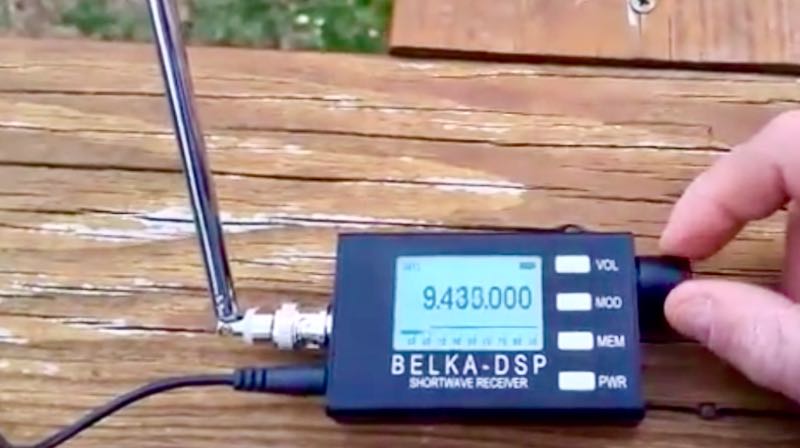
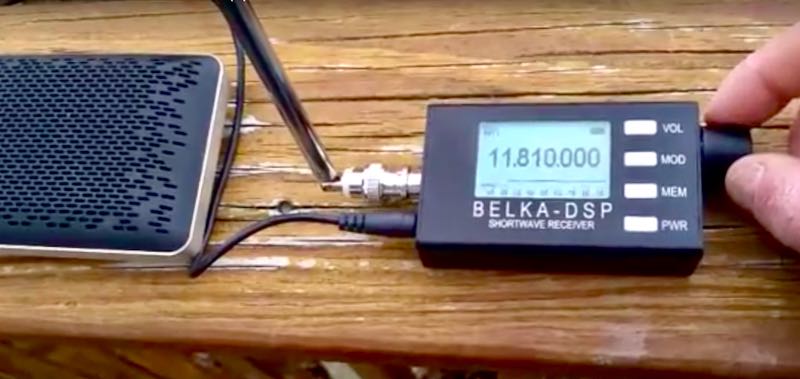
I did notice a few frequencies on the Belka where there are digital artifacts – one occurs at or around 11,810 kHz, the BBC frequency. You can see that in the accompanying video as I tuned up from 11,810.
Others are noticed at various points all the way up through the receiver’s top tuning range of 30 MHz, though thankfully most are not in major SWL bands.
Digital audio artifacts are seen on portable receivers using IC chips, notably the XHDATA D-808 which has several annoying digi-burps on some key frequencies occupied by stations. On my D-808 for example, 9,650 kHz has a digital artifact that interferes with reception of Guinea.
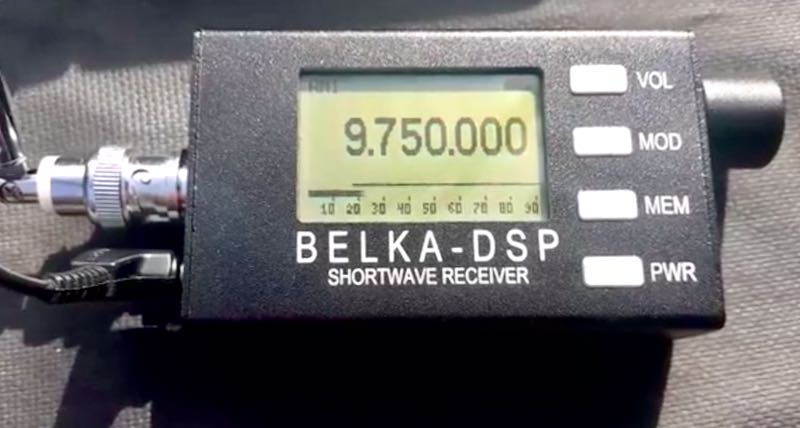
Tuning on the Belka is simple once you get used to the steps. The knob on the right serves for tuning, selection of tuning steps, volume, high-low sensitivity, the various audio “cut-off” modes which essentially function as DSP selectivity. There are 32 memories. Modes are: LSB, USB, CW, NFM, AM1, AM2. For AM mode, AM1 is the most useful, as AM2 seems to be quite harsh in its various DSP audio modes.
The Belka is very sensitive to the type of speaker it is plugged into, assuming you are not using a bluetooth dongle. Connecting via a 3.5 mm cable to a basic Brookstone speaker that has bluetooth produced audio overloads on the Belka, requiring careful placement of the speaker in proximity to the radio.
Whether this had anything to do with the quality of 3.5 mm cable I was using, I am not sure. These audio overload issues were not present using the DSP only with a pair of quality SONY studio headphones. I have not tested the Belka yet with a bluetooth dongle. So be prepared to do some experimenting with speakers and cables.
As mentioned by one person on SWLing Post, the surprise when I received the Belka was that the tuning range is actually 1.5 to 30 MHz rather than 3.5 MHz shown on the Belrig description and in the video there.
This certainly makes the small Belka more attractive, though one wonders why it could not include the full medium wave band.
Also unclear is whether the Belka will have the capability in future for firmware updates, and addition of any new features such as bluetooth though I have to think that adding bluetooth would impact battery duration.
I posed four questions to Alex, including why he made the decision to have the battery soldered in rather than easily user replaceable with battery terminals, whether he is considering adding bluetooth capability, adding capability for firmware updates, and whether he is thinking about extending coverage to include the full medium wave band.
Alex thanked me for my “interesting questions” adding:
“Now Belka-DSP is a final product in this regard no updates or modifications are planned in the near future. We do think about the way how to improve this receiver, how to make it even more user friendly, but I can not say exactly which changes will take place and when. Looking forward for your future questions.”
Alex says that the Belka receivers ship out with batteries not fully charged to comply with post office regulations.
For me, the battery issue is a bit annoying. Similar to cellphones with built-in batteries this means that when the Li-Ion cell does deteriorate you are stuck with a bit of soldering to replace it – and I am not good at soldering.
Another example of this practice is the Pocket SDR made by Gerhard Reuter in Germany which uses flat Li-Ion batteries that are soldered in. If you have no problem using soldering irons, then none of this is a concern.
I can live without on-board Bluetooth, since dongles are available online. But I would like to see coverage of the full medium wave band and it would certainly be nice to have FM band coverage. Obviously the ability to update the radio’s firmware would be a welcome addition.
Another suggestion I would make to Alex would be to provide some way to quickly move from band to band, similar to the capability seen on most regular portables. Having to constantly press the side knob to switch to rapid 50 kHz slewing to move say, from 49 meters to 19 meters, involves too much fiddling.
It would be interesting to see the internals of the Belka radio – four Philips screws are located on the left and right sides of the receiver, so that should not be difficult, though I have chosen not to go exploring inside mine.
Summary
Overall, I am very impressed with the Belka. This seems to be an amazingly quiet and sensitive little receiver. It’s obviously similar to the CR-1a in that it has a display, but much smaller and perfect for Dxing on the road, with a BNC connector that enables connection of any amplified antenna, loops or longwires.
I have included a video made outside my house using only the BNC telescopic antenna with the Belka, showing reception at about 1800 to 1830 UTC of some major stations in the SW bands.
This demonstration shows how sensitive the Belka is in broad daylight hours (also shown is my SONY SW-1000T).
A search of YouTube shows at least two other handheld DSP receivers being demonstrated in 2019, both with full scope screens, seemingly experimental units and on Russian YouTube channels. There is some discussion of availability, but as of early 2020 these units do not seem to be available.
It’s unclear whether any of these units ever made it to production on any scale. Comparing the features on these to the Belka – including AGC, Noise Reduction, Squelch, etc – it seems there might be quite a bit of space on the open market for SDRs that far exceed the capabilities of the Belka.
On the other hand, inclusion of larger scope displays would clearly have implications for battery life, which is one area where the Belka SDR – with its claimed 24 hour duration – obviously excels.
I will be interested to read other user reviews of the Belka-DSP – for now, it appears to be the only receiver of its kind and size being produced in significant numbers, so I certainly want to thank Alex for bringing it to the market.
Thanks so much, Dan for sharing your review of the Belka-DSP. I agree that likely the reason the Belka-DSP is less prone to the effects of holding and grounding is because it has a metal case and is probably better shielded. I agree that there should be an easy way to move between the various meter bands. Including features like this is always a concern in terms of ergonomics for small radios with simplified controls.
It is a fascinating and unique little receiver. Since it’s designed and produced by a “mom and pop” company, I imagine upgrades won’t happen unless there’s a new version produced at some point. With that said, this engineer obviously has the know-how to make a capable receiver!
Thanks again, Dan, and we look forward to any/all updates you wish to share!
Radio Waves: Stories Making Waves in the World of Radio
Because I keep my ear to the waves, as well as receive many tips from others who do the same, I find myself privy to radio-related stories that might interest SWLing Post readers. To that end: Welcome to the SWLing Post’s Radio Waves, a collection of links to interesting stories making waves in the world of radio. Enjoy!
Many thanks to SWLing Post contributors, Paul Evans, Troy Riedel, Michael Bird, and Marty for the following tips:
Behold the Sun’s convulsing surface at a level of detail never seen before.
The Daniel K Inouye Solar Telescope on Hawaii has released pictures that show features as small as 30km across.
This is remarkable when set against the scale of our star, which has a diameter of about 1.4 million km (870,000 miles) and is 149 million km from Earth.
The cell-like structures are roughly the size of the US state of Texas. They are convecting masses of hot, excited gas, or plasma.
The bright centres are where this solar material is rising; the surrounding dark lanes are where plasma is cooling and sinking.[…]
It is understood the NZ cabinet has signed off on a high-level decision to proceed and to commission a business case, after the Minister for Broadcasting, Kris Faafoi, presented a revised paper on Monday.
There was pushback from some senior Labour and New Zealand First ministers about the way the preferred option was landed on, the implications for public broadcasting if RNZ ceased to be a standalone company, and the speed at which it had been progressing.
The plan was to work towards having the new media company in place by about 2023 and that appears to still be the goal.
RNZ was told the amended proposal puts a specific emphasis on the fact the new company will be primarily a public service media outlet, and to ensure that is made crystal clear in any legislation, and through a charter.[…]
Good morning. I have been following SWLing over the years and it’s an amazing resource.
I’m writing from https://onesdr.com which is an Education website with articles that simplify Software-defined Radio. I write about practical aspects of SDR including associated components such as Low Noise Amplifiers, Filters, Bias Tees, etc. My goal is to demystify RF technology and make it more accessible to the growing community of SDR enthusiasts.
As well I have been contributing to several RF-related Wikipedia pages* to popularize RF and Wireless in general.
95% of respondents to ABC Friends’ Survey of ABC emergency broadcasting in bushfire affected communities believe there is a need for a national plan of additional essential communications infrastructure.
This devastating bushfire season attests to the ABC’s position as Australia’s pre-eminent emergency broadcaster. The number of ABC emergency broadcasts has risen from 256 in 2017-2018 to 371 in 2018-2019 to 673 to date this year (4 Jan). The ABC’s emergency broadcasts continue in the face of ongoing funding cuts and with no additional funding to cover the resources which have been poured into the effort.
On 3 January, via Facebook, ABC Friends National asked for feedback about the ABC’s emergency broadcasts from those affected by the bushfires. Whilst highly praised, there were reports that access to ABC broadcasts was sometimes a problem.
ABC Friends subsequent media release made an urgent call for the Federal Government to restore funding that guarantees infrastructure and transmission that is vital for emergency services broadcasting. It also advised of the launch of a survey (see appendix 1) to obtain more formal feedback about access to emergency broadcasts. This survey was delivered on 13 January via Facebook and via email through our membership and supporter base.
750 people responded to the survey.
91.1% of those surveyed said that the ABC local emergency broadcasts were important to them during the crisis.
96.1% of those surveyed said that ABC staff with local knowledge was important to them.
98.5% of those surveyed said that it was important to them that their local ABC outlet remain open and well-staffed.[…]
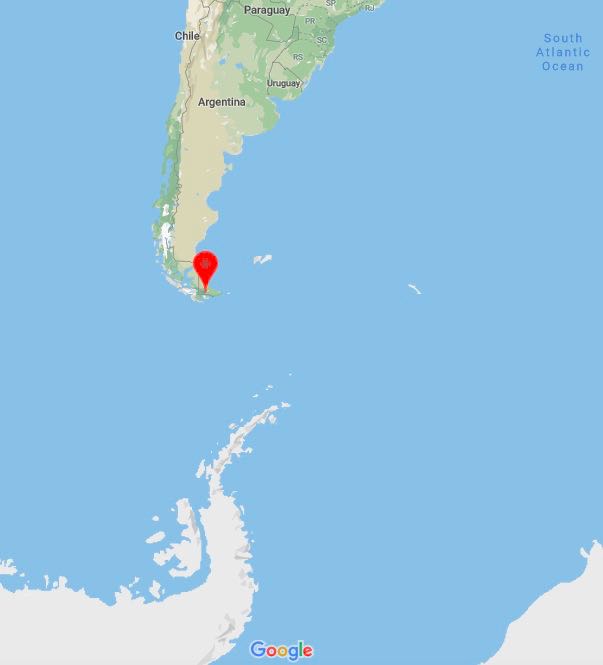
Thanks for sharing this, Tracy! I’ve been listening to this station the past few weeks as they do stream online. Puerto Williams/Cape Horn would certainly be a fascinating part of the world to visit and one that’s on my bucket list! For now, I’ll enjoy their community station!
Many thanks to SWLing Post contributor, Paul Evans, who writes:
I see this receiver as a remarkable break through. Using audio processor to emulate modes from IQ is very, very clever. This is perhaps the article of the year!:
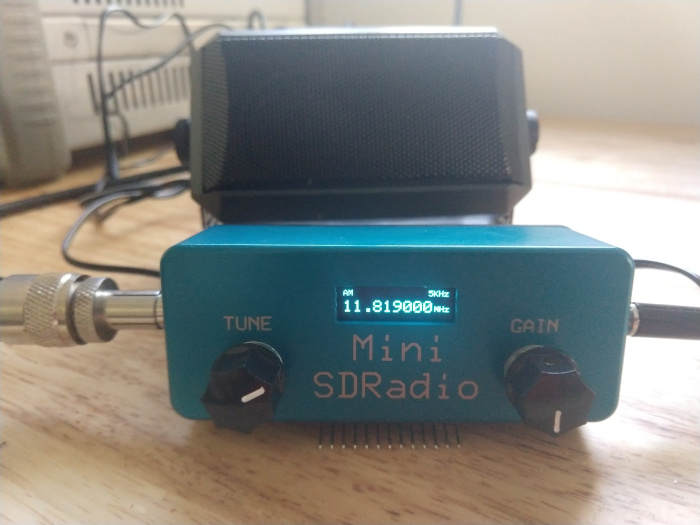
[…]This is a revised version of my FV-1 based SDR. I replaced the CS2100 clk generator with the Si5351 clk generator. The Si5351 has some advantages over the CS2100, namely you can generate quadrature clks directly. This simplifies the hardware design and improves the quadrature accuracy. The sideband rejection in LSB/USB modes is impressive..somewhere around 60 db as best I can measure. The DSP processing is accomplished by the use of a FV-1 audio processor. The device makes the base band signal processing a snap. It requires some code to be loaded on a EEprom but the circuitry is simple and allows for up to 8 selectable programs. I created three: AM/USB/LSB . The FV-1 provides for three analog POT inputs to control any parameters you choose. Gain, variable filter bandwidth and depth, AGC are some examples of adjustable parameters if you desire. I kept it simple and created fixed band pass filters to taste. I did use one of the controls for AF gain. The design has no tuned circuits or band pass filters but they could easily be added. It works just fine without them. Occasionally, I come across a ghost signal from harmonic mixing, when tuning, but not enough to matter. The design uses an OLED display and a rotary encoder for tuning. The frequency coverage is from 2.7 Mhz to 25Mhz. The bottom limit is created by the inability of the Si5351 to support quadrature below this frequency. Although I have improved my DSP programs for the FV-1 and have developed new display drivers and the new code for the Si5351, useful detail about using the Fv-1 can be found in my original design from a few years ago: https://circuitsalad.com/2015/06/19/comming-soon-stand-alone-software-defined-radio-baseband-demodulator-no-computer-required/
The design uses a LTC6252 low noise op amp as an RF input with gain. It provides a constant and reliable resistive Rf termination for the sampling detector. This allows for random antennas to be used without adversely affecting the input termination to the detector. All the code to operate the main processor(display/clk generator/tuning, band select and receive mode) was written in MikroC which is a C compiler for PIC and AVR processors. The generation of quadrature signals out of the Si5351 is not difficult to implement once you know how but..figuring that out took me a couple weeks of experimentation! You can connect switches, the encoder, volume pot and display directly to the main board for operation but I created a secondary board to mount the display and encoders. Instead of an analog pot and selection momentary switches, I used another microcontroller and two encoders(with one built in momentary push switch each) to create all of the switching signals, gain control, etc. This allowed me to have just two controls for all features. The controls include: tuning, audio gain, mode, and tuning step. Tuning resolution is from 1Hz to 100KHz . For fun, I made the output of the FV-1 differential into the audio amp. This is not necessary.
Here is a link to all the files used to build this radio in a zip file(updated 1/18/20):
Wow–that is fascinating! Thanks for sharing, Paul. I’m curious if any SWLing Post readers have experimented with the Si5351.
Interestingly, SWLing Post friend Dave Richards (AA7EE), also recently shared this video of an amazing Si5351-based VFO built by JF3HZB:
This must be one of the best analog emulations I’ve seen on a display. Marry the SDR receiver above to this VFO and you could have a top-shelf homebrewed receiver!
Many thanks to SWLing Post contributor, Troy Riedel, who recently shared his observations about low self-discharge batteries with me. He has kindly allowed me to post his message here on the SWLing Post. Troy notes:
I’ve lauded Tenergy rechargeable NiMH batteries and I wanted to share something with you.
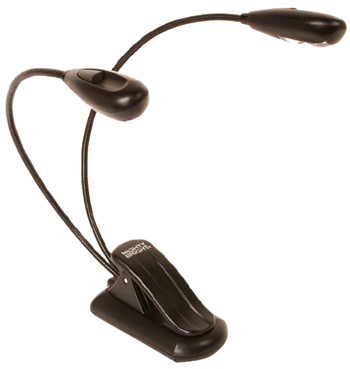
Mighty Bright Navigation Light
I have a box of Mighty Bright combination Red & White LEDs that I use for astronomy (they’re a clip-on light used by pilots and also marketed for use in the automobile – they hold three AAAs).
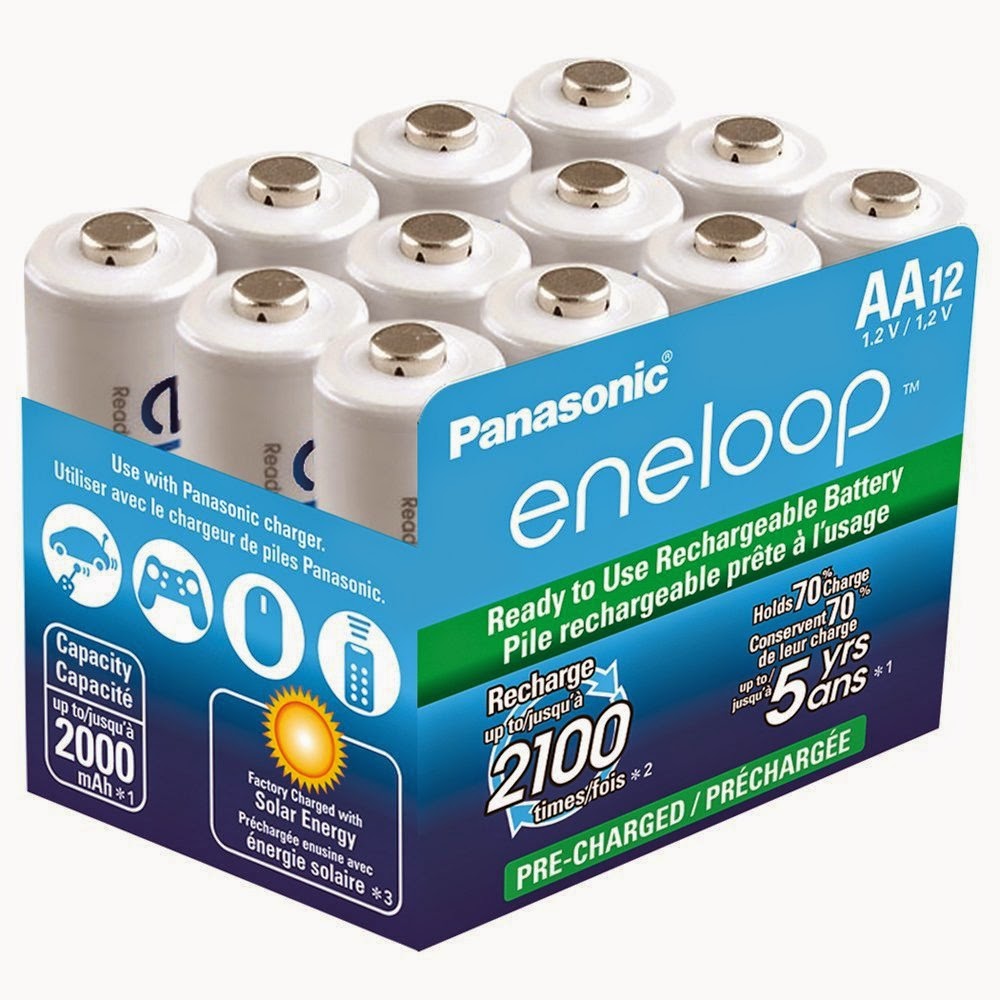
Approx. 18-months ago I put fully charged Rayovac, Energizer, Eneloop & Tenergy Centura Low Self-Discharge batteries in them.
Last night I pulled them out.
Rayovac: 0% charge. Energizer: 0% charge Tenergy Centura LSD & Eneloop: both averaged ~ 70% of a charge … (6 batteries in two lights) … though some of the Eneloops had a slightly higher charge (maybe 2 – 5% higher), most of the batteries were virtually indistinguishable.
You can buy 8 Tenergy for $9.99 while 8 Eneloop cost $17.99.
If cost were not an issue I’d still go with Eneloop (a longer track record), but the Tenergy is a worthy – no, very worthy – value vs. performance choice.
Panasonic Eneloop batteries
Thanks for sharing your real-world feedback, Troy.
I’m a big believer in low self-discharge rechargeable batteries. Indeed, I’ve almost replaced all of our “legacy” (meaning not low self-discarge) NiMH AA and AAA batteries with Eneloop cells.
Eneloops are pretty pricey, though, and the costs add up if you have a lot of devices that require batteries. As you might imagine, portable radios demand a steady supply of AA batteries at SWLing Post HQ.
I’ve been very pleased with my Eneloop batteries and, frankly, haven’t switched brands because of the terrible luck I’ve had with “legacy” rechargeables in the past. I’ve purchased so many that worked wonderfully for a few months then began to lose their capacity even though I employ an intelligent charger that properly breaks-in and cycles them.
I do believe I’ll add some Tenergy AA and AAA batteries in the mix now–especially for non-radio applications like lighting, remotes, clocks, and other consumer electronics.
Radio Waves: Stories Making Waves in the World of Radio
Because I keep my ear to the waves, as well as receive many tips from others who do the same, I find myself privy to radio-related stories that might interest SWLing Post readers. To that end: Welcome to the SWLing Post’s Radio Waves, a collection of links to interesting stories making waves in the world of radio. Enjoy!
Many thanks to SWLing Post contributors, William Lee, Stana Horzepa, Rich Cuff, and Marty for the following tips:
This iconic Los Angeles landmark has been emitting secret messages since it opened. However, only those with a keen eye for Morse code can decipher what they say.
It was the former president of Capitol Records, Alan Livingston, who got the idea to have the light on top of the building send out a signal in Morse code. The word chosen for this secret message was “Hollywood.” When the building opened in 1956, Samuel Morse’s granddaughter Leila Morse had the honor of turning the light on.
Some are interpreting this as meaning that – every – AM will be switching to digital leaving a Jillion AM only receivers with nothing to listen to (except for electrical gizmo noise). I give more credit than that to the owners of AM Radio Stations. I would highly doubt if any market would see all of their AM’s go digital. Perhaps in an ownership that had two AM’s it might make sense to have one of each.
[…]Other question is, what will the company that owns HD Radio (EXPERI) want to extract from the owner of an AM station that’s willing to put everything on the line and go all digital?
The bottom line is there appears to be a lot of interest in this proposal. The FCC’s process will likely draw a number of comments, pro and con. This will be an interesting process to watch. I can say one thing, never did I ever dream that we would be debating this issue![…]
Numbers stations—shortwave radio transmissions of monotone coded messages—are inherently creepy. But call sign UVB-76 has outcreeped them all by playing the same jolting tone from Russia since 1982. Similar broadcasts are useful for sending messages where snoops might intercept digital comms, so “the Buzzer” could simply assist spies. But it plays far fewer words and digits than confirmed espionage outlets, so some suspect it’s a science project that bounces radio waves off the ionosphere to detect solar flares. The most intriguing theory posits that it’s a doomsday device that will go silent should Russia suffer a nuclear attack, thus triggering retaliation.
My theory is that these mysterious sounds are actually the intro to a Pink Floyd song, possibly from their 1969 album Ummagumma. Because the early Floyd albums, before Dark Side of the Moon, are no longer heard on-air, the Russians stole this music knowing we’d never notice. Ooh, gotta go… I hear the black helicopters coming…[…]
When iHeartMedia announced this month it would fire hundreds of workers across the country, the radio conglomerate said the restructuring was critical to take advantage of its “significant investments … in technology and artificial intelligence.” In a companywide email, chief executive Bob Pittman said the “employee dislocation” was “the unfortunate price we pay to modernize the company.”
But laid-off employees like D’Edwin “Big Kosh” Walton, who made $12 an hour as an on-air personality for the Columbus, Ohio, hip-hop station 106.7 the Beat, don’t buy it. Walton doesn’t blame the cuts on a computer; he blames them on the company’s top executives, whose “coldblooded, calculated move” cost people their jobs.[…]
Amateur radio enthusiasts have proved themselves useful during the recent bushfires after traditional telecommunication channels broke down.
Amateur radio, also known as ham radio, is a skill and international hobby whereby enthusiasts use specific radio frequencies to communicate with each other.
In Australia, users must complete an exam to obtain a license through the Australian Communications and Media Authority (ACMA).
It was volunteers with these skills who were called in to assist during the recent New South Wales bushfires.
Neil Fallshaw is vice-president of WICEN NSW Communications, a group of volunteers with amateur radio licenses who can help in emergency situations.
He said about 30 members provided a temporary radio system in the Bega, Cobargo, Narooma, and Bermagui areas after some of the local radio infrastructure was damaged or had lost power.
“We deployed one of our radio repeaters on the mountains. We put a radio repeater system on that mountain to cover a portion of the south coast,” Mr Fallshaw said.
He said that radio system assisted the NSW Volunteer Rescue Association and Bega Valley Shire Council staff to communicate from bushfire-affected towns like Bermagui and Cobargo.
“They normally use just mobile phones, but the mobile phones in the area were down because of fire damage,” Mr Fallshaw said.[…]
Please support this website by adding us to your whitelist in your ad blocker. Ads are what helps us bring you premium content! Thank you!