Author Archives: Thomas

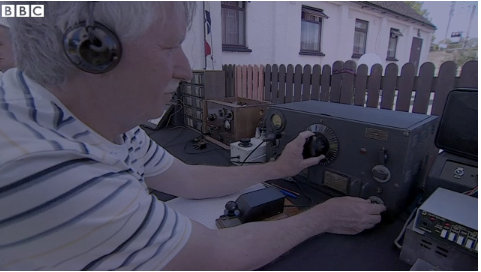
Video: Dan listens to RNZI’s Sunday Night with Grant Walker on a Hammarlund SP-600

DanH-SP-600

Many thanks to SWLing Post contributor, Daniel Hawkins, who writes:

One of my favorite Radio New Zealand International programs is Sunday Night with Grant Walker. This program is heard on RNZ in New Zealand from 8:06-10:00 p.m. and is run at the same time on RNZI. Sunday Night features hit oldies and one interview. Each program highlights oldies from one year. Last Sunday was 1977 and the week before was 1955. My video from last Sunday includes a favorite that I haven’t heard for many years.

The RNZI broadcast of Sunday Night is 0806-1000 UTC Sunday on 9700 kHz. That’s 1:06-3:00 a.m. Sunday, PDT. Definitely a show for night owls. West Coast reception is nearly spectacular for the distance: 6,600 miles from my location in Davis, CA, USA. The radio used for the video is a Hammarlund SP-600 JX-21, built in 1956 or 1957. Yes, the tuning dial is a little off on this band. I’m using the 8 kHz selectivity setting with fully advanced AVC. The antenna is a 106’ outdoor random wire. The speaker is antique as well: a 10” Jensen PM-10C with matching transformer connected to the 600 ohm audio output on the SP-600.

DanH

Click here to view on YouTube.

Wow! Thank you for the program recommendation, Dan!  I, too, have an SP-600–there are few valve receivers that can rival it for both audio fidelity and sensitivity. What a beauty of a rig you have there!

The AAA-1C: An affordable loop antenna amplifier kit

Active-Antenna-the-kit-product-7

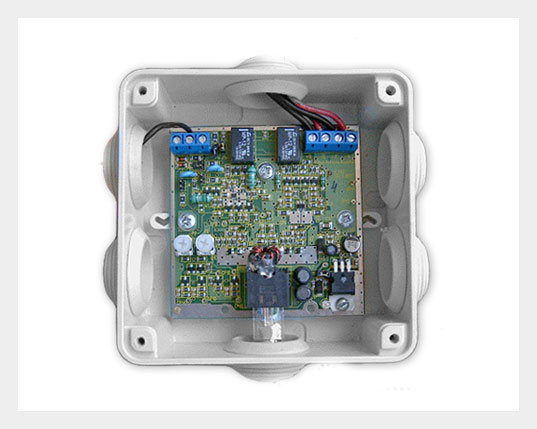
I recently stumbled upon the Active Antenna Amplifier (model AAA-1C) by LZ1AQ. At 87.00 EUR, it’s a pretty affordable and flexible solution for those who would like to design or use a loop antenna.

According to the website, it packs a lot of features:

  • 4 remotely switched modes (Loop A, Loop B, crossed parallel loops A&B and dipole)
  • Each mode can be switched immediately
  • Good sensitivity and a flat frequency response
  • High dynamic range
  • Protected input from strong signals
  • High immunity to local noise with balanced amplifiers and balanced feed line
  • Balun transformer coupling for common mode noise reduction
  • Extensive documentation manuals with detailed description how to build your own small antennas

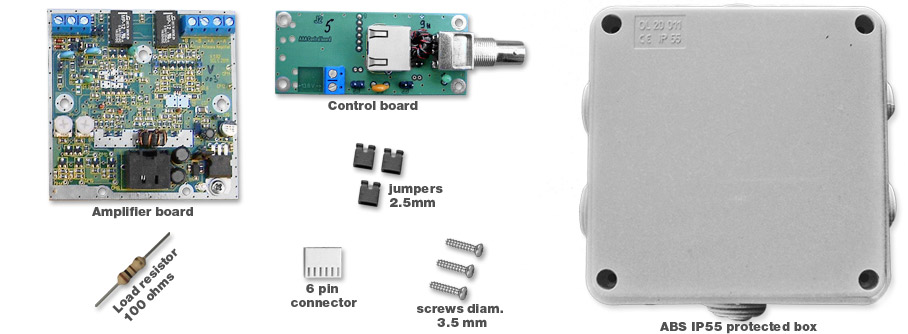
The amplifier is described as a kit because you must mount the board, wire up the antenna and set up remote switching yourself. It appears the SMT board comes pre-populated, though so I’m not sure if any actually soldering is required (perhaps someone can verify).

AAA-1B kit components

AAA-1C kit components

Click here to download the mounting instructions (PDF).

I’m tempted to purchase one this winter for use on mediumwave.

Click here for more info about the AAA-1C at LZ1AQ’s website.

Have any SWLing Post readers built and used this amplifier? Please comment!

Secret life of village that helped crack WWII code

WWii-radio(Source: Southgate ARC)

Whaddon: Secret life of village that helped crack WW2 code

On May 9, 2016, Milton Keynes Amateur Radio Society members operated GB1SOE to establish contact with French special event station TM75SOE using WWII equipment

This was to commemorate the 75th anniversary of the first transmission sent back to Whaddon Hall, Buckinghamshire, by Special Operations Executive (SOE) agent Georges Begue. They operated from Whaddon Hall during Monday using a replica MKIII transmitter and HRO receiver,  on the French side a WWII B2 spy set was used.

The BBC report: The Codebreakers at Bletchley Park are well known for their top secret work which helped to change the course of the World War Two.

But the Buckinghamshire village of Whaddon, just a few miles down the road, has long been forgotten, despite the vital role it played. It was codenamed Section 8 and was a satellite station for Bletchley Park.

It is hoped a new memorial will give it its rightful place in history.

Watch the BBC TV report on the commemoration at Whaddon
http://www.bbc.co.uk/news/uk-36245666

A shorter version of the BBC report is at
http://www.bbc.co.uk/news/uk-36248874

Further information in the QRZ.com entries for TM75SOE and GB1SOE

Milton Keynes Amateur Radio Society (MKARS)
http://www.mkars.org.uk/

FM DXing: Troy’s unexpected catch

Troy-FM-DX

Many thanks to SWLing Post contributor, Troy Riedel, who writes:

Thomas, if I were to read this on your blog, I would not have believed the following.

I live in Virginia nearly equidistant from RIC/Richmond Int’l AP (east of Richmond) and PHF AP (in Newport News). I had a 1:40 P.M. doctor’s appt. [July 12] and I took to I-64 East en route to the doctor near Newport News. My Silverado has an XM Radio that I typically listen to, but the reception is bad in the summer because of the wooded nature of the interstate.

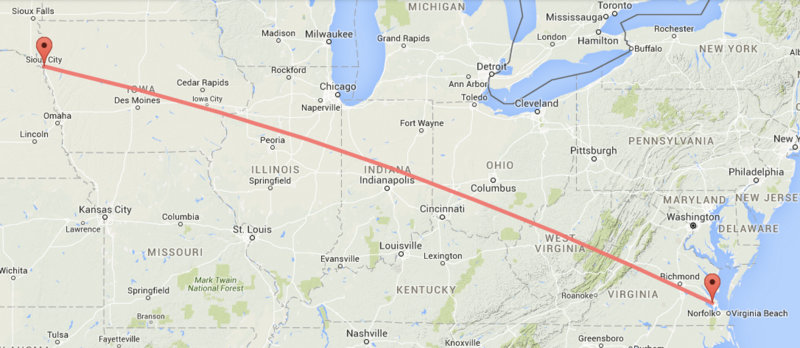
I hit the “FM” button and I quickly found a station at 105.7. There were two other 105.7 stations that periodically interfered, but one station was dominating/booming. After music I heard commercials about concerts in Iowa. I heard an Iowa Lottery Commercial. And a Lasik commercial – yes, all from Iowa. I heard a weather forecast that definitely wasn’t for Virginia. After 10-12 minutes I got a station I.D.. It was KSUX Sioux City, Iowa. Sioux City, Iowa is 1,332 miles away or an estimated 22-hour drive!

KSUX dominated the airwaves until I got very close to my Newport News, VA appt. By then (around 12:55 P.M.) I had picked-up one of the other two stations that were competing on 105.7. It was a station on the Outer Banks, NC (about 2.5 hours by car away).

When I went back to my Silverado at exactly 2 P.M., the KSUX was barely audible as the Outer Banks, NC station was now the most clear. I drove back towards my home on I-64 West and after a few miles (5-10 at most) the third of the three stations became clear. The third station was “Kiss 105.7” originating in Richmond, VA. That means the Sioux City, Iowa station, 1,332-miles away, had obliterated the Richmond, VA signal from 12:30 P.M. to almost 1:00 P.M. even though at this juncture of my drive Richmond was 45-55 miles away.

The KSUX Sioux City, IA station … even though weak on the drive home … still occasionally popped through the airwaves to cause interference with the Richmond, VA signal.

If I hadn’t heard it, I would have never believed it. I did a quick check and I didn’t see anything regarding closer stations possibly simulcasting the KSUX signal. It appears to be 100% legit.

I’m dumbfounded. It’s a head scratcher for sure.

Thanks for sharing your experience, Troy. You, sir, were the recipient of some excellent FM DX openings!

FM DXing conditions

There are a few conditions that make for proper FM DX:

  1. Sporadic-E and tropospheric ducting (DXers often call this, “Tropo”)
  2. Meteor scatter, where signals bounce off of ionized trails left by meteors
  3. Also, when there is exceptionally high sunspot activity, FM signals have been known to bounce off the ionosphere (like shortwave signals)

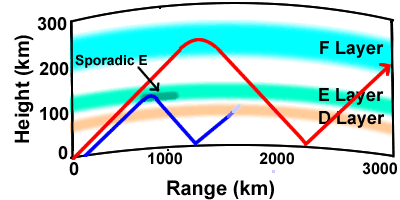
I strongly suspect you were enjoying FM DX from sporadic E. If memory serves (and keep in mind, I’m currently vacationing in an off-grid cabin without Internet), we had a K Index of 5 or so on July 12–at least, I believe I heard a ham radio operator report this on 40 meters that day. I can confirm that the HF bands were absolutely obliterated parts of that particular day. Conditions were very unsettled for the HF (high-frequency) bands, but potentially excellent for sporadic E.
Source: Wikimedia

Source: Wikimedia

Fred Osterman writes about Sporadic E on DXing.com:

Sporadic-E propagation is caused by patches of intense ionization in the E-layer of the ionosphere (approximately 35 to 60 miles above the Earth’s surface). Signals on frequencies above 30 MHz normally pass through the ionosphere and into space. However, sporadic-E “clouds” are capable of refracting such signals back to Earth. The term “clouds” is an apt way to describe the patches of highly charged particles that form during a sporadic-E event. Like clouds, these patches move and are highly irregular in size and shape. It is possible to track the movement of a sporadic-E “cloud” by noting the locations of stations that fade in and out on a frequency as the cloud moves.

Sporadic-E propagation can occur any time of day or year. However, sporadic-E is most common from about mid-May to late July, with another peak a week before and after the winter solstice. Sporadic-E seems to be most common from about mid-morning to noon, local time, and again from late afternoon through the evening hours.

If you’re interested in chasing a little FM DX (’tis the season–!), read Fred’s full article about FM and TV DXing on DXing.com. What I like about Fred’s article is that it’s simple and easy to understand.

Post readers: Has anyone else enjoyed a little FM DX this summer? Please comment! This is a part of the DXing hobby that I rarely feature on the SWLing Post, but would love to highlight more often. Let me know if you’d like to write a guest post on this topic!

Reminder: PCJ’s Vintage Radio Netherlands broadcast

pcj(Source: PCJ Press Release)

PCJ Radio International Vintage Radio Netherlands

In July PCJ Radio International will present a special two hour program called From the Radio Netherlands Archives.

The special program will broadcast material from the Radio Netherlands archives that has not been hear since it was originally broadcast. Material will be from 1947 to 1995 and will include some rare material.

Rare material will be from Jerry Cowan, Dody Cowan, Harry van Gelder, Eddie Startz, Tom Meijer and many others. Also included will be rare performances recorded at the wereldomroep of some internationally known artists.

The program will be presented by Paulette MacQuarrie; producer, editing will be Keith Perron who will also do the prologue.

This will be the first of a number of specials. Listeners who write in will also get a special e-QSL.

North America: 0100 to 0300UTC – Frequency 7570kHz July 18, 2016

Europe: 0600 to 0800UTC – Frequency 7780kHz

July 17, 2016

For more information contact PCJ at [email protected]

Milwaukee AES to become Ham Radio Outlet store

logo_hamradioMany thanks to SWLing Post contributor, Dave Zantow, for sharing the following press release from HRO:

(Source: Ham Radio Outlet)

RE: HRO-Milwaukee, Amateur Electronic Supply’s closing on 7/28/2016

On July 1, 2016 Amateur Electronic Supply (AES) made the decision to close down their entire organization and terminate all retail operations at their Las Vegas, Cleveland, Orlando and Milwaukee locations.

Upon hearing the news, and with the concurrence of AES senior management, Ham Radio Outlet (HRO) sent senior management to each location to interview the staff with hopes of acquiring some of the Amateur Radio retail employee talent in each of the current AES locations.

Together with this interview process, HRO examined what it would take to perhaps acquire one or more of the AES store locations. At the time of these interviews, many opportunities were explored with current AES senior management.

We are very excited to announce that HRO was successful in providing offers of employment to a number of soon to be former AES employees and that to some, we have offered positions that involve HRO sponsored and funded relocation.

We are also extremely pleased to announce that, after the closing of the Milwaukee AES location on July 28, 2016, Ham Radio Outlet will begin an extensive remodeling project to create the largest Amateur Radio retail showroom in North America. We will open our newest and largest Ham Radio Outlet in Milwaukee at the end of August 2016.

Effective at the closing of AES on July 28, 2016, all former AES locations’ direct telephone numbers and toll free telephone numbers will be redirected to the closest HRO location so as to not disrupt providing service to the AES customer base. Additionally effective on July 28, 2016, the www.aesham.com website will be directed to www.hamradio.com also so as not to disrupt service for the AES online customer base.

Steve Gilmore, National Sales Manager for HRO states, “We are extremely excited to have a store in the Central Northern part of the United States. It will minimize shipping times for our products to be able to be delivered in 2 days or less in most of the lower 48 United States. We are building a showplace that all must come see! It will be expansive with massive inventory levels and a large all encompassing demonstration area featuring nearly all of the Amateur Radio transceivers on the market today.”

Robert Ferrero, President of HRO tells us, “It is with great pleasure that we are able to continue Terry Sterman and Phil Majerus’ legacy of providing a fantastic Amateur Radio store in Milwaukee, Wisconsin. It is our immediate goal to have the largest, most well stocked Amateur Radio retail store in North America and perhaps even the world.”

HRO is a family owned business with 14 sales locations throughout the United States which includes a formidable presence on the Internet, making it the largest Ham Radio dealership in the world.

HRO has been continually expanding with our most recent location in Plano, Texas which opened on February 2, 2015. HRO is also continuing to evolve with the relocation and expansion of our Portland store which will open on July 25, 2016 at 14405 SW Pacific Highway, Portland, Oregon 97224.

Ham Radio Outlet – Milwaukee is located at 5710 W Good Hope Rd, Milwaukee, Wisconsin. It will be open for business at the end of August 2016.

“Shortwave” – student film recounts 1973 Military Coup in Chile

Shortwave-Film

Many thanks to SWLing Post contributor, Gary Wise (W4EEY), who writes:

YouTube recommended a video titled, “Short Wave”. Of course I had to watch.

It looks like it might be  student film. It recounts the 1973 Military Coup in Chile with a ham radio operator reporting from Santiago.

Takes me back to my college days. Worth a look:

Click here to watch on YouTube.