Category Archives: Art

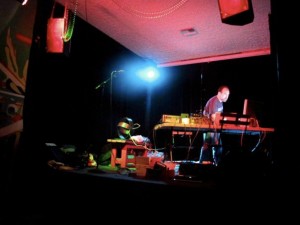
For Elliott Sharp, musical experimentation was inspired by shortwave radio

In the past, we’ve noted several artists and musicians who were inspired by the audible characteristics and sonic texture of shortwave radio (check out the Besnard Lakes and Radius, for example).

Guitarist, Elliot Sharp, was inspired not only by the sonic qualities of shortwave radio, but also the mechanical qualities:

(Source: the Star Tribune)

Elliott Sharp does not believe in categories or conventions. It’s not that he’s trying to be rebellious. He’s just very curious — the kind of tinkerer who built a short-wave radio as a kid — and smart enough not to be deterred by artificial distinctions.

…[H]e’s worked with a ridiculous array of musicians, ranging from such rockers as Sonic Youth and singer Debbie Harry, to jazz greats such as Jack DeJohnette, to the legendary Pakistani singer Nusrat Fateh Ali Khan and classical music’s groundbreaking Kronos Quartet.

[…]Then there is the scientific side of Sharp’s brain. He grew up in Cleveland, where his father designed speakers and microphones. Already grounded in music from studying classical piano at age 6, he built a short-wave receiver at 11 and began experimenting with layers of noise.

Later he would link music and mathematics. Some compositions, he said, use algorithmic approaches “derived from the workings of recombinant RNA and the dynamics of bird flocking and wolf packs.”

He was also among the first musicians to deploy computers. The last of his three solo sets at the Walker will include “additional electronics and more free-ranging improvisation,” he said.

For more on Elliot Sharp, check out the full Star Tribune article quoted above, or visit Sharp’s website.

Willis Conover’s Jazz: A secret weapon in the Cold War

David Goren, Shortwaveology author and producer for Jazz at Lincoln Center, released a JazzStories Podcast today featuring VOA broadcaster, Willis Conover. Willis Conover is a noted name in both Jazz music and international broadcasting. His characteristic deep and articulate voice guided many shortwave listeners behind the iron curtain, into the realm of Jazz music.

Here is the description of the podcast from  Jazz at Lincoln Center:

During the Cold War with the Soviet Union, the United States had a secret weapon: Willis Conover’s “Jazz Hour,” carried on the shortwave radio signals of The Voice of America across Russia and Eastern Europe:. Starting in 1955 and running for over forty years, ‘Jazz Hour’ nurtured generations of jazz musicians who grew up under the restrictions of Communism. On this edition of Jazz Stories we hear Willis Conover and two outstanding jazz musicians, Czech bassist George Mraz and Russian trumpeter Valery Ponomarev – both of whom learned about jazz from his broadcasts.

You can preview this podcast on the Jazz at Lincoln Center podcast page (look under “Jazz and the Cold War”) or simply subscribe and download it on iTunes.

ShortWaveMusic offers one-day music download in honor of World Radio Day

Our friend, Myke, over at the ShortWaveMusic blog has a very special World Radio Day gift:

As the preeminent blog dedicated to preserving and disseminating indigenous sound and music as heard via international radio, ShortWaveMusic is observing World Radio Day with a special, one-day-only offer: a download of the 5-CD retrospective box set, The Clouds Should Know Me By Now: ShortWaveMusic 2005-2010. This box set was compiled in 2011 for release on a prominent independent record label, but has since stalled at the gate for various reasons. As a result, I’ve decided to give it away on the occasion of World Radio Day – perhaps no more fitting time to compel others to enjoy the vast and kaleidoscopic array of music available via shortwave radio.[]

What are you waiting for? Go to ShortWaveMusic and get your free download–bookmark the site, too, as Myke offers some incredible recordings and journals of his audio/radio expeditions. (This is not the first time we’ve mentioned Myke’s work on the SWLing Post.)

Thanks, Myke, and happy World Radio Day!

London pirate radio documentary offers insight

This documentary certainly touches on the motivation behind most pirate radio stations. I should note that while many FM pirate stations are dissapearing with the advent of online sources, shortwave pirates seem to be going strong and they use many of the same remote transmitter tactics that appear in this short film.

If you have trouble watching the embedded video above, please click here for the documentary video page.

Chucho Valdés: Inspiration from VOA Jazz Hours

(Source: Kim Elliott via the Hartford Courant)

24 Jan 2012, Owen McNally: “Still very much an irrepressible life-force at 70, Chucho Valdés, the renowned Cuban pianist, composer and bandleader, is on a winter tour of the United States that sets down for high-energy maneuvers … at the cabaret series at the University of Connecticut’s Jorgensen Center for the Performing Arts. … The title track [of his new CD], ‘Chucho’s Steps,’ … is a 50-bar adventure in challenging harmony in which he pays tribute to John Coltrane’s intimidating masterpiece, ‘Giant Steps.’ Valdés notes that as a young man in Cuba he would listen on short-wave radio to a program called ‘The Jazz Hour’ on The Voice of America, an experience that opened his ears to Coltrane’s innovations and the creative fervor of the new, iconoclastic music that was fermenting in the States.”

A nostalgic Cold War shortwave audio montage

Kudos to Mike Barraclough for bringing this video/audio to my attention. According to Mike, this audio montage was featured in an edition of Communications World in October 2000. It’s an amazing mixture of Cold War era audio recorded entirely on the shortwave spectrum. Enjoy via embedded video below, or click here to view directly on YouTube.

(Source: Paul Dougherty)

Cold War Shortwave was created in 1989 using off-air recordings made while I was traveling in Europe circa 1985. This was a time when propaganda was harsh, before the Gorbachev inspired thaw. The collage was done with Soundwave from Impulse, my first experience with non-linear, random access editing.