Category Archives: Articles

SWLing in Belize City: comparing the Grundig G5 and G3

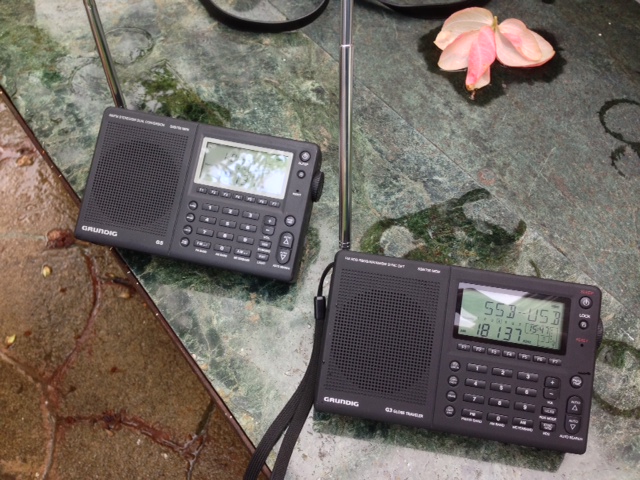
G3AndG5BelizeFor the past week, I’ve been traveling:  this time, in the inner-city section of Belize City on behalf of Ears To Our World, where we’ve been working with ETOW’s partner organization, The Belize Council for the Visually Impaired (BCVI).  I had the honor of working with a group of visually-impaired and blind children, giving each a self-powered shortwave radio, along with instruction on its use.

One of our talented advisory board members, David Korchin (KC2WNW)–also an avid SWLer–met me on this recent adventure. One afternoon, we found a moment to pull out our portable radios.  Turns out, he had brought his Grundig G5 while I had my Grundig G3. So we sat back to listen: to broadcast stations (including RRI and REE), to ham radio communications, and to some medium wave stations, including Radio Reloj on 790 kHz. Some great radio listening, by the way.

It was interesting to observe that in almost every case, the G3 had a slight edge on the G5. The G3 noise floor was slightly lower, and audio characteristics slightly better, than the G5’s. Where the G3 really had an edge, though, was on single-side band, where its selectivity was far superior to that of the G5.

With that said, if you purchase a G3, be sure to check out  your unit’s performance thoroughly–and keep your receipt. When Amazon last posted a sale on the G3, we had several reports of faulty units (check out the comment thread in this post). Though I cannot confirm this, I suspect these may be among the final units of the G3 production line.  Choose carefully, and you’ll enjoy a great radio.

By the way, I’ve always had good luck purchasing through Universal Radio.
WWVB celebrates 50 years of quietly keeping time

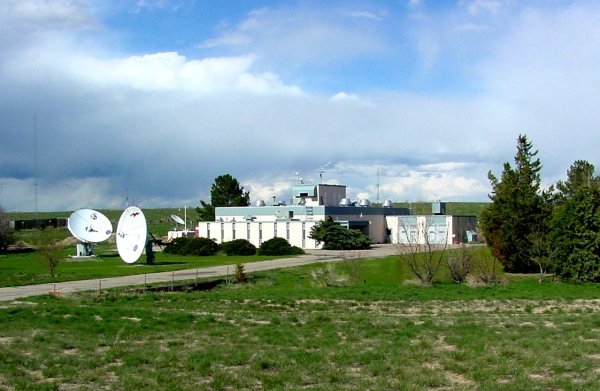
WWV building in Fort Collins, Colorado (photo courtesy: NIST)

WWV building in Fort Collins, Colorado (photo courtesy: NIST)

Thanks, David, for sharing a link to this brilliant article on the history and future of WWVB:

(Source: Wired)

Every night, while millions of Americans are fast asleep, clocks and wristwatches across the country wake up and lock on to a radio signal beamed from the base of the Rocky Mountains. The signal contains a message that keeps the devices on time, helping to make sure their owners keep to their schedules and aren’t late for work the next day.

The broadcast comes from WWVB, a station run by the National Institute for Standards and Technology. WWVB marks half a century as the nation’s official time broadcaster on July 5. Together with its sister station, WWV, which is about to hit 90 years in service, NIST radio has been an invisible piece of American infrastructure that has advanced industries from entertainment to telecommunications. (WWV’s broadcast includes a wider range of information, including maritime weather warnings and solar storm alerts).

Most people aren’t even aware that these stations exist, but they have a rich and fascinating history. Their future is uncertain, however, as newer technologies threaten to make them obsolete.

[…]WWV began broadcasting reference frequencies for signal calibration using equipment not that different from the chunk of quartz in a modern wristwatch. These days, though, a bit of quantum physics keeps the nation’s signals in sync. Cesium-133 atoms within the NIST-F1 atomic clock oscillate a frantic 9,192,631,770 times per second, acting like the pendulum of a grandfather clock. By tuning into that oscillation, NIST defines the basic unit of time, and by extension, frequency. Over the years, the reference frequencies have been so finely calibrated that they are accurate to beyond a single cycle in a trillion.

[…]WWVB’s value might have a lot to do with the type of signal it broadcasts and its location. While most commercial radio waves measure only a few meters between peaks, WWVB’s low frequency signal results in a whopping five kilometer wavelength. These long-wavelength signals can reach around the curvature of the planet by clinging to the semi-conductive surface of the Earth. On a clear night, a radio-controlled watch can pick up WWVB’s 60 kHz signal as far away as Patagonia or New Zealand.[…]

Read the full article at Wired.com.

Interview on Syntone

SyntoneI’m honored that Etienne, with the French radio arts website Syntone, posted an interviewed he recently conducted with me.

For those of you who speak French, you can click hear to read the full interview–and I would suggest you also bookmark this excellent site. If you don’t speak French, you can always run the post through a machine translator.

Merci, Etienne!

The 24th Anniversary of Tiananmen Square

Tiananmen Square_man_blocks_tank_238Yesterday, I had two reminders of how important shortwave radio is in China.
The first was this incredible recording shared by David Goren–an unidentified Radio Beijing announcer who departed from the script and commented on the massacre of protestors in Tiananmen Square in 1989. It’s believed this announcer is still imprisoned:

The second was an article that a journalist friend had posted. It’s simply a list of search terms that the Chinese government blocked on Sina as of June 4th. Of course, the list contains words you would assume would be included, like: 1989, 89, vigils, and memorial ceremony. But it also includes words like: Internet block, sensitive word, and inappropriate for the public. Think of how many sites and posts this blocked (certainly ours!). Of course, there are many more terms on the list–check out this article on China Digital Times for more information.

So why is shortwave radio still important in China? It’s impossible to block those search terms on radio.

Radio Vacation

MTCoverMay13

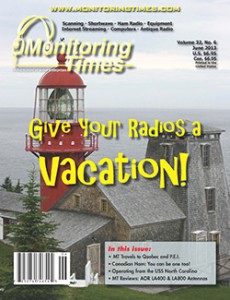
The front cover of MT features a photo I took at Pointe-à-la-Renommée lighthouse and Marconi station in Quebec, Canada. Without a doubt, one of the most beautiful lighthouses I’ve ever seen.

Some of you may remember that I took an extended vacation last year in the maritime region of Canada.

Monitoring Times Magazine just published an article I wrote about the vacation which includes a visit to Sackville, New Brunswick, four weeks in an off-grid cabin in eastern Prince Edward Island and a trip through the Gaspe region of Quebec.

Looking back, it’s amazing how much radio time I packed into that trip.

Read the full article in the June 2013 issue of Monitoring Times magazine.

Check out the AFRTS Archive

AFRTSMany shortwave listeners are familiar with the Armed Forces Radio and Television Service (AFRTS); we’ve mentioned them before and the wide variety of programming they offer via several transmission sites.

I recently discovered the AFRTS Archive, an excellent blog that posts archived audio and memories from the AFRTS. The AFRTS Archive is actively updated and chock-full of nostalgia.

It’s Memorial Day here in the States and found this a fitting time to dig through the AFRTS Archive.

Of course, you can still listen to the AFRTS on shortwave–here are the frequencies:

AFN/AFRTS Shortwave Frequencies (note: all broadcasts are in USB)

  • Diego Garcia:
    • 12,579 kHz daytime
    • 4,319 kHz nighttime
  • Guam:
    • 13,362 kHz daytime
    • 5,765 kHz nighttime

Jonathan explores the past and present of the Radio Netherlands Madagascar Relay Station

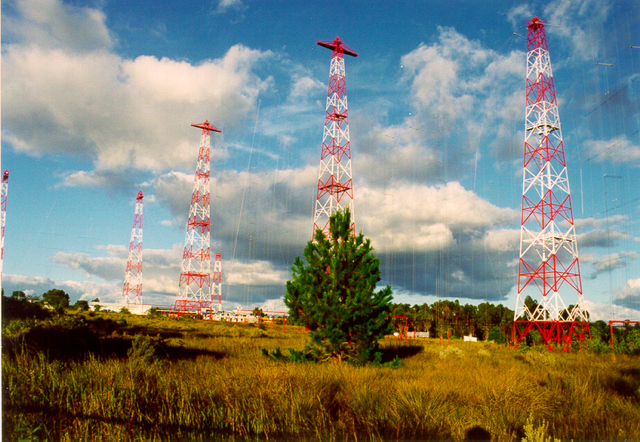
Madagascar Transmission Towers (Source: Critical Distance)

Madagascar Transmission Towers (Source: Critical Distance)

Many thanks to former RNW Media Network host, Jonathan Marks, for sharing this insightful look at the Radio Netherlands Madagascar Relay Stationa must read!

Indeed, check out this article and many more on Jonathan’s Critical Distance Weblog.

If you were a fan of Media Network, you should also bookmark Jonathan’s Media Network Vintage Vault.