Category Archives: FM

Ajit Pai designated as chairman of the FCC

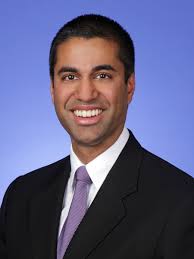
FCC Commissioner Ajit Pai (R)

(Source: Forbes)

In one of his first official acts, President Trump designated Commissioner Ajit Pai as the new chairman of the Federal Communications Commission. He is the first newly appointed Republican chairman since Kevin Martin nearly 12 years ago. Many have asked: how will the FCC change under Chairman Pai?

Until recent years, the FCC was not a partisan agency. Having served with commissioners Mignon Clyburn and Michael O’Rielly, Chairman Pai is not expected to be particularly partisan.

Chairman Pai has served as a commissioner for nearly 5 years, and his views on a wide range of topics are publicly available on his FCC website that highlights his many Commission opinions, Congressional testimonies, speeches, publications, and blogs.

It is impossible to predict exactly where Chairman Pai will go with specific future policies such as network neutrality, particular mergers, and the aftermath of the disappointing and flawed broadcaster spectrum auction. But it is easy to describe broad themes of a Chairman Pai: follow the law, less regulation, and a folksy approach to government. […]

Continue reading at Forbes.com.

March 2-4, 2017: Join us for the 30th (!!!) NASWA Winter SWL Fest!

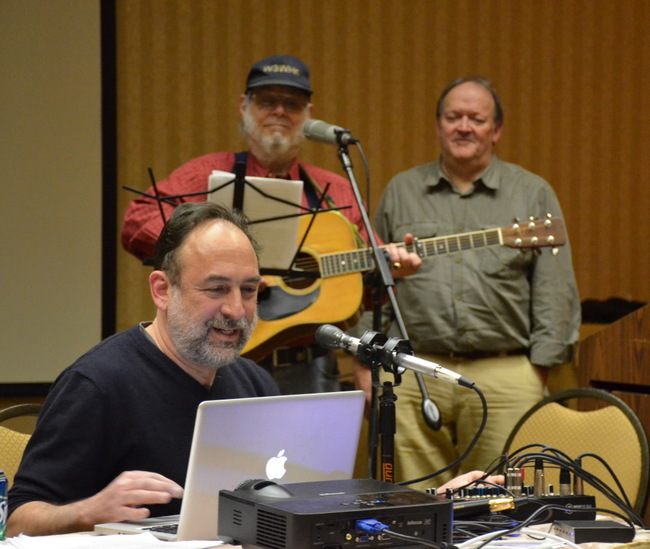
Broadcasting a live performance of the Shortwave Shindig at the 2015 Winter SWL Fest.

Every year, I look forward to the only event I know that brings together both my avid interest in radio and my loyal radio-listening friends: the Winter SWL Fest. This is the one place where, among the 125-plus attendees, you can talk freely about all aspects of the shortwave hobby without any need of explanation as to why you find radio so fascinating. As a result, over the course of the eight years I’ve attended the ‘Fest, it has begun to feel less like a technical hobbyists convention and more like a (most enjoyable) family reunion.

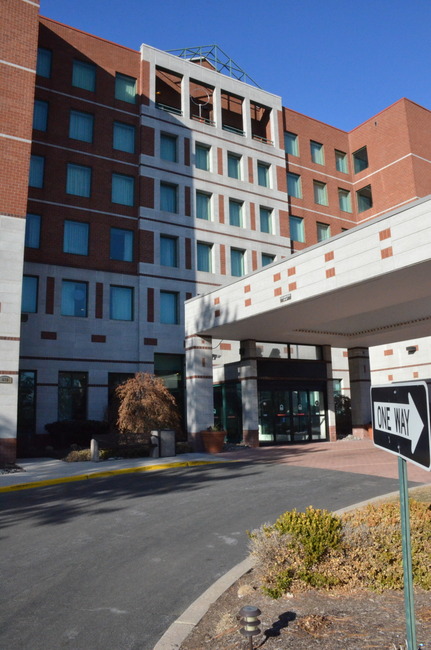
The DoubleTree hotel where the Winter SWL Fest is held. Notice anything unique about the top floor of this hotel?

This year, the Winter SWL Fest is celebrating its 30th (!!!) Anniversary. The ‘Fest organizers have added an extra day to the convention making it a special three day event.

Here’s the description from the Winter SWL Fest website:

The Winter SWL Fest is a conference of radio hobbyists of all stripes, from DC to daylight. Every year scores of hobbyists descend on the Philadelphia, Pennsylvania suburbs for a weekend of camaraderie. The Fest is sponsored by NASWA, the North American Shortwave Association, but it covers much more than just shortwave; mediumwave (AM), scanning, satellite TV, and pirate broadcasting are among the other topics that the Fest covers. Whether you’ve been to every Fest (all 29, starting with the first year at the fabled Pink & Purple Room of the Fiesta Motor Inn) or this year’s will be your first, you’re sure to find a welcome from your fellow hobbyists.

For 2017, the 30th Annual (!!) Winter SWL Fest will have three days of sessions where you can learn about the latest developments in the radio listening hobbies, but there’s so much more going on. There’s a silent auction that takes place, where you’re bound to find something of interest. There’s the Hospitality Suite, where attendees partake of tuning oil and other treats and engage in spirited conversations. There is the closing Banquet, with after-dinner remarks by a luminary from the field, often one of the many broadcasters who attend the Fest, followed by the raffle, where you could win one or more of the dozens of prizes, ranging from pens from stations up to top-notch communications receivers. And of course, the infamous midnight ride of Pancho Villa that closes things out every year.

Early registration fees are available through the month of January, as an incentive to register early. We strongly urge you to do so as fees will increase for those registering January 28th and later.

Hotel Registration: The Doubletree Guest Suites offers a special $109 rate (single or double) that includes a full breakfast buffet. Reservations may be made by phone at +1-610-834-8300 or 800-222-8733 or online here; click on Special Rates and enter the group code NAS. If at all possible, please reserve hotel rooms using our group code, so we can maintain proper credit and keep costs down.

Fest Registration: A paper reservation form may be downloaded here; you may also register online via PayPal here.

Your hosts, Richard Cuff and John Figliozzi, work throughout the year to ensure that attendees have a great time over the weekend, and by all accounts, they succeed stunningly. How else could this event have lasted for 30 years (egad) and draw people from around the world to southeastern Pennsylvania? Won’t you join us?

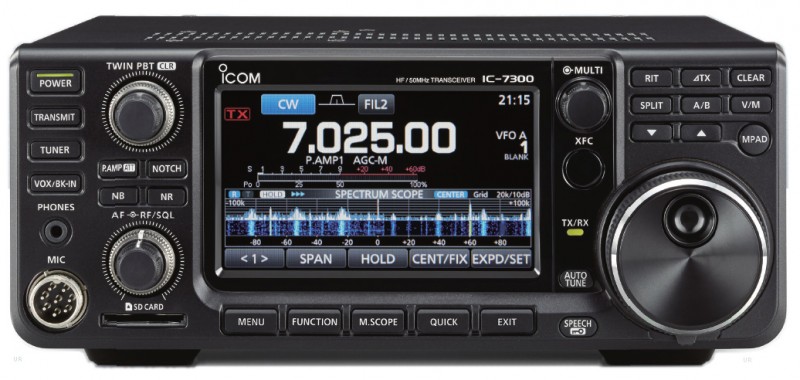
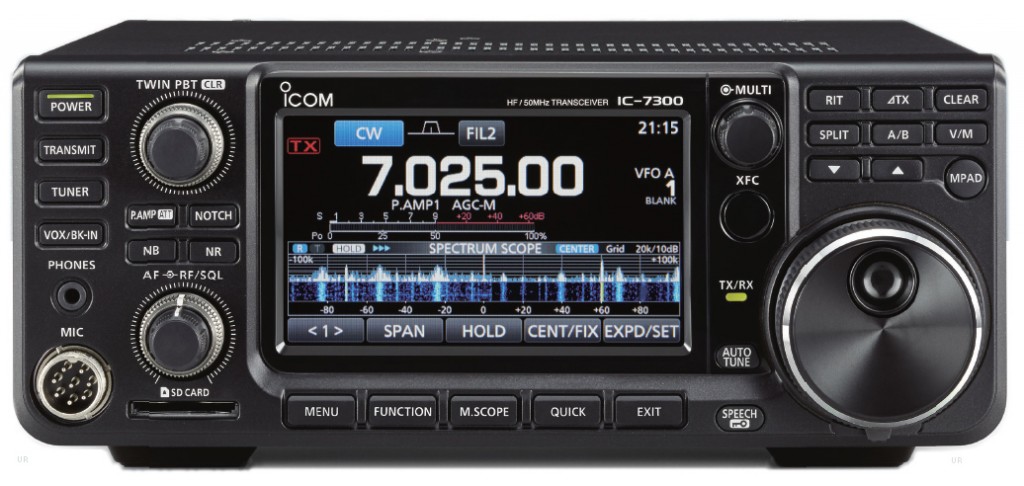
This year, the grand prize at the Winter SWL Fest is the new Icom IC-7300 transceiver (which also happens to be an exceptional general coverage HF receiver).
If you can make a pilgrimage to Plymouth Meeting, PA, please do so. I think you’ll enjoy the diversity of programs and people who attend. I’ll be there along with a number of regular SWLing Post contributors. It’s a great time to exchange stories and ideas in person.

I always leave the Winter SWL Fest energized about a new aspect of our radio hobby. I think you will too.

Click here to register for the Winter SWL Fest online.

TECSUN S-8800e availability in Europe and Bertrand’s first impressions

Many thanks to SWLing Post contributor, Bertrand Stehle (F6GYY), who writes:

Hi Thomas,

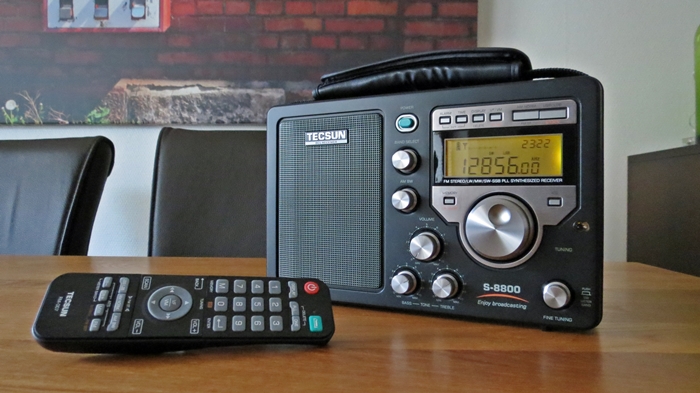
The new SSB portable receiver TECSUN S-8800 has been available from Germany, since the beginning of 2017.

Supplier:https://www.wellenjagd.com/ has the S-8800e, a Europeen version.

I have one unit here and also being an owner of the PL-880, [I would describe it as] a better PL-880 with more features.

DSP filters on SSB: 0.5 – 1.2 – 2.3 – 3.0 and 4.0 kHz

DSP Filters on AM: 2.3 – 3.0 – 4.0 and 6.0 kHz

Long telescoping Antenna L = 92 cm

BNC Antenna socket

AM External antenna (500 Ohm ) on panel….with an internal /external antenna switch.

Main and fine tuning [much] like the PL-880 , but all metallic buttons, bigger and of better quality.

VFO main tuning knob is large and has a good feeling.
Line out is stereo ( 2 channels ) L and R
Separate bass and treble control
2X LiH Batteries 18650 ( no external power supply possible, no 12V socket). Batteries can be charged while the rx st still in use.

On this S-8800e–my first impressions:

  • Very sensitive on longwave… ( PL-880 was not )
  • Very good copy of ssb stations
  • RX does not get so quickly overloaded as the PL-880 does…
  • Quite bigger than the PL-880 => 27 cm X 17 cm, about 7cm thick.

Wow–many thanks for sharing your first impressions, Bertrand!

I’ve been waiting quite a while for the S-8800 to be released. I will have one on order soon and will do some comparisons with the PL-880 and PL-660.

As you discover more about this receiver, please share your impressions with us!

Anyone else have the S-8800?  Please comment!

FMX: Not all broadcast innovations come to fruition

Many thanks to SWLing Post contributor, Aaron Kuhn, who shares the following in-depth article from Tedium.com:

The story of FMX, the wannabe radio standard that was taken out in a very public way

Attempts at standard-building in the radio industry have come up repeatedly over the years, and few of them have stuck, not even in the nobody-knows-about-it way that AM stereo has made its mark.

Perhaps the most fascinating of these attempts to improve the radio signal, however, is that of FMX. Formulated in the late 1980s as a more pristine version of the FM dial, it intended to solve a major problem with FM that had been lingering since stereo had been added in the early 1960s: When you move to the edges of the coverage area, the sound quality gets really low.

As you can probably tell by the fact that it’s generally still a problem in many vehicles today, FMX failed to solve that problem.

But the reason why it failed to solve that problem is more complicated than saying it didn’t work. There were both technical and political issues at play.

The technology, for what it’s worth, did have the right folks supporting it: The brainchild of Tom Keller, an engineer with the National Association of Broadcasters, and Emil Torick, who worked in the same role for the CBS Technology Center, FMX was intended to fix stereo’s weaknesses in low-quality areas. The best part? It was backwards compatible. It would reduce noise and improve the fidelity of FM stations for stereos with upgraded equipment, but those with cheap beater radios would still have the same staticky-in-outlying-areas experience that they did before.

Paul Riismandel, a radio industry observer who co-founded the industry news outlet Radio Survivor, notes that the FMX technology wasn’t the first of its kind. For example, Dolby attempted to bring its noise-reduction technology, common in cassette tapes, to radio stations in the 1970s, but its offering was generally ignored due to the fact that proprietary equipment was needed. (Over at the Internet Archive is a sample of what Dolby FM sounded like during a 1978 Minnesota Public Radio broadcast.)

But FMX likely got further than most due to two factors that became apparent in the 1980s: The fuzziness of radio stations in fringe parts of the broadcast areas, and the pristine sounds of the compact disc, which was becoming popular at the time.

“FMX was a way for radio to compete with this new digital technology and adapt to listener expectations,” Riismandel noted.

But the FMX technology proved controversial within the radio industry due to two separate incidents that cost the technology its momentum.[…]

Read the full article on Tedium.com.

In Sweden, Ambulances testing system to jam car radios

(Source: BBC News via Richard Langley)

Ambulances in Stockholm are testing a system that interrupts in-car audio systems to warn drivers that they need to get through.

The solution was developed by students at the KTH Royal Institute of Technology in the city.
It broadcasts a voice warning, while a text message also appears in the radio display.

It uses an FM radio signal to jam drivers’ speakers and stop music playing.

It will only be able to alert cars that have their radios turned on. It can also interrupt CDs and music connected via Bluetooth.

The radio transmission is sent from the emergency vehicle to nearby FM tuners that are equipped with RDS, a communications protocol for embedding small amounts of digital information in FM radio broadcasts. It is most commonly used to display the station or song title.

[…]The city will begin testing the system in a limited number of ambulances and fire engines, with plans to expand across the country later this year.

The warning system can work out how far in advance messages need to be heard depending on the speed of traffic.

Continue reading at BBC News…

Oops…Dutch regulator removes FM broadcaster’s antenna

(Source: Southgate ARC via Mike Terry)

Dutch regulator removes broadcaster’s antenna

It is reported the Dutch Radiocommunications Agency dismantled the antenna of a legally operating broadcast station

It appears they thought Vechtdal NL in Ommen on 105.6 MHz was a pirate but the station, an associate of Vechtdal FM, was correctly licenced. The Agency says that something went wrong with the checking of licences.

The antenna was on the watchtower of the State Forestry Besthmenerberg Ommen near Nieuwleusen. It is unclear if the Radiocommunications Agency will pay compensation for the damage.

Radio.NL article
http://radio.nl/812498/legaal-radiostation-vechtdal-nl-door-at-uit-de-lucht-gehaald

Muzen Audio handcrafted radios

Many thanks to SWLing Post contributor, John Figliozzi, who writes:

This [company] was mentioned in regard to the CES show out in Las Vegas:

http://www.airsmartaudio.com/

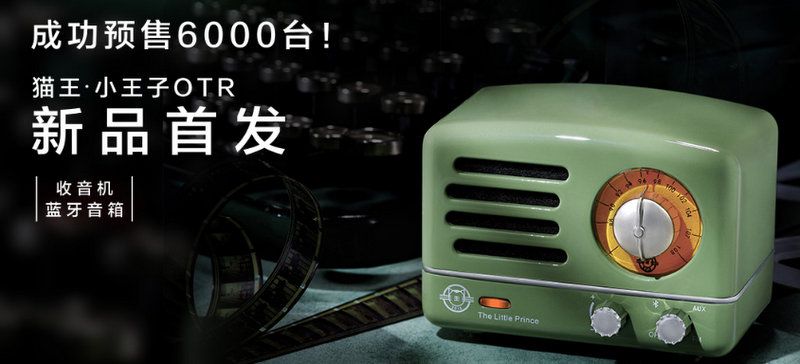
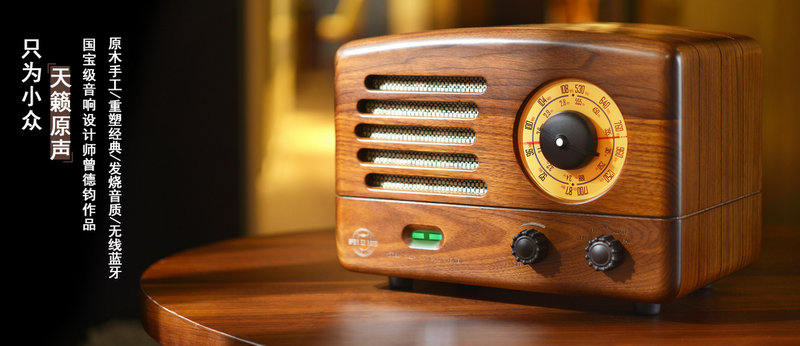
It’s a Chinese company with a rather novel approach to the design of modern radios — AM/FM/Internet Bluetooth, along with the use of tube amplifiers in some models. The web site is almost all in Chinese but the pictures are cool.

Air Smart Audio is the parent company; Muzen Audio the subsidiary.

John also shared the following item from Radio World:

Muzen Audio Group’s founder Dejun Zeng, referred to as the “Father of the Tube Amplifier” in China, is looking forward to the new challenge, saying in a statement: “It is my greatest desire to build a legacy with this organization that will lead customers to say, ‘I am proud to have a Muzen radio.’”

The company received a 2017 CES Innovation Award for their new AM/FM/internet radio and Bluetooth speaker lines, the fifth CES Innovation Award received by Zeng. Muzen Audio also designs a series of vintage-style tube amplifier radios and what the company calls “on-the-road” radios.

(Source: Air Smart Audio)

Thank you, John!

From what I gather, Muzen radios are very much “boutique” radios, thus come with a “boutique” price tag–some models costing as much as $500 US.

Still: it’s refreshing to see a Chinese radio manufacturer marching to their own beat, making handcrafted products in small batches.

According to Twice.com, Muzen recently introduced the  “Classic 1” AM/FM radio with Bluetooth speaker that is powered by a “fluorescent display tube amplifier.” Twice notes:

The Classic 1 is handmade and crafted with real rosewood, and every unit comes with a unique code verifying its hand craftsmanship.

Frequency response of the speaker is 75Hz to 16KHz, of the amplifier, 30Hz to 20KHz.

Pricing and availability will be announced during CES 2017.

I’m looking forward to learning more about Muzen radios! I do love the designs.

Click here to view the Air Smart Audio website (in Chinese). 

Post readers: Anyone familiar with Muzen Audio or own one of their products? Please comment!