Shortwave listening and everything radio including reviews, broadcasting, ham radio, field operation, DXing, maker kits, travel, emergency gear, events, and more
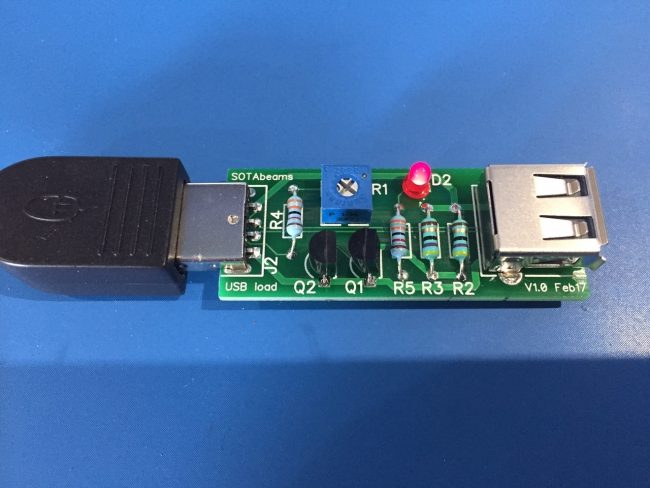
USB power banks are a convenient way of powering low power USB devices in the field. Unfortunately, as they are designed for charging phones and tablets, many have an internal electronic cut out circuit that switches power off below a certain current draw. The exact current that they switch off at varies from pack to pack.
Although there are circuits on the internet that purport to solve this problem by applying a pulsed load, we found this did not work with all power banks. As a result we designed a neat variable electronic load to address this problem.
Available as a kit, using it is easy; just plug it into your power bank, plug your target device into it and adjust the current draw until the pack remains on.
Many thanks to SWLing Post contributor, Tom Ally, who shares the following news via the Cornell Chronicle:
Engineers devise two-way radio on a single chip
Two-way communication requires, of course, both send and receive capabilities. But putting them in the same device requires a filter between the send and receive circuits to provide signal isolation.
Without a significant filter, communication would be impossible.
“Your transmit signal is [10 to the power 14] times stronger than your receive signal,” said Alyosha Molnar, associate professor of electrical and computer engineering (ECE). “That’s 100 trillion times stronger – that’s a really hard problem.”
But researchers in Molnar’s lab have offered up a solution.
Molnar and collaborator Alyssa Apsel, professor of ECE, have devised a method for both transmitting and receiving a radio signal on a single chip, which ultimately could help change the way wireless communication is done.
Their work is described in “A wideband fully integrated software-defined transceiver for FDD and TDD operation,” published online Jan. 27 in the Institute of Electrical and Electronics Engineers’ Journal of Solid-State Circuits. Doctoral student Hazal Yüksel and Dong Yang, Ph.D. ’15, are co-lead authors.
Separating the send and receive bands is difficult enough, but the problem is compounded by the ever-increasing number of bands in the latest devices. From GPS to Bluetooth to Wi-Fi, each band requires a filter to stop the strong transmit signals from drowning out reception.
Molnar and Apsel have come up with an ingenious way to separate the signals. Their idea lies in the transmitter – actually a series of six subtransmitters all hooked into an artificial transmission line. Each sends its signal at regular intervals, and their individually weighted outputs are programmed so that they combine to produce a radio frequency signal in the forward direction, at the antenna port, while canceling out at the receive port.
The programmability of the individual outputs allows this simultaneous summation and cancellation to be tuned across a wide range of frequencies, and to adjust to signal strength at the antenna.
“In one direction, it’s a filter and you basically get this cancellation,” Apsel said. “And in the other direction, it’s an amplifier.”
“You put the antenna at one end and the amplified signal goes out the antenna, and you put the receiver at the other end and that’s where the nulling happens,” Molnar said. “Your receiver sees the antenna through this wire, the transmission line, but it doesn’t see the transmit signal because it’s canceling itself out at that end.” […]
Many thanks to SWLing Post contributor, Ed, who notes:
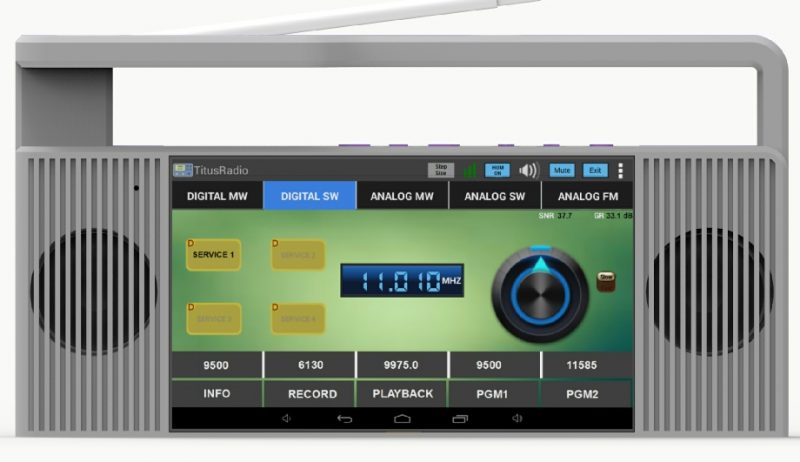
I just received a status update on the pantronX Titus II portable SDR from Mike, their chief engineer.
Mike said the self-contained SDR portable will include “SoapySDR as the interface to make it much easier to roll your own SDR app.” Here’s some info about SoapySDR:
Mike also said, “To be 100% truthful, our biggest push right now is for the international MW & SW broadcasters. They want to go DRM digital is the worst way!”
You might want to share this news with SWLing Post readers.
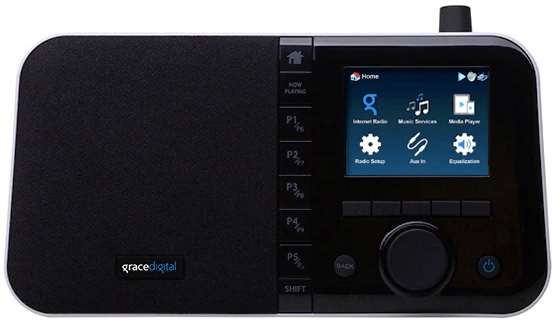
[T]hey are saying it is supposed to ship out sometime next month. [S]ome of the things it has –over the old Mondo–is Bluetooth 4.1 and Chromecast built in.
Thank you, Tom! Here’s the product description from Kickstarter:
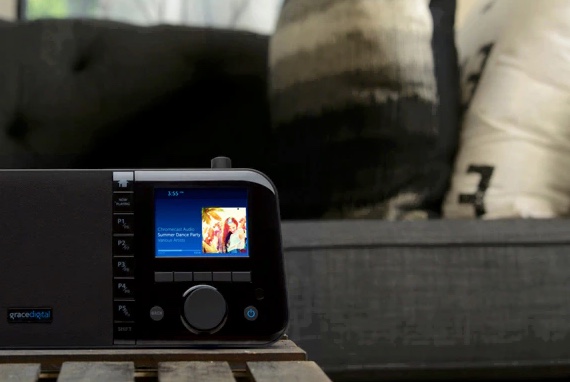
The home audio market is evolving, and Grace Digital is leading the way. We combined the latest Wi-Fi audio streaming technologies from Google, added Bluetooth audio streaming, and over 30,000 AM/FM/HD radio stations from around the corner to across the globe. The Grace Mondo+ can even be controlled by the Google Assistant on devices like Google Home, the front panel controls, free smartphone apps, or the included remote control. We wrapped the technology in a beautifully crafted cabinet, and drive the audio with custom made speaker drivers and high performance class D digital amplification, ensuring the best possible listening experience in a perfectly compact design. We hope you love the Mondo+ as much as we do!
This is an “all or nothing” campaign, meaning it’ll have to be fully funded for the production run to become reality.
As a Kickstarter supporter, the pricing is in line with the Grace Digital Mondo (we reviewed last year).
I am still quite happy with my Como Audio Solo, so will not plan to back the Mondo+ at this time. If I was interested, I would splurge for the $174 Early Bird package which includes a Lithium Ion battery pack. Shipping could be as early as April 2017.
Here’s the product description of the Mag Loop with Power Inserter from the W6LVP website (where orders can also be made–pricing identical to eBay):
The Wellbrook Model ALA1530LN-2 and DX Engineering (Pixel/Inlogis) Model RF PRO-1B magnetic loops are both good amplified receive antennas. However, they are both expensive. Shipping the Wellbrook antenna from the UK to the US adds another $100.
Extensive side-by-side testing of the Wellbrook, DX Engineering, and W6LVP receive loops was compiled using simultaneous WSPR signal-to-noise reception reports on all LF, MF, and HF amateur bands. In addition, extensive laboratory bench tests measuring gain, signal-to-noise ratio, and IMD were also performed. Signal-to-noise ratio is important to pull weak signals out of the noise and IMD is important to reject distortion caused by nearby strong transmitters such as AM broadcast stations. In both test regimens, all three antennas performed very well and without significant difference.
The antenna version listed here includes a power inserter for use with receivers or with transceivers that have a separate receive antenna input. If your rig doesn’t have a receive antenna input, check out my antenna with a transmit/receive switch.
If you live in the shadow of one or more high-power AM broadcast transmitters, contact me about a special version just for you. Please contact me at [email protected].
W6LVP amplified receive-only magnetic loop antenna (boy is that mouthful):
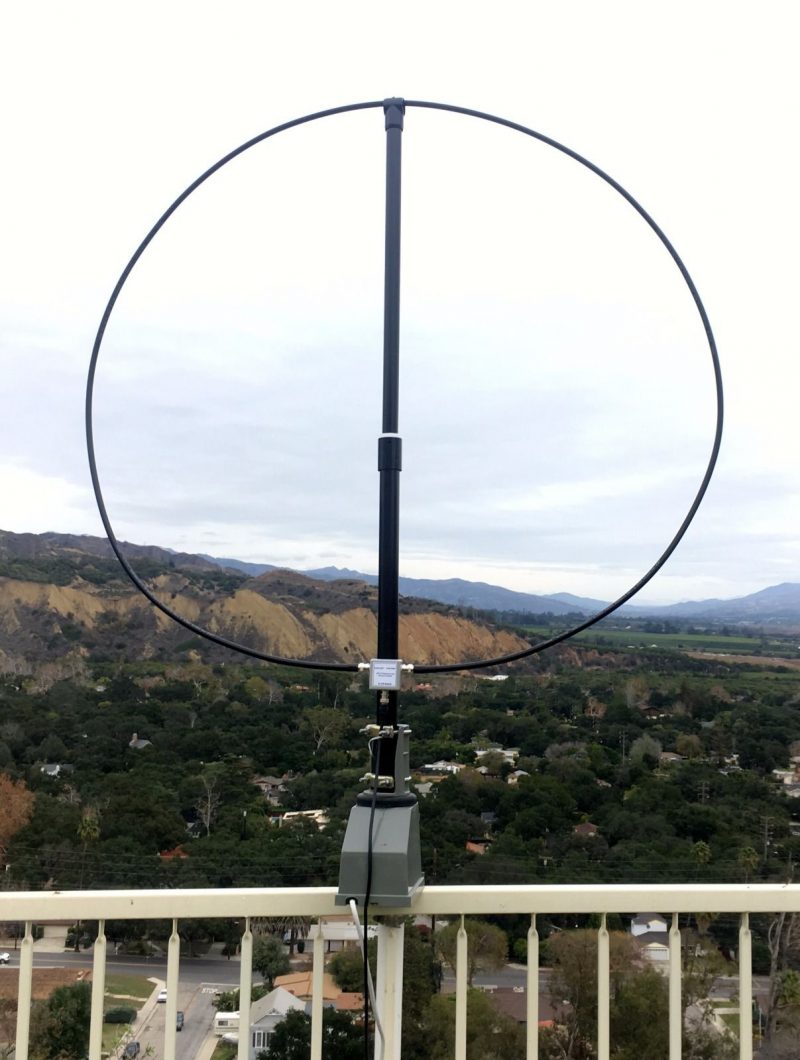
The W6LVP mag loop is a complete receive antenna system delivering top-of-the-line performance to amateur radio operators and SWLs – particularly for those with space and/or budget limitations. It is a great complement to vertical or wire transmit antennas. You have a knob to turn up the power but don’t have one to turn up the received S/N.
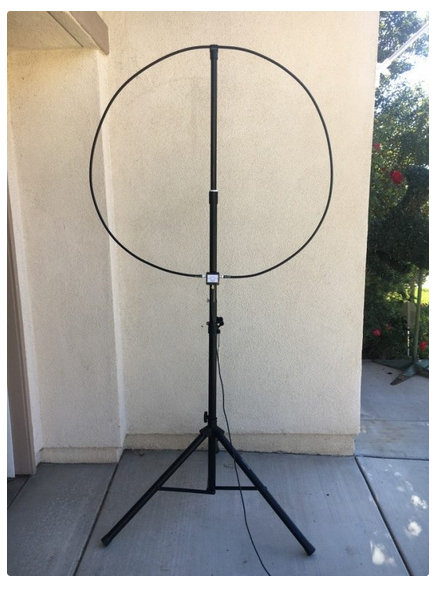
Ten foot circumference (approximately 1 meter diameter) loop. Small size yields a natural stealth for HOA challenges. The loop is rigid enough to maintain its shape but flexible for portable transport or attic installation.
Includes a low-noise, broadband amplifier covering 2200 (135 kHz) through 10 meters (30 MHz) with no tuning or adjustment. Perfect match for continuous tuning SDR receivers. Great for contesters to quickly check all bands. Greater coverage is possible at reduced performance.
Light-weight antenna structure fabricated from furniture-grade PVC yields a strong but very light antenna weighing only 2 pounds (not including power inserter or power adapter). Great for both portable/camping as well as fixed installations. Light weight and small size make for lower shipping cost – particularly compared to shipping from the UK.
Directly compatible with a low-cost speaker tripod stand (not included) for portable operation.
Compatible with light-duty rotator (recommended) for fixed operation. Loop can be rotated to null interference by up to 30 dB or enhance desired signals.
Includes low-noise linear AC power adapter to generate clean 12 volts for the loop amplifier. Unlike the DX Engineering antenna which requires 24 VAC, power can be easily supplied by 12 volt batteries during portable operation. Reverse polarity and short circuit protection provided by automatically resettable fuse.
I also discovered this short video of W9OY comparing the W6LVP loop to a full size 80 meter vertical (verticals are much more susceptible to noise than loops):
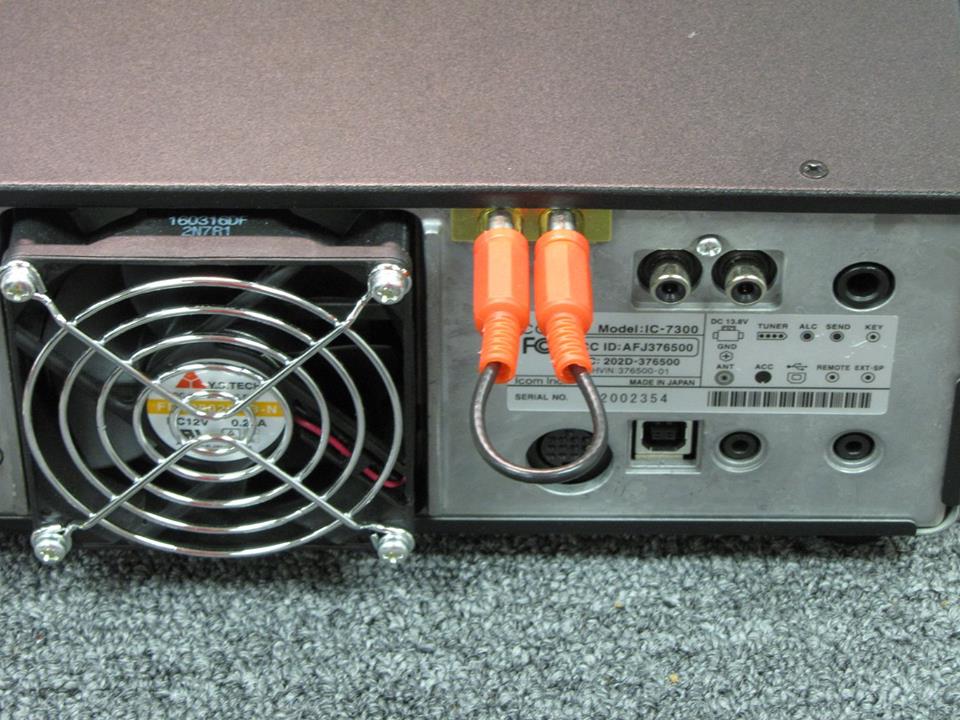
IHSG and Vibroplex/INRAD announce the release of a new accessory product for the Icom IC-7300 which provides a receive antenna socket on the rear of the radio.
The INRAD model RX7300 allows the user to add a receive-only antenna jack to the Icom IC-7300. This easy to install plug-in modification requires no soldering and is simple to install and easily reversible. The RX7300 can also be used for the insertion of accessory items into the receiver chain on the IC-7300 like receive-only bandpass filters, low noise preamps, etc.
When installed, the transceiver will use the SO-239 antenna connector on transmit, and one RCA phono jack on the RX7300 for receive. To use the transceiver in normal operation via the SO239, leave the RG-174 coax loop installed between the 2 phono sockets.
The RX7300 retails for £49.95 or £99.95 fitted and is only available through HIS group affiliated stores. Customers who purchased their IC-7300s via an IHSG store will receive a £5.00 discount from the supply only price and £15.00 discount from the installed price.