Shortwave listening and everything radio including reviews, broadcasting, ham radio, field operation, DXing, maker kits, travel, emergency gear, events, and more
“It’s a great radio with top FM, AM, and speaker sound. It blows away my C.Crane Radio-2E. Lack of illumination, however, makes it less than ideal as a bedside clock radio.”
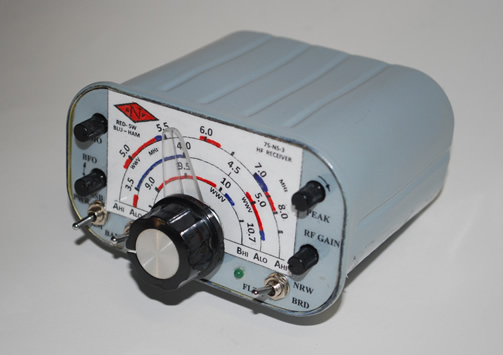
National RF, of California, has introduced a new “semi-kit” receiver: the RF 75-NS-3. Here’s an excerpt from the product description page of the National RF website:
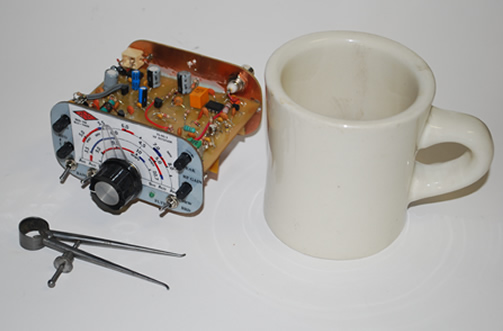
National RF’s 75-NS-3 receiver is a complete super-hetrodyne mini high frequency receiver, designed specifically for the short-wave listener, electronics enthusiast or radio amateur, who wants to use their hands and build a radio. The receiver is offered as a semi-kit in which the electronic assembly is loaded and functionally tested at the National RF facility. The customer must then go to the grocery store (yes…the grocery store!), procure a can of [Spam] lunch meat, eat it or give it to the dog, and then proceed to drill and paint the can, in order for it to become the receiver’s enclosure! […] Detailed drilling instructions and final assembly instructions are provided as part of the kit. All other parts required for completion of the receiver are provided as well. Recognizing that the finished assembly looked somewhat like the fabled Collins receiver of the ‘60s, the 75S-3, (particularly when the can is painted a light gray) National RF engineers dubbed it (with tongue firmly planted in cheek, of course) the 75-NS-3! Although we have had fun packaging this receiver in a lunch meat can, it is nothing to turn your nose at! Its performance and portability will surprise you, and it is an ideal radio to bring with you on any trip!
The receiver architecture is that of a single conversion super-hetrodyne receiver, that is capable of receiving AM, SSB, or CW. The receiver incorporates a dual gate FET as an RF amplifier with manual peaking and gain controls. A ceramic filter is used in the IF section with a front panel switch that controls a broad or narrow IF response. Other front panel controls include audio drive, BFO setting, and a band switch for the HF bands. The 75-NS-3 has internal receive frequency coils that are switched at the front and rear panels. The frequency range of the receiver, over three band set positions, is 3.5 through 12 MHz. This allows reception of several international short-wave bands, the 80, 60, 40, and 30 meter amateur radio bands, and of course, WWV time and frequency standard stations at 5 and 10 MHz.
For those who simply want a lower cost receiver to monitor the shortwave frequencies, National RF offers two variants of the original receiver: the 75-NS-1 and the 75-NS-2. Both are based on the design and circuit of the 75-NS-3, but do not have the band switching and frequency range of the 75-NS-3 receiver. The 75-NS-1 covers between 3 and 6 MHz, including the 80 and 60 meter amateur band. The 75-NS-2 covers between 6 and 12 MHz, including the 40 and 30 meter amateur bands. Both units have the fixed ceramic resonator band width set for about 6 KHz. And, of course, they are both designed to fit in the tasty potted meat can!! All other specifications presented apply to both of these models as well.
Pricing of the 75-NS-x versions:
Type 75-NS-1 Mini HF Receiver Semi-kit (covers 3 to 6 MHz) $189.95
Type 75-NS-2 Mini HF Receiver Semi-kit (6 to 12 MHz) $189.95
Type 75-NS-3 Mini HF Receiver Semi-kit (band switched from 3.5 through 12 MHz in three switched positions) $269.95
Shipping and Handling to within the US $10.00 each
Readers: if you haven’t checked out the SWLing chat room, I would encourage you to do so! There’s almost always someone there and, many evenings, readers share reception reports in real time. Click here to check out the chat room.
After publishing my initial review of the Sangean ATS-405 on July 25, I contacted Sangean and requested a sample radio for comparison purposes. Back story: there were some receiver performance issues that I suspected may have been tied to my particular ATS-405 unit. Sangean kindly dispatched another ATS-405 which I received last week. The following is an update to my initial ATS-405 review.
In truth, there were two main reasons I wanted another unit to compare to my initial review radio:
I wanted to see if the new unit showed improved performance–sensitivity, selectivity, and, specifically, noise floor–in comparison with the first review unit tested
I noted strong DSP “birdies” (noises) on 800 and 1600 kHz on the test model, while several of our readers commented that their ‘405s did not feature birdies
Shortwave sensitivity/selectivity and noise
I noted in my initial review that the initial ATS-405 had an ever-present noise, a sort of low-volume static hiss. The noise floor, while not high, certainly seemed to be higher than other comparable shortwave portables, and was most noticeable when tuned to marginal/weak stations. I suspect many listeners may not notice it unless they compare it with other portables.
Fortunately, my new review unit’s noise floor seems to be slightly lower than that of my initial review unit. [Perhaps this unit’s board is better soldered–?] The noise is still there, but can be better mitigated by judiciously using narrow filters and the three-position audio tone control.
I suspect this is a noise somewhere in the audio amplification chain, because I find it less noticeable with headphones, and more pronounced via the ATS-405’s internal speaker.
In terms of sensitivity and selectivity on the shortwave bands, I believe my new unit is identical to that of the initial review unit. That is to say, the ATS-405 is not an especially sensitive shortwave receiver, but fairly average, and thus will fit the bill for most but not for the discriminating weak-signal hunter. Frankly, even my $46 Tecsun PL-310ET does a better job of pulling in weak stations.
I’ve tried tinkering with the AGC settings and soft mute–very cool features!–in an attempt to improve sensitivity, but alas, these only help the quality and stability of the received signal.
Birdies
Immediately after opening the box of the new ATS-405 sample, I popped in a fresh set of AA batteries and tuned the Sangean to 1600 kHz AM. [If you read my initial review, I noted a strong DSP birdie on 1600 and (to a lesser degree) on 800 kHz].
At first listen, I was happy to note that the new unit lacks the wild DSP noise that overwhelmed my favorite local station on 1600 kHz.
As I listened more carefully, though, I did note a metronomic “chick” sound that was also present but partially buried in the noise on my initial ATS-405.
Below, I’ve embedded audio comparing the two receivers:
Initial review unit:
New review unit:
Listening to these samples, I realize I may have had the filter set to the middle position on the first sample and the wide setting on the second (hence, the brighter tone).
To further demonstrate the difference between the two, I made this short video; I start with my initial review unit, then switch to the new review unit provided by Sangean:
Note that this was recorded at least 100 feet from my house on the tailgate of my pickup truck. DSP birdies on 800 kHz sounded very much like the 1600 kHz sample, save the noise level on the latter is slightly lower and there are no broadcast stations in the background.
None of my other portables have digital noises or birdies on 800 and 1600 kHz.
So, the bad news: I do still hear a noticeable (and slightly annoying) internally-generated noise on the new review unit. The good news: it isn’t as objectionable as that on my initial review unit.
While the new ‘405 review sample seems to perform better than the initial ‘405 sample, I find the discrepancy somewhat marginal, especially since I spend the bulk of my time on the shortwave and mediumwave bands.
I’m not a fan of production runs where units vary so greatly from one to another, making accurate testing difficult. Therefore it’s quite possible you might receive a unit that performs better than those I tested…but unfortunately, the opposite is also true.
So, if you’re a Sangean fan, if you don’t mind the birdies on mediumwave, and if you mostly listen to strong shortwave stations, you may entertain purchasing an ATS-405. The keypad layout is almost identical to previous Sangean models.
To be clear, of course, this radio’s negatives above have been viewed under a microscope; the ATS-405 is not a “bad” receiver, it’s just not that exceptional. Other than the added mute/AGC/squelch features, when compared to its predecessors, it’s really not a better iteration.
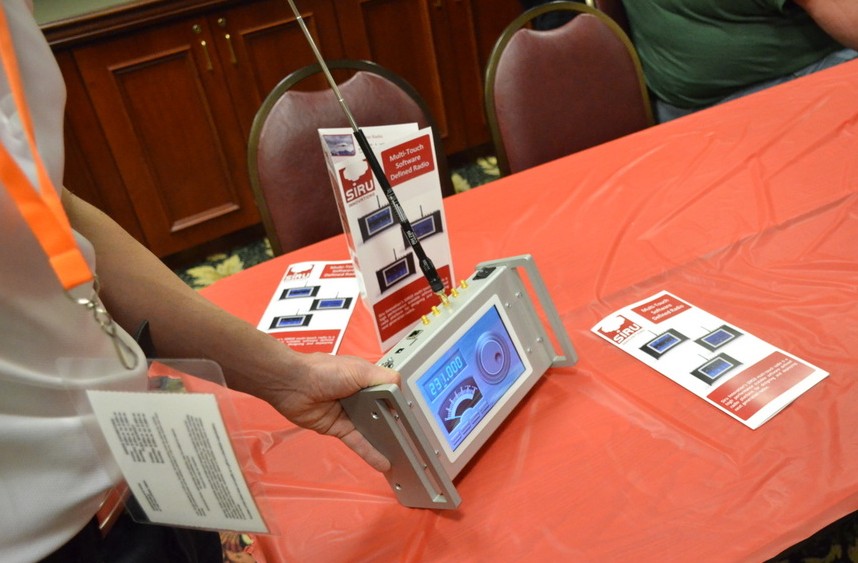
Many thanks to Jarkko Mäkivaara with Siru Innovations who writes with the following update:
We have added some new features to our SDR20 portable radio!
Please see the video [below] for a demonstration of the following features:
* Smooth zoom in FFT/waterfall view
* Adaptive menu
* Frequency memory with snapshot pictures of signals
* Sliding effect between views
* Keyboard beep
* FM broadcast receiver
* Example of Ham radio transceiver with Narrow-FM mode
You also might got the email sent out Today where this is in HTML format.
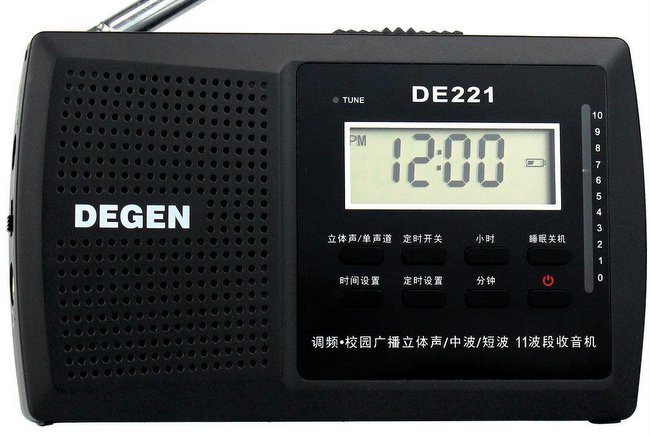
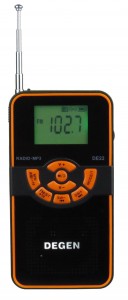
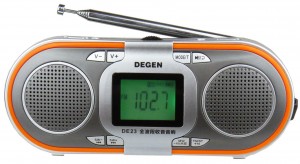
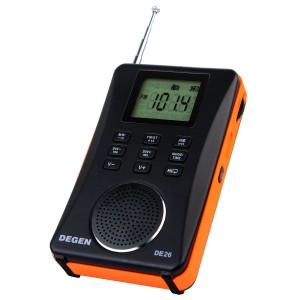
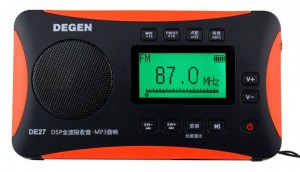
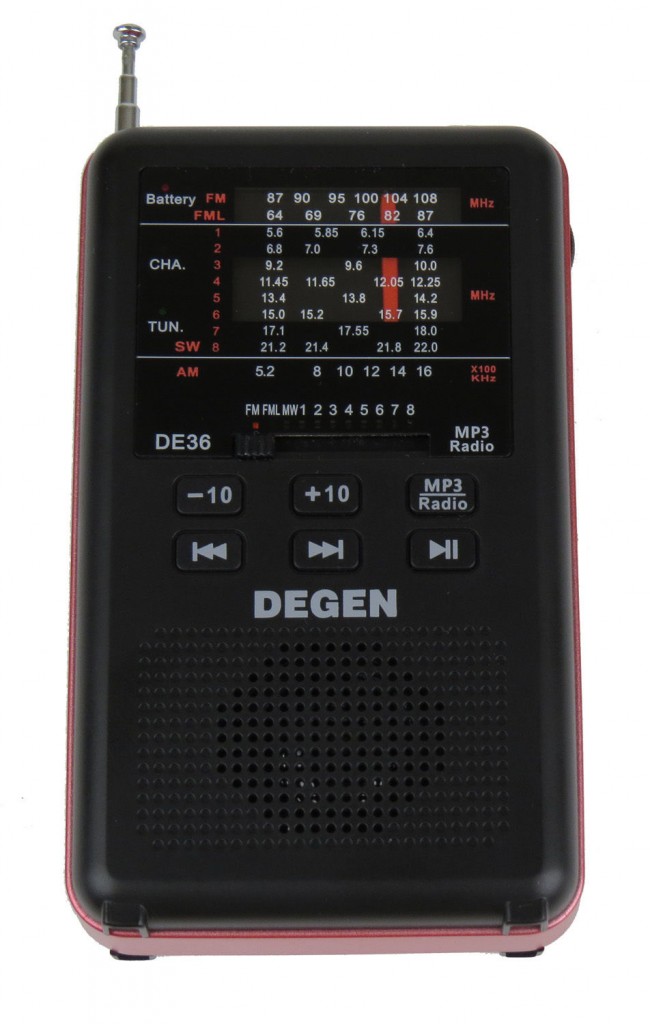
Many thanks to SWLing Post reader, Paul, who commented with a link to the new Degen DE221 “ultralight” radio: http://ebay.to/1fKWZ2m
Paul’s link lead to the discovery of several new Degen models, in fact. Many of the new models have the same form factor–and a slightly different model number–from their predecessors.
There may be even more 2015 Degen models than those I listed here and, in fact, they could’ve been on the market for a while.
I’ve already purchased the Degen DE221 for review since its predecessor, the DE321, was an acceptable radio for the $20 price tag. The DE321’s analog dial made for very vague tuning, however, so I’m curious if the DE221’s new digital display will be a worthy improvement. At this point, I don’t plan to review any of the other models above.
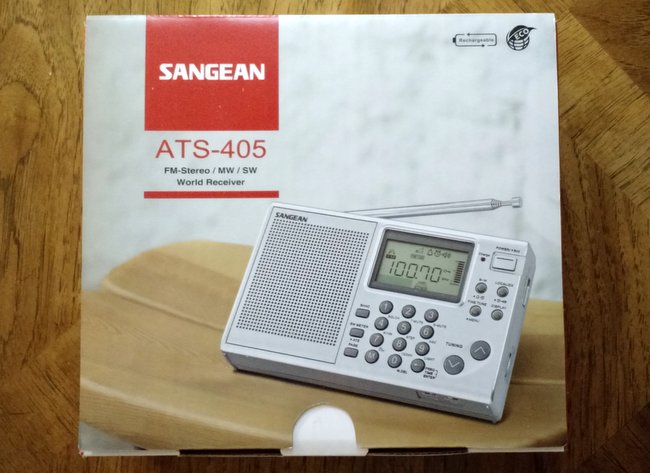
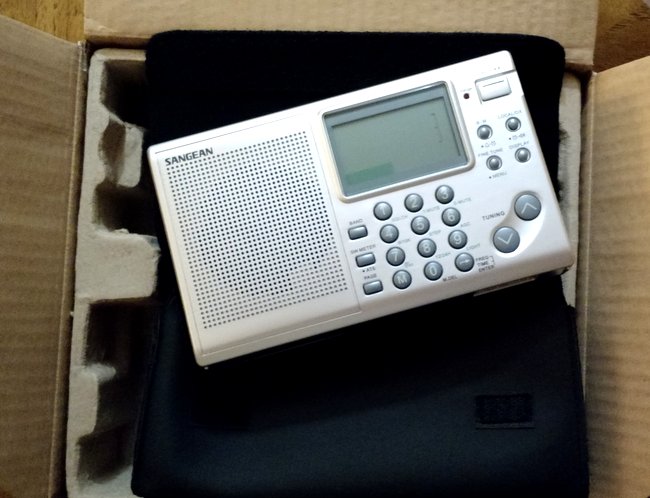
Just last week, I received the new Sangean ATS-405 on loan from Universal Radio. Though I’ve only had the radio for a week, I thought I’d share a few un-boxing photos (by request) and my initial impressions/review of this radio.
Unboxing
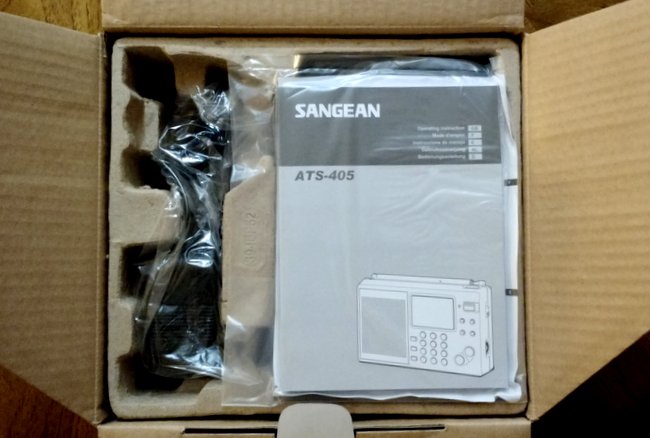
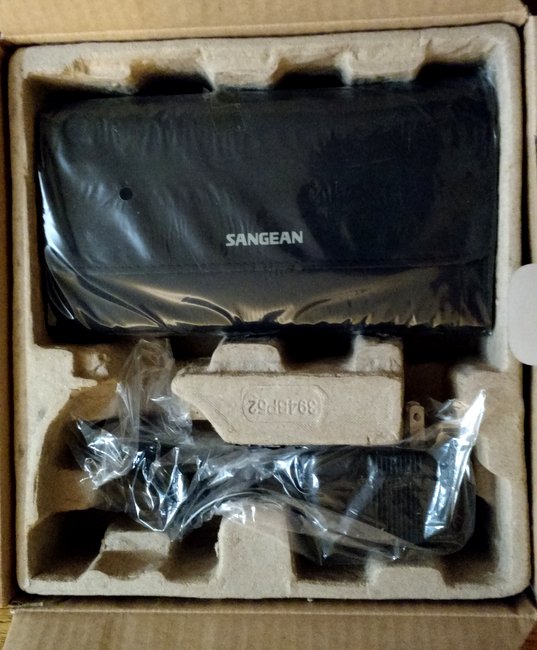
The ATS-405 comes with a thick owner’s manual (in five languages), a 7.5 volt AC adapter, and a soft radio case. The package does not contain rechargeable batteries nor a clip-on wire antenna (like many Tecsun products do, for example).
Overall, the packaging accommodates the radio and accessories efficiently and would probably ship safely even if the carrier doesn’t handle it with particular care.
The first thing I noticed about the ATS-405 is the near-identical design and layout Sangean has used in their design of past shortwave radios. If you’re a Sangean fan, you’ll find all of the functions, buttons, and labels pretty much in the same place; virtually no learning curve.
Performance: first impressions
After unboxing the ATS-405, I installed a fresh set of AA batteries in it and turned on the radio…
Display
Like most Sangeans, the display is crisp, clear and can easily be read straight-on or at low angles, like when the radio is resting on its back stand, for example. If you look at the display from a higher angle, however, you’ll find that the LCD digits nearly disappear.
Back-lighting is perfect: it’s soft and consistent across the display, very much like the ATS-909X.
Audio
Audio from the internal speaker is good. It’s in the same league with most similarly-priced competitors.
Receiver performance
Keeping in mind that I’ve only logged a few days of listening time on the ATS-405, I do have some initial impressions about receiver performance across the bands:
Right side view (click to enlarge)
FM
On a positive note, I believe FM performance is quite good. Perhaps not in the same league with my PL-660 or PL-680, but still the Sangean offers above-average sensitivity. I was able to pick up my distant benchmark FM stations with ease, though to help with the signal lock, I had to switch from stereo to mono reception.
AM/Mediumwave
AM reception is a bit of a mixed bag. I find that the ‘405’s overall sensitivity and selectivity are quite good for broadcast band listening.
When I first tuned around on the AM broadcast band, however, I found the noise floor a little too high. Regardless of whether I was tuned in to a station or not, there was an ever-present high-pitched hiss, like static. It was quite disappointing, especially since I read a review by Jay Allen that really complimented the AM performance on the ATS-405.
I trust Jay’s reviews, however, so I promptly contacted him. Jay pointed out that the problem may be that I was listening in the default “wide” filter setting on AM. And indeed, he was right–though I had changed filter settings a few times while tuned to local stations, I had moved it back to wide and didn’t make note of this. (The ATS-405, by the way, has three filter settings: wide, medium and narrow.)
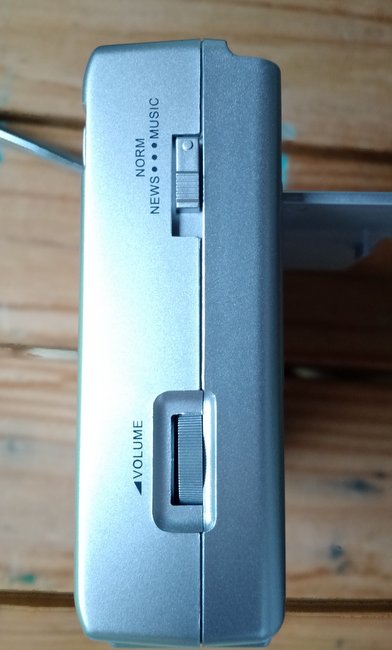
Left side view (click to enlarge)
But the wide setting is really too wide, and was certainly the source for the bulk of the high-pitched hiss I heard. The best filter setting for most broadcast band listening is the middle position, which sounds like a 5-6 kHz filter. In the middle position, noise is decreased significantly. I also believe selecting the “music” audio tone setting helps dissipate some of the noise.
Regarding the noise floor: to be clear, I still feel like the noise level is slightly more noticeable, to my ear, on the ATS-405 than on the PL-660, PL-600, and PL-310ET when band-scanning or weak signal listening. This is most likely some internally-generated noise that somehow still meets Sangean’s engineering spec.
Local AM stations sound fantastic, and the ATS-405 can detect all of my benchmarks. AM audio fidelity is better than that of my PL-660 and, even, PL-310ET. When locked on a local station, the noise floor also seems to disappear. For some reason, I even find that the ATS-405 does a better job receiving local AM stations from indoors–even near noisy electronics–than other sub-$100 portables with which I’m familiar.
Uh-oh, birdies
The most disappointing discovery I made on the Sangean’s AM broadcast band is that it has DSP birdies. Birdies are internally-generated noises resulting from the outputs of the oscillators that form part of the DSP receiver circuit. While almost all receivers do have birdies somewhere in the receiver’s reception range, radio engineers try to keep them out of the way of the important parts of the band.
Unfortunately, my ATS-405 has strong DSP birdies on 800 and 1600 kHz. This is a big negative for me, since my favorite regional AM broadcast station is located on 1600 kHz (WTZQ). Rather than attempting to describe what the birdies sound like, here are a few audio clips that will give you an idea–I start with 1350 AM, which has no birdies and is representative of good AM reception:
WZGM 1350 kHz (broadcast sample with no birdie):
800 kHz (birdie on frequency with no broadcast signal):
WTZQ 1600 kHz (birdie on broadcast signal):
The ATS-405’s birdies almost sound like a jamming signal on 1600 kHz. Indeed, if this station were only located on a different frequency, I’m sure it would be quite audible on this radio…too bad.
Birdies on 800 and 1600 kHz may very well be deal-breakers for many of us. Again, since one of my favorite regional independent broadcasters is on 1600 kHz, it’s a deal-breaker for me.
Jay specifically mentioned a lack of birdies on the AM broadcast band in his review. It could very well be that he doesn’t hear them on his particular receiver–variations in quality control on a radio production line are certainly a real phenomena (the Grundig G3 is a case in point). This could indicate that some units may have pronounced birdies while others don’t. If you purchase an ATS-405, I would check to see if your unit has birdies after powering it up.
When I contacted an engineer for Sangean North America, and described my listening experience, he confirmed that he believed these are, indeed, DSP birdies. I may ask Sangean if they can send another ATS-405 for comparison.
On a more positive note, I checked harmonics in the HF/shortwave bands and heard no DSP birdies there.
Country of origin?
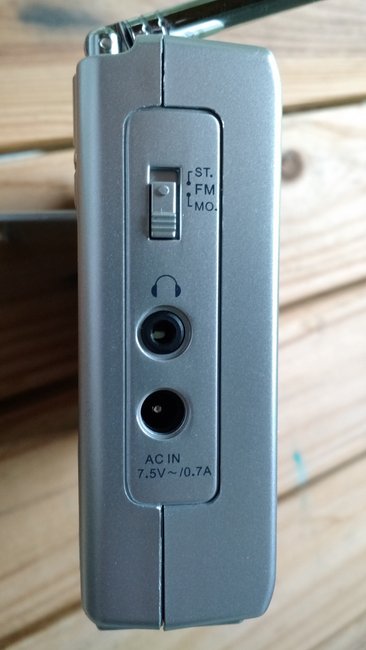
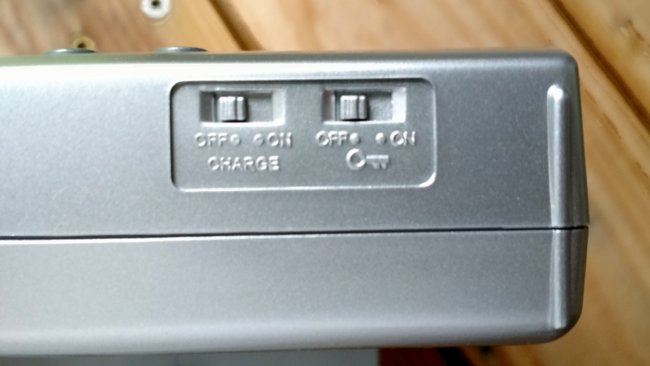
Bottom view with charge and keylock mechanical switches (click to enlarge)
One additional question I posed to Sangean: where is the ATS-405 made? One reader told me the radios are produced in both Taiwan and China. Thinking variations in quality control may be accounted for by two different production lines, I checked my radio to see where it was made. Unfortunately, my unit has no mention of country of origin; not on the radio, the box, the manual, behind the battery cover, nor on the back stand. It’s possible it could be marked internally, but I didn’t want to take apart a receiver I’ve been loaned.
Sangean came back with a firm answer:
“I can confirm that the ATS-405, along with all our radios, are manufactured in China. We have an office in Taipei for engineering, sales, marketing and customer support.”
Not a big surprise here; I expected China was the country of origin.
To sum up AM performance: if you aren’t bothered by the birdies on 800 and 1600 kHz, or if your unit isn’t producing them, you’ll find the ATS-405 a capable little AM broadcast band receiver.
Shortwave
Our HF propagation conditions since last Friday (when I first turned on the ATS-405) have been poor. Other than a few short band openings, I’ve struggled to hear anything other than the normal blow-torch broadcasters we hear in North America. Still, bad propagation conditions are actually good for reviewing some aspects of a shortwave receiver, so I used the opportunity.
In terms of sensitivity on the shortwave bands, I think the ATS-405 is mediocre. It lags behind my Tecsun PL-660, PL-600, PL-310ET, and CC Skywave. Adding a clip-on wire antenna to the telescoping whip (there is no aux antenna port) does help in terms of sensitivity.
Since I do most of my listening on the shortwave bands, this, too, is a deal-breaker for me. If you primarily listen to stronger shortwave stations, or spend most of your time on the FM/AM bands, then you might still consider the ATS-405.
The ATS-405’s selectivity seems to be on par with my other DSP-based portables. In truth, though, band conditions have been so unfavorable, I don’t feel like I’ve had ample opportunity to test selectivity. I’ll likely follow up this initial review with an update.
And as on medium wave, the noise floor on the shortwave bands seems a little high to me–especially with the filter set to the “wide” position.
Cool, innovative features
While I clearly haven’t been wowed by the ATS-405’s shortwave performance, I have been more favorably impressed with some of its innovative features: specifically, the ability to control squelch, tuning mute, and soft mute.
Using the menu button (see image above), you can engage or disengage the tuning mute and soft mute by pressing the “2” or “3” buttons on the keypad, then using the tuning up/down buttons to toggle these features on and off. Squelch works the same way, using the “1” button and volume control to set the threshold.
This menu control works regardless whether the radio is turned on or off.
Of course, by using the menu button and the keypad, you can also control the ‘405’s tuning steps, AGC, clock, and backlighting functionality; each of these are marked in green next to the appropriate button on the keypad (see image above), a very useful feature.
I wish other radio manufacturers would give users the ability to control some of the DSP chip’s built-in functionality, as the ‘405 does with the muting–especially since over-active soft muting has been the downfall of several DSP-based radios. Thanks for trail-blazing, Sangean!
Summary
Invariably, all radios have strengths and weaknesses; here is a list of my notes from the moment I put the ATS-405 on the air:
Pros:
Improved features and controls:
Soft Mute
Tuning Mute
Squelch
AGC
Crisp, clear display
Good travel size, similar to the Grundig YB400
Good AM/mediumwave sensitivity
Three audio/tone settings: Music, Norm, and News
Good FM sensitivity
Dedicated mechanical switches for keylock, audio tone, FM stereo/mono, and charging.
Cons:
Lackluster shortwave sensitivity
DSP Birdies on 800 and 1600 kHz
Higher SW/AM noise floor (especially in wide filter setting)
No tuning wheel
No AUX antenna port
No shortwave SSB reception (AM only)
No audio line-out port
I’m going to hold onto the Sangean ATS-405 for a few more weeks, as I’d like to give it a more thorough test on the shortwave bands. I hope to follow up with a post offering a few representative recordings.
My nutshell opinion of the ATS-405 so far is that it’s a decent little radio with a lot of functionality and features for a rig in its price class. But overall, its performance seems to me rather mediocre. If you primarily listen to FM, you’ll be pleased. If you’re a mediumwave listener, you’ll be pleased only if you don’t mind the 800/1600 kHz DSP birdies. If you’re primarily a shortwave listener, you’ll need to carry a clip-on wire antenna to bring the sensitivity up to the level of similarly-priced receivers.
In short, I do want to like this radio unreservedly. But it appears that Sangean may need to pull up its socks on their quality control. Readers: please comment if you’ve purchased the ATS-405–I’m very curious to learn whether there are QC discrepancies in performance from one unit to the next.
PLEASE NOTE: After publishing this following review, Sangean kindly agreed to dispatch a second unit for comparison.

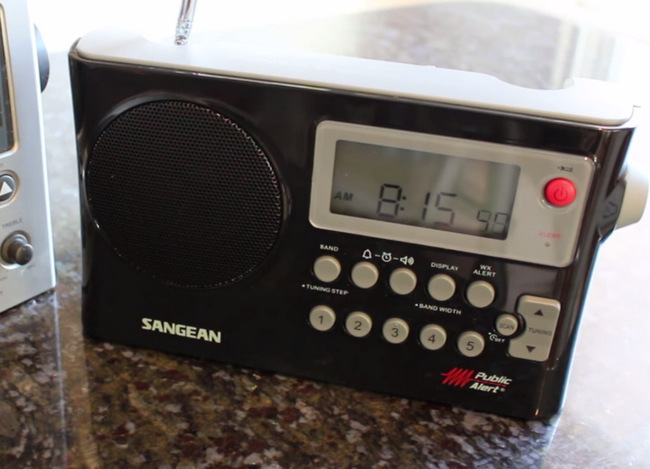
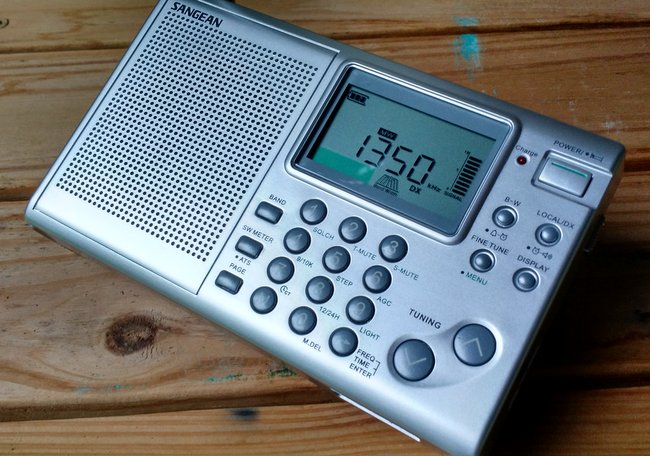

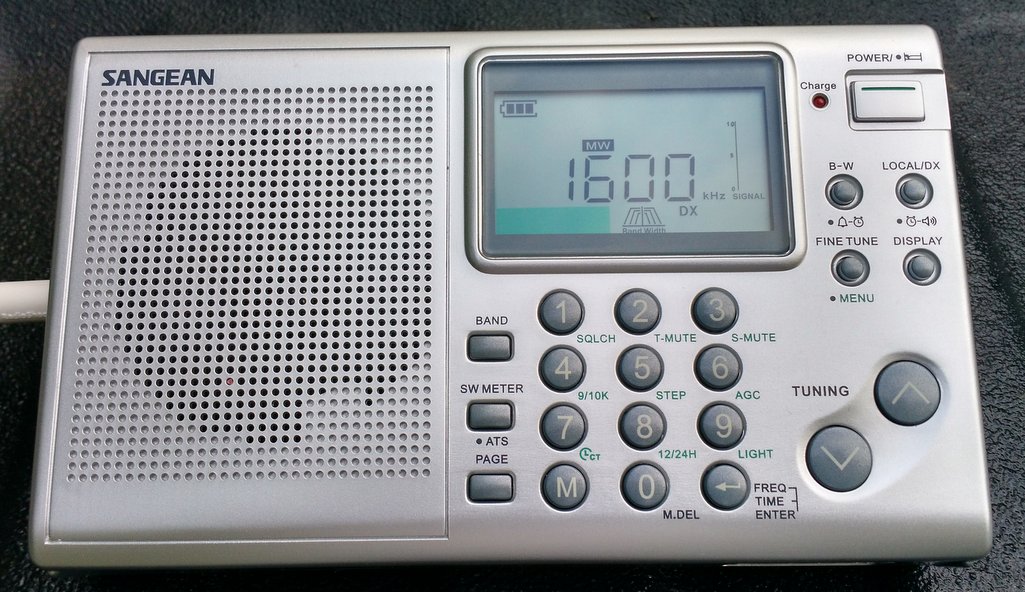
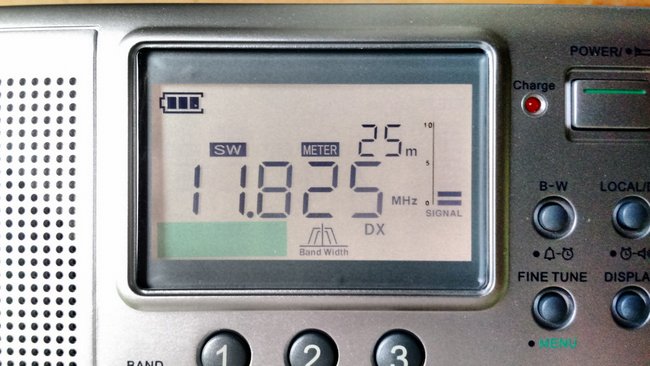
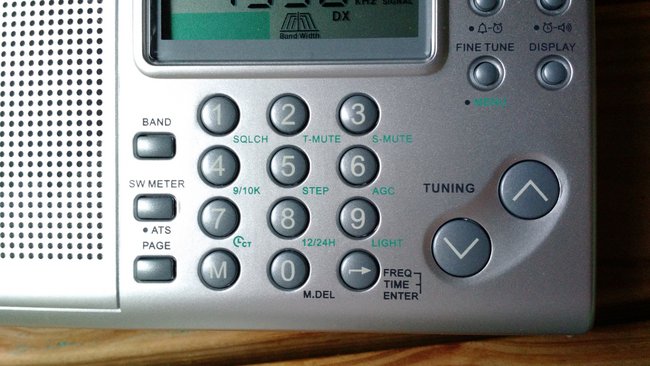 Using the menu button (see image above), you can engage or disengage the tuning mute and soft mute by pressing the “2” or “3” buttons on the keypad, then using the tuning up/down buttons to toggle these features on and off. Squelch works the same way, using the “1” button and volume control to set the threshold.