Shortwave listening and everything radio including reviews, broadcasting, ham radio, field operation, DXing, maker kits, travel, emergency gear, events, and more
Update: This article, from the Epoch Times, is somewhat misleading: it appears that RTI is not actually being silenced; rather, they’re merely removing sites that are retired and redundant. See post comments for more info.
Media freedom in Taiwan is again under attack by political forces from mainland China, resulting in a sudden decision by Radio Taiwan International (RTI) to dismantle two of its substations. Among RTI’s customers who will lose their contracts are Sound of Hope Radio and Radio Free Asia, which have played an important role in broadcasting uncensored news to the mainland.
Earlier this month, RTI’s largest customer, Sound of Hope Radio (SOH), received a notice that the Huwei substation in Yunlin County will be dismantled beginning June 1. The eight radio antennas pointing towards China will be removed ahead of schedule, and the broadcasting business will also stop at the end of May.
Tainan, another RTI substation in Tianma, will also be dismantled in a few months’ time, according to an insider.
[…]According to insider information, RTI high-level executives visited mainland China at the end of February. Soon after, RTI announced its intention to take down the two substations.
Following the removal of the substations, RTI will terminate all its rebroadcasting customers and also stop its own shortwave broadcasting, and develop a mobile platform and Internet broadcasting instead, the insider said.
Zeng (Allen) Yong, President of SOH, told The Epoch Times he had rushed to Taiwan as he was very concerned about RTI’s move to terminate its main customers in the name of consolidating substations and eventually ending shortwave broadcasting into China–a matter of great concern to the Communist Party, which censors media in the mainland.[…]
The following is a no-spoiler review, as I assume many of you may be waiting for the film to hit the big screen, and I wouldn’t want to reveal any cinematic surprises.
We first mentioned The Numbers Station back in late 2011 –and admittedly, I was eager to see public attention drawn to this public-yet-covert shortwave communications medium that’s still in existence today. Indeed, it’s no wonder that a numbers station became the subject of a film; the subject is truly mysterious. Only a few days ago, while describing numbers stations to a visiting friend who had never heard of them, I played a recording of a numbers station that I made last year–her initial response upon hearing the recording was, in her words, that she experienced “chills” running up her spine.
But what is a numbers station?
Numbers stations, for those of you not familiar with them, are shortwave radio broadcasts that contain only strings of what seem to be random numbers. In truth, these numbers are encrypted messages for operatives in the field (otherwise known as secret agents). The operatives tune in the station with a simple shortwave radio, then decode the message with a one-time decryption key. Once the message has been deciphered, the message pads are immediately burnt or destroyed (or, at least, they’re meant to be…). Oddly, even though this is a very public communication which anyone with a shortwave radio can hear, only one or two individuals will likely ever decode the message. Such messages have been known to exist in a variety of languages at least since the time of the Cold War, but strangely did not conclude with the Cold War’s supposed end–they are ongoing even today. (Click here to check out our other numbers station posts.)
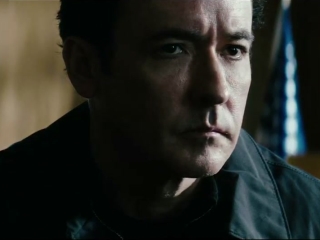
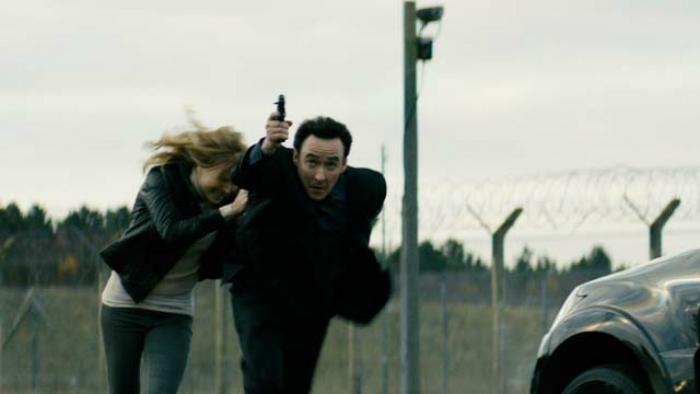
John Cusack as Emerson (Photo: Image Entertainment)
The Movie
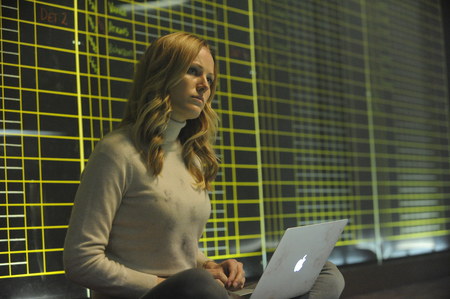
In the movie The Numbers Station, John Cusack’s character, Emerson, is a seasoned field operative–a “black-ops” agent–who faces a life-changing dilemma in the field which places his career in jeopardy. In an attempt to give Emerson some time to reconcile his emotions, his leader (Liam Cunningham) assigns him to what should be a simple, routine assignment: to protect Catherine (Malin Akerman), a cryptologist who broadcasts at a rural remote numbers station in the UK.
Things go terribly wrong when the station is compromised and Cusack finds himself again facing the same dilemma that sent him to this assignment in the first place: whether to “retire” his asset (namely, Catherine) in order to fulfill his duty, by cutting off loose ends? Or will his conscience–and tenuous friendship with Catherine–take him in another direction? It’s a difficult ethical dilemma, one Emerson has been attempting to avoid.
Malin Akerman as Catherine (Photo: Image Entertainment)
I’ve seen a number of John Cusack films over the years, and while he’s an extraordinary talent, The Numbers Stationunfortunately doesn’t quite allow us to see his full range as an actor simply because his character, Emerson, is stoic and quite introspective. But the chemistry between Emerson and Catherine is complex and tense, and one can’t help but believe he cares deeply for her.
On the action front, The Numbers Station is a much greater success: pacing is good, with a few moments to collect your breath; still, there’s always looming conflict. The bulk of the film is set in a dimly lit, underground bunker-come-numbers station, and there are actually very few shoot-’em-out scenes, yet the tension and suspense are constant.
I won’t comment on how the plot resolves, but I can say that if you like dark films with tension, moral decisions, action, and intrigue, this is well worth watching. I enjoyed it.
Moreover, if you love shortwave radio, and are intrigued by numbers stations, you will be pleased to discover that this film treats the concept with due respect and more accuracy than I would have anticipated.
(Photo: Image Entertainment)
How accurate is The Numbers Station?
While those who write about numbers stations have presumably never worked for one, there’s an existing body of knowledge out there built on thousands of hours of listening, cataloging stations and even court documents from cases involving spies. This gives us a fairly accurate idea of the true nature of numbers stations.
Likely inaccuracies
Though it is possible, I have never heard of a numbers station which has a live voice behind the microphone, reading numbers; these would most likely be advance-recorded or computer generated.
In the film, Malin Akerman’s character, Catherine, only seems to read a string of numbers for a matter of seconds, not minutes; in reality, this would take much more time.
I heard no preamble of numbers to ID the correct decipher key.
And yet…likely accuracies
In the film, under standard operating conditions, no one at the station knows the nature of the messages being broadcast–this reflects a probable fact about such stations.
The numbers station is located in a rural and remote part of the UK, a convincing setting for a numbers station (though some may broadcast from major broadcasting sites).
Once the station has been compromised, Cusack’s character explains in some detail how numbers stations work on the operative’s end; this description is very true to what is known or believed of actual numbers stations.
So, should you see it?
I anticipate that most any shortwave radio enthusiast will enjoy The Numbers Station. As a non-movie-reviewer–in other words, as a regular joe public movie-goer–I give it 8 stars out of 10. Go ahead!
Clandestine station, Radio Free Sarawak, offers an alternative voice in Malaysia ahead of elections next week. For those living in remote jungle communities–places where the Internet is not readily available–Radio Free Sarawak can be heard on shortwave radio.
Al Jazeera’s Florence Looi reports from a village in Sarawak:
Uncertainty about the BBC World Service budget as the corporation prepares to take on full funding of the service is “unacceptable”, MPs have warned.
Foreign Office funding for the service will stop in April 2014 when it will be paid for out of the licence fee.
The Foreign Affairs Committee said the World Service could not “plan properly” because the BBC had yet to issue an operating licence to define its budget.
[…]A World Service spokesman said the change in funding next April, when it will be integrated with the BBC’s domestic news services, “provides certainty and stability”.
But the committee of MPs said it did not see how the World Service could prepare when it would not know “either the priorities, targets or characteristics which have been set for it, or its budget” until a few months before the change came into force.
[…]The committee also warned that, while it was logical to withdraw shortwave radio in dwindling markets where audiences had access to the internet and TV, such services still had a place.
“The World Service must continue to take into account significant audiences in certain parts of the world, such as rural India and Africa, who currently rely on shortwave radio,” it added.
BBC Panorama presenter, John Sweeney attempts to defend his actions on the BBC. (Source: YouTube/BBC)
If you’ve been a reader of the SWLing Post for long, you may know I am an avid supporter of free speech via radio and other media; I am also a strong advocate of journalistic ethics. Following, I share choice words about a reporter who ignored one in the claimed pursuit of the other–and why I believe neither was ultimately served.
While I’ve written much in support of the BBC World Service, the radio arm of the BBC, I have not had the same favorable view of the television arm of the BBC. Recently, I received a concerning email from my post-graduate alma mater,The London School of Economics, which lowered my opinion of the BBC TV producers yet further.
On Monday night the BBC television show Panorama featured an investigative report on North Korea by presenter John Sweeney; this investigation, while revealing virtually nothing the western world didn’t already know about North Korea, is receiving inordinate amount of attention–primarily negative. Moreover, Sweeney’s report has received a great deal of criticism from the London School of Economics (LSE). And for good reason.
In brief, as I understand it, here’s what occurred : In 2012, an LSE student group, organized by Tomiko Sweeney, wife of BBC Panorama presenter and 1980 LSE alumnus John Sweeney. This past March, another such event was organized; but on this eight-day student tour of North Korea, there was a striking difference. The LSE students, who of course understood the (measurable) risk inherent in touring a country like North Korea, were merely made aware in advance that there would be “a journalist” among their group. But upon their arrival in China and immediately prior to their flight to North Korea, the student tour group found that the BBC had sent not one journalist, but rather a three-maninvestigative crew from Panorama falsely claiming to represent the LSE, with secret plans to film outside the dicatorships’s permissible range; among them, Sweeney himself, claiming to be an LSE PhD student. In short, the student group was unaware of the scope of Sweeney’s orchestrated deception until it was underway.
While in North Korea, Sweeney and his crew proceded to secretly film an investigative report, breaking firm rules imposed on the tour group. In so doing, Sweeney knowingly–and without prior consent from the students–put everyone on the tour at very great risk. If caught, Sweeney, his crew, and the deceived students could very well have been imprisoned and forced to work in labor camps indefinitely…or worse. Such treatment of journalists is not unprecedented in North Korea.
Fortunately, the full tour group and their illegal digital footage escaped North Korea without incident. However, now that North Korea has learned of the investigative report and the deception, North Korea has begun to threaten the LSE students on the tour.
John Sweeney lied to the North Korean authorities and to the North Korean touring organization–but more to the point, he deceived the LSE students on the tour who served as his front. The BBC sanctioned (and salaried) Sweeney’s cowardly deception. Sweeney admits to lying, and has awkwardly attempted to justify his actions by stating that the students are “adults” and therefore “aware of the risk…this isn’t Toramolinos [a Spanish vacation locale].” It now seems quite clear that Sweeney never fully disclosed to the students the degree of risk to which he would be subjecting them, which is only now unfolding in threatening letters from North Korea to the students themselves. These threats warned against airing Sweeney’s program, and the LSE promptly made this concern known to the BBC. Sweeney aired the program anyway.
As for this television report for which Sweeney risked these students’ lives and futures? The painful fact is that Sweeney’s product is neither insightful nor even particularly interesting.
Crossing the line
Regardless of reason, Sweeney capriciously and foolishly ignored a basic journalistic ethic called the harm limitation principle; according to the Society of Professional Journalists: “Ethical journalists treat sources, subjects and colleagues as human beings deserving of respect.” While it states that an ethical journalist “recognize[s] that gathering and reporting information may cause harm or discomfort,” it continues: “Pursuit of the news is not a license for arrogance.”
Of course, one expects there to be some “harm or discomfort” during the course of investigative reporting, especially investigation of a closed dictatorship that is actually insightful or relevatory. But reporters such as Sweeney and his crew are paid–and paid well, I might add–to take such risks. The LSE students he used as a cover–essentially as human shields–were not paid by the BBC for the unremarkable reporting that was to put them in harm’s way to a greater degree than they knew. The BBC and Sweeney believed that the students’ personal sacrifice and the reputation of the LSE were secondary to the content contained in their report.
If the BBC wanted an investigative report from North Korea, they should have paid professional actors and/or journalists who fully understood the risks and were amply compensated for them to pose as students. Instead, the BBC used, in every sense of the word, a group of university students. BBC Panorama seemed to view these individuals as expendable.
One can only imagine the students’ dismay at being caught in this web of deception, with the North Koreans weaving their own web such as exists in any closed dictatorship, while Sweeney and the BBC entangle them in yet another, perhaps more insidious, web of deceit. As a result, avenues of study, careers, reputations, lives–all have been cut off or jeopardized by Sweeney’s selfish, cowardly, and truly pointless actions in conducting this investigation under these circumstances.
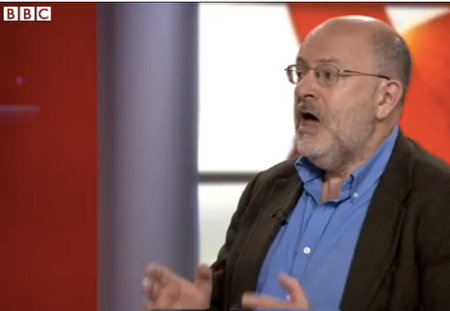
While watching this BBC interview of the bumbling John Sweeney in his attempts at justification, one cannot help but recall the test of an ethical journalist which Sweeney fails: “Pursuit of the news is not a license for arrogance”:
[Note that I’ve included, below, the full text of the letter from the LSE to which Sweeney refers and that I also received.]
What a waste
Not surprisingly, the BBC Panorama investigative report is, at best, mediocre. I have seen numerous other video reports on North Korea by reporters and citizen journalists that are much more revealing of the true state of North Korea–and which practice good ethics and superior journalism besides. Even YouTube has better one-man reports from travelers. Click here for an example on YouTube.
In contrast, too, the BBC World News’ program Our World produced in 2010 a more informative and insightful investigative report on North Korea. Presenter Sue Lloyd Roberts captured virtually the same footage as Sweeney’s crew–with the North Korean handlers close by and without the use of cover or deception, I might add–but makes much better use of it. You can view this excellent report on YouTube, as well; it’s divided into two parts: click here for part 1 and part 2.
Then, what was Sweeney’s Panorama report adding to the body of knowledge we already have about the DPRK? Virtually nothing. Instead, his motivation to air his piece seems to have been one of professional gain…or, perhaps, simply ratings. More warm bodies in front of British tellies. Not a deeper knowledge of North Korea, certainly not journalistic integrity.
We’ve mentioned North Korea recently as they’re making headlines across the planet; their governing method is deeply flawed and their repression of their own people is simply criminal, and needs to be made known. Yet by using LSE university students in this trip as his cover, Sweeney has insured that LSE will not be welcomed back North Korea for the foreseeable future. Perhaps other similarly sensitive countries will follow suit. And it’s truly a shame: LSE staff and students provide insight and potential for the creation of gradual positive change in repressed parts of the world like the DPRK. And the LSE, which has long been known for their diplomacy, will be hard pressed to recover the reputation that Sweeney has sullied.
If he is, in fact, an LSE alumnus, Sweeney should have considered that he was harming the reputation of a valuable educational institution well known for building political bridges. Sweeney is simply not deserving of an LSE degree. Clearly, he needs to return to the classroom for Introduction to Ethics…Although, considering his actions, it is highly doubtful that he would understand any of it.
•••••••••••••••••••••••••••••
Should investigative reporting happen in North Korea? Certainly. Will rules and laws have to be broken in order to make this happen? Of course. Should reporters use innocent people as covers and human shields in order to carry out their reporting? Absolutely not.
What do you think? Share your views and comments below.
•••••••••••••••••••••••••••••
The letter the LSE sent to all alumni:
The School wishes to alert all staff and students to a serious development which may affect them personally in future. This relates to the conduct of the BBC in respect of a Panorama programme entitled North Korea Undercover, which is due to be shown next Monday evening, 15 April.
The programme has been produced using as cover a visit to North Korea which took place from 23-30 March 2013 in the name of the Grimshaw Club, a student society at LSE. The School authorities had no advance knowledge of the trip or of its planning. The visiting party included Mr John Sweeney, Mr Alexander Niakaris and Ms Tomiko Sweeney. In advance of the trip it was not known to the rest of the party that they were three journalists working for or with the BBC. Their purpose, posing as tourists, was to film and record covertly during the visit in order to produce the Panorama programme.
LSE’s chief concerns are twofold. First, at no point prior to the trip was it made clear to the students that a BBC team of three had planned to use the trip as cover for a major documentary to be shown on Panorama. BBC staff have admitted that the group was deliberately misled as to the involvement of the BBC in the visit. The line used was that “a journalist” would join the visit. BBC staff have argued that this lack of frankness in denying the genuine members of the group the full details was done for their own benefit in the event of discovery and interrogation by North Korean authorities. It is LSE’s view that the students were not given enough information to enable informed consent, yet were given enough to put them in serious danger if the subterfuge had been uncovered prior to their departure from North Korea.
BBC staff asserted in a meeting with LSE management on 9 April 2013 that the BBC had undertaken its own risk assessment in advance of the trip, which had been approved at the highest level. LSE believes that a reasonable assessor of risk, or indeed any parent contemplating their child’s involvement in such an exercise, could only have concluded that the risks taken were unacceptable.
Our second major concern relates to information that came to light after the meeting on 9 April. This is that John Sweeney gained entry to North Korea by posing as a PhD student. The North Korean authorities allege that he described his occupation for entry control purposes as “LSE student, PhD in History” and gave his address as that of LSE – including a specific office room number which is actually used by a genuine member of LSE staff. Students report that the North Korean guides during the visit repeatedly addressed him as “Professor” and that he actively went along with that. John Sweeney graduated from LSE in 1980 with a BSc in Government. He is not an LSE student. If he has a PhD in History (or anything else), it is not from LSE. He does not work for the LSE.
We have no information about how Mr Niakaris or Ms Sweeney may have described themselves in order to gain entry to North Korea, but no description of them as current LSE students or staff can have been accurate.
While this particular trip was run in the name of a student society, the nature of LSE’s teaching and research means that aspects of North Korea are legitimate objects of study in several of our academic disciplines. Indeed, LSE academics work on aspects of many politically sensitive parts of the world, including by travel to those locations. It is vital that their integrity is taken for granted and their academic freedom preserved. The BBC’s actions may do serious damage to LSE’s reputation for academic integrity and may have seriously compromised the future ability of LSE students and staff to undertake legitimate study of North Korea, and very possibly of other countries where suspicion of independent academic work runs high. Finally, LSE is aware of grave concerns about the actions of the BBC raised by at least two students who took part in the visit and the parents of one.
In light of all of the above, the Chairman of LSE asked the BBC on 10 April to withdraw the planned programme and issue a full apology to LSE for the actions of BBC staff in using the School and its good reputation as a means of deception. This endangered the students and could endanger academics in the future.
LSE deeply regrets that, earlier this afternoon, the Director-General of the BBC has refused the Chairman’s request. LSE is fully supportive of the principle of investigative journalism in the public interest, and applauds the work of journalists in dangerous parts of the world. We cannot, however, condone the use of our name, or the use of our students, as cover for such activities.
The School stands ready to discuss with any student or member of staff who so wishes how best to address the possible difficulties which the actions of the BBC may entail for them in future.
•••••••••••••••••••••••••••••
This story is multifaceted, far more so than my summary; I encourage you to read articles from The Independent, The Guardian and/or the BBC for more details.
The Mighty KBC, the VOA and PCJ radio will broadcast radiograms (digital text) over shortwave radio this weekend.
Reception conditions could be challenging depending on the impact of the incoming CME (Coronal Mass Ejection) which is expected to disrupt the high frequency bands today. All the more reason to attempt to decode these messages as Dr. Kim Elliott is studying each digital mode and its ability to effectively overcome adverse conditions. Email your reports and audio files to: [email protected]
Here are details from each broadcaster:
The Mighty KBC
Broadcasting 14 April 2013 from 00:00-02:00 UTC on 7,375 kHz.
At about 0133 UTC, two slow (less than 60 WPM) but robust modes will be transmitted: Olivia 8-1000 centered on 1000 Hertz, and MFSK16 on 2000 Hertz.
At just before 0200 UTC, Olivia 8-2000, with Flmsg format, will be centered on 1500 Hertz.
The Voice of America
VOA Radiogram for the weekend of 13/14 April 2013 will feature the Olivia modes, with MFSK modes also transmitted for comparison.
The modes will be transmitted in groups of three, and all will be centered on an audio frequency of 1500 Hertz, except where indicated:
Olivia 16-1000 (centered on 2000 Hz) versus music, 2:03
MFSK 32 closing text and image, :51
Reception reports with (if possible) sample audio and screenshots would be appreciated. Audio files from outside the United States are especially helpful.
Here is the VOA Radiogram broadcast schedule:
(all days and times UTC)
Sat 1600-1630 17860 kHz
Sun 0230-0300 5745 kHz
Sun 1300-1330 6095 kHz
Sun 1930-2000 15670 kHz
All via the Edward R. Murrow transmitting station in North Carolina.
PCJ Radio
PCJ Radio will transmit text on 14 April 2013 at 02:27 UTC via WRMI, Radio Miami International on 9,955 kHz. The mode will be Olivia 8-1000.

 Update: This article, from the Epoch Times, is somewhat misleading: it appears that RTI is not actually being silenced; rather, they’re merely removing sites that are retired and redundant. See post comments for more info.


 The letter the LSE sent to all alumni: