Tag Archives: Radio Moscow

Shortwave Memories — Go Go Radio Moscow

by Karl D. Forth

Radio Moscow didn’t seem confrontational. We’re here, their attitude seemed to be, and we’re going to offer our opinion on things, which you may or may not like.

Looking at the World Radio-TV Handbook in the early 1970s, Radio Moscow was on dozens of frequencies from many different transmitters thousands of miles apart. The Far Eastern transmitters were 5,000 miles from Moscow.

In 1974, Radio Moscow offered programs in 64 languages, along with Russian by Radio, and a transcription service. U.S.S.R. was one of the largest broadcasters, with shortwave transmissions in many languages, from Bambara to Urdu.

“If you’d like first-hand information about the Soviet Union, its developed socialist society, the Soviet way of life and the Soviet view on major international issues tune in to Radio Moscow,” an ad for the broadcaster stated.

I thought that Radio Moscow offered a straightforward outlook, and they tried to make the programs truthful but were sometimes selective in what was covered. Their job was to promote progress that was being achieved in the Soviet Union, and to criticize the West.

(If you’re interested in the Soviet viewpoint from that time, an interesting book to read is Parting With Illusions, by Vladimir Pozner.)

One subject that got under Radio Moscow’s skin was NATO’s deployment of short-range cruise missiles in the early 1980s.

Later, there was Vasily’s Weekend, broadcast about 1990 and 1991, in the last days of the Soviet Union. The show, hosted by one Vasily Strelnikov, a Russian who had grown up mostly in America, was an informal English-language program of popular music and listener requests, a segment that must have stood in contrast to the station’s other programs.

Moscow’s exit from shortwave was sudden. It was renamed the Voice of Russia in 1993, after the breakup of the Soviet Union. The shortwave radio broadcasts were ended completely by Vladimir Putin in 2014.

Go Go Radio Moscow was an actual 45 single by Nikita the K, probably the only 45 record about a shortwave station. It was an American record and was not, as far as we know, ever played on Radio Moscow. (For the record, there is a rock band called Radio Moscow based in Iowa, not the Russian capital.)

Karl D. Forth has been interested in radio and DXing for more than 50 years. This story was included in the book Radio Nights and Distant Signals.

Please note: all Amazon links are affiliate links that support the SWLing Post at no cost to you.

Dan Shares Recordings of the Golden Days of European Shortwave Listening

Many thanks to SWLing Post contributor Dan Greenall, who shares the following guest post:


Europe on shortwave in the 1970’s

by Dan Greenall

During the golden years of shortwave listening, many European countries had an international shortwave service and broadcast programs to North America (where I live) in English. As a result, these stations were usually among the first that a newcomer to the hobby would find.  However, since there was no internet or e-mail, schedules often had to be found in the various club bulletins and hobby magazines.  QSLs arrived through the postal system and could often take months to arrive.

I soon developed the habit of making a brief recording of each station as additional “proof of reception,” and many of these have survived to this day.  These were typically made by placing the microphone directly in front of the speaker of my receiver.  In recent years, they have been uploaded to the Internet Archive, and links to some of them from the early 1970s can be found here.

[Note that each title links to the Archive.org page where you can find more information and QSLs.]

Radio Moscow

Deutsche Welle, Cologne 

Radio Berlin International 

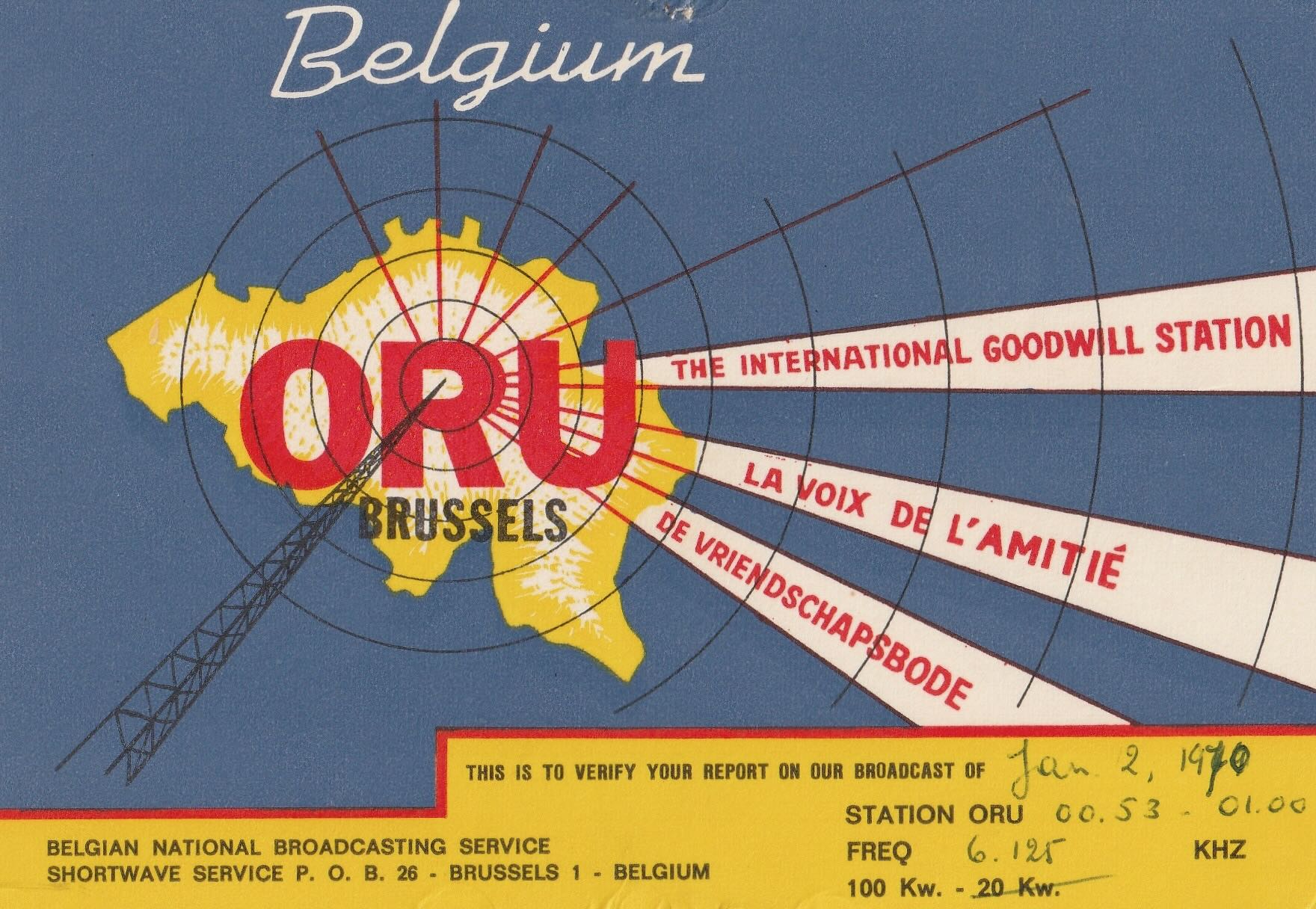
Belgian Radio

Radio Belgrade

RAI, Rome

ORTF, Paris

IBRA Radio via Radio Trans Europe in Portugal

Radio Sofia Bulgaria

Austrian Radio

Radio Prague

Radio Denmark

Radio Luxembourg

Vatican Radio

Radio Sweden

Trans World Radio Monte Carlo

Radio Kiev

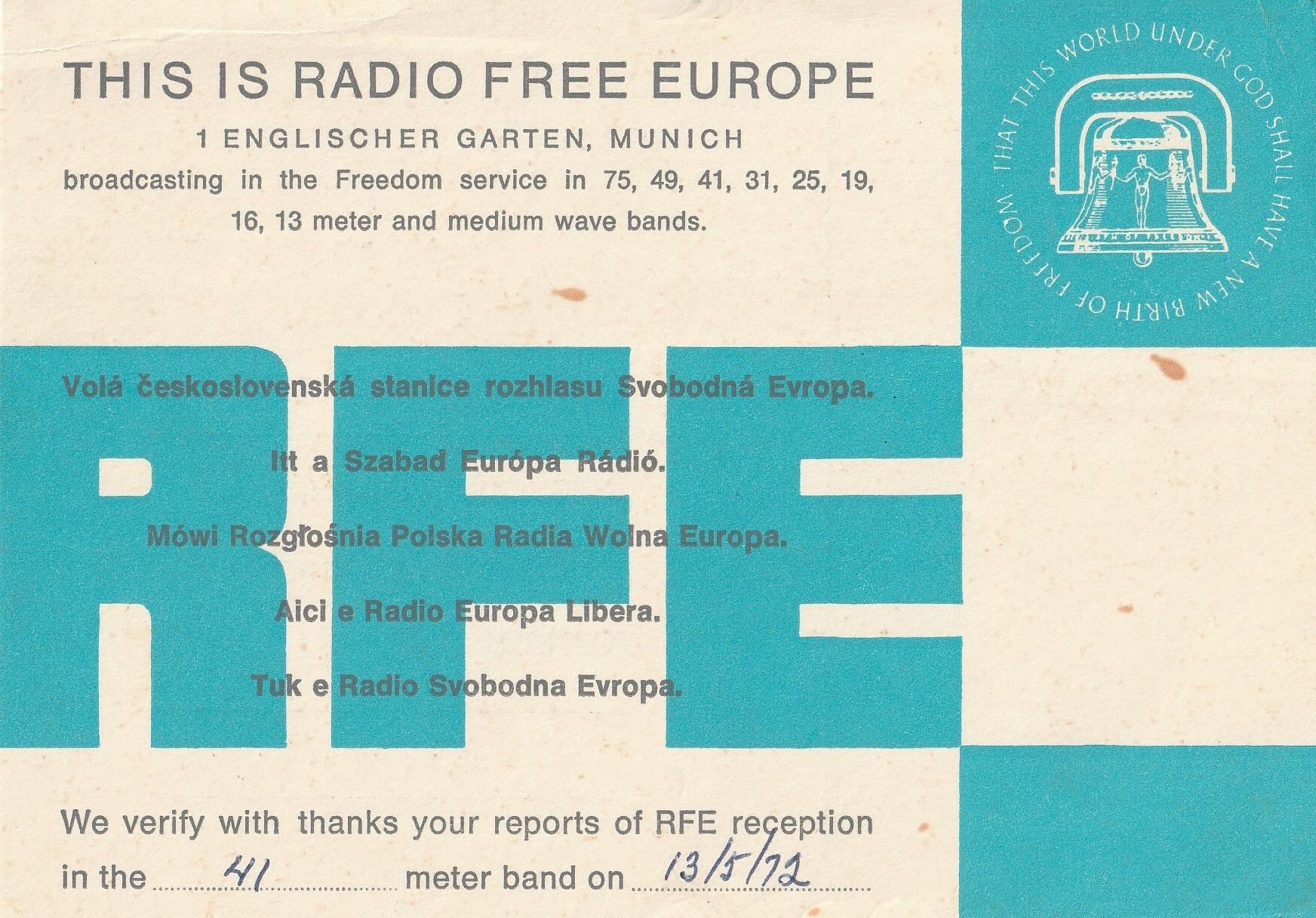
Radio Free Europe

Radio Nordsee International

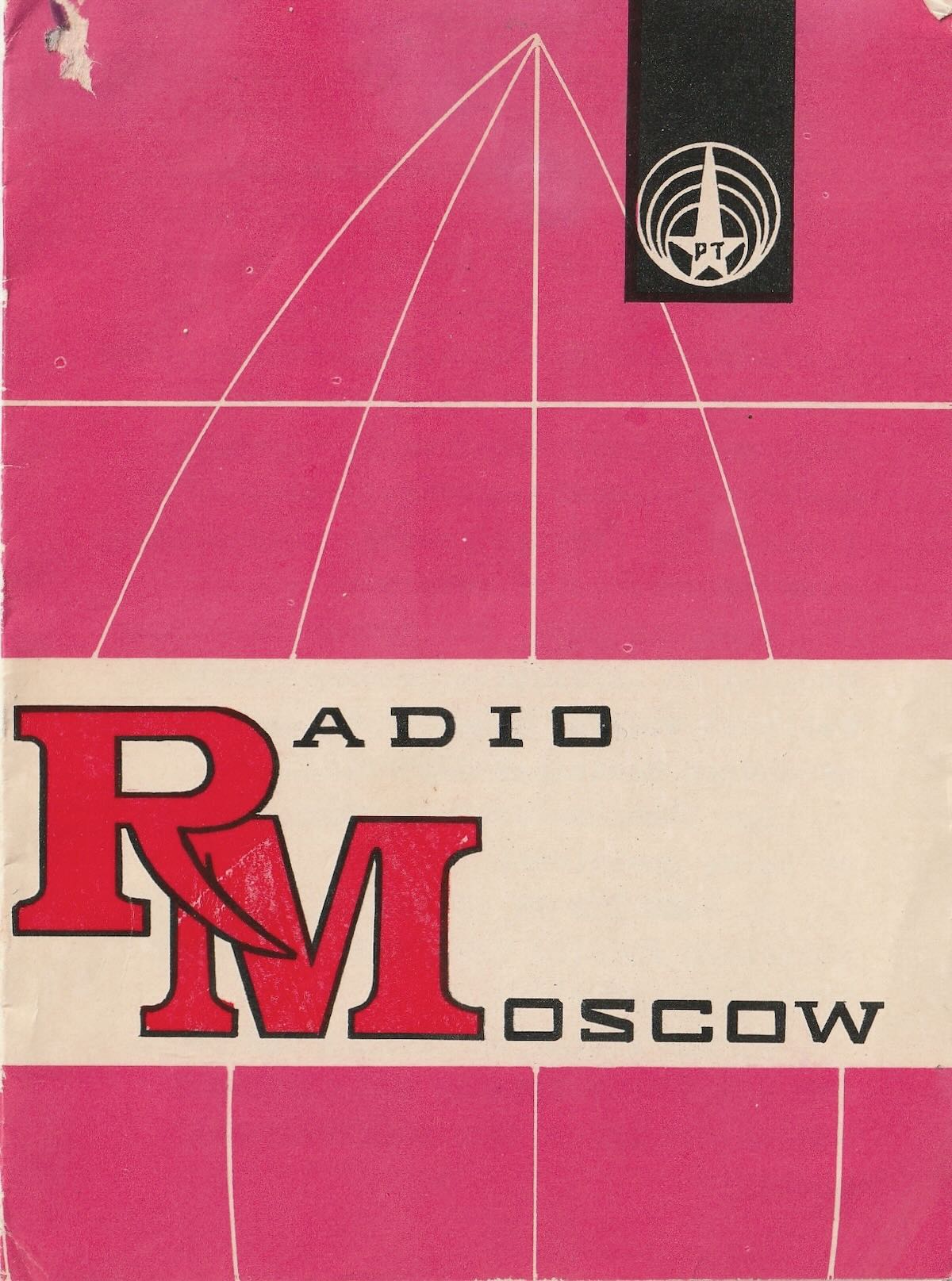
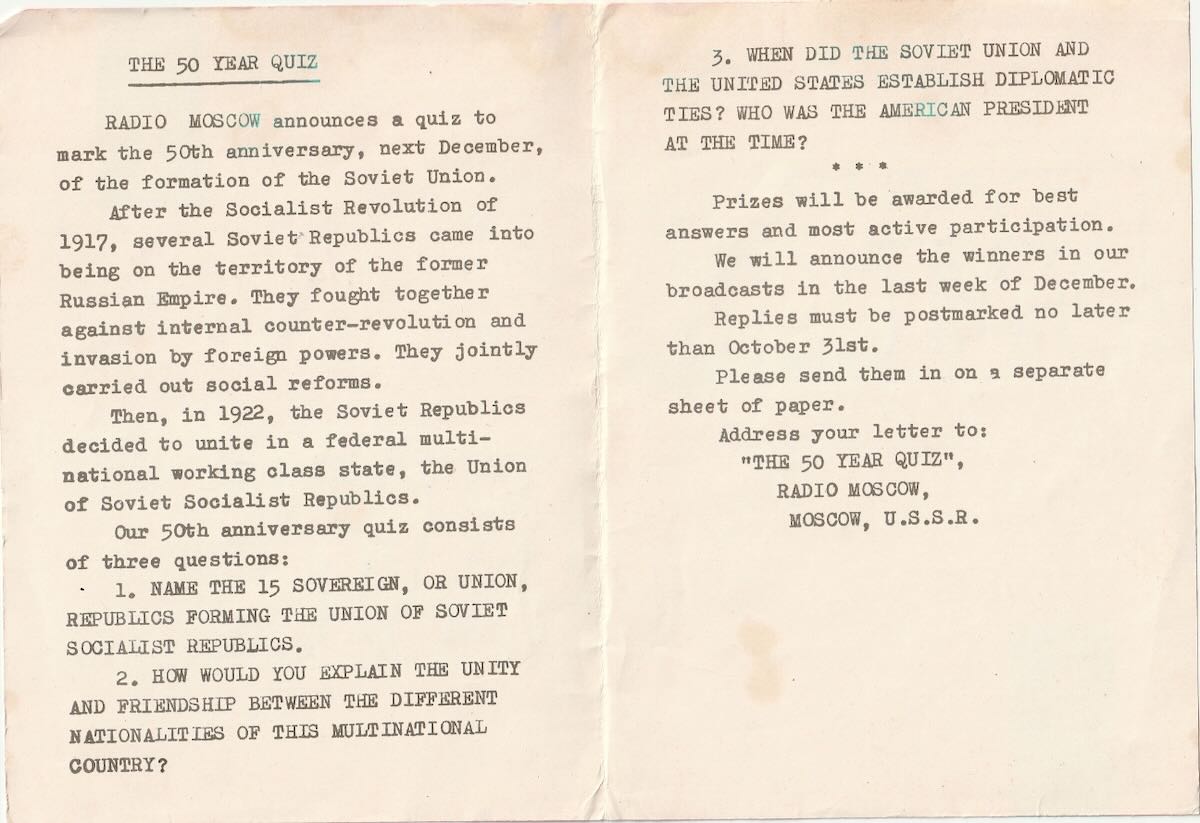
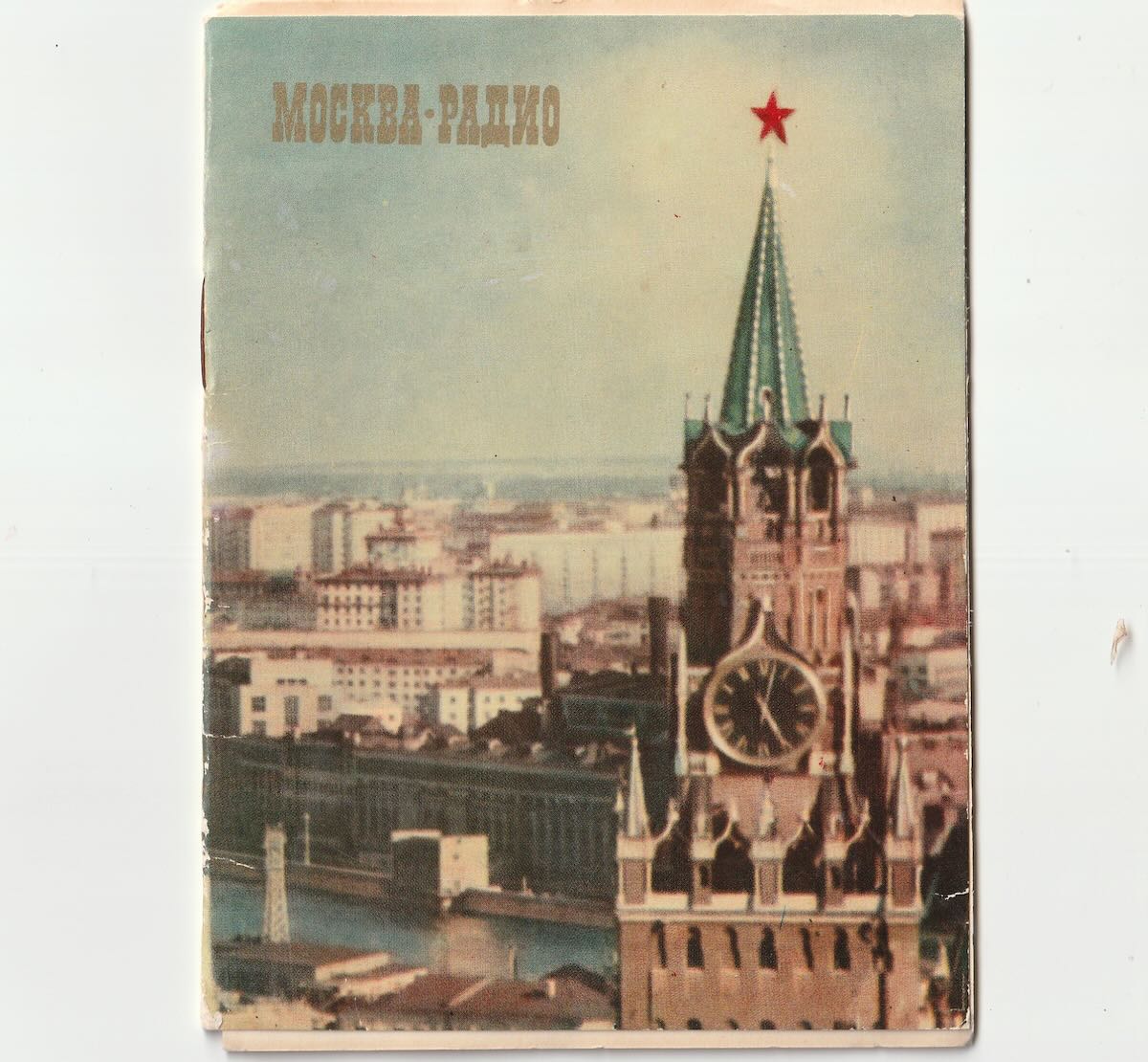
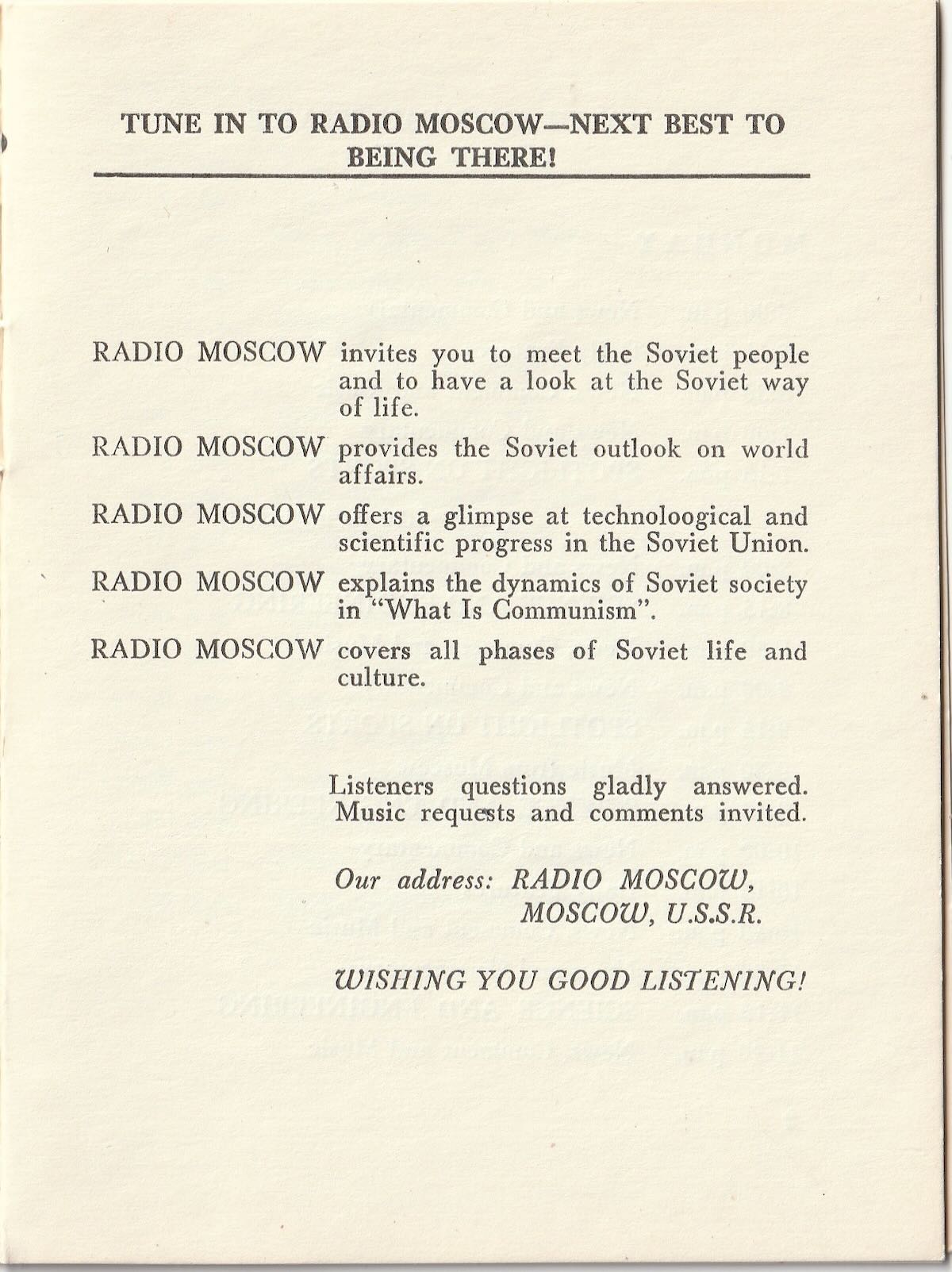
Radio Moscow Ephemera Circa 1972

Many thanks to SWLing Post and SRAA contributor, Dan Greenall, who shares the following Radio Moscow ephemera from 1972. This media is also posted on Archive.org:


I first began listening to shortwave radio in December 1969 at the age of 15. My parents were very supportive of this newfound hobby and allowed some space in the basement for a listening post, in addition to permitting external antenna wires to be run across their property. Various pieces of radio equipment, audio cassettes, shelves of reference books and printed matter including albums filled with QSL’s were accumulated over the next several years, and it all followed me when I moved out. Or so I thought! While clearing out my parents estate in 2016, I came across some ephemera received from Radio Moscow in 1972, that was mixed in with a pile of old papers.

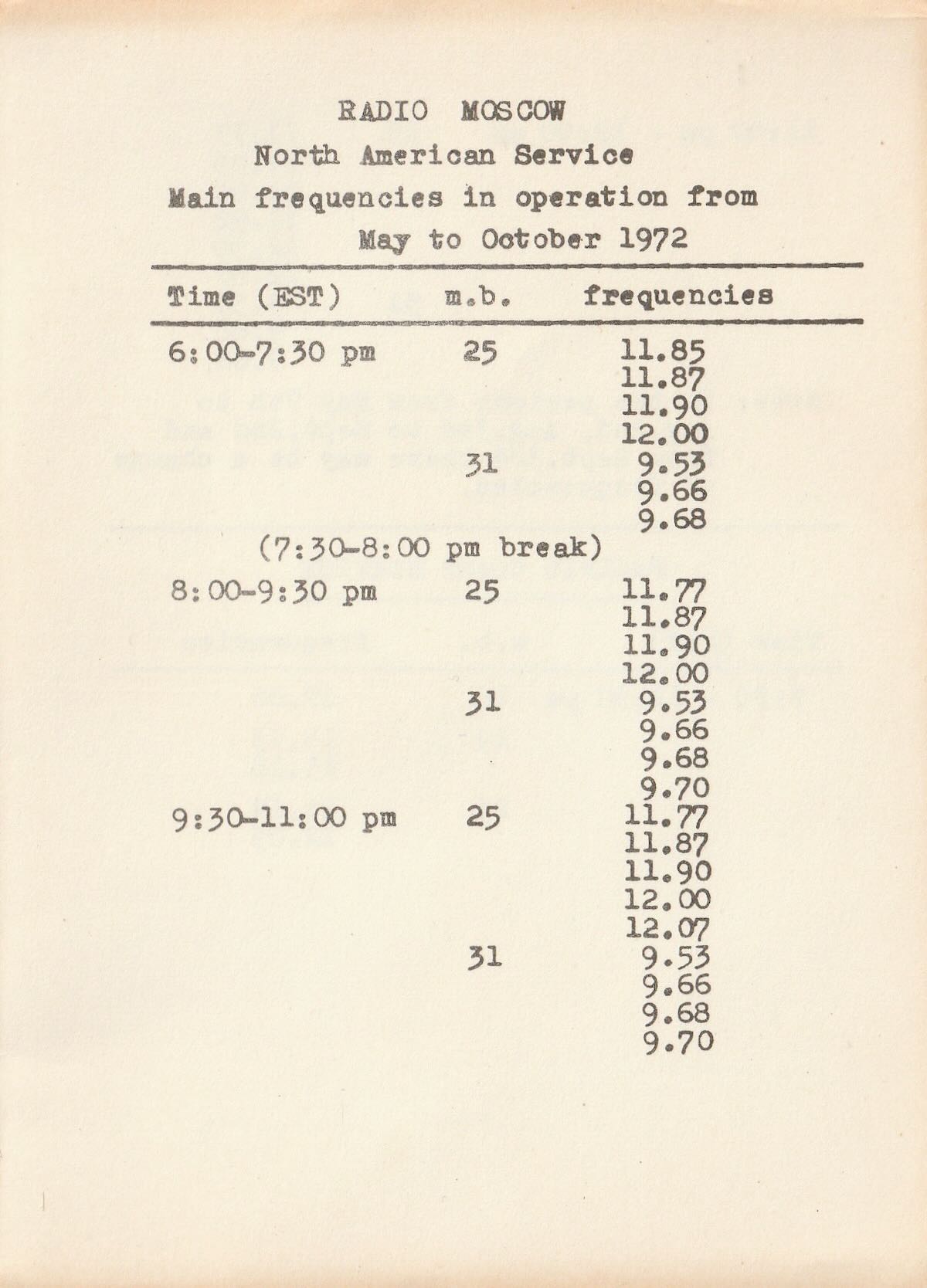
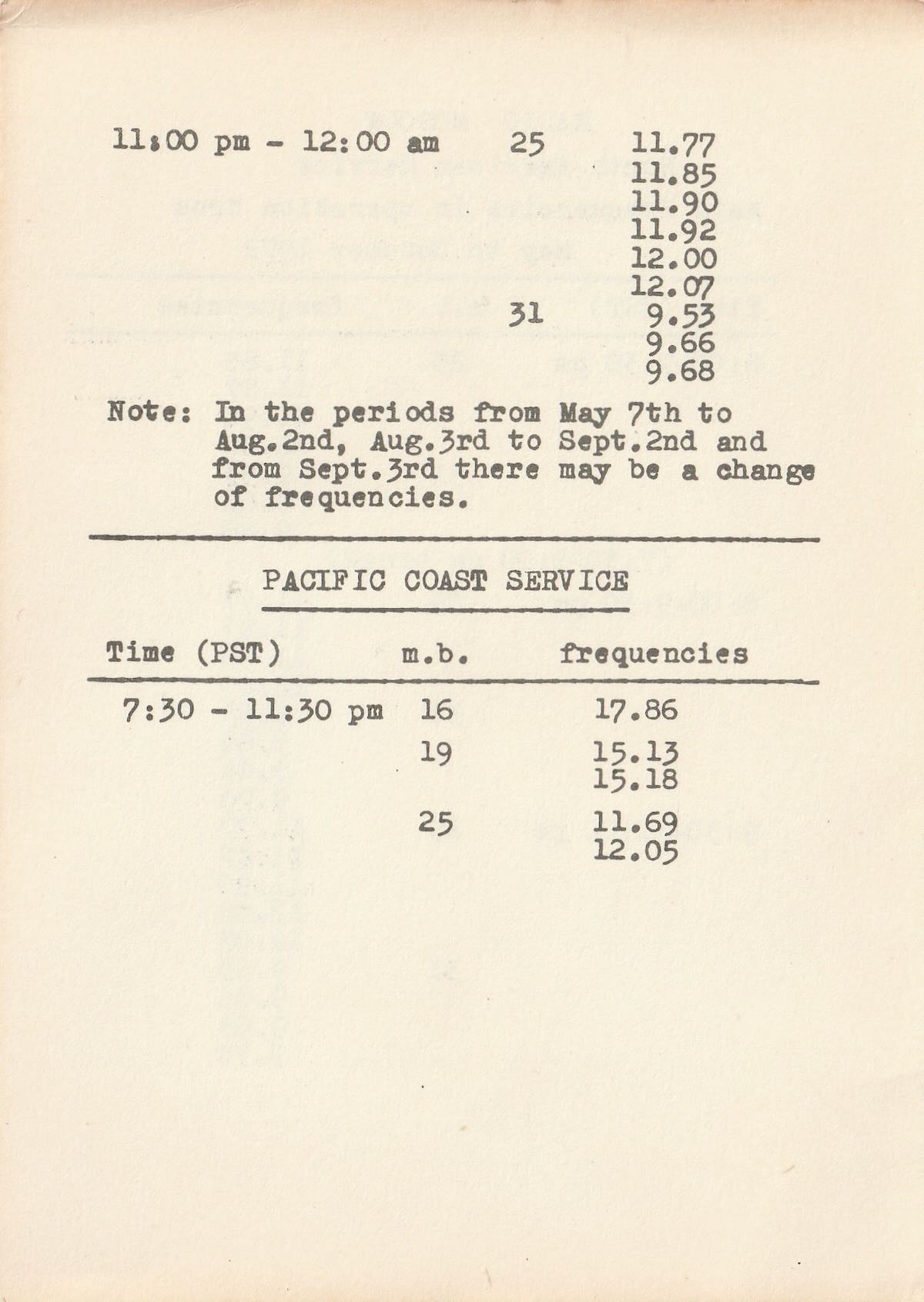
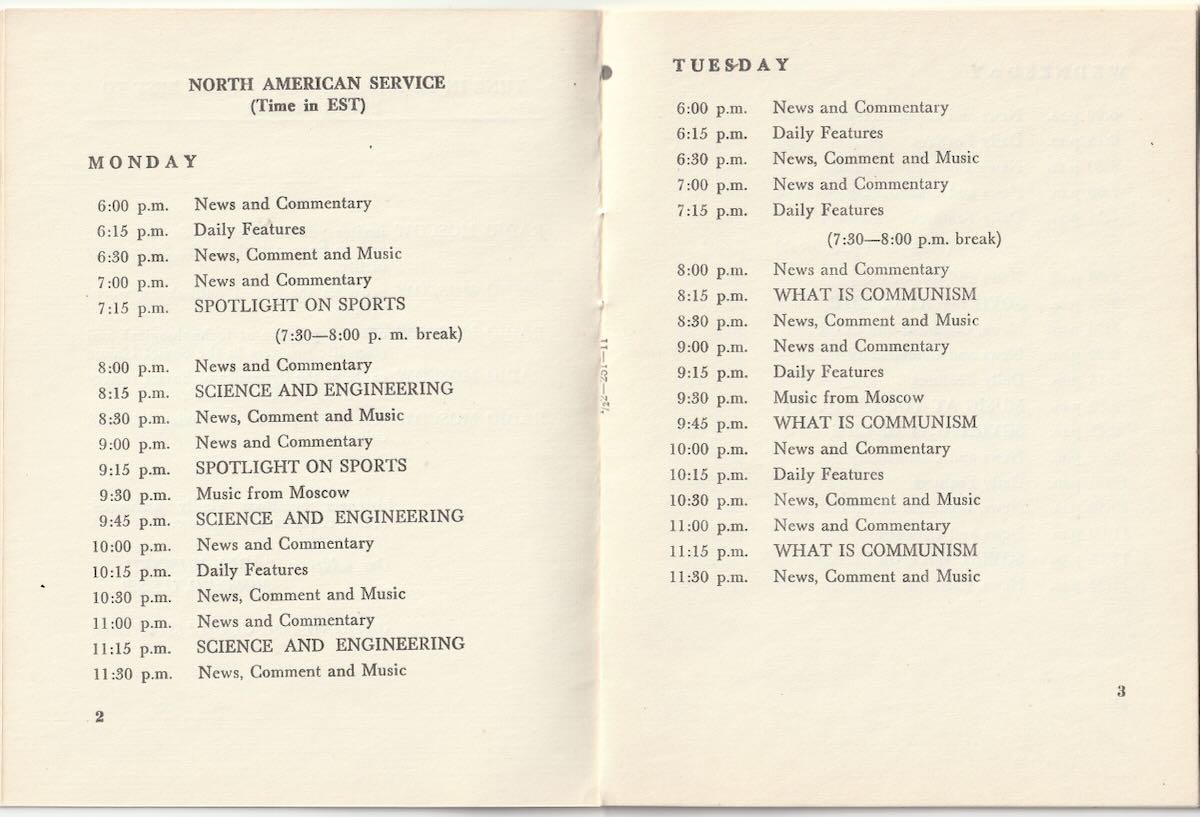
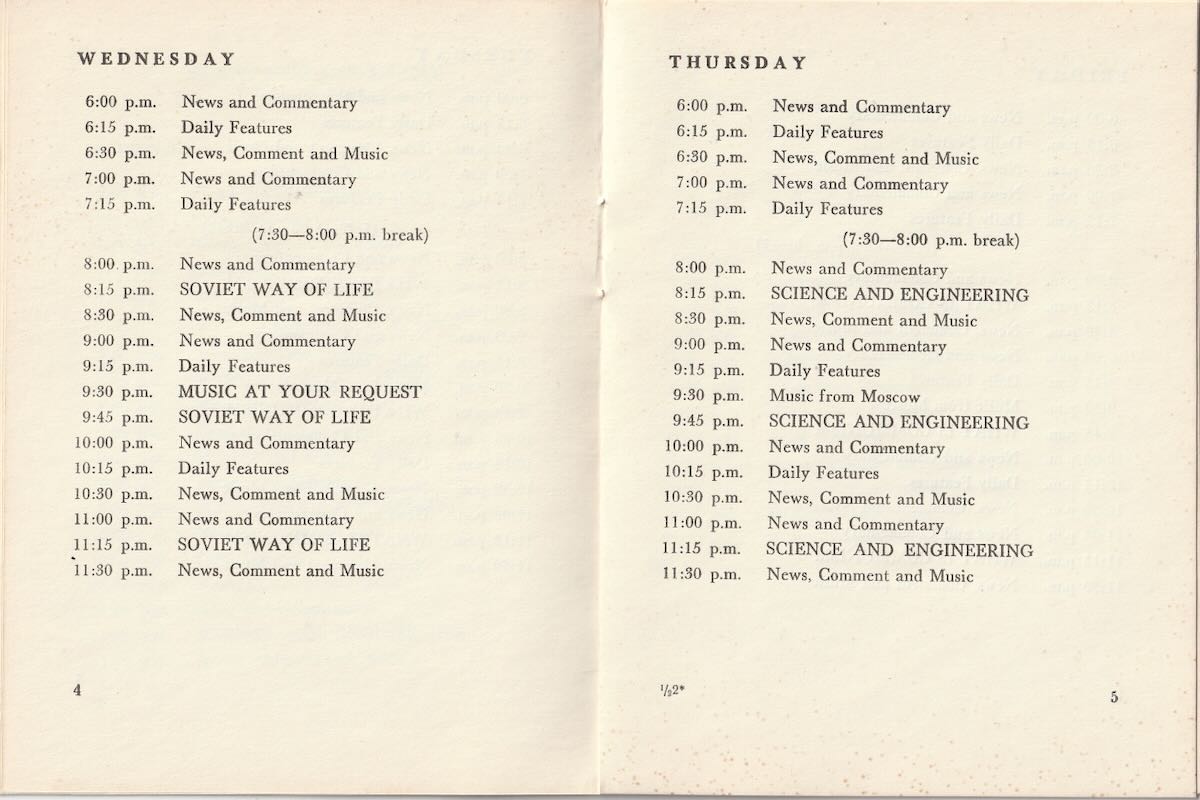
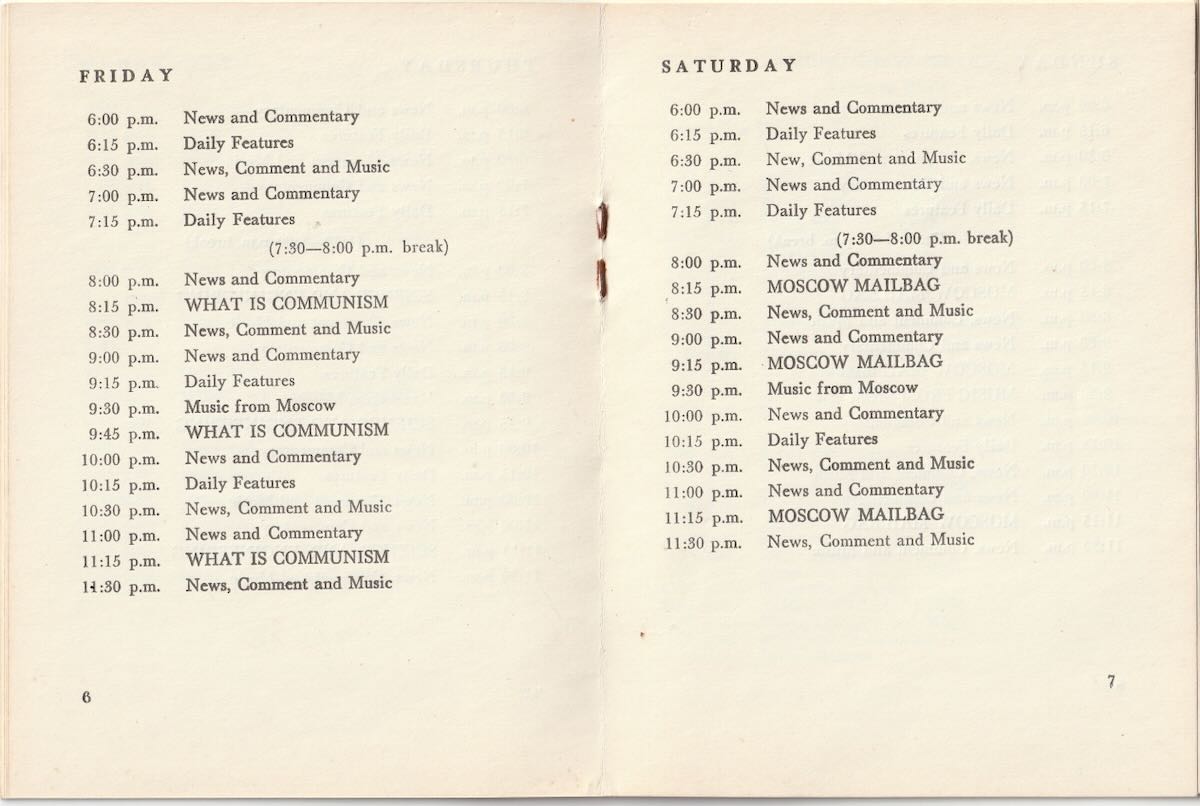
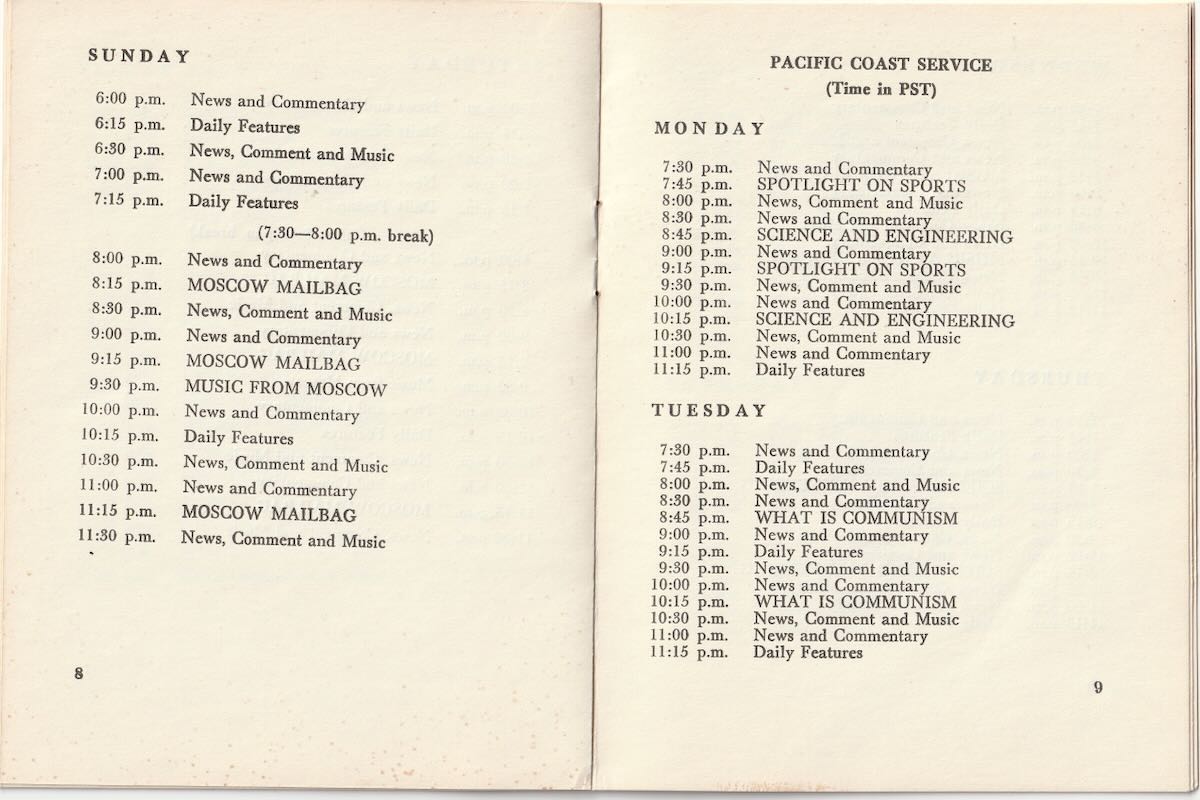
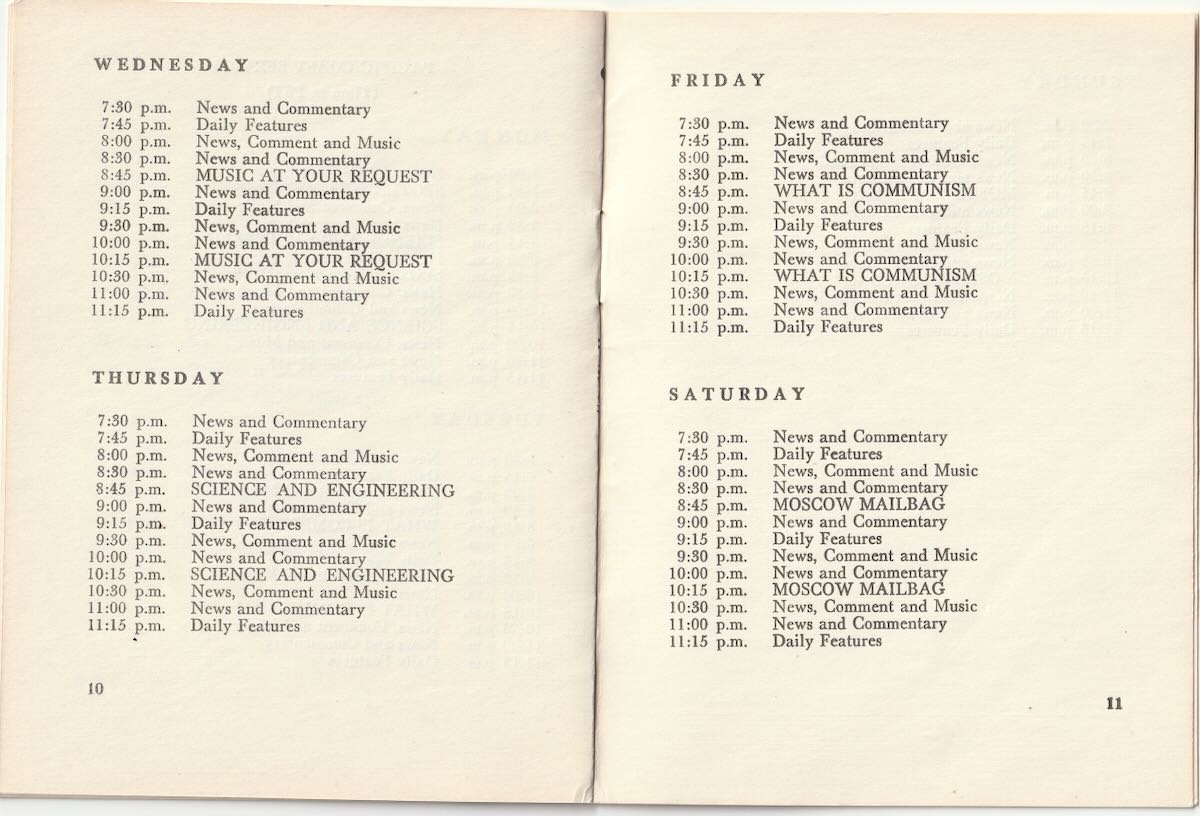
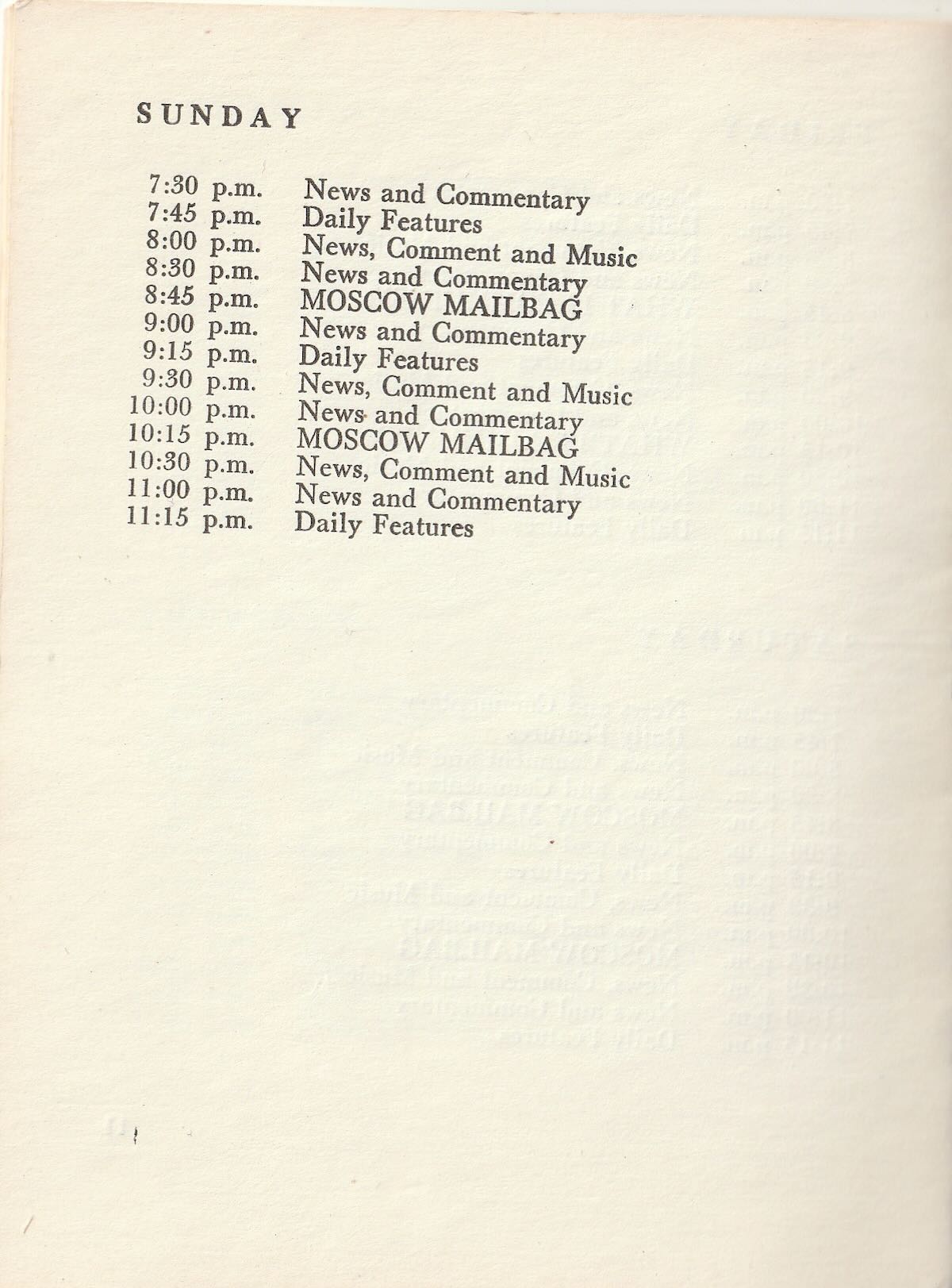
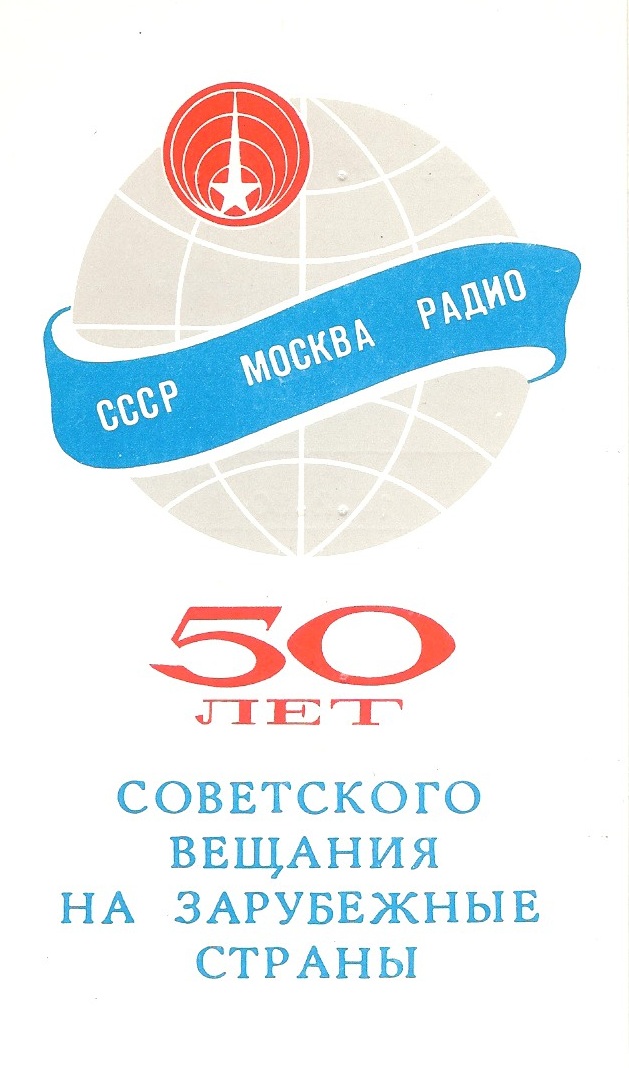
These included a leaflet announcing a Quiz to celebrate the 50th anniversary of the USSR, a frequency guide for their North American service from May to October 1972, and a small 12 page program guide for their North American and Pacific Coast Services.

Studio Recording: Radio Moscow New Year’s Eve Show with Joe Adamov: January 1, 1980

Shortwave Radio Audio Archive contributor, Tom Gavaras, shared this studio recording of Radio Moscow from January 1, 1980. We posted this recording on the SRAA, but I also wanted to share it here as I’m sure there are readers who might have even heard this show over shortwave live back in the day.

I’m certain anyone familiar with Radio Moscow during the Cold War also remembers the voice of Joe Adamov. Enjoy:

Thank you for sharing this recording, Tom!

Happy New Year!

Radio Waves: More Solar Minimum, Cold War Moscow, C-19 Ham Radio Event, and a WWII Code-Breaker is SK

Radio Waves:  Stories Making Waves in the World of Radio

Because I keep my ear to the waves, as well as receive many tips from others who do the same, I find myself privy to radio-related stories that might interest SWLing Post readers.  To that end: Welcome to the SWLing Post’s Radio Waves, a collection of links to interesting stories making waves in the world of radio. Enjoy!

Many thanks to SWLing Post contributors Bill Patalon, Dirk Rijmenants, Rodrigo Tarikian, and David (G4EDR) for the following tips:


Deep ‘Solar Minimum’ is feared (Southgate ARC via Forbes)

Forbes magazine reports a deep ‘Solar Minimum’ is feared as 2020 sees record-setting 100-day slump

Jamie Carter writes:

While we on Earth suffer from coronavirus, our star—the Sun—is having a lockdown all of its own. Spaceweather.com reports that already there have been 100 days in 2020 when our Sun has displayed zero sunspots.

That makes 2020 the second consecutive year of a record-setting low number of sunspots

So are we in an eternal sunshine of the spotless kind?

Read the full article at
https://www.forbes.com/sites/jamiecartereurope/2020/05/12/the-sun-is-asleep-deep-solar-minimum-feared-as-2020-sees-record-setting-100-day-slump/

Radio Moscow and the Cold War (SIGINT CHATTER)

Geopolitics and international conflicts during the Cold War made it important for the United states and the Soviet Union to inform people or influence their political views, and this in many countries around the world. But how did they reach their audience?

Today, we can hardly imagine a world without Internet, cable and satellites that brings all the news and information from across the globe in your lap. Yet, during most of the Cold War, people only had newspapers, local TV, FM and AM radio. The only solution to spread ideas was shortwave radio, as these waves travel around the globe and can listened to by everyone with a shortwave radio.

Both East and West had, and still have, shortwave radio stations with a world service. The best known were Voice of America, Radio Free Europe and Radio Liberty on one side, and Radio Moscow, Radio Beijing and Radio Havana Cuba on the other side. Everyone had their own truth and accused the other side of expansion drift, disinformation and inciting across the world.

One truly iconic station was Radio Moscow World Service. Their foreign service broadcasting started in 1929 with transmitters in Moscow and Leningrad, and later also relay stations in Vladivostok and Magadan. Radio Moscow reached whole Eurasia, Africa and North and South America. During the Cold War, their broadcasts reached across the world with transmitters in the Soviet Union, Eastern Europe and Cuba, and they broadcast in more than 70 languages.[]

COVID-19 Radio Communication Event (SRAL)

COVID-19 RADIO COMMUNICATION EVENT
DATE: June 06-07, 2020.
STARTS 10.00 UTC SATURDAY – ENDS 09.59 UTC SUNDAY

For amateur radio operators worldwide, social distancing is not an issue. Our ham radio network of radio-wave signals flies high and wide, across all borders near and far. Amateur radio operators are well-known for their communication on skills during the happy days, but also during times of crisis.Even if ham radio operators are now confined to their homes, they are encouraged to communicate, to enhance their friendships, and to keep their minds and skills sharp for global messaging whenever needed.

Click here to download the full announcement with event details (PDF).

Tributes as World War Two code breaker Ann Mitchell dies aged 97 (BBC News)

Tributes have been paid to Ann Mitchell – one of the last of a World War Two code-breaking team at Bletchley Park – who has died aged 97.

Mrs Mitchell, who deciphered German codes at the British code-breaking centre from 1943, died at an Edinburgh care home on Monday.

Her family and friends said she had been declining in health for some years and had “a life well lived”.

The Scotsman reported she had tested positive for Covid-19 recently.

Her son Andy Mitchell, 61, told BBC Scotland: “She was a loving mother and it’s very sad but she was declining in old age with memory loss and physical frailties.

“I’m pleased she has been given the recognition for a life well lived.”[]


Do you enjoy the SWLing Post?

Please consider supporting us via Patreon or our Coffee Fund!

Your support makes articles like this one possible. Thank you!

Shortwave Archive: 1979 Radio Moscow Mailbag Studio Recordings

If you’ve been a shortwave radio listener since the Cold War, you no doubt remember Radio Moscow‘s Mailbag program with Joe Adamov.

Tom Gavaras, a new contributor at the Shortwave Radio Audio Archive, recently shared a series of seven Radio Moscow studio recordings and noted:

These recordings were originally provided to me on reel-to-reel tape directly from Radio Moscow (which I dubbed to a cassette). At that time, I was program director at St. Cloud State University’s radio station KVSC-FM (St. Cloud, MN) and aired Moscow Mailbag once a week during the afternoon news block programming. Transcription shows from other shortwave stations were played on other weekday slots at the same time.

Here’s the first studio recording:

We’re publishing a new recording each week over at the Shortwave Radio Audio Archive. Click here to follow this series.

Many thanks, Tom, for sharing these excellent recordings!

Radio Moscow: New Year’s Day, 40 years ago

Happy New Year SWLing Post community!

A few months ago, I published a post about Colin Anderton’s excellent Radio Moscow recordings from the late 1970s. Being a space flight enthusiast, all of Colin’s brief off-air recordings feature news from the 1977-1978 Soyuz 26 mission to the Salyut 6 space station.

Recently, I started posting Colin’s recordings on a schedule so that each recording is being published exactly 40 years from the original broadcast date. Check out the Shortwave Radio Audio Archive each day (or subscribe via iTunes) to listen to the recordings.

Below, I’ve embedded the recording from New Year’s Day 1978 where we learned that Yuri Romanenko and Georgi Grechko toasted the New Year with fruit juice (for obvious reasons, champagne was not allowed on the station!).

Click here to listen via the Shortwave Radio Audio Archive.