Category Archives: News

WBCQ: variety and open source on New Year’s Eve

wbcq-logo

(Source: Stephen Kellat)

As long as our “i”‘s are dotted and our “t”‘s are crossed, there will be a New Year’s Eve special on WBCQ on 5.110 MHz from the production team at Erie Looking Productions in concert with the team behind the Ubuntu UK Podcast.

The Joint New Year’s Eve Special will be airing at 7 PM Eastern on New Years Eve, 12 AM UTC New Year’s Day.  The show is a variety hour with a retrospective on the world of Linux and Ubuntu more specifically, poetry and music by Ashtabula-area musician Mike Kellat, and a policy essay on global communications in the aftermath of the World Conference on International Telecommunications 2012 in Dubai.  Other PSAs such as “Profile America” from the US Census Bureau and some silliness is included as well as a music break.  Cleveland-area life studies artist Big Ed Kellatis assists Mike Kellat with the poetry reading.

The show is licensed under a Creative Commons Attribution Share-Alike 3.0 United State License which is further explained athttp://creativecommons.org/licenses/by-sa/3.0/us/ with the show to be attributed with “Joint New Year’s Eve Special” as title and “Gloria D. Kellat” as the responsible producer.  Sharing and posting of airchecks is encouraged especially by sites like SWLing Post.  [Gotcha!]

Erie Looking Productions produces “LISTen: An LISNews.org Program” at http://lisnews.org/podcast to cover the realm of library & information science as well as “Ubuntu Ohio – Burning Circle” at http://ohio.ubuntu-us.org/burningcircle to cover the activities of the Ohio Local Community team of the Ubuntu Linux project.  The Ubuntu UK Podcast production team releases programs athttp://podcast.ubuntu-uk.org/ covering the world of Ubuntu more specifically and Linux more generally.  Gloria D. Kellat, producer at Erie Looking Productions, served as overall producer for the joint effort this year.

Much like last year’s shortwave special produced by Erie Looking Productions alone, this is done to highlight the impact of dangerous trends towards a fractured and broken Internet that have grown ever larger since the start of the Arab Spring.  It is far too easy in today’s world for the Internet to simply go away whether by human intention or the intervention of natural circumstance as seen in the multiple failures of Netflix during 2012.  This remains yet another drill to show that message content rather than transport medium is key to communications viability.

Shortwave is most certainly not dead yet…

Voice of Croatia leaving shortwave in 2013

VoiceOfCroatiaOver the holidays, the Voice of Croatia announced that they will be leaving the shortwave spectrum as of the 1st of January 2013. They sent the following message to their listeners:

Dear listeners:

From January 1, 2013 this program will no longer be broadcast on shortwave. You’ll still be able to find us on the medium wave in Europe and on the satellite and the Internet for the whole world. Funds which have hitherto been used to service the transmission on shortwave will be used to offer diverse content of this program including the launch of multimedia content.

Here schedule of shortwave until Dec 31:
0000-0200 on 7375 NAU 100 kW / 300 deg to CeAm
0200-0400 on 7375 NAU 100 kW / 315 deg to NEAm
0400-0600 on 7375 NAU 100 kW / 325 deg to NWAm
0600-1700 on 7370 DEA 100 kW / 000 deg to WeEu
0700-1100 on 17860 SNG 100 kW / 135 deg to AUS
1700-0600 on 3985 DEA 100 kW / 000 deg to WeEu
2300-0400 on 7375 NAU 100 kW / 255 deg to SoAm

VOA’s “Music Man,” Leo Sarkisian, retires at 91

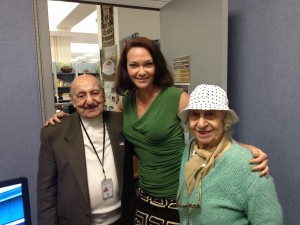
From right to left: Leo Sarkisian, Heather Maxwell, and Mary Sarkisian. (Photo: VOA)

Many shortwave radio listeners know the name Leo Sarkisian, founder of the Voice of America show Music Time in Africa. For decades, Leo and his wife, Mary, traveled to every corner of Africa, lugging with them a large reel-to-reel recorder that Leo used to capture for broadcast the diverse music found across the continent. A monumental cultural record is the result. Earlier this year, at 91 years old, Sarkisian retired from VOA; he leaves his show and his wonderful library of recordings in the capable hands of radio host Heather Maxwell.

Today, Richard Harris offered an excellent radio piece he produced on Leo Sarkisian for PRI’s The World–you can listen to it below or on PRI’s site:

In addition, both the VOA and The Washington Post featured Leo and Mary earlier this year; both of these articles are delightful.The Washington Post article even describes Sarkisian’s work as “diplomacy.” I particularly love the following description:

Long before there was ping-pong diplomacy or pere­stroika, a short, balding Armenian American was lugging an enormous reel-to-reel from village to village, sweet-talking people into singing and playing for him.

[…]In Africa, he socialized with presidents, military dictators, accomplished musicians and tribal villagers. He outwardly steered away from politics, but under the surface he wove a subtle diplomatic tapestry based around grooving on tunes.

That’s one thing I love about shortwave radio–in all forms, in all countries, it offers a medium of accessible, lasting diplomacy–however “subtle” it may seem–for at least as long as the shortwaves continue to grace our airwaves.  Of course, music is inextricably integrated into this diplomatic medium.  Thank you, Leo and Mary, for a reminder of that, in the form of a truly extraordinary life’s work. 

Ears To Our World: Giving the gift of radio

Doulek's Association of Disabled People, Cameroon (Photo: ETOW)

Doulek’s Association of Disabled People, Cameroon (Photo: ETOW)

This holiday season, you might consider giving a charitable donation to Ears To Our World. A one time donation of $40 US can help a community through the power of shortwave radio.

Many readers may know that I’m quite involved with ETOW.

We recently published this article showing the impact of one self-powered shortwave radio in rural Cameroon. It’s pretty amazing and this mission would not be possible without the support of those who understand the importance and impact of shortwave radio; people like you. Thank you!

The SWLing Post Podcast

podcasticonThanks to SWLing Post reader, Michael, I have set up our RSS feed for podcasts.
This means that if you enjoy listening to our shortwave radio recordings, you can now easily subscribe and download all of our audio automatically. This is not edited material–no introductions, nor host–simple shortwave radio recordings.

If you would like to subscribe to the SWLing Post Podcast, point your favorite podcasting application to our RSS feed:
http://feeds.feedburner.com/TheSwlingPost

In iTunes, for example, go to the “File” menu and select “Subscribe to podcast”–then, simply paste our RSS feed address in the url field.  Other podcast applications will have a similar approach.

Thanks, Michael!

Severance pay of Radio Netherlands CEO under scrutiny

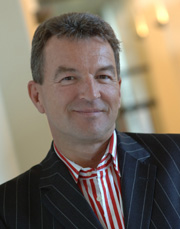
Outgoing Radio Netherlands CEO, Jan Hoek (Photo: RNW)

Outgoing Radio Netherlands CEO, Jan Hoek (Photo: RNW)

(Source: de Volkskrant, translated by Andy Sennitt)

The severance payment for the outgoing CEO of Radio Netherlands Worldwide is excessive. This is what Sander Dekker, deputy minister responsible for the media, wrote on Thursday in a letter to the Lower House of the Dutch parliament.

RNW Director-General Jan Hoek was originally set to receive a fee of 1.1 million euros. Following an urgent request by Mr Dekker and his predecessor, the RNW Supervisory Board agreed with the Director-General to reduce the severance pay to 800,000 euros. Despite the reduction in the amount, according to Mr Dekker it is still “too high and therefore inappropriate and undesirable.”

The Deputy Minister willl investigate the legal issues, but sees no possibility of preventing payment of the severance premium. Mr Dekker says that taking the matter to court offers no solution, because according to the agreement signed in 2001 Mr Hoek is formally entitled to receive his full severance payment.

A new law regulating the salaries of public officials goes into effect on 1 January. This will prevent excessive payments in the future. Under the new rules, a severance payment will be restricted to a maximum of 75,000 euros. But agreements already signed are not covered by the new law.

International Broadcasters support freedom of information

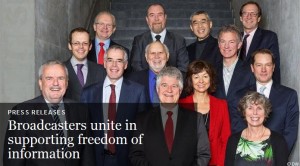
JointStatementThe international broadcasting arms of France, Australia, the US, the United Kingdom, Germany, Japan and the Netherlands issued a joint statement in support of press freedoms across the globe. With the exception of the Netherlands (RNW), all of these countries still broadcast over the shortwaves.

(Source: BBC Media Center via Kim Elliott)

We, the representatives of Audiovisuel Extérieur de la France (AEF), Australian Broadcasting Corporation (ABC) [Australia], British Broadcasting Corporation (BBC) [United Kingdom], Broadcasting Board of Governors (BBG) [US], Deutsche Welle (DW) [Germany], Nippon Hoso Kyokai (NHK) [Japan] and Radio Netherlands Worldwide (RNW), have met in Berlin to discuss common concerns.

We find international journalism is facing unprecedented challenges from countries that seek to deny their own citizens access to information from outside their borders in violation of Article 19 of the Universal Declaration of Human Rights, which states:

“Everyone has the right to freedom of opinion and expression; this right includes freedom to hold opinions without interference and to seek, receive and impart information and ideas through any media and regardless of frontiers.”

We call upon the world’s nations to strengthen their commitment to Article 19 and to support expanded opportunities to share information across borders through digital and mobile technologies.

Yet we note with dismay that certain governments continue to control the flow of information. For example, China routinely blocks the Web and social media sites of our broadcasters and jams our shortwave signals, or Iran and Syria interfere with the satellite signals that carry our programs. Governments in Eurasia, Africa, the Middle East and Latin America also seek to control what their own citizens can see, hear and read.

Many of these actions, including intentional jamming of satellites, violate international regulations. We condemn them without reservation.

We also call attention to troubling new challenges to free expression. Some governments are seeking to enact far-reaching telecommunications regulations to stymie free speech.

At the World Conference on International Telecommunication (WICT) in Dubai, representatives of the world’s nations have considered telecommunications rules that might explicitly apply to the Internet for the first time.

We cast a wary eye on such efforts to control the Internet, and we denounce efforts to identify and track Internet users in order to stifle free expression, inquiry and political activity.

We have agreed to increase, whenever possible, our support for efforts to circumvent Web censorship through the use of new and innovative hardware and software tools. We also agreed to increase our advocacy for Internet freedom.