Many thanks to SWLing Post contributor, Ed, who notes that the latest version of the DRM Handbook is available for download.

Many thanks to SWLing Post contributor, Ed, who notes that the latest version of the DRM Handbook is available for download.
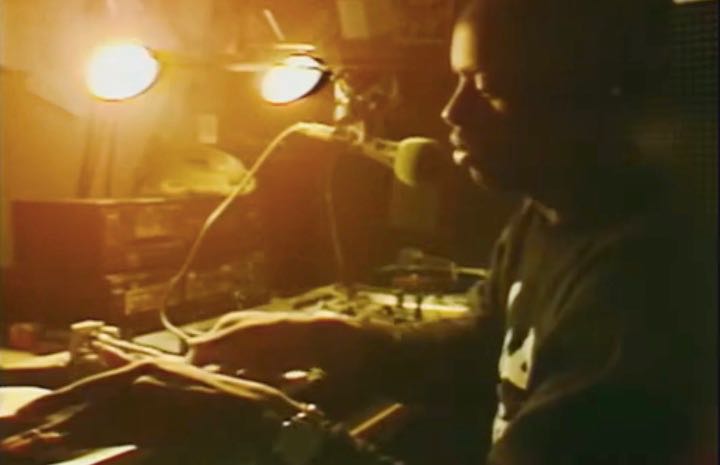
Many thanks to SWLing Post contributor, Mark Fahey, who shares a link to this BBC documentary about pirate radio:
(Source: Radio Amateurs of Canada via Bruce Atchison)
*/For immediate release:/*
https://wp.rac.ca/ised-canada-responds-to-petition-about-interference/
On June 6, 2018, Martin Bérubé of Louiseville, Quebec initiated a petition involving a radio station that was “generating interference on purpose”. The petition attracted 1,135 signatures and was presented to the House of Commons on January 30, 2019.
The Government of Canada tabled the following response on March 18, 2019.
“Innovation, Science and Economic Development Canada <http://www.ic.gc.ca/eic/site/icgc.nsf/eng/home> (ISED) was informed of the individual’s conduct in December 2015 by a group of Amateur Radio operators from Quebec. The individual was operating an Amateur Radio station without proper authorization and was known to insult, threaten and impersonate other Amateur operators.
As the individual disregarded ISED’s written and verbal warnings, the department took action to enforce the /Act/. Due to repeated offences, ISED carried out three searches of the individual’s residences and issued seven notices of violation totalling $2,500 plus fees.
On October 17, 2018, the individual was found guilty of these seven violations of subsection 4(1) of the /Radiocommunication Act/, pursuant to subsection 10(1) of the /Act/, by Justice of the Peace Annie Vanasse at the Trois-Rivières Courthouse.
ISED also called upon a federal prosecutor to obtain an injunction against the individual. This injunction is currently at the interlocutory stage. ISED understands that the individual has not been heard on Amateur Radio since August 8, 2018. ISED is closely following this case.”
The text of the petition and the Government Response can be found at the following link:
https://petitions.ourcommons.ca/en/Petition/Details?Petition=e-1631
*Alan Griffin
RAC MarCom Director*
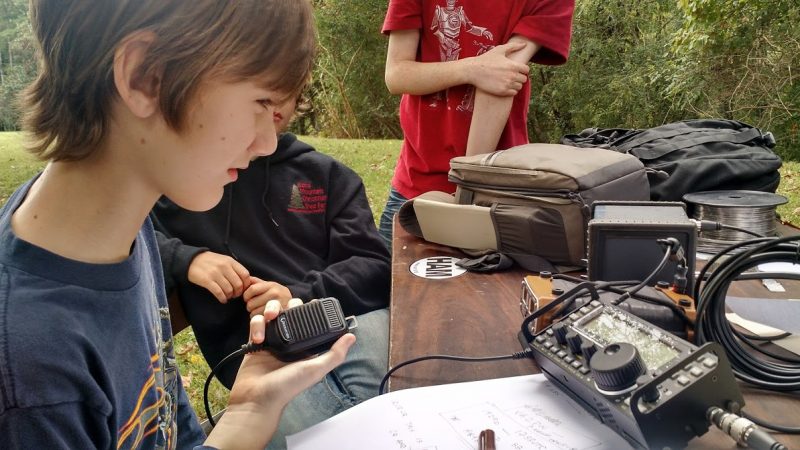
(Source: Southgate ARC)
The FCC has invited public comments on ARRL’s 2018 Petition for Rule Making, now designated as RM-11828, which asks the FCC to expand HF privileges for Technician licensees to include limited phone privileges on 75, 40, and 15 meters, plus RTTY and digital mode privileges on 80, 40, 15, and 10 meters.
Interested parties have 30 days to comment. The Technician enhancement proposals stemmed from the recommendations of the ARRL Board of Directors’ Entry-Level License Committee, which explored various initiatives and gauged member opinions in 2016 and 2017.
“This action will enhance the available license operating privileges in what has become the principal entry-level license class in the Amateur Service,” ARRL said in its Petition. “It will attract more newcomers to Amateur Radio, it will result in increased retention of licensees who hold Technician Class licenses, and it will provide an improved incentive for entry-level licensees to increase technical self-training and pursue higher license class achievement and development of communications skills.”
Specifically, ARRL proposes to provide Technician licensees – both present and future – with:
* Phone privileges at 3.900 to 4.000 MHz, 7.225 to 7.300 MHz, and 21.350 to 21.450 MHz.
* RTTY and digital privileges in current Technician allocations on 80, 40, 15, and 10 meters.The ARRL petition points out the explosion in popularity of various digital modes over the past 2 decades. Under the ARRL plan, the maximum HF power level for Technician operators would remain at 200 W PEP. The few remaining Novice licensees would gain no new privileges under ARRL’s proposal.
ARRL’s petition points to the need for compelling incentives not only to become a radio amateur in the first place, but then to upgrade and further develop skills. Demographic and technological changes call for a “periodic rebalancing” between those two objectives, ARRL maintained in his proposal. The FCC has not assessed entry-level operating privileges since 2005.
The Entry-Level License Committee offered very specific data- and survey-supported findings about growth in Amateur Radio and its place in the advanced technological demographic, which includes individuals younger than 30. It received significant input from ARRL members via more than 8,000 survey responses. “The Committee’s analysis noted that today, Amateur Radio exists among many more modes of communication than it did half a century ago, or even 20 years ago,” ARRL said in its petition.
Now numbering some 384,500, Technician licensees comprise more than half of the US Amateur Radio population. ARRL stressed in its petition the urgency of making the license more attractive to newcomers, in part to improve upon Science, Technology, Engineering, and Mathematics (STEM) education, “that inescapably accompanies a healthy, growing Amateur Radio Service.”
ARRL said its proposal is critical to develop improved operating skills, increasing emergency preparedness participation, improving technical self-training, and boosting overall growth in the Amateur Service, which has remained nearly inert at about 1% per year.
The Entry-Level License Committee determined that the current Technician class question pool already covers far more material than necessary for an entry-level exam to validate expanded privileges.
ARRL told the FCC that it would continue to refine examination preparation and training materials aimed at STEM topics, increase outreach and recruitment, work with Amateur Radio clubs, and encourage educational institutions to utilize Amateur Radio in STEM and other experiential learning programs.
(Source: ARRL)
Those interested posting brief comments on the ARRL Technician Enhancement proposal (RM-11828) using the Electronic Comment Filing System (ECFS) should access FCC Electronic Comment Filing System Express. In the “Proceeding(s)” field, enter the number of the PRM, i.e., RM-11828 (using this format), complete all required fields, and enter comments in the box provided. You may review your post before filing. All information you provide, including name and address, will be publicly available once you post your comment(s). For more information, visit “How to Comment on FCC Proceedings.”
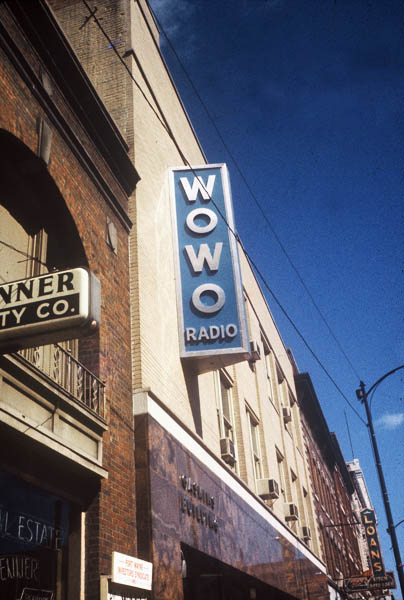
Photo source: historyofwowo.com
Many thanks to SWLing Post contributor, Dave Snyder, who shares the following in reply to our previous post about a chunk of the WOWO fire escape in lucite:
Thomas,
Have you ever visited “www.historyofwowo.com“–?
This site was put together by Randy Meyer and has hundreds of photos from 95+ years of broadcasting. Many pictures are from me as I worked there from 1969 to 1982. The link below is to the promotional items page where there is another picture of the “World Famous WOWO Fire Escape” chunk of steel cast in lucite.
These were made in 1978 after the station moved from the Gaskins Building to the Central Building. (By the way, the Central building is no longer there.)
The Gaskins Building was a dismal place with no windows. The air and news people had to open the door to the fire escape to see if was sunny or raining. That is why the local temperature was from the World Famous Fire Escape. My piece of fire escape is in a box in the basement.
Many thanks for sharing this, Dave! WOWO is such an iconic AM station with such a deep history–I’m grateful all of these photos and history are being archived and shared online.
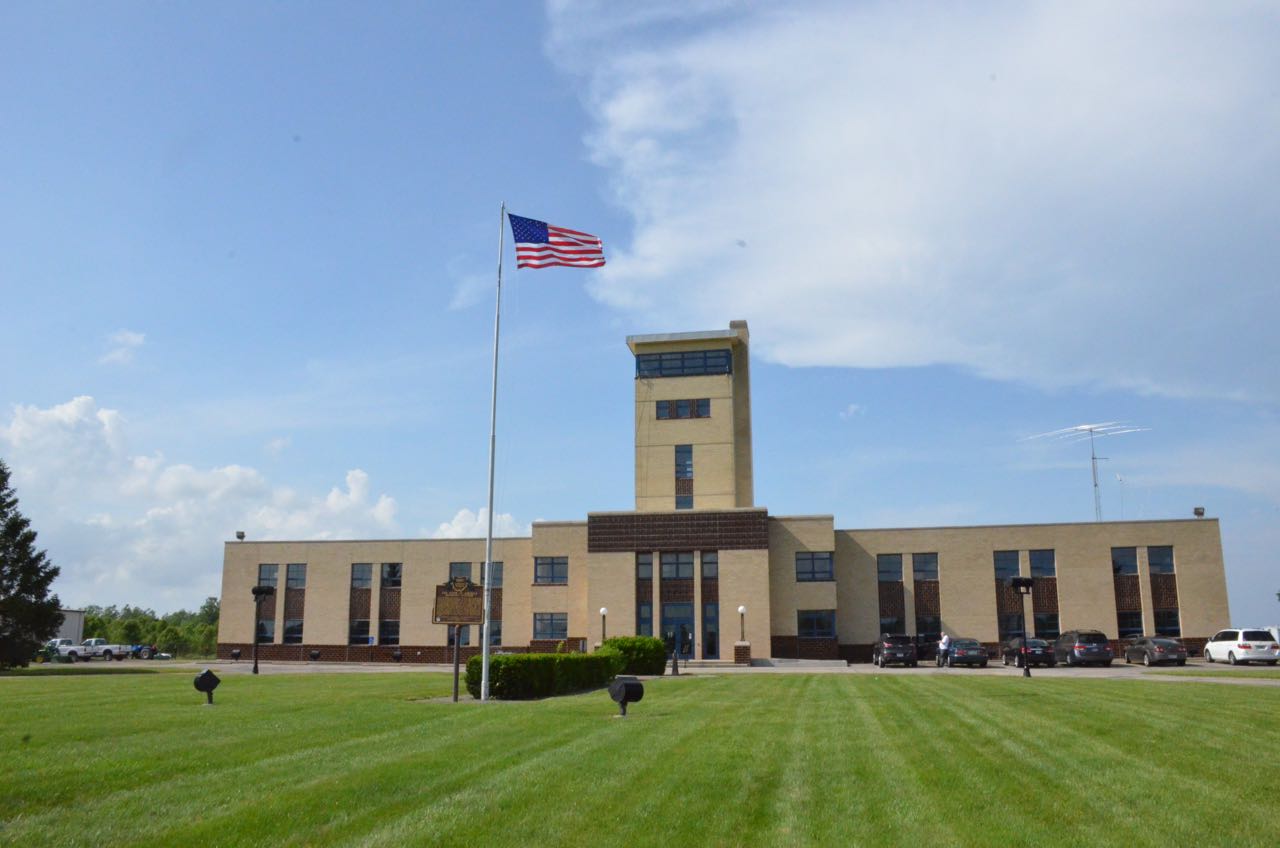
(Source: Cincinnati.com)
If you’ve ever wondered why the VOA-Bethany Station needed a secured, square mile of land surrounding its 1944 art deco building in West Chester, Jack Dominic has the answer.
Dominic, the National Voice of America Museum of Broadcasting director, will speak on the “History of the VOA-Bethany Station and the VOA Museum Today” Wednesday, April 3, from 7 to 8:30 p.m. at the MidPointe Library in West Chester’s community room.
The free event is the second of a four-part series, “The Voice of Truth in America: Celebrating 75 Years of the VOA Bethany Station,” with the MidPointe Library System.
The VOA museum hosts other free events this year to commemorate the 75th anniversary of the VOA-Bethany Station, which now houses the Cold War-era history and broadcasting museum.
“From World War II through the Cold War, the VOA-Bethany Station played a vastly important role in transmitting real news via shortwave radio to people living in countries that lacked a free press,” said Ken Rieser, VOA museum board president. “And it all started here in Cincinnati, with two brothers who developed the technology that evolved into the commercial radio industry.”[…]
The VOA museum will host its fourth annual “75 Years of Rockin’ the Radio” fundraiser Saturday, Sept. 21, with dinner and dancing. Sponsorships are now available.
Museum hours are 1 to 4 p.m. Saturdays and Sundays at 8070 Tylersville Road. Admission is $5 for adults and $1 for children.
For a complete schedule of 2019 VOA museum events, “The Voice of Truth in America,” series and WCARA events, visit www.voamuseum.org, www.midpointelibrary.org and www.wc8VOA.org.
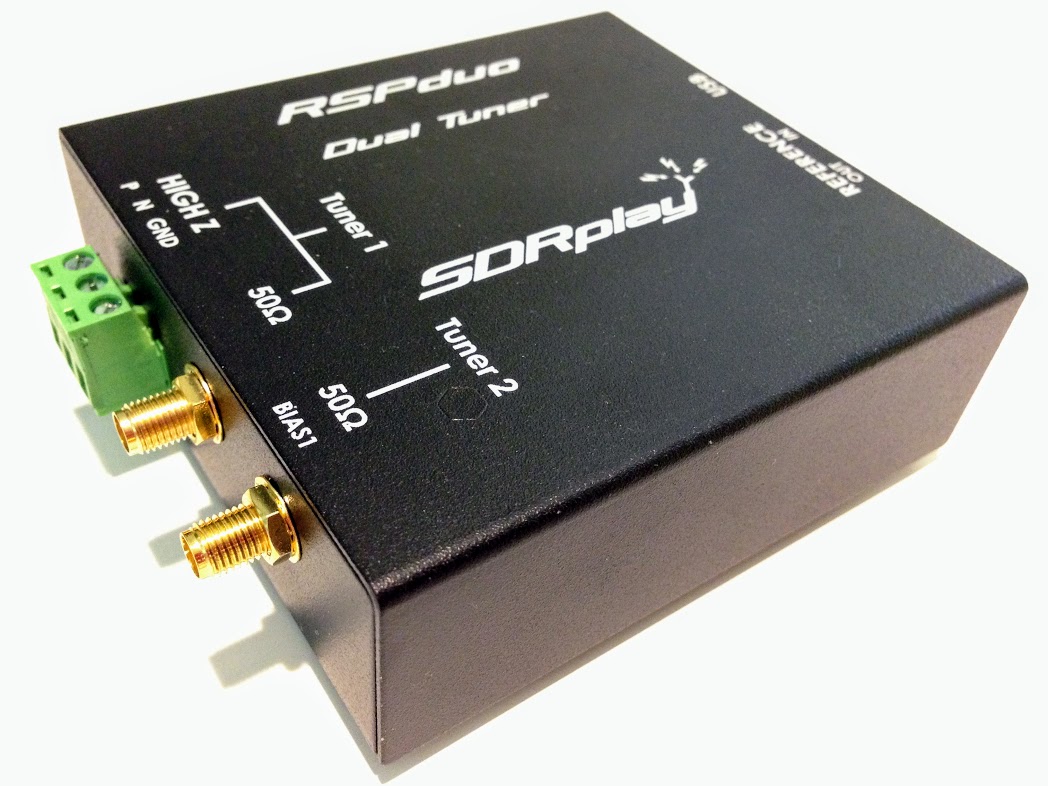
The SDRplay RSPduo
(Source: Jon Hudson at SDRPlay)
This video guide demonstrates the new RSP TCP server software which is now included in the latest Raspberry Pi SD Card image. The video shows how easy it is to set up an RSP at a remote location for access over the internet.
Click here to view on YouTube.
The video uses a Raspberry Pi at the remote location, and a Windows PC running HDSDR back at home base.
We are only demonstrating the Raspberry Pi version of the server here. Also, we are demonstrating extended mode (enabling the full RSP ADC resolution which only works with software which supports an EXTIO interface). Other (non EXTIO compatible) RTL-SDR software will also run via the server on an RSP device – but in “normal mode” meaning that the data resolution will be restricted to 8 bits.