Category Archives: Radio History

Recording Radio History: The Queen’s Diamond Jubilee via BBC World Service

Diamond Jubilee at Buckingham Palace (photo: BBC)

Ten years ago, my wife–then fiancée–and I lived in the UK, and were fortunate enough to attend The Queen’s Golden Jubilee celebration on the vast lawn at Buckingham Palace. It was without doubt the largest party I’ve ever attended, packed to the gills with the British public–a thoroughly amazing event, featuring a who’s who of past-and-present British musicians and personalities, encouraging attendees to join them in their bit of fun–and, of course, God save the Queen.

Yesterday, I re-lived the energy of that party as I heard (and recorded) the follow-up event these ten years later–The Queen’s Diamond Jubilee, on the BBC World Service–as heard from remote Ascension Island.
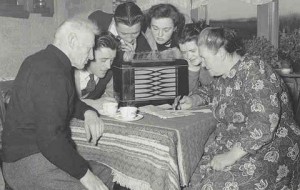
When hearing live events like this on shortwave–especially ones like this that celebrate national heritage–I know I’m listening to history in the making. The crowds applauding and cheering in a live broadcast over shortwave reminds me of a former era when British Expats across the globe relied on the BBC World Service to connect them with ol’ Blighty.
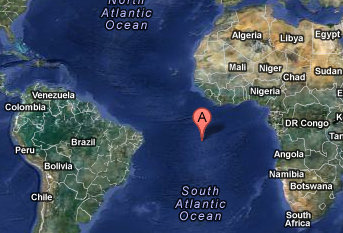
Ascension Island, marked with an "A" (image: Google Maps)

I recorded these broadcasts from my home in the southeastern US, hearing the BBC World Service relay station on the tiny, isolated Ascension Island in the South Atlantic. The broadcast was heard at first on 15,400 kHz, then moved to 9,915 kHz coinciding with their normal broadcast schedule. The broadcast, while completely intelligible, is weak in the beginning, but gains considerable strength by the end. There are summer static crashes heard as storms moved through the southeast US. I divided the broadcast into two parts, coinciding with my shift from one frequency to the other.

I also included a BBC WS news broadcast in Part 2 which followed the end of the show.

Either use the embedded Archive.org audio player below, or simply click here to download the mp3 files for Part 1 and Part 2.

I used the WinRadio Excalibur to record both of these segments. Its synchronous detection helped deal with fading (QSB) present at the beginning of the recording.

Once again, history is made…and archived on shortwave radio.  Enjoy!
Andy Sennitt: The Media Network years – the noughties

Media Network, which covered international broadcasting developments at Radio Netherlands, recently ended a 30-year run on RNW. In a series of four articles, Andy Sennitt mentions some of the highlights, and then looks ahead to how international broadcasting might develop in the next ten years.

Part 3 of this series, “The Media Network Years: the noughties” is now available on RNW’s website. 

Grandfather of WWV’s atomic clock

I just discovered a film produced by the National Physical Laboratory (NPL) Film Unit in the 1950s explaining the principles behind the first accurate atomic clock. The clock was designed by Louis Essen and built at the National Physical Laboratory in 1955.

This film gives fascinating insight into the physics that run atomic clocks like those behind the WWV and CHU time stations. Better yet, the science is easy to swallow with the traditional “BBC” style voice narration. Enjoy!

Andy Sennitt: The Media Network years the 1990s

Media Network, which covered international broadcasting developments at Radio Netherlands, recently ended a 30-year run on RNW. In a series of four articles, Andy Sennitt mentions some of the highlights, and then looks ahead to how international broadcasting might develop in the next ten years.

Part 2 of this series, “The Media Network Years: the 1990s” is now available on RNW’s website. 

Andy Sennitt: Looking back at 30 years of Media Network

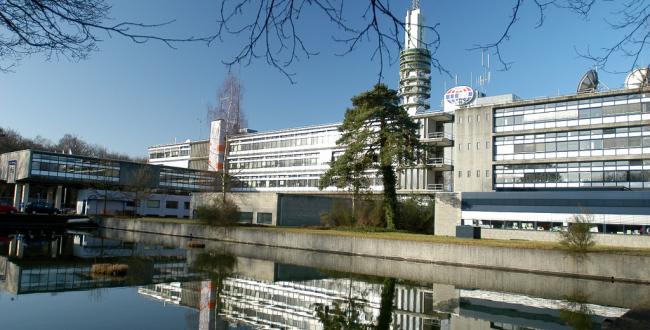
RNW headquarters in Hilversum, Netherlands (photo coutesty: RNW)

Media Network, which covered international broadcasting developments at Radio Netherlands, recently ended a 30-year run on RNW. In a series of four articles, Andy Sennitt mentions some of the highlights, and then looks ahead to how international broadcasting might develop in the next ten years.

Part 1 is now available on RNW’s website. Part 2 will be published on May 1st 2012. This read is definitely worth your time.

Your shortwave could have delivered the newspaper?

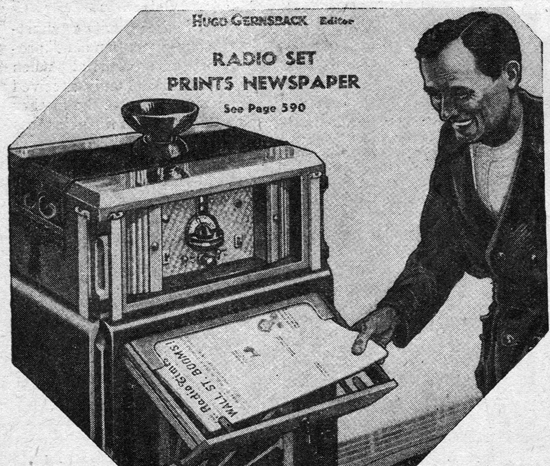
1938: The Gernsback Radio Newspaper (Photo: Smithsonian Magazine)

(Source: Smithsonian Magazine)

The introduction of broadcast radio caused some in the newspaper industry to fear that newspapers would soon become a thing of the past. After all, who would read the news when you could just turn on the radio for real-time updates?

Newspapers had even more to fear in 1938 when radio thought it might compete with them in the deadtree business as well.

The May, 1938 issue of Hugo Gernsback‘s Short Wave and Television magazine included an article titled “Radio to Print News Right In Your Home.” The article described a method of delivering newspapers that was being tested and (provided it didn’t interfere with regular radio broadcasts) would soon be used as a futuristic news-delivery method.

[…]This invention of a wireless fax, as it were, was credited to W.G. H. Finch and used radio spectrum that was otherwise unused during the late-night hours when most Americans were sleeping. The FCC granted a special license for these transmissions to occur between midnight and 6am, though it would seem that a noisy printing device in your house cranking away in the middle of the night might have been the fatal flaw in their system. It wasn’t exactly a fast delivery either, as the article notes that it takes “a few hours” for the machine to produce your wireless fax newspaper.

The full article, is a must-read.

Fascinating to realize that even in the infancy of wireless, newspapers already felt threatened by new technology. Goes to show that the more things change, the more they stay the same.

Willis Conover’s Jazz: A secret weapon in the Cold War

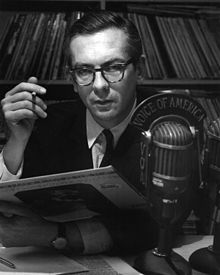
David Goren, Shortwaveology author and producer for Jazz at Lincoln Center, released a JazzStories Podcast today featuring VOA broadcaster, Willis Conover. Willis Conover is a noted name in both Jazz music and international broadcasting. His characteristic deep and articulate voice guided many shortwave listeners behind the iron curtain, into the realm of Jazz music.

Here is the description of the podcast from  Jazz at Lincoln Center:

During the Cold War with the Soviet Union, the United States had a secret weapon: Willis Conover’s “Jazz Hour,” carried on the shortwave radio signals of The Voice of America across Russia and Eastern Europe:. Starting in 1955 and running for over forty years, ‘Jazz Hour’ nurtured generations of jazz musicians who grew up under the restrictions of Communism. On this edition of Jazz Stories we hear Willis Conover and two outstanding jazz musicians, Czech bassist George Mraz and Russian trumpeter Valery Ponomarev – both of whom learned about jazz from his broadcasts.

You can preview this podcast on the Jazz at Lincoln Center podcast page (look under “Jazz and the Cold War”) or simply subscribe and download it on iTunes.