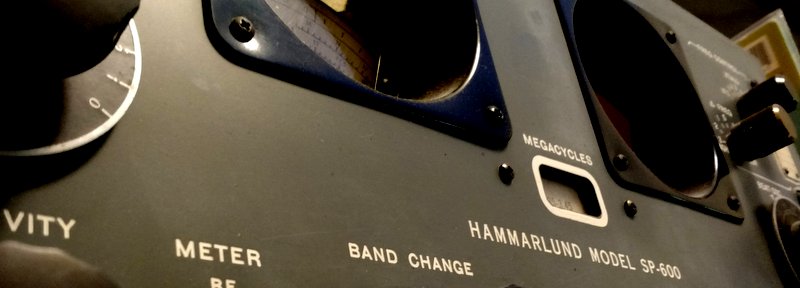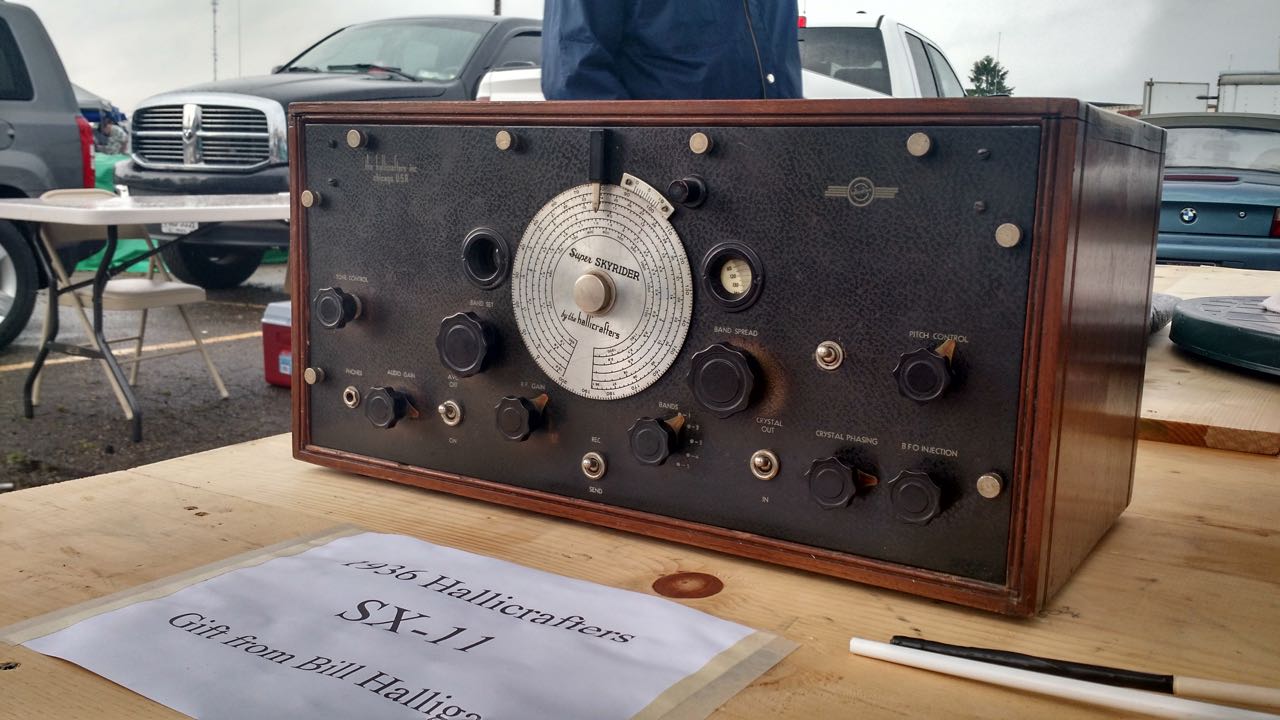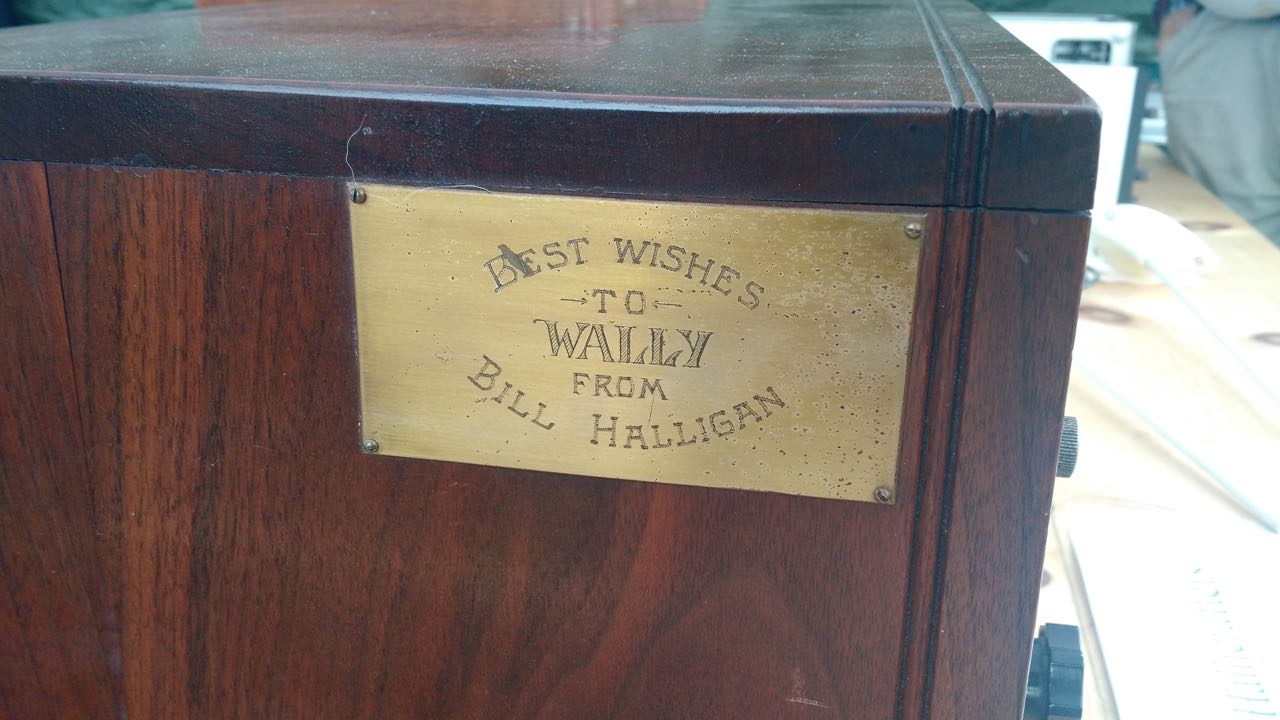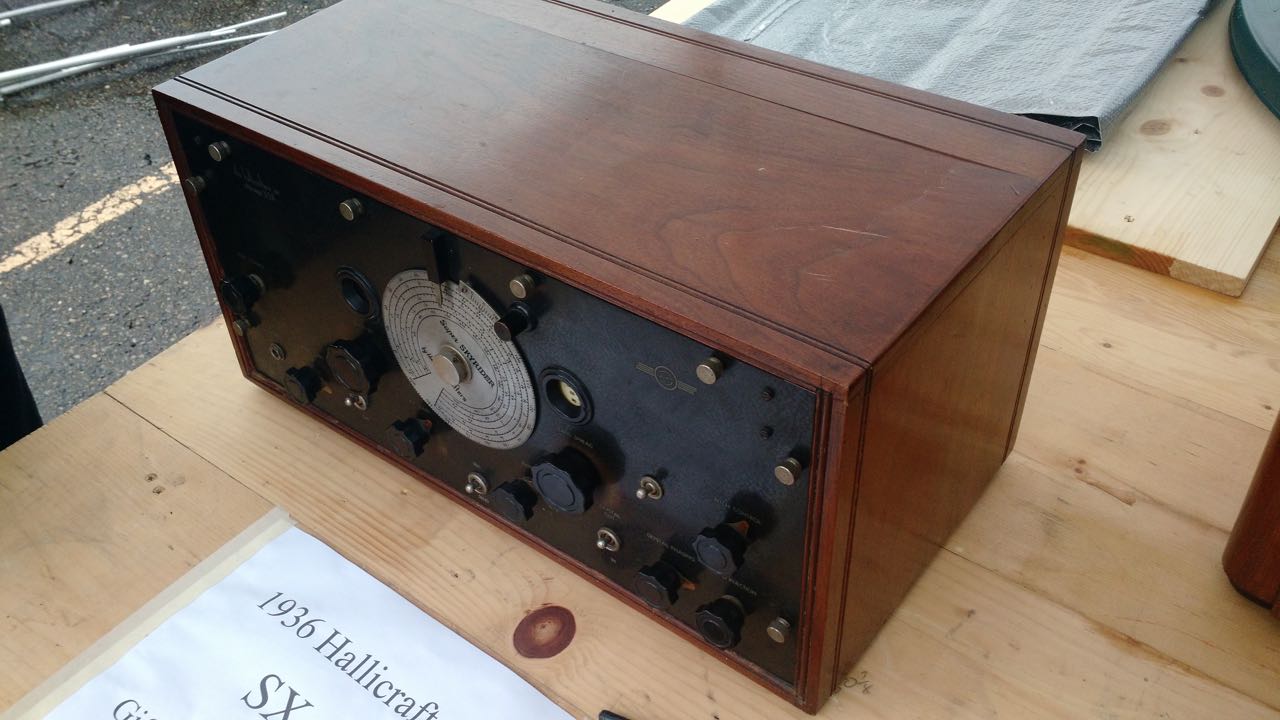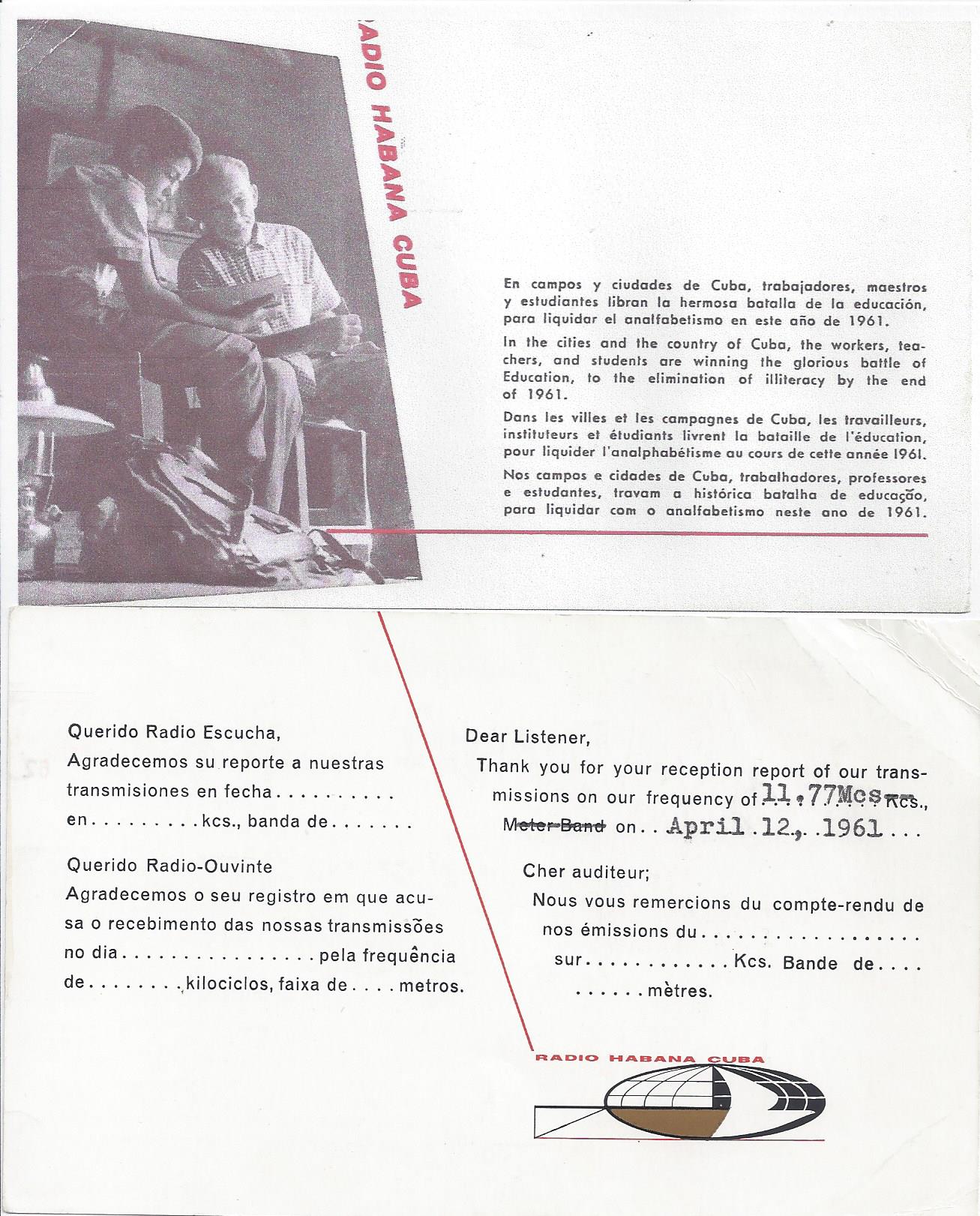
Many thanks to SWLing Post reader, Bob La Rose, who shares a QSL he received (see above and below) from Radio Havana Cuba after they had only been on the air a few days back in 1961.
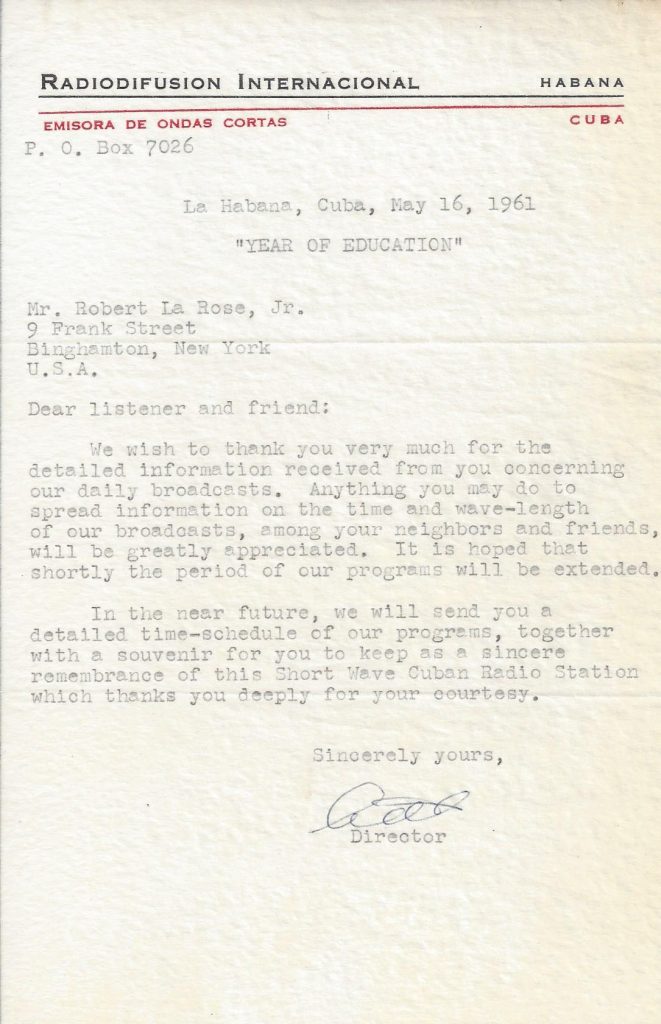
Amazing, Bob! Thanks for taking the time to scan and share this report!
Also, many thanks to Arnie Coro, Host of Dxers Unlimited at Radio Havana Cuba, for sharing the full text/script from his May 1st 2016 anniversary edition of DXers Unlimited:
Radio Havana Cuba
Dxers Unlimited
Dxers Unlimited’s weekend edition for 1 May 2016
By Arnie Coro
Radio amateur CO2KK
Hi amigos radioaficionados, welcome to the weekend edition of Dxers Unlimited, today l am happy to celebrate with you all the 55th Anniversary of Radio Havana Cuba… Yes amigos, it was on the first day of May of 1961, during the May Day celebrations when Cuba had just won the battle against the mercenary invasion that we went on the air using our present name Radio Havana Cuba… Two announcers, Orlando Castellanos and Fernando Alcorta announced to the world that Radio Havana Cuba, was on the air… Previously we had used the name Cuban Experimental Short Wave, but from May one of 1961, we are known worldwide as Radio Havana Cuba…
So today is a very special day… remembering those who have passed away after many years of valuable services to our station, like Pedro Costa the General Administration Manager, Carlos Estrada our Chief Engineer, and former Director Generals Marcos Behamaras. Orlando Fundora, Jose Antonio Caiñas and Alfredo Viñas. I also keep very nice memories of Angel Hernandez our bilingual announcer with the most effective voice for short wave radio that I can recall, and also I remember Manolo Ortega, reading our Spanish language editorials so that they could be heard clearly through his powerful voice…
Si amigos, I was there at the station 55 years ago as a young radio technician in charge of supervising the operations of our studios and transmitters that at that time included four Brown Boveri Swiss made short wave transmitters connected to a still under construction antennas farm, and the two studios borrowed from Radio Progreso until we could finish building our first studios .
The history of Radio Havana Cuba is full of very relevant moments, like the day that our Experimental Station announced to the world that the mercenary invasion that entered the Bay of Pigs had been defeated after sixty six hours of fierce combats .
With a lot of enthusiast and the impacting presence of a new generation of announcers, journalists , technicians, engineers and support personnel we are moving ahead to provide the best possible programming keeping our short wave transmitting facilities because we do believe on the use of international short wave broadcasting, while not disregarding the feeding of streaming audio to the Internet-
I am Arnie Coro, your host here at this special 55th Anniversary edition of Dxers Unlimited, that will continue in just a few seconds after a station ID..
Musical short cut
Yes amigos this is Radio Havana Cuba, using short wave frequencies at different times of the day on the 16, 19, 22, 25 ,31, 49 and 60 meters bands… and now our next radio hobby related item, a very popular section of this show under the name Antenna Topics , that is dedicated today , at the request of several listeners to a very effective Dxing antenna, low take off angle radiator, known as the HENTENNA, A great number of listeners from all around the world have written to me recently, asking to learn more about this Japanese antenna design , known as the HENTENNA, that seems to continue to be making headlines in radio publications around the world once again… But before telling you more about the mysterious HENTENNA…. A solar activity update… believe it or not, we are seen the solar flux moving up to very near 100 units for the first time in many weeks… following the typical ups and downs of the tail end of solar cycle 24… so propagation conditions have improved on the short wave bands …. Now back to the HENTENNA…
By the way, the first original report about the HENTENNA that went on the air here at Dxers Unlimited, dates back to 1999,more precisely, it went on the air the 12th of October of 1999, and according to my records, it then generated a lot of interest from our listeners, who were at that time, 1999, getting ready to enjoy the peak years of solar dream solar cycle 23 !!! >Never as powerful as super cycle 19, but nevertheless much better than the present very poor cycle 24.
So amigos here is at the request of Dxers Unlimited’s fans , a special Dxers Unlimited’s report on the HENTENNA, the Japanese elongated rectangular loop antenna with an easy match to coaxial cable feedlines of any impedance, be it 50, 60 ,75 or 93 ohms…or even 150 ohms !!! Of course that you can feed it with parallel transmission line of 300 to 450 ohms too, it is just a matter of minutes to find the perfect match for the feedline in use.
Let me start by saying that I recently built yet another HENTENNA for the FM broadcast band, and it is working nicely, having already picked up some Sporadic E skip DX stations from Mexico, the US and Puerto Rico during first few days of this year’s spring and summer E skip season.
Now you will have to learn something very unusual about the HENTENNA… the HENTENNA produces or receives VERTICALLY polarized waves when the antenna is placed horizontally; that is, with the long sides of the rectangular loop parallel to the ground. AND, if you want horizontal polarization, just flip the HENTENNA so that the long sides of the loop are vertical, and the short sides are parallel to the ground, something that is puzzling, but that’s the way it is amigos…
By the way, one of the world’s foremost antenna experts, Dr. L. B. Cebik, amateur radio operator W4RNL, did during his fruitful life an extensive analysis of elongated loops, and his findings are really fascinating. Dr. Cebik , now sorrily a silent key specialized in computer modeling of complex antenna systems, and his work with the HENTENNA and other similar elongated loops shows that the HENTENNA is a very good performer indeed.
In a few seconds, be ready to write down, the formulas for calculating HENTENNAS in the frequency range from 14 megaHertz all the way up to 220 megaHertz.
And now, as promised more about the japanese wonder antenna… the HENTENNA. Dr. Cebik’s computer modeling shows that the elongated loop HENTENNA has an edge over a regular square one wavelength loop and the regular elongated loop.
HENTENNAS for receiving FM broadcast signals are very easy to build, using a wooden or PVC pipe frame and copper wire. I built the one just
mentioned cut for 100 megaHertz, using PVC insulated no. 12 wire, the one that is typically used for home wiring.
The loop was closed by soldering with a butane torch, and using regular solder with rosin core… The reason for using the butane torch is that no soldering iron at hand here could handle the heavy wire PLUS the high speed heat transfer of the copper wire.
The loop for the 100 megaHertz antenna is 1.5 meters on the long sides of the rectangle and 50 centimeters on the short sides. The feed point for the 50 ohm cable is was found to be located about 55 centimeters from one of the short sides of the loop.
The antenna is installed with the long sides in a vertical position; for receiving horizontally polarized FM broadcasts. I tried both 50 ohms and 75 ohms coaxial cables, and could not detect any difference on the weakest station that I am picking up here regularly with the FM band HENTENNA.
Again, now please pay extra attention …if you want to make of these elongated loops for receiving, here are the measurements to use: for the long sides of the rectangle 1/2 of a wavelength at the operating frequency, for the short side, the length is 1/6 of a wavelength… and the connection point for the coaxial cable of 50 ohms impedance is a little more than 1/6 of wavelength from one of the short sides of the rectangle, and it must be found experimentally by locating the point that provides the minimum standing wave ratio.
HENTENNAS can be built for any frequency between 10 megaHertz and 300
megaHertz by using heavy WIRE, and for the frequency range from about 50 megaHertz to 500 megaHertz you may try building HENTENNAS with copper or aluminum tubing.
Hope to have you all listening to my middle of the week edition of Dxers Unlimited amigos and do enjoy the improved short wave propagation conditions now in progress, especially after your local sunset.