(Almost) All-in-One in a Box
By Robert Gulley K4PKM
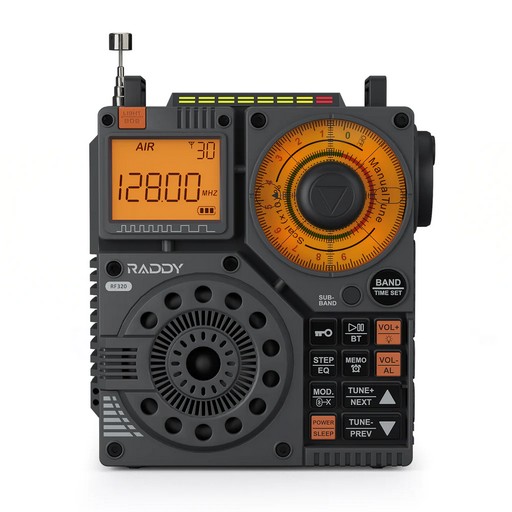
The RADDY RF320 is a rather attractive, if not slightly curious-looking radio, which breaks from the more recent offerings from Raddy and other small portable radios. Compact, but not pocket-sized, the radio comes in at roughly 3-3/4” x 4-1/2” almost square (not counting the tuning dial on the side, the slightly raised antenna on top, or the light on the side).
The radio can receive AIR, FM, VHF, MW(AM), SW, and Weather Band signals. (For those interested in the U.S. Aircraft Band, this model does feature AM modulation, so civil aircraft can be monitored). While the radio does have AM SWL bands, there is no SSB reception. SW bands run from 90m thru 13m, with tuning in 5kHz single steps and scan mode.
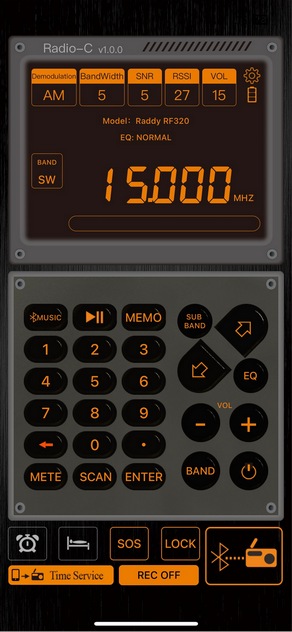
This is the IOS version of the Bluetooth App. Clean layout, keyboard frequency entry and radio control
There are four tuning methods if the user includes the Apple or Android app which feature direct keyboard entry in addition to the three modes found on the radio. As a rather cool feature, the QR scan codes are imprinted on the back of the radio for both IOS and Android apps, so if you are out and about you can easily download the app to your phone or tablet. A nice touch! No having to type an esoteric web address or search for the app. (I tried both codes and they worked just fine.)
In addition to the usual tuning methods, the RF320 has what they refer to as “fine tuning knobs” on the side and front of the radio, with the knob on the side a continuous tuning within a band mode. The knob on the front is something, well, a bit unusual. While it is a fine-tuning knob, it is designed to manually tune in search mode. A little explanation is in order.
Most radios which feature a search mode, this one included, allows the user to long-press a directional button or rotate a tuning dial a given distance to activate a search mode. When the typical radio finds a station, it may stop momentarily or completely, depending on the design. The search modes in this radio all do the latter- they stop completely. However, unlike most radios, this radio features three different methods of searching. The up/down arrows can be pressed for a second or two to start a search, or the tuning knob on the side can be rotated some distance quickly, and a search will begin. The third method is the tuning knob on the front. By manually turning the knob the radio will attempt to find the next signal within the current band or sub-band without stepping through each 5kHz frequency (of course it is doing this internally, but it is not really obvious visually).
For example, when in FM mode, this tuning method will jump to the next usable station. In SW mode, in a given sub-band (13m, 90m etc.), this knob will jump to what it senses as the next usable signal, rather than scanning every 5 kHz as done in the other modes. This allows for a very quick check of a given band (or sub-band).
As with any search mode on a radio like this, there will be false positives. Life is not fair – static crashes and birdies and digital signals can all fool a radio’s search mode.
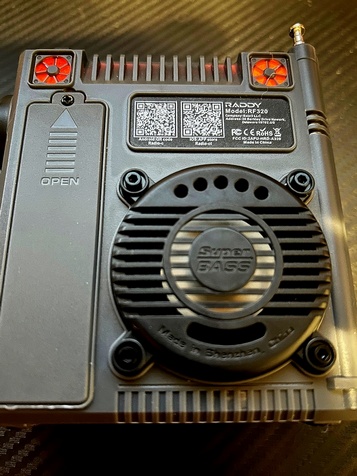
Changing lights, Bass Boost, and QR Codes for Downloading Android or IOS Apps
The radio features excellent sound for its size, with a rather large front-facing 5W speaker, and a bass port on the back. I can crank the volume louder than I would ever want in a room and the audio remains clear.
Reception on all the bands is quite acceptable, keeping up with typical portables its size, and even ones with longer antennas and larger ferrite bars for AM reception. This is not a Panasonic RF-2200 or a GE Superadio, but for what it is designed to do, it does quite well.
The radio also has an abundance of memories, allowing you to save up to 995 stations, including 199 each for AIR, FM, VHF, MW, and SW.
Like some of the other radios from RADDY, this one has Bluetooth connectivity to Android or IOS for the App functionality, and takes a TF memory card to allow for playing music, podcasts etc., as well as having a flashlight and S.O.S. capability. There is a headphone jack and Aux. jack, as well as a USB-C charging port for the replaceable 18650 2000mAh battery (whoo-hoo!). Sleep mode, timer, wake to music and six sound effects are added features.
Lights, lights, and more lights. ‘Nuff said! (See images)
Pros and Cons
Pros: Good audio, AM receive for aircraft band, good sensitivity, multiple ways to tune, excellent App connectivity on my iPhone with direct frequency entry, good form factor, unit seems solid, replaceable battery, 18-month warranty(!), carry strap, aux. input to allow the radio to act as a speaker, included wire antenna and charging cable.
Cons: Telescoping antenna a bit frail, side tuning knob feels a bit wobbly (but I experienced no problems), back colored lights seem unnecessary (nit-picking and just a personal opinion, YMMV), EQ effects seem weak as only a few seem to make much of a difference (and not needed in my opinion, since the standard audio is quite good), no SSB (not a problem for me but will be a deal-breaker for some), and typical for this type of radio soft muting while tuning.
Conclusion
This is a good, solid radio with lots of options in terms of modes and bands, as well as extras which make it an almost all-in-one radio. This is a radio one could take to the beach or a park, or use in an office or on the coffee table or night stand. It is small, portable, packed with features, and controllable from your phone or tablet. At a price well under $100 ($71.99 special price from Radioddity at the time of publication), this may well be the radio you have been looking for to fill that portable niche!