By Robert Gulley (Guest Post)
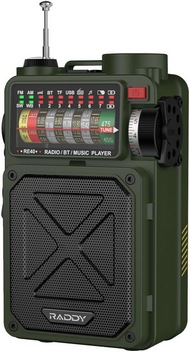
The Raddy RE40 is another portable shortwave radio offering from Radioddity, but with a twist – it is intended to be an emergency radio first, and a listening-for-pleasure radio second. In this review I will cover the emergency options incorporated into the unit, as well as discuss operability and its overall functionality as a radio.
As always when I do a radio review, I will point out what I believe are the radio’s strengths and weaknesses, as well as where this might fit in your radio arsenal. The usual disclaimer applies for any product I review – I tell it like it is, good or bad. While the radio was provided to me without cost by Radioddity, that does not affect my opinions one iota. With that out of the way, let’s get into the meat and potatoes of the rig!
As we have come to expect from other Raddy portables, this has a lot of features packed into a relatively small package. I say “relatively small” because it is thicker than many vertical portables, and heavier. This is a solid bit of kit, and the size and weight are the first clue that this radio is not just intended to sit on a coffee table. It is definitely designed to work outdoors, as well as finding a place in the car or boat for when you need to check on the weather, or be out in it.
Specifications
-
- Frequency Range: FM: 87-108MHz, AM: 520-1710KHz, SW: 5.7-17.9MHz, WB: 162.400-162.550MHz
- Bluetooth: Version 5.0
- Card Type: MP3/WAV/FLAC/APE
- White Noise: 7 different natural sounds
- Max. Capacity of Micro SD Card: 256GB (not included)
- Size: 81x52x132mm / 3.2x2x5.2in
- Weight: Approximately 350g / 0.77lb
- Operating Voltage: 2.7V-4.2V
- LED Light: 1W/120LM
- Max. Power: About 5W
- Speaker: 4? 5W
- LED Flashlight: 1W/120LM
- Battery Capacity: 4000mAh / 3.7V (non-replaceable)
- Operating Temperature Range: -10? to 60??14°F to 140°F?
What’s in the box?
-
- 1 x RE40 Radio
- 1 x Type-C Cable
- 1 x Wrist1 x User Manual
Power Options
This radio can be powered by an internal battery charged by a USB-C port, solar powered to charge the battery, or by a hand crank. Here is the manual description of the emergency power options:
A. Solar Charging
- Put the solar panel directly towards sunlight. When the green charging indicator lights on, it indicates that the solar panels charging the internal battery.
- The charging efficiency depends on the solar exposure: the stronger the sunlight, the better the charging effect.
B. Hand Crank Charging
- Turn the hand crank clockwise or anti-clockwise and the green charging indicator will light up to indicate that it is
- Speaker has no sound: Hand crank at 130-150 rpm for 1 minute, the flashlight can be used for more than 30+ minutes or play the radio (medium volume) for 3
NOTES:
- The hand crank can be turned for 3-5 minutes before using the product to activate the internal battery.
- The hand crank is normally used in emergency situations when the power is out.
The radio has a compass built into the volume control knob on top, a flashlight, analog tuning dial, and switches for moving between playback modes (Radio, Bluetooth, and media) and desired operations (SOS, Standard battery or solar/crank charging modes, and USB charging). As an aside, the SOS feature is LOUD!
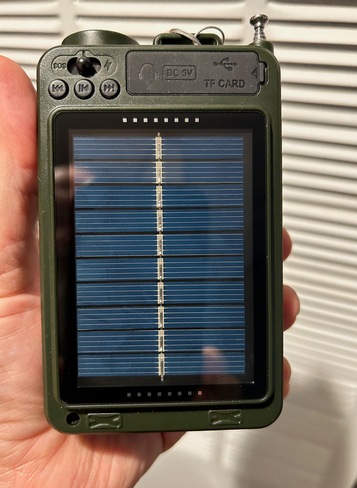
Almost the whole back of the radio is devoted to the solar cell. This is much larger than other solar cells on portable radios that I own, and presumably will recharge the internal battery faster. There is a rubber flap over the headphone, USB and memory card jacks/slots.
The unit has another interesting feature: you can charge your phone or other USB device from the standard USB slot under the flap. To use this feature the mode switch on the back of the radio has to be in the right-hand position under the charging symbol. When set to charge another device all other functions are disabled, so if you turn your radio on and can’t get anything to work, you might just have pushed the button over to the right accidentally, or intentionally the last time you used the radio.
Radio Performance
I’ll not spend a lot of time here, not because the radio performance is poor, but because as I have already noted, that is not the primary focus of this radio. There are plenty of portable radios by Radioddity and others which have better performance. However, I found the FM reception to be exceptional for a radio in this class, and AM radio reception to be reasonably acceptable for a radio with a lot going on inside. I did not test the AM radio reception with one of my loop enhancement units, mainly because I am not looking to use this as a regular radio receiver. This is going in my car for emergency/safety issues, and to grab when I am having a picnic lunch or the like.
Shortwave reception is on par with other radios of this size, and a pleasant feature is a sturdy telescoping antenna. Unlike several other small Raddy radios which have very fragile antennas, this one is much more solid.
Weather band reception is decent, but not quite as good as other radios I have tested. I can pick up one very strong signal, and a usable/readable second signal, but some other radios I have give me 4 or 5 stations. Of course, as long as you can get one strong signal, it is likely that is the one most important to you in your immediate location. With at least a second station you have the chance to pick up information should the one nearest you experience difficulties.
Sound and White Noise
As for the sound quality, it has a nice large speaker and delivers good sound, and I have found this typical of most all of the Raddy radios I have tested. In addition to the typical sleep timer radio option, this radio features a “white noise” option which allows the user to select between 7 different white noise options for those who prefer to go to sleep that way.
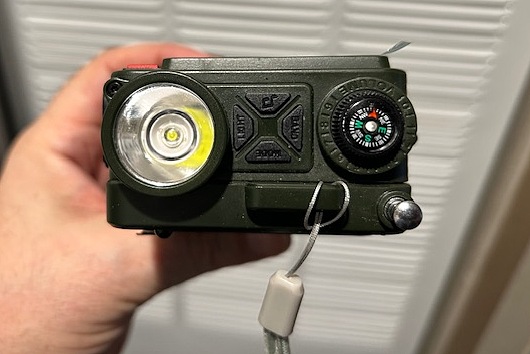
Compass and Flashlight
Pros
- Feature-Packed in a small footprint
- Loud SOS
- Sturdy Antenna
- Large Solar Charging Cell
- Ability to charge phone
- Multiple ways to power radio/flashlight
- Strong FM, acceptable AM and Shortwave (no SSB)
- Price ($49.99 from Radioddity, $44.99 plus 10% off coupon from Amazon at time of writing. There is also a bundle offer from Amazon which includes an SP4 4W Portable Solar Panel for $59 plus 10% off coupon) [Note that these are affiliate links that support the SWLing Post at no cost to you.]
- 18-month(!) warranty
Cons
- Weather band not as impressive as some other radios, but hardly a deal-breaker
- Analog tuning dial very sensitive (if you have shaky hands this is probably not for you, except perhaps for the emergency functions)
- Multi-colored striped analog dial is sometimes hard to read (then again, I need my reading glasses for a lot of things!)
Wrap-up
This little radio packs a lot of punch for the money, adding features similar emergency radios do not have. If you are like me, emergency radios are a necessity given our unstable weather and power grids, and I like knowing I can use solar power to recharge a radio, or crank it when the sun is not available. Some folks expect more power from a hand-crank generator than these small radios produce, but my main goal is to be able to quickly check weather conditions, use the flashlight, or make use of the SOS function if needed. These do not require massive amount of time spent cranking the generator, and to me that is a plus.
I would recommend one for each car or boat, or to take with you on outdoor trips just in case of an emergency. Of course, you could always listen to the ballgame on your front porch, too!
Cheers, Robert K4PKM