Category Archives: Shortwave Radio

New High Power Broadcast of VORW Radio International to Europe & Africa!


Hello shortwave listeners! I wanted to share an exciting update about a new high power broadcast I’ll be doing for listeners in Africa, Europe and beyond!

Beginning Monday the 11th of December, 2023 and continuing every Monday – this radio program will be heard across Africa, Europe & Beyond from a high power transmitter in Issoudun, France.

The broadcast is 1 hour in length and I always consider it to be a light entertainment program. The aim of this radio show is to provide good music and occasional news commentary to listeners worldwide. Oftentimes, listener music requests are taken and played – and all are invited to participate.


Here is the broadcast schedule for this additional airing:

Mondays 1900 UTC  – 11920 kHz – Issoudun 100 kW – Africa, Europe, Middle East

For this airing I will resume QSL verification of reception reports, there will be a new QSL every month!

Reception reports and feedback are most welcome at [email protected]

That’s all for today, I just wanted to let you all know that there’s a new airing out there if you’d like something to listen to!

73’s John

More radio of the imaginary kind

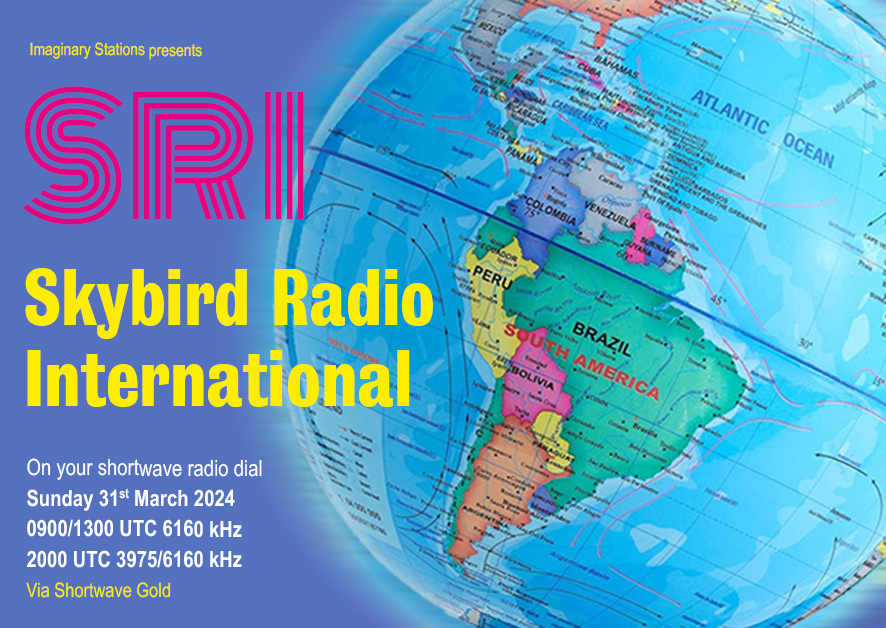
Hi all SWLing Post Community, FastRadioBurst 23 here. This week the Imaginary Stations crew bring you WS12S featuring a celebration of the twelve inch single. This show will be beamed to Europe by Shortwave Gold on Sunday 10th December 2023 at 1000/1400 hrs UTC on 6160 kHz and then on 3975 kHz at 2100 UTC. Expect some special extended mixes remixed by the ionosphere.

Then on early Monday 11th December via the transmitters of WRMI we have CBRG at 0300 UTC on 9395 kHz. More about CBRG below:

For more information on the shows please email [email protected] and check out our old shows here.

The Sony ICF-8000: Bob’s nostalgic journey

Many thanks to SWLing Post contributor, Bob Butterfield, who shares the following guest post:


The SONY ICF-8000

By Bob Butterfield

As many radio enthusiasts have experienced there are some pieces of equipment that come and go for a variety of reasons.  Many times, there are regrets about radios or accessories that are here one day and then gone another.  Years ago, I was gifted a Sony ICF-8000 “Super Sensitive” FM/MW/SW portable radio.  My ICF-8000 was one of those that “went.”  To tell you the truth, I am not actually sure where it went off to!  In those days I used my “Super Sensitive” radio on vacation trips, on the back deck, and for local MW/FM and casual SW listening.  When a new position with the Government necessitated relocation, I left this radio behind at my parents’ house where it was regularly used by my mother in the kitchen.  That is when things get fuzzy.  Suffice it to say that I am not sure what happened to it.

As far as I can determine, the Sony ICF-8000 is a close relative of the earlier Sony TFM-8000W, another “Super Sensitive” model.  What sets them apart is that the Sony TFM-8000W has the Public Service Band (PSB) and the Sony ICF-8000 does not.  The ICF-8000 has its SW bands spread out into 4 bands: 1.6 to 3.5, 3.5-7, 7-14, and 14-26.1 MHz.  In contrast the TFM-8000W has a slightly shorter SW frequency range split into three bands: 1.6-4, 4-10, and 10-22 MHz.  Both radios have continuous coverage with no gaps from MW to SW as well as FM.  These radios are almost identical in appearance.  Other than the PSB and three SW bands on the TFM-8000W, the only other visual differences from the ICF-8000 are how the bands are arranged, identification of the Public Service Band on the face plate, and the addition of an on/off squelch toggle switch for the PSB.  Internally the TFM-8000W has a couple more semi-conductors.  In line with these two radios is the older Sony TFM-1600W “Super Sensitive” which came out circa 1971, has its own distinctive but similar appearance, and is set up like the ICF-8000 with FM/MW/SW.

A while ago the “I used to have that radio nostalgia bug” hit me, and I have been searching since for a decent ICF-8000 to purchase.  Sony TFM-8000Ws in decent shape are up for sale on eBay on occasion, but I was looking for the ICF-8000.   Finally, I spotted one recently (which was listed as a TFM-8000W!) at a price and condition I was comfortable with.  After negotiation with the seller, I purchased it.   There is some useful information on the Web about the Sony TFM-8000W.  Jay Allen has a good piece on this unit worth checking out.  The Sony ICF-8000 appears to be much harder to find, information on the Web is skimpier, and I am not sure how long they were produced.  It is quite possible that its production run was limited.  Manufacturing likely started in 1976 when it probably replaced the Sony TFM-8000W.  One reference I located on the Web listed the ICF-8000 being made as early as 1974 but provided no source.   I also found evidence of at least two versions of ICF-8000s being produced; one with a switch located in the battery compartment allowing multiple different voltages including that for Japan, and one operating on 120 volts only.  The corresponding model number identification panels on the rear are annotated accordingly with voltages available.  Both versions have “FM/AM Multiband Receiver” lettering on the face plate.   Sony, like Panasonic, often tweaked models for domestic and foreign markets, adding or modifying features to fit those markets accordingly.  If anyone has more information on these models, year(s) manufactured, availability of free manual copies, etc., drop them in the comments section.

The Sony ICF-8000 I purchased was in very good shape having just some minor imperfections showing on the faceplate paint. No cleaning was necessary, nevertheless I gave it one.  All switches were quiet and functioned as they should.  A nice feature of the ICF-8000 is its exceptionally smooth tuning mechanism which utilizes a flywheel.  In addition, on my radio, the tuning scale is practically spot-on on all the bands.  Not usually the case in an analog set of this type forty-five plus years old.  When added to the fact that the SW frequencies are spread out in four bands instead of three, tuning is easy.  The presence of a fine-tuning knob is a nice touch and can be useful.  Also available is a tone control knob, signal/battery strength meter, a lighted dial, AC/DC capability, external antenna connection, world time calculator wheel (at the rear on the battery compartment cover), and a dual FM AFC and AM Broad/Sharp bandwith control.

Nostalgia aside, the Sony ICF-8000 has provided reliable performance on all bands so far.  MW sensitivity is adequate while SW reception is above average using the built-in telescoping antenna which measures 44 inches (111.75 cm) in length.  I did a limited shortwave reception comparison in the 49-meter band between the ICF-8000 and the Panasonic RF-2600 with its 37 inch (94 cm) built-in telescoping antenna and found the Sony performing equally with the Panasonic; at times even better perhaps due to its longer antenna.  When connected to an external 75-foot (22.86 meters) longwire I found the ICF-8000 shortwave reception to be particularly good.  I did not experience any overloading, nor did I encounter multiple images.  The sound was, as others have attributed to the TFM-8000W, “mellow”.  If this is not to your liking on the shortwave bands the tone adjustment is useful.   Noise levels were well tolerated.  I suspect that the Sony TFM-8000W would perform similarly.

Is the Sony ICF-8000 a fantastic DX machine?  No, it is not.  Is it “super sensitive”?  Maybe not “super,” but definitely above average, and surely sensitive enough for general listening.  Is it an attractive, affordable classic, easy to use, and sturdy radio with decent performance that can hold up through the years?   I think so.  Does it bring back fond memories?  Absolutely!

Carlos captures a number of Radiofax decodes with his XHDATA D-808

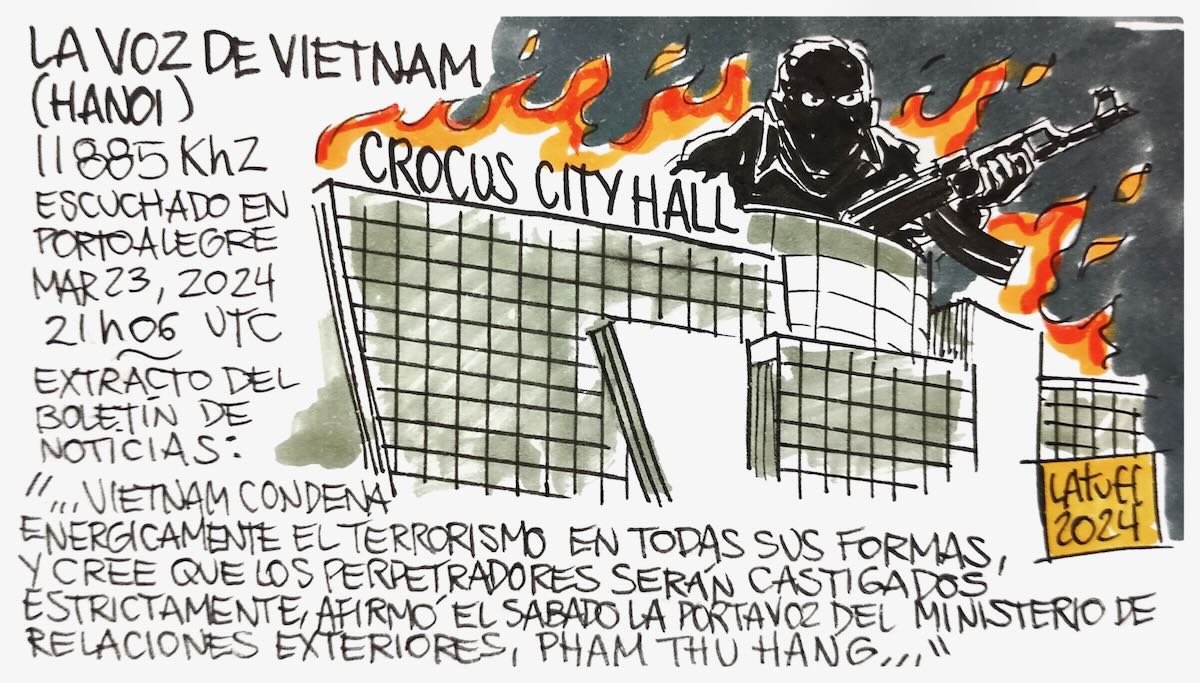
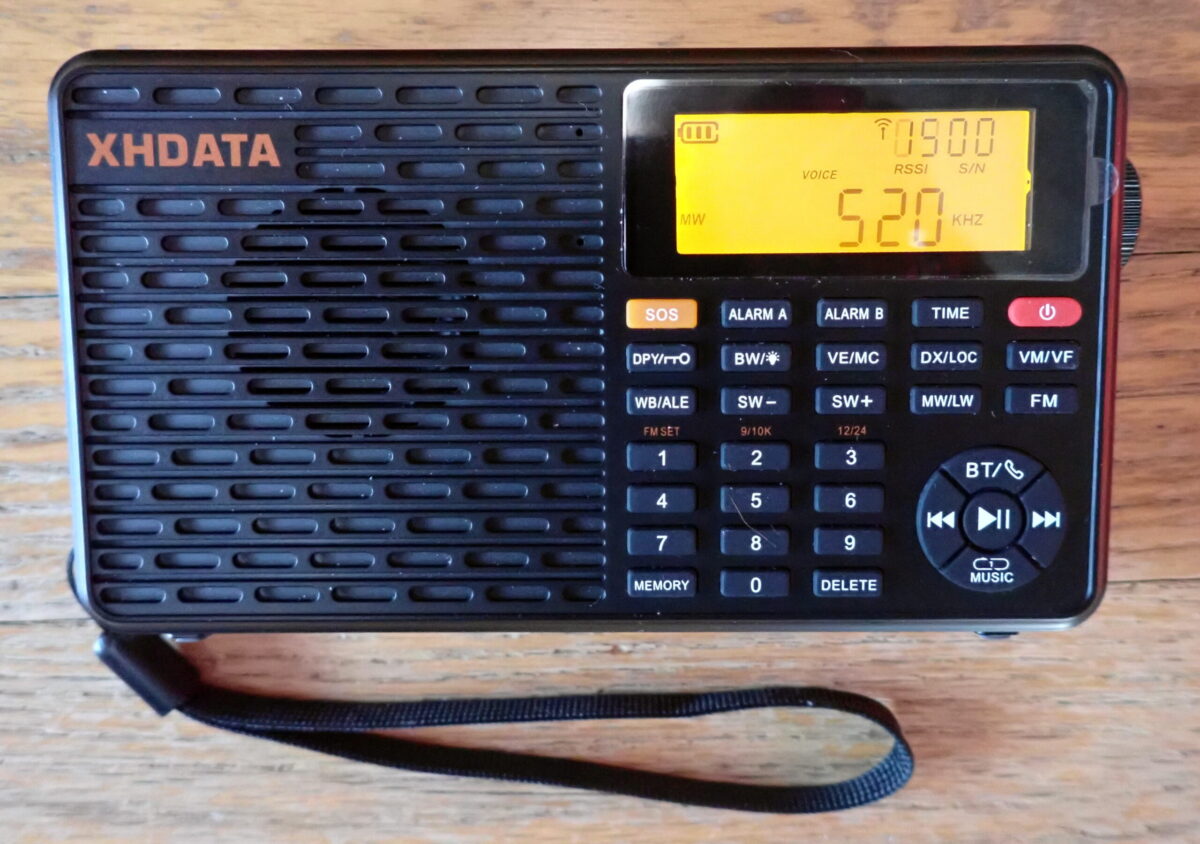
Many thanks to SWLing Post contributor, Carlos Latuff, who shares these recent Radiofax decodes on Twitter:

Hey Thomas my good man, have a look how good were the NOAA radiofax reception in Urca Beach, Rio de Janeiro, from USCG radio stations in Pt. Reyes, Boston and Honolulu:

Radio of the imaginary kind

Hi all SWLing Post Community, FastRadioBurst 23 here. This week via the ionosphere, the Imaginary Stations crew bring you WS10S featuring a celebration of the Ten inch single. This show will be beamed to Europe by Shortwave Gold on Sunday 3rd December 2023 at 1000/1400 hrs UTC on 6160 kHz and then on 3975 kHz at 2100 UTC. Expect 78, 45 and 33 rpm ten inchers too!

Then on early Monday 3rd December via the transmitters of WRMI we have the return of The Shortwave Music Library at 0300 UTC on 9395 kHz. It’s a special Blues & Blues edition which feature tunes with Blue in the title. So tune in next Monday and join DJ Frederick and listen to the blues.

For more information on the shows please email [email protected] and check out our old shows here.

Radio Exterior de España suspends shortwave service Dec 4-5 due to power cuts

Radio Exterior de España transmits its programming on Short Wave from its broadcasting center in Noblejas (Toledo). Source: RTVE

Many thanks to SWLing Post contributor, David Iurescia, who shares the following announcement from Radio Exterior de España (originally in Spanish):

Temporary suspension of shortwave emission

We inform you that the next few days December 4-5 Radio Exterior de España will be forced to suspend its shortwave broadcasts.

The reason: a cut in the electricity supply, beyond our control, which will affect the shortwave emitting center that Radio Exterior has in the town of Noblejas. The break is due to work that the Unión Fenosa company has to do in the electrical substation from that Toledo municipality and that will affect our facilities.

Consequently, shortwave emission will be suspended next Monday, December 4 and will last until Wednesday, December 6, which will be when the signal resumes.

We apologize for this incident, completely unrelated to the will of Radio Exterior de España.