Shortwave listening and everything radio including reviews, broadcasting, ham radio, field operation, DXing, maker kits, travel, emergency gear, events, and more
Elad USA Inc.
618 Cummings Chapel Road
Ridgeville, SC 29472 [email protected] or call 312-320-8160 (10am-6pm)
PRESS RELEASE
Elad S.R.L. Italy and Elad USA Inc.
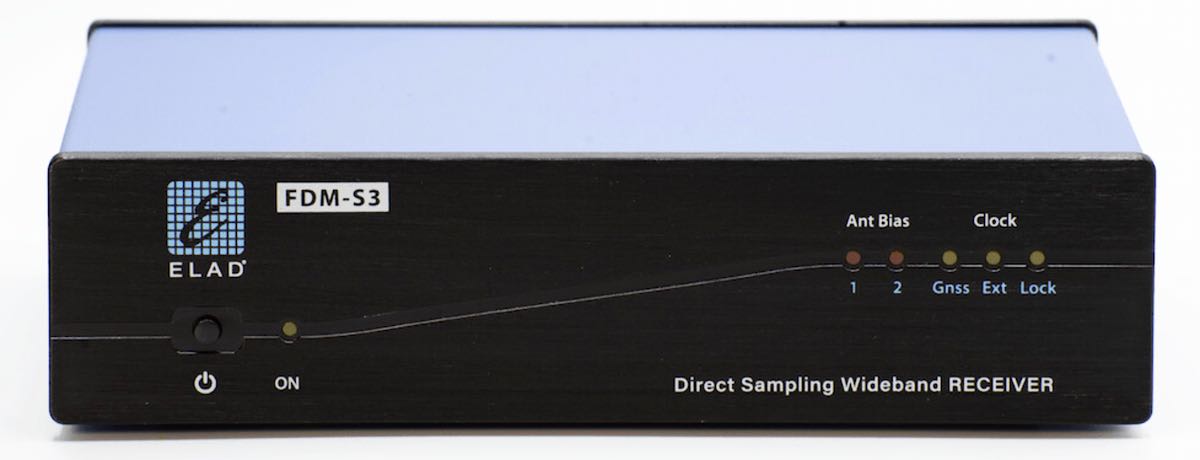
Elad are pleased to announce the ELAD FDM-S3 is now in production and shipping to distributors world-wide.
The ELAD FDM-S3 is a 16bit state of the art Software Defined Radio, for radio enthusiasts, shortwave listeners and radio hobbyists and test labs. The S3 contains several exciting options. It will allow for reception of up to 24Mhz of bandwidth across the frequency range of 9kHz to 108Mhz as standard. (Extended range from 9Khz- 2Ghz will be available later in the year with an optional internal downconverter.)
Oscillator features:
Standard Oscillator version with TCXO 0.1ppm lockable to GPS (included) need only GPS antenna
Optional Oscillator OCXO with less phase noise and accuracy lockable to GPS. Includes GPS Antenna.
The radio can be used with Elad’s famous SW-2 software or third-party software, like SDR- Console from Simon Brown.
The radio has Bias-T power on two of the three antenna ports, one for HF and one for VHF to enable items like powered LNA/Filters
Connects to PC via USB3.0 cable (supplied) and GPS can also be interrogated via UBlox software.
Many thanks to Mike Ladd at SDRplay who notes that they have added a new IQ Demo Files page to the SDRplay website.
Here’s the intro:
IQ Demo Files
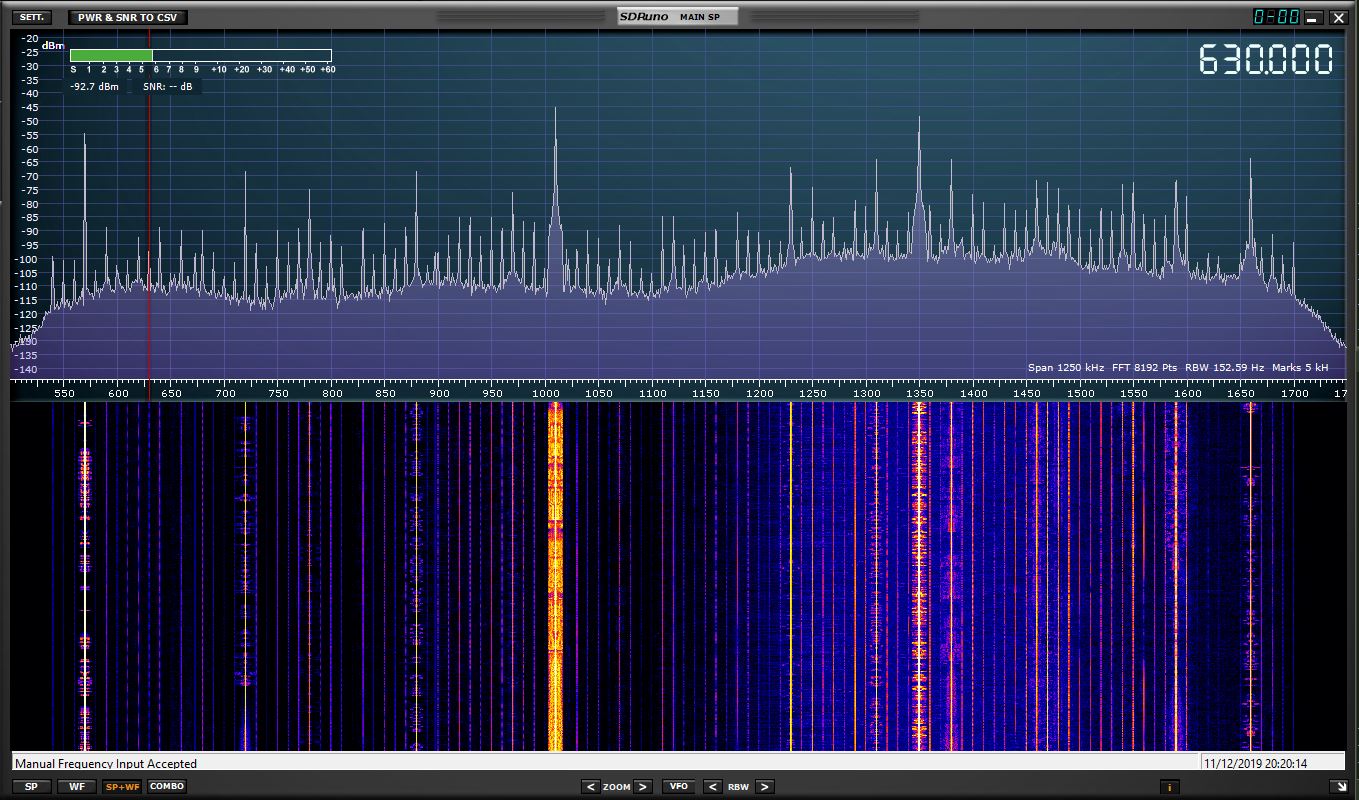
Here you can find off air IQ recordings for you to check your SDRuno and related software settings for a variety of different situations.
If you don’t already have an RSP, because these demo files have been recorded using an RSPdx, you can get to see and hear exactly how SDRuno works in conjunction with an RSPdx. Simply download a copy of SDRuno from https://www.sdrplay.com/sdruno/ and follow the instructions below to select the WAV file input using one of the IQ files below. (Please note these are not traditional audio “WAV” files – the WAV format is used as a wrapper to contain these very large data files (100s of MBytes) containing the stream of data normally exchanged over the USB cable between RSP and computer)
If you have an RSP and are configuring software for specific types of signal decoding, we have included a number of sample IQ demo recordings you can use to check your setup before looking for real world signals.
Following up on our recent MFJ post, SWLing Post contributor, Ron, writes:
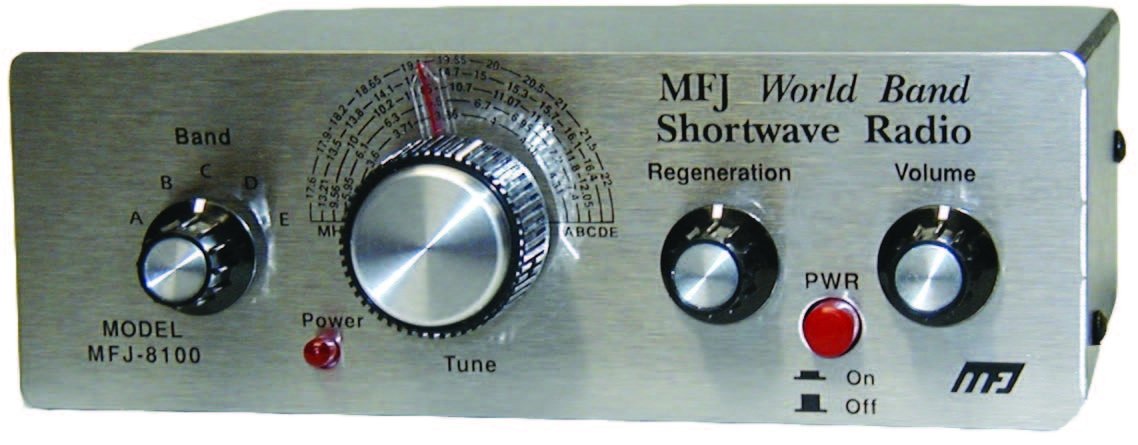
Another thing about MFJ is they still offer the MFJ-8100 as a kit or built. This is the only regenerative receiver available as far as I know.
Mr. Jue and his guys did a couple of tweaks like limiting band coverage to insure stability, using 1/8 inch 3.5mm stereo phone jacks and use an LM386 audio IC to drive headphones or speaker.
The whole thing is in a metal enclosure to minimize hand capacitance found in most regens.
The QRP crowd likes to use the 8100 with flea power CW rigs, it’s that good.
And it’s been in production far longer than the Heathkit GR-81 or any of the Knight Kit regens, too.
Thank you for sharing that, Ron! I had completely forgotten about this little kit when someone recently asked about the availability of Ten-Tec regen receiver kits (that are, sadly, no longer on the market to my knowledge)! I might have to grab one of these kits–looks like a fun one to build.
Many thanks to SWLing Post contributor, Paul Walker, who shares the following note from Gilles Letourneau, the CIDX, and International Radio Report:
WHRI has ceased relaying Voice of Vietnam to North America since its purchase by WBCQ. Please take the time to write them and let them know it would be important to keep shortwave alive and maybe suggest they could relay via WRMI, here is the contact page Contact | THE VOICE OF VIETNAM (vovworld.vn)
Radio Waves: Stories Making Waves in the World of Radio
Because I keep my ear to the waves, as well as receive many tips from others who do the same, I find myself privy to radio-related stories that might interest SWLing Post readers. To that end: Welcome to the SWLing Post’sRadio Waves, a collection of links to interesting stories making waves in the world of radio. Enjoy!
Many thanks to SWLing Post contributors Mark Hist, Kris Partridge, John Palmer, and the Southgate ARC for the following tips:
Radio reporters to be axed by BBC and told to reapply for new roles Critics fear end of an era because of plans to make audio journalists work across media platforms
BBC radio voices have described and defined modern British history. Live reports from inside a British bomber over Germany during the second world war, or with the British troops invading Iraq in 2003, or more recently from the frontline of the parent boycott of a Birmingham school over LGBT lessons have also shaped the news agenda.
But now the BBC plans to axe all its national radio reporters and ask them to reapply for a smaller number of jobs as television, radio and digital reporters, rather than as dedicated audio journalists. Many fear it is not just the end of their careers but the premature end of an era for the BBC.
“Radio reporting is a different job. Of course, you can do both, but a report designed for television starts from a completely different place. Radio is also more agile and also a lot less expensive,” said one experienced broadcast journalist. “I am pretty sure most of us will not be given new TV roles. It seems sad to lose all that specific radio expertise.”
Among the well-known voices likely to be affected are Hugh Sykes, Andrew Bomford – who has just completed a long feature on the child protection process for Radio 4’s PM show – and the award-winning and idiosyncratic Becky Milligan, as well as a wider team of expert correspondents.[…]
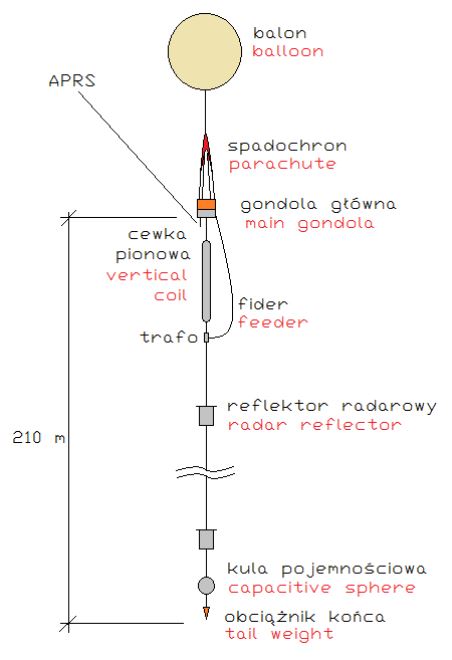
A high-altitude balloon experiment, launched by Warsaw University of Technology, is planned to lift off September 12, carrying a VLF 210-m-long fully-airborne antenna system, transmitting on 14.2 kHz
14.2 kHz is the former frequency of the Babice Radio Station in Poland.
The project is delivering very important data for a doctoral dissertation – any and all feedback on the reception of the signal (reception location, SNR, bandwidth etc.) is extremely important; your help with the listening to the transmission would be invaluable!
The balloon will also be transmitting APRS on 144.800 MHz FM, callsign SP5AXL.
Invented for the first time in 2014, in 2020 it will finally be implemented – the idea of „restoring” the TRCN, but in the stratosphere, where there are no mechanical limitations at the height of the antennas, and the achieved range can be gigantic.
The launch of a stratospheric balloon from the Przasnysz-Sierakowo airport of the Warsaw University of Technology is planned for September 12, 2020, in order to perform atmospheric tests – measuring UV radiation, recording the cloudy surroundings with a high-speed camera and conducting an inductive experiment at 14.2 kHz using a special antenna system.
The inductive system uses a modified long-wave transmitter (A1 emission, unkeyed) from the GLACiER project of the Warsaw University of Technology, implemented as part of the IGLUNA – a Habitat in Ice programme (ESA_Lab / Swiss Space Center). The power of the transmitter, due to the emission limits for this type of inductive devices, shall not exceed a few watts. The antenna system is a centrally fed (35: 1) dipole with capacitive (Hertzian) elements and a vertical axial coil. The electrical length is between 400 and 500 m, with a total system length of 210 m. The antenna is equipped with metalized radar reflectors.
The entire balloon mission will use 144.8 MHz (as SP5AXL) and 868 MHz (as part of the LoVo system) for navigation. Flight information will be available in advance in NOTAM (EPWW).
Planned balloon launch (even if the sky is full of ‘lead’ clouds) at 12.00 UTC (14.00 CEST, local time). The 14.2kHz experiment will be switched on on the ground, with the antenna initially folded in harmony. The predicted total flight time is 3 hours – around 13.30-14.00 UTC / 15.30-16.00 CEST it is planned to reach the maximum altitude of 30 km above sea level.
How can you help with the experiment? By recording as much as possible! Every parameter is valuable – from the spectrum / screenshot with the spectrum, to the EM field strengths, SNR and bandwidth, to the change of the EM field strength over time. The collected data can be sent to our e-mail address: [email protected]. On the day of launch, we plan to post updates on the launch, flight and the experiment itself via our Facebook page: facebook.com/radiostacjababice.
Stay tuned!
Many thanks to SWLing Post contributor, Richard Lacroix, who shares the following:
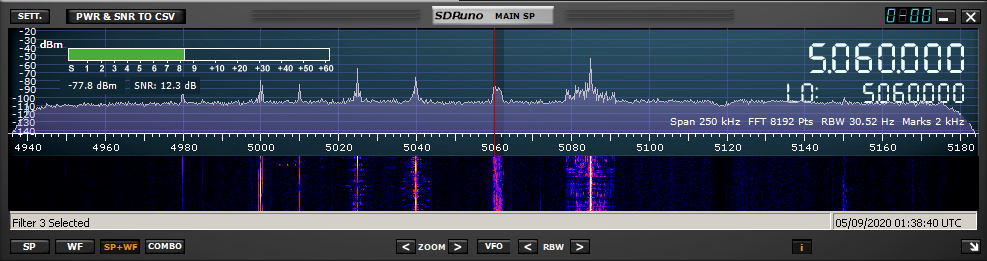
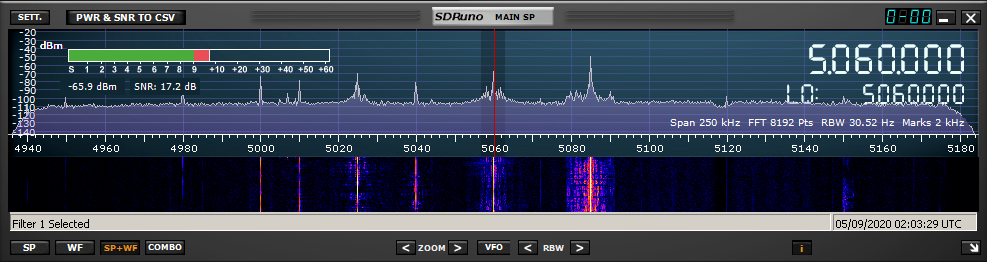
First off, thank you goes out to John Hudak’s timely post on the ODXA group. Shortly after his post, I was able to quickly tune-in and intercept 2 pirate radio stations on September 5 2020 during the period 00:30 to 02:17 UTC.
John’s post read:
“Pirate station WDOG is on 5060kHz. USB right now as I write this – 0027UTC Sept. 5, 2020 (8:27 p.m. EDT Fri. Sept. 4). Fairly good signal, playing various rock and pop songs. Frequent ID’s between songs and sound of dog barking.”
There were in actuality 2 sequential broadcasts. The first from WDOG on 5060.0 kHz USB from an unconfirmed start time until sign-off with “Star-Spangled Banner” played by Jimi Hendrix at Woodstock at 01:53 UTC.
The second broadcast followed suite by Radio Station EFP, as well on 5060.0 kHz, but this time in AM mode. Radio Station EFP continued to broadcast until approximately 02:17 UTC after which it started to exhibit deep signal path fades and eventually went off-air at 02:17:40 UTC.
Armed with the combination of devoted listeners posting reception reports and a radio always at the ready, this made for a very exciting 2 hours of SWL.
Included is a 10 minute audio compilation for everyone to enjoy which I stitched together from the 2 plus hours of off-air broadcast recording I saved:
This is brilliant, Richard! Thank you so much for sharing your notes and recording.
I haven’t done nearly enough pirate radio listening this summer. Your timely report reminds me it’s time to change that! Arrrrr!
Please support this website by adding us to your whitelist in your ad blocker. Ads are what helps us bring you premium content! Thank you!