Category Archives: Shortwave Radio

Radio World: “The Internet’s Impact on International Radio”

The Edward R. Murrow Transmitting Station Control Room

Many thanks to SWLing Post contributors, Dennis, Eric, and Michael who share the following story from Radio World. Please note my comments below following a short excerpt from this piece:

OTTAWA — During the height of the Cold War (1947–1991), the shortwave radio bands were alive with international state-run broadcasters; transmitting their respective views in multiple languages to listeners around the globe.

The western bloc’s advocates were led by the BBC World Service, and included Voice of America, Radio Liberty/Radio Free Europe, Radio Canada International and a host of influential European broadcasters. The eastern bloc’s de facto team captain was the USSR’s Radio Moscow (with its unique hollow, echoing sound), supplemented by broadcasters in Soviet satellite countries (like East Germany’s Radio Berlin International) and allies like Fidel Castro’s Radio Havana Cuba.

Then 1991 arrived, and the Cold War apparently ended with the fall of the Soviet Union and the destruction of the Berlin Wall.

In the seeming peace that followed, many governments no longer saw the sense in spending millions on multi-megawatt transmitters and vast antenna farms to keep broadcasting their messages globally.

The leader among them, the BBC World Service (BBCWS), trumpeted the web and webcasting as modern, cost-effective alternatives to expensive shortwave broadcasting (along with satellite radio and leasing local FM airtime in the countries they used to broadcast to). This is why the BBCWS ceased shortwave transmissions to North America and Australia in 2001 and Europe in 2008, while retaining SW broadcasts in less-developed parts of the globe.[…]

The full article is available here and quite a good piece exploring how the Internet has had an impact on shortwave radio broadcasting.

I, along with a number of fiends in the shortwave community–Bob Zanotti, Jeff White, Colin Newell, and Ian McFarland to name a few–we’re quoted in this piece.

As with most any published piece, quotes and statements are trimmed and edited to fit the print space. If you read the full article, you will have noticed some quotes from me. Here’s a larger portion of my full statement for this piece:

Most audience analysts agree that the number of shortwave listeners has been on the decline at the same time Internet access has been on the rise. Moreover, shortwave listener numbers are hard to quantify due to the very nature of anonymous listening; no one can truly “track” a shortwave radio listener. On the other hand, there is nothing anonymous about those who listen to or watch Internet content–not only can the audience be measured by numbers, but a much deeper and more invasive set of data can be gleaned from an online audience. Thus the decline in shortwave also denotes a loss of anonymity on the part of the listener.

This is not to say there aren’t shortwave listeners. A significant number of listeners are radio enthusiasts/DXers who appreciate the shortwave medium. But perhaps more meaningfully, shortwave listeners are those living in rural and remote parts of the world who benefit from the instant, free, and anonymous information shortwave provides.

At Ears To Our World, we received this photo from a school in rural Tanzania in June 2019. The teacher has been using one of our self-powered shortwave radios to listen to news and improve language skills.

Some broadcasters effectively target both of these audiences. Large government broadcasters, however, have always tried to reach the “influencers” in a country–those who might eventually help guide a country’s policy and international relationships. And the great majority of these influencers, according to audience research, have moved to social media and the Internet as a source of information.

Note that I received the photo above in June. At Ears To Our World, we still work with communities that appreciate the accessibility of radio. Perhaps our partners are more the exception than the rule, but there are still those who benefit from radio–especially those living in rural and remote areas. Where large government shortwave broadcasters are pulling out of the scene, often community-driven stations are taking their place. We’ve been working with Radio Taboo in Cameroon, for example, and they are an amazing case in point.

As a radio enthusiast, I’ll also add that I love the homegrown nature of shortwave broadcasting these days. As private broadcasters have a larger market share of the airwaves, individuals have an opportunity to buy their own broadcast time and produce amazing, unique shows like VORW, Free Radio Skybird, Encore, From the Isle of Music and Uncle Bill’s Melting Pot. These are just a few examples–if you’d like more, just check out the latest edition of Alan Roe’s guide to music over shortwave.


Do you enjoy the SWLing Post?

Please consider supporting us via Patreon or our Coffee Fund!

Your support makes articles like this one possible. Thank you!

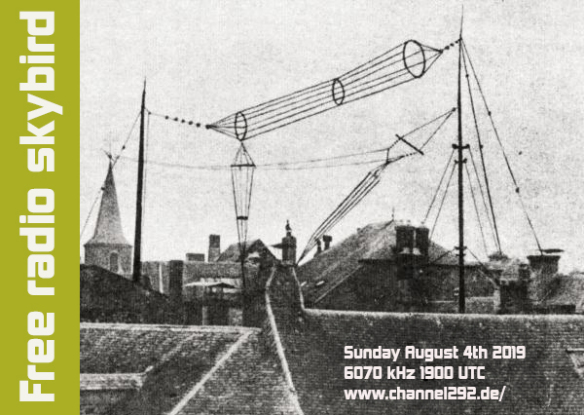
Free Radio Skybird returns August 4, 2019

I just received a message from DJ Frederick noting that Free Radio Skybird will “broadcast on 4 August @ 1900 UTC on 6070 kHz.”

Free Radio Skybird is “a shortwave radio show celebrating music & culture in the spirit of free radio.”

According to our friend, One Deck Pete, he’ll feature his “Soul on shortwave” and Justin Patrick Moore from Sothismedias will feature the first episode of his Radiophonic Laboratory.

Certainly, a show not to be missed as these radio personalities are all friends of the SWLing Post!

I highly recommend tuning in to Free Radio Skybird, then sending your reception reports to: [email protected]

VOA exhbition: “a fascinating look at early shortwave radio”

Many thanks to SWLing Post contributor, George Herr, who shares the following item from the LA Times:

Long before cell towers started sprouting up everywhere, the federal government commissioned telecommunication companies to build five massive fields of shortwave radio antennae. The structures, which reached up to 450 feet, were located in out-of-the-way places in California, Ohio and North Carolina. Each was designed to bounce radio waves off the ionosphere, allowing federally produced programming to be transmitted all over the globe.

The U.S.’ international radio broadcaster Voice of America was born during World War II. It expanded during the Cold War. As technology advanced, its programs were carried via television and digital platforms. Today it is part of the U.S. Agency for Global Media, providing news and information in 50 languages to a weekly audience of 275 million.

Its early years are traced in a fascinating exhibition at the Center for Land Use Interpretation in Culver City. “Voice of America: The Long Reach of Shortwave” takes visitors back to the predigital world, before our political leaders began tweeting their innermost sentiments and policy decisions. Back then, international audiences were addressed more formally, via carefully scripted programming.

[…]The antennae are the stars of the show. They appear in photographs, in videos and on touch-screen monitors. Arranged in grids, arcs and asymmetrical arrays, they resemble high-tech fishing nets, impossibly spindly bridges, supersized spirit catchers and otherworldly telephone poles. Sculpturally impressive, they make Land Art look fussy, precious and small.

All but one of the five transmission stations have been abandoned. The most haunting component of the exhibition is a three-minute video documenting the destruction of the antennae. In sequence after sequence, little puffs of smoke appear before the towering antennae yield to the tug of gravity and topple to the earth in seemingly slow motion. Some crash into others, causing them to fall like skyscraper dominoes. It’s a sad ballet that marks the end of an era.

A pair of touch-screen slideshows is also bittersweet. It takes visitors on a virtual tour of Transmission Station B (the only one still functioning) and Transmission Station A (its twin). Both are near Greenville, N.C. To see the up-and-running station alongside its vandalized, disused doppelganger is to glimpse a living world next to a dying one.

Both are ours.

Click here to read the full story at the LA Times.

New Silicon Labs automotive radio tuners support DRM and built on “SDR-friendly technology”

Many thanks to a number of SWLing Post readers who shared this latest press release from Silicon Labs. This is certainly a major upgrade to the Silicon Labs line of tuners/DSP chips. Native Digital Radio Mondiale (DRM) support will, no doubt, meet the needs of car manufactures in countries (like India) that have adopted DRM rather than HD radio and DAB/DAB+.  Of course, perhaps this might lead to an affordable DRM portable in the future:

Silicon Labs enhances Si479xx automotive tuner family with software-defined radio (SDR) technology.

(Source: Silicon Labs)

AUSTIN, Texas, July 29, 2019 /PRNewswire/ — Silicon Labs (NASDAQ: SLAB), a leading provider of automotive radio solutions, has introduced new hybrid software-defined radio (SDR) tuners, expanding its portfolio to meet the growing need of automotive radio manufacturers to support all global digital radio standards with a common platform. The new Si479x7 devices are Silicon Labs’ first automotive radio tuners supporting the Digital Radio Mondiale (DRM) standard. The Si479x7 tuners are an extension of Silicon Labs’ popular family of Global Eagle and Dual Eagle AM/FM receivers and digital radio tuners, providing the same outstanding field performance, pin and package compatibility between single and dual tuners, and bill of materials (BOM) cost advantages.

In addition to introducing new DRM-capable tuners, Silicon Labs is enhancing its Si4790x/1x/2x/5x/6x automotive tuners with unique “SDR-friendly” technology, effectively transforming these devices into hybrid SDR tuners. Silicon Labs’ hybrid SDR technology includes advanced DSP-based automotive features such as Maximal Ratio Combining (MRC), Digital Automatic Gain Control (AGC), Digital Radio Fast Detect and Dynamic Zero-IF (ZIF) I/Q. These features enable automotive radio manufacturers to support global digital radio standards with a common radio hardware and software design. This added flexibility helps OEM and Tier 1 customers reduce design, qualification, sourcing and inventory costs while avoiding the complexity and inefficiency of supporting multiple automotive radio platforms.

“Silicon Labs’ automotive tuners with hybrid SDR capabilities deliver the highest integration and reception performance and the lowest BOM cost of any automotive SDR tuners in mass production today,” said Juan Revilla, General Manager of Broadcast Products at Silicon Labs. “Our tuners with advanced digital radio features enable radio manufacturers to develop a single platform to demodulate and decode worldwide digital radio standards, greatly simplifying car radio designs and reducing system cost. A single digital radio platform can be achieved either with an SDR-based design approach or by using a tuner-plus-coprocessor design.”

Silicon Labs’ automotive tuner portfolio includes highly integrated single and dual device options with best-in-class AM/FM receiver performance. The portfolio supports all broadcast radio bands including AM, FM, Long Wave, Short Wave, Weather Band, HD Radio, DAB (Band III) and DRM. The tuners are built on Silicon Labs’ industry-leading RF CMOS technology, delivering outstanding automotive receiver performance. The tuners’ proven mixed-signal, low-IF RF CMOS design provides excellent sensitivity in weak signal environments and superb selectivity and intermodulation immunity in strong signal environments.

Imre’s HanRongDa HRD-737 modification increases sensitivity

Many thanks to SWLing Post contributor, Imre Olajos, who writes:

Hi, HRD 737 lovers! I have a good news!

I  (became brave enough to) modify my HRD-737.

I tried reverse-engineering- but I gave up. No numbers on IC-s. I found specifications for the analog switches (one for each band ) and found information about the transistors around those analog switch IC-s. Nice, 1 GHz fT transistors, all surface mount, so I gave up that line.

I found an NPN SM transistor in a damaged TV remote. It is only a 300 MHz transistor but
I had no better than that, so I started to build a little antenna amplifier circuit, wide band and simple.

I lost a few SM capacitors during the soldering but I have plenty of those. So the 1/4 square inch circuit board was finished last week. I tested it with an external 3 volt battery and I found it good working. Today ( 07-27-2019 ) I opened up the HRD-737 and wired it into the radio.
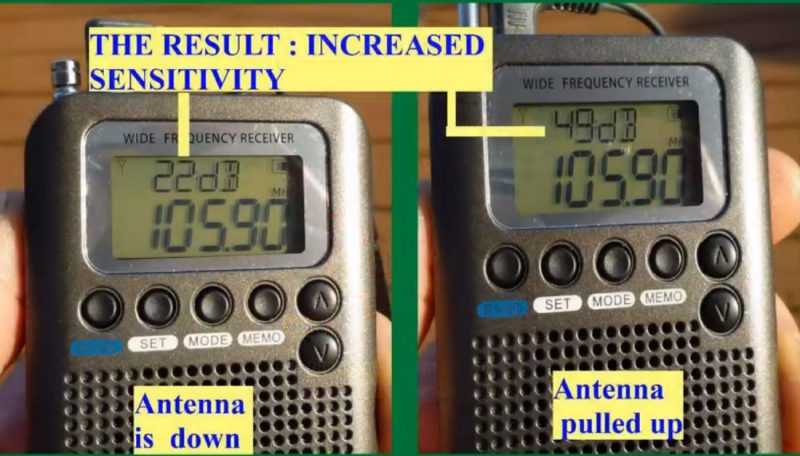
The results are much better than I expected. The HDR-737 became a good shortwave radio!

When I touch the built in antenna by my finger, radio is sensing the touch and station comes in. This effect was not there before. Radio became more sensitive on CB band than my Realistic DX392.

I have a YouTube channel [in the following video/slideshow] and I will show you the little ugly but great working circuit in the radio:

Click here to view on YouTube.

Later on next week I will try to record some video of the shortwave reception and post up it on the same YouTube channel.

I am a shortwave lover since 50+ years and I will be very happy to share the good news with others. Now I can listen my Greek music on this little radio, on 9420 kHz. Yes, the radio became [more sensitive than I had hoped].

You can see my other shortwave radios on my YouTube channel too, Have fun and never give up the hope!

Many thanks, Imre, for sharing and documenting this modification. One of the lessons here, too, is that if you have an inexpensive radio like the HanRongDa HRD-737 and you feel tempted to try a modification, there’s little to lose. It’s not like modifying a $1000 transceiver–just dig into the little radio and give it a go. If you harm the radio, you’ve only invested $37 or so in the project. That’s a much better solution than letting it sit on a shelf collecting dust because it’s not sensitive enough! Well played, Imre!

Special event stations celebrating anniversaries of famous European pirate stations

Many thanks to SWLing Post contributor, Harald Kuhl (DL1AX), who writes:

At the beginning of August there will be two special event amateur radio stations active on shortwave, celebrating anniversaries of famous European pirate stations Radio North Sea International and Radio Caroline:

Radio Northsea International PA45RNI

from 01-08-2019 to 31-08-2019

http://www.radio-northsea.org

email: [email protected]

[source: https://www.qrz.com/db/pa45rni]

and

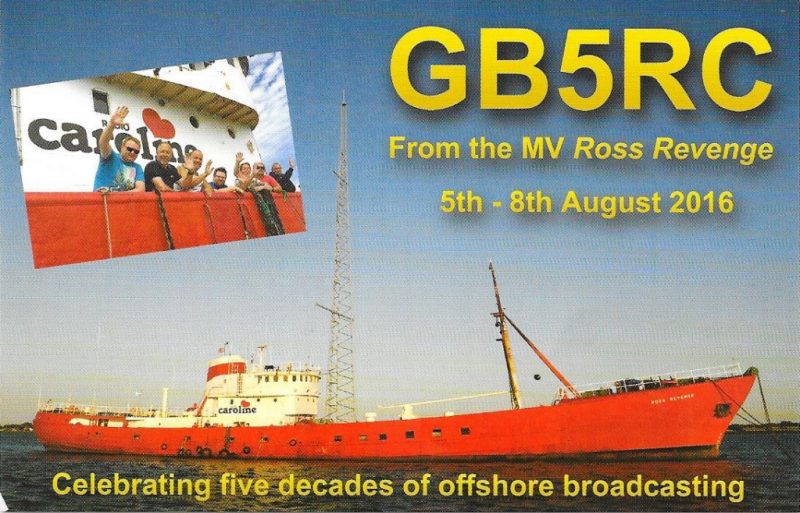
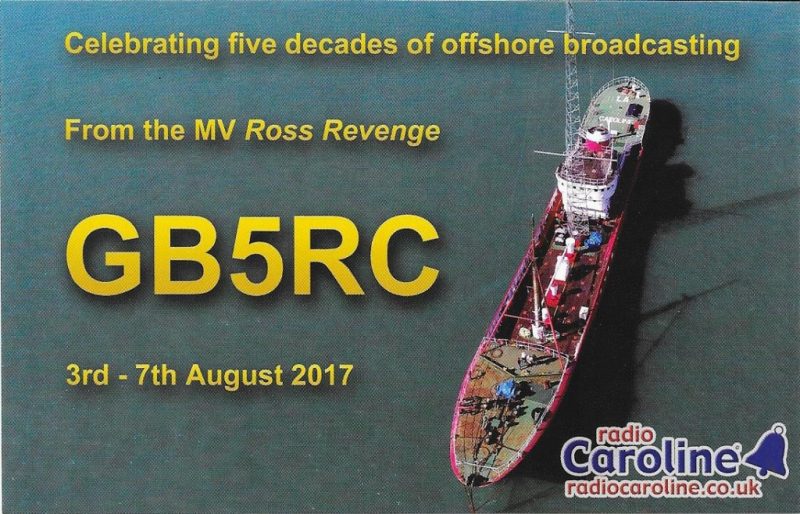
GB55RC will be active from the Ross Revenge:

Celebrating fifty five years of Radio Caroline

Thursday 1st – Monday 5th August 2019

2019 is the fifty fifth anniversary of Radio Caroline and the Martello Tower Group are pleased to be able to activate the world famous MV Ross Revenge again in August. This year we have been granted the ‘special’ special callsign of GB55RC. […]

[source: https://www.qrz.com/db/gb55rc]

Special QSLs will be available.

[The QSLs above are] from previous GB5RC activities.

Thank you for the tip, Harald! I’d love to grab one of those QSLs!

A photo tour of the 2019 WCARS hamfest

Yesterday, I attended the WCARS hamfest in Waynesville, North Carolina, with my friend Sébastien (VA2SLW) who is currently on vacation in the area.

The WCARS hamfest is a smaller regional hamfest, but it attracts a lot of folks from the mountain regions of north Georgia, Tennessee, South Carolina, North Carolina, and beyond.

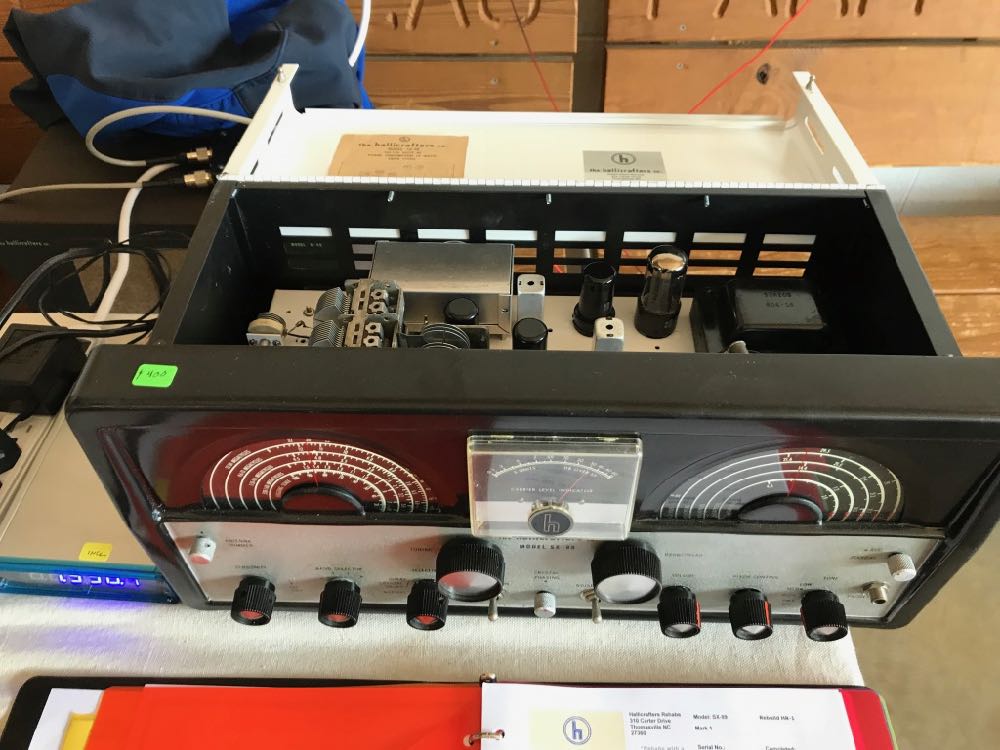
The WCARS hamfest flea market always has quite a variety of radios, including a number of great vintage models. I’ve been very lucky in the past finding excellent deals, too. This year, I (reluctantly) passed up a few deals knowing I’m also attending the Huntsville Hamfest in August and the Shelby Hamfest in September.

Below, you’ll find a selection of photos from the hamfest. Note that you can click on the image to enlarge it and I attempted to include price tags when possible:


Do you enjoy the SWLing Post?

Please consider supporting us via Patreon or our Coffee Fund!

Your support makes articles like this one possible. Thank you!