Category Archives: Shortwave Radio

NIST Radio Stations: MARS COMEX asks for reception reports and suggestions in survey

Many thanks to SWLing Post contributor, Skip Behnke (W2OZ), who notes that MARS (Military Auxiliary Radio System) COMEX website is asking for your reception reports, notes, and suggestions regarding the NIST radio stations WWV, WWVH and WWVB.

This survey is being conducted while WWV and WWVH are announcing military communication exercises.

Click here to take the survey and submit your report at the DoD MARS COMEX website.

Classical Music on Radio Tumbril, April 28 – May 3

Encore – Classical Music on shortwave – broadcast Sunday afternoon in Europe & USA

Encore – Classical Music this weekend is being broadcast as usual by Channel 292 (Europe) on 6070 kHz at 15:00 UTC Sunday 28th April.
Back on the air after ten days of maintenance.
And by WBCQ on 7490 kHz at 00:00 – 01:00 UTC Monday 29th April.

There is a repeat on 6070 kHz on Friday at 19:00 UTC.

The show this week will start with a fanfare on medieval bladder pipes followed by some Holst and an organ sonata by Bach. We have two lyrical and romantic contemporary pieces from Thomas Adès, also some Telemann and Mozart. Amongst much else – Leonard Bernstein conducts Charles Ives and the programme finishes with some early Russian polyphony.

As usual – reception reports and requests for music to play in future programmes will be very welcome.

Regular Broadcast times are:
15:00 – 16:00 UTC Sunday, and repeated 19:00 – 20:00 UTC Friday on 6070 kHz (Channel 292 Germany).
00:00 – 01:00 UTC Monday on 7490 kHz (WBCQ – Maine).

Brice Avery – Encore – Radio Tumbril – www.tumbril.co.uk

W9IMS: New season of Indianapolis Motor Speedway-themed special events

2018 W9IMS QSL

Many thanks to SWLing Post contributor, Brian D. Smith (W9IND) who shares the following W9IMS press release:

Amateur radio station W9IMS prepares to unveil a new season of Indianapolis Motor Speedway-themed special events, with three QSL cards and a certificate available to hams and SWLs.

DATE: April 24, 2019

Three colorful QSL cards and a glossy certificate await amateur radio operators and SWLs who manage to contact – or tune in – Indianapolis Motor Speedway special event station W9IMS during all three of its 2019 special events. And even those who fall short of the trifecta can claim one or two of the QSLs.

2018 W9IMS QSL

Your first shot comes in two weeks as W9IMS fires up from May 5-11 to commemorate the IndyCar Grand Prix. Only nine days later, the second W9IMS special event (May 20-26) gets underway, this one in honor of the venerable Indianapolis 500. Then comes a summer break until Sept. 2-8, when W9IMS stages its third and final special event of the year, celebrating the Brickyard 400 NASCAR race.

The certificate and QSLs change every year, so even if you scored the clean sweep in 2018, you’ll find new trophies to pursue this year.

But you’ll have a chance to snare the station on either of two bands (20 and 40 meters) and possibly three (80 meters). Remember, too, that on Race Day – the final day of each operation – W9IMS generally stays on the air late, sometimes until midnight local time (0400 UTC).

Here are a couple of hints for tracking down the station during special event weeks:

  1. Go to the W9IMS web page (www.w9ims.org), find the “2019 Operating Schedule” heading, and click on the link to the IndyCar Grand Prix or any other race. Although some W9IMS operators take to the airwaves at unscheduled times, you’ll have your best luck looking for the station during the hours and bands reserved with a name and a callsign.
  2. Check DX Summit (www.dxsummit.fi) anytime for spots that identify the current frequency (or frequencies) of W9IMS, if any. And if you type “W9IMS” in the search box, you can customize it to show reports for only that station.

For additional details, consult the W9IMS web page. Feel free to submit all of your 2019 QSL and certificate requests in the same envelope. Again, although you’ll need to catch W9IMS during all three races to qualify for the certificate, you can earn a unique QSL card for each individual race.

Ultra-Rare Tristan da Cunha QSL: The Art of the Hunter-Killer QSL Pursuit

The remote South Atlantic island of Tristan Da Cunha (Image via Google Earth)

Many thanks to SWLing Post contributor, Dan Robinson, who shares the following guest post:


Ultra-Rare Tristan da Cunha QSL: The Art of the Hunter-Killer QSL Pursuit

by Dan Robinson

Those in the QSL collecting community are likely to have noticed the recent appearance on Ebay of one of the rarest QSL cards in existence.
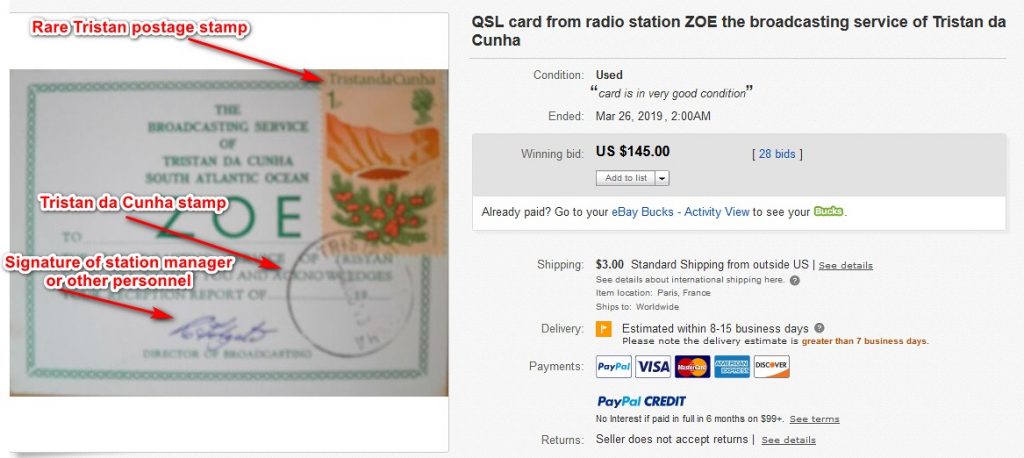
The QSL from Tristan da Cunha showed up around March 19th with a six day auction window, by a seller in France who also listed a number of other older QSLs.

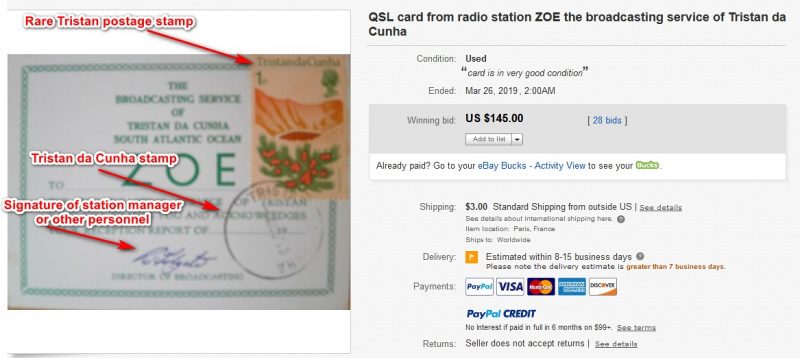
For a description, the seller wrote: “QSL card from radio station ZOE the broadcasting service of Tristan da Cunha 1973. A very rare and sought after QSL. Seldom seen on Ebay. . .”

Understatement to be sure. Along with QSL letters directly from Biafra, the breakaway state in Nigeria many decades ago, QSLs from Tristan da Cunha are pretty much NEVER seen.

ZOE Tristan was a station intensively sought by thousands of DX’ers when it occupied the 90 meter frequency of 3,290 kHz with a power of only 40 watts.

Only a handful of DX’ers ever heard and QSL’ed Tristan.  In this story still accessible online–three persons from South Africa are described as having received QSLs, along with two others, in the UK and in Florida, USA.

As a young DX’er, I remember reading the entry in the WRTH and the feeling of frustration with the reality that it was impossible to hear with my receivers, largely due to its limited broadcast time and hour of transmission which I recall was 2000 UTC.
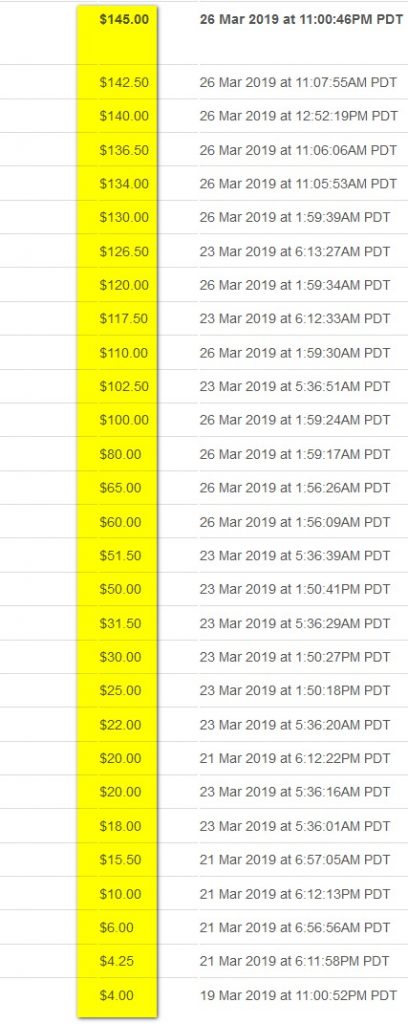
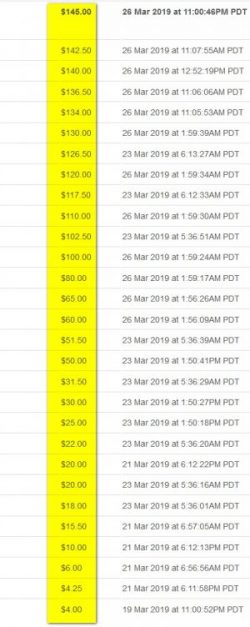
eBay bid history

As the hours ticked away in the auction, the number of bids increased. The ending time fell in overnight hours EDT. This increased chances of obtaining the card for a lower price, though bidders in other parts of the world would surely be stationed at their PCs and on their phones in the final hours of the auction.

I have been one of the most active QSL hunters in the world, and there are specific strategies involved in competing for QSLs.

For purposes of this article, I’ll just note that these involve constant attention, especially toward the end. As an auction nears conclusion, it’s important to “test” the bid level to assess the likelihood of the item selling at that or a much higher price.

Some cards or verification letters have the potential to bring hundreds of dollars. I assessed that this Tristan card could bring as much as $500-$1,000 depending on whether someone had “gone high” with an automatic “knock out” bid using either the Ebay system or other auto-bidding site.

As you can see in the image, from a starting price of $4.00 on March 19th the Tristan card had reached only $50.00 several days later on March 23rd.  The $100 mark was reached on March 26th.  One bidder retracted his $150 bid at one point.

On the final day March 26th, it was anyone’s guess how high the Tristan card could go.  The card only inched up in small bid increments, surprising given its rarity.

If one assumed that any of the four bidders involved placed a “knock-out” auto-bid, and if two had placed such a bid, in the final seconds the Tristan QSL could quickly shoot up from the $142.50 level to whatever the extremely high maximums would be.

Due to the rarity of the card, my bid fell in the “knock out” category.  I went to sleep reasonably confident, but concerned the competition could drive the price of the card through the roof.

When I awoke the next day, I was relieved — the Tristan card, complete with its original postage stamp, rubber stamp mark, and signature by the station, was mine.  The price:  an astoundingly low $145.
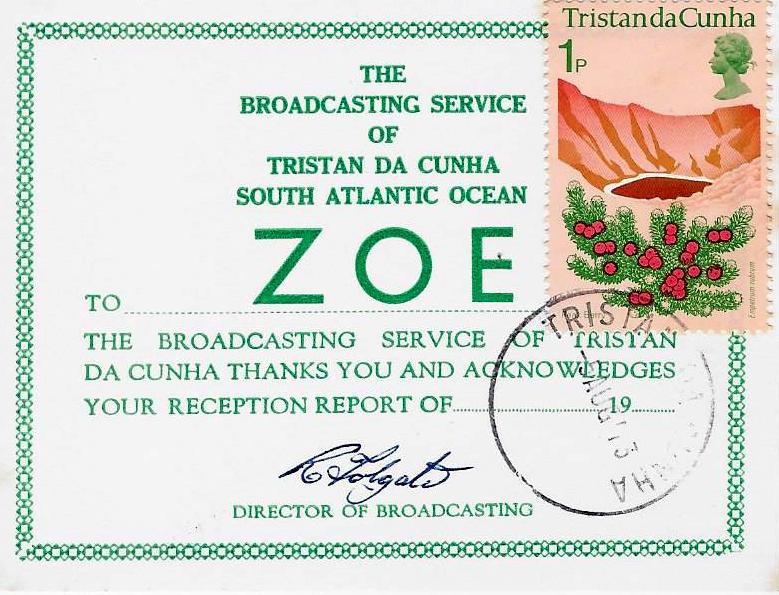
Such is the excitement involved in being a “hunter-killer” QSL card collector. As I noted in SWLing Post last year, I now own three of the world’s rarest QSLs.

These include possibly the last remaining QSL letters sent directly from Radio Biafra, a QSL from Portuguese Macao, and now this wonderful ZOE Tristan da Cunha card.

That is–actually two ZOE QSLs.  About a decade ago, while scanning Ebay listings for QSLs, I was astounded to see a ZOE card listed as part of a group of amateur radio QSLs being offered by a seller in Europe.

I couldn’t believe what I was seeing. Until that point I had seen not a single ZOE QSL appear since the Ebay market for QSLs began to heat up in the late 1990s

(Source: SWL Card Museum)

This particular card, which you can see posted at the excellent “SWL Card Museum” site has “ZOE” printed in large letters, like the card that I recently won, a date of reception as “June 1, 1977” but no signature.

The card did arrive with the original envelope in which it was sent to a European DX’er, complete with a postage stamp and postal mark for Tristan.

Why that particular ZOE card was not signed by someone at the station, and why it was placed in an envelope rather than post marked on the card itself, remains a mystery.

Back to the story noted above, about the group of South African DX’ers who were among the few worldwide to have heard Tristan da Cunha.

In that article, the author notes that two other DX’ers, one in the U.S., one in Europe, had received QSLs from Tristan.

With a bit of online sleuthing, and help from some fellow DX’ers, I was able to determine that one of those two, Dave Sharp, is indeed still with us.

In response to an email inquiry, Dave provided the following history:

“I forget when exactly I heard the station, but it was 1984 or just prior, as I was still in high school. I was in Florida at the time and was using a rotatable three element beam ham antenna. [I] heard threshold talk from a woman with a deep voice and this apparently matched to voice of the Radio Tristan announcer at the time.

[I] received a reply from Pat Patterson, the Tristan postmaster and a Ham radio operator himself. Since my reception report was tentative, I felt a QSL wouldn’t have been issued if they hadn’t been reasonably confident of reception.

I received a personal letter, stamp bulletin, and a small QSL, bright green on white background, with “ZOE” across the front.

Long story, but many of my personal belongings were lost over the years and this includes my entire QSL collection (which had been left in possession of my sister).

Needless to say, I received a fair bit of ridicule after coming forward with the QSL. To emphasize, my report was tentative and they decided to issue a reply.”

It remains to be seen if other ZOE/Tristan da Cunha QSLs will surface in the future, and of course it is unknown how many of the cards that were sent out to the few DX’ers who heard, or claim to have heard, the station, still exist.


Wow! Thank you for shedding light on the history of ZOE Tristan Da Cunha QSLs. At those meager power levels, from such a remote location, and during that broadcast window, I can see why ZOE must be one of the rarest of QSL cards. I’m happy to know you obtained the card, too, Dan as you have such a long history of properly archiving and sharing your cards. As you just did.  Thank you!

Classical Music on Radio Tumbril, April 21 – 26

(Source: Radio Tumbril)

Classical Music on shortwave – broadcast Sunday afternoon in Europe & USA

Encore – Classical Music this weekend Is being broadcast as usual on WBCQ at 00:00 – 01:00 UTC Monday 22nd April.
Channel 292 is off air at the moment for servicing so the normal 15:00 UTC Sunday 21st April transmission will not happen this week.

The show will start with a Boccherini quintet, then some ballet music from Swan Lake.
There will also be some French wind band music, an organ work from Bach and some interesting works for the human voice.

As usual reception reports and requests for pieces to pay in future programmes will be very welcome.

Broadcast times are:
15:00 – 16:00 UTC Sunday, and repeated 19:00 – 20:00 UTC Friday on 6070 kHz (Channel 292 Germany).
00:00 – 01:00 UTC Monday on 7490 kHz (WBCQ – Maine).

(Channel 292 is off air for ten days from Monday 16th April.)

Brice Avery – Encore – Radio Tumbril – www.tumbril.co.uk

The ALT-512: A new QRP transceiver

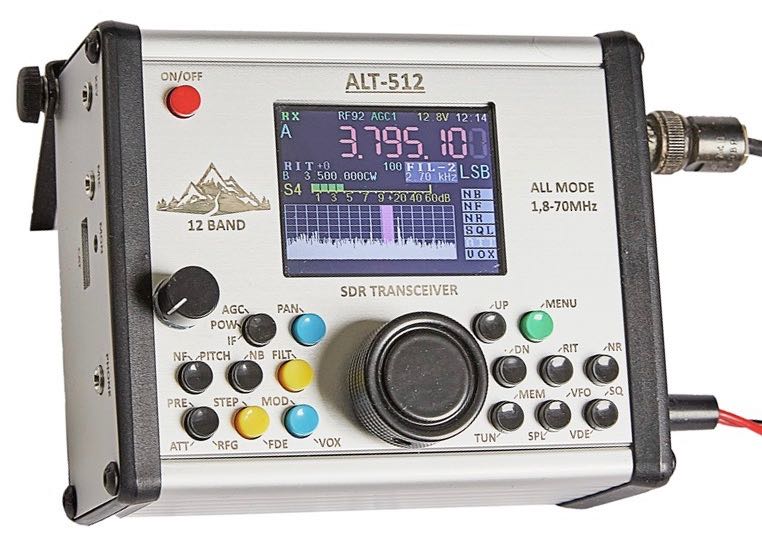
There’s a new QRP transceiver on the market: the twelve band ALT-512 by Aerial-51.

At first glance, you’ll see a similarity between the ALT-512 and the LnR Precision LD-11/Aerial-51 SKY-SDR. The LD-11 and SKY-SDR, are very similar, save the LD-11 is marketed to North America (via LnR) and the SKY-SDR to Europe. The SKY-SDR had several iterative upgrades, most importantly the dual-threaded software used in the firmware, which cut CPU latency in half. Both the LD-11, SKY-SDR and now the ALT-512 are made in Europe.

Click here to read my review of the LnR Precision LD-11.

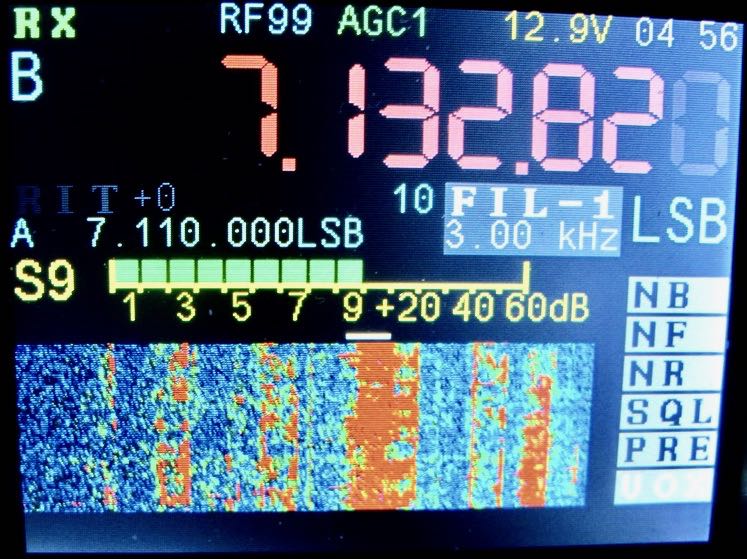
ALT-512 Waterfall display (Photo: DJ0IP)

According to Aerial-51, the new ALT-512 is built on the LD-11/SKY-SDR platform, has the same chassis design but has many improvements over the SKY-SDR:

  • 4m Band
  • 2.4 in. Color Display
  • Improved receiver pre-amplifier
  • 2 transistors in the transmitter PA (was 1)
  • Waterfall in addition to the Pan-Adapter Bandscope
  • 4 additional front-panel buttons
  • User friendly front-panel adjustment of often used parameters (formerly embedded within the software menu)
  • FULL TS-2000 command set implementation
  • Built-in Sound Card; Digi Modes run using only one USB-2 cable connected to the PC. No additional hardware required.

If the ALT-512 performs as well as or better than its predecessor, it’ll certainly be a great little QRP radio.

Pricing has not yet been posted, but Aerial-51 plans to make this transceiver available in the next few weeks.

Click here to check out the ALT-512 on the Aerial-51 website.

Classical Music on Radio Tumbril this week

(Source: Radio Tumbril)

Classical Music broadcast on Sunday afternoon in Europe & USA

Encore this week will start with a beautifully lyrical Piano piece by Sibelius, then we’ll have a movement from Elgar’s Cello Concerto in an historic recording by Jaqueline du Pré.
There will also be a song from Gluck, two string quartet pieces by Janacek, some of Mahler’s 5th, Copeland’s clarinet concerto, a little Bach organ music and some Albinoni.

Broadcast times are 15:00 – 16:00 UTC Sunday on 6070 kHz (Channel 292 Germany) and 00:00 – 01:00 UTC Monday on 7490 kHz (WBCQ – Maine).

(There would normally be a repeat on Friday 19th on on 6070 kHz but 292 will be off air for ten days from Monday 16th April for adjustments)

Brice Avery – Encore – Radio Tumbril

www.tumbril.co.uk