Category Archives: WiFi Radio

Radio Waves: FCC Fines Drone Retailer, High School WSPR Buoy, Flashing Radio Firmware, and “Radio Recliner” Powered by Senior Resident DJs

Radio Waves:  Stories Making Waves in the World of Radio

Because I keep my ear to the waves, as well as receive many tips from others who do the same, I find myself privy to radio-related stories that might interest SWLing Post readers.  To that end: Welcome to the SWLing Post’s Radio Waves, a collection of links to interesting stories making waves in the world of radio. Enjoy!

Many thanks to SWLing Post contributors Ron, Pete Eaton, Paul Evans, and Jennifer Gulley for the following tips:


FCC Fines HobbyKing Nearly $3 Million for Marketing Unauthorized Drone Transmitters (ARRL News)

The FCC has issued a Forfeiture Order (FO) calling for HobbyKing to pay a fine of $2,861,128 for marketing drone transmitters that do not comply with FCC rules. An FCC Enforcement Bureau investigation stemmed in part from a 2017 ARRL complaint that HobbyKing was selling drone transmitters that operated on amateur and non-amateur frequencies, in some instances marketing them as amateur radio equipment. The fine affirms the monetary penalty sought in a June 2018 FCC Notice of Apparent Liability (NAL). The FCC said its investigation found that dozens of devices marketed by the company transmitted in unauthorized radio frequency bands and, in some cases, operated at excessive power levels. “Such unlawful transmissions could interfere with key government and public safety services, like aviation systems,” the FCC said.“We have fully considered HobbyKing’s response to the NAL, which does not contest any facts and includes only a variety of legal arguments, none of which we find persuasive,” the FCC said in the FO. “We therefore adopt the $2,861,128 forfeiture penalty proposed in the NAL.”[]

High School Marine Buoy Transmitter Now Active on 20-Meter WSPR (ARRL News)

Phil Karn, KA9Q; Randy Standke, KQ6RS, and members of the Mount Carmel High School Amateur Radio Club (MCHSARC) in San Diego have constructed and deployed an amateur radio marine buoy in the Pacific. The buoy, which transmits WSPR on 14.0956 MHz USB, has already been heard around the continental US, Brazil, Hawaii, Japan, Costa Rica, Australia, and South Africa.

“Over the past year, Randy and I have mentored the MCHSARC in designing and constructing a simple marine buoy that was deployed from the RV Sally Ride [on July 16], about 700 kilometers off the coast of southern California,” Karn said in a post on the AMSAT Bulletin Board. “It is up and transmitting WSPR on 20 meters using the call sign KQ6RS, and is being received all over the US and into Canada and Brazil.” Karn is blogging about the project with updates.

The electronics are the 20-meter WSPR version of the WB8ELK “pico tracker” that has been flown on long-duration balloons. “We removed the solar panels and substituted 21 ordinary alkaline D cells, wired to supply 4.5 V,” Karn explained. “We estimate battery lifetime will be 6 months.”

[…]The first reception report was on July 16 at 12:52:30 UTC from grid square CL89eu, although the current carried the buoy east into CL89fu at 20:32:30 UTC. The buoy (KQ6RS-1) can be tracked on the APRS and WSPRnet sites.[]

Stop Bad Laws Before They Start (Hackaday)

With everything else going on this summer, you might be forgiven for not keeping abreast of new proposed regulatory frameworks, but if you’re interested in software-defined radio (SDR) or even reflashing your WiFi router, you should. Right now, there’s a proposal to essentially prevent you from flashing your own firmware/software to any product with a radio in it before the European Commission. This obviously matters to Europeans, but because manufacturers often build hardware to the strictest global requirements, it may impact everyone. What counts as radio equipment? Everything from WiFi routers to wearables, SDR dongles to shortwave radios.

The idea is to prevent rogue reconfigurable radios from talking over each other, and prevent consumers from bricking their routers and radios. Before SDR was the norm, and firmware was king, it was easy for regulators to test some hardware and make sure that it’s compliant, but now that anyone can re-flash firmware, how can they be sure that a radio is conformant? Prevent the user from running their own firmware, naturally. It’s pretty hard for Hackaday to get behind that approach.[]

New Internet Radio Station Helps Seniors Share Their Favorite Music (NPR)

A new internet radio station called Radio Recliner has started during the coronavirus pandemic. It gives residents in senior living facilities a chance to share some of their favorite music.

Click here to check out the Radio Recliner website.


Do you enjoy the SWLing Post?

Please consider supporting us via Patreon or our Coffee Fund!

Your support makes articles like this one possible. Thank you!

Radio Globe: A handy way to explore the world of Internet radio

Many thanks to SWLing Post contributor, Dennis Dura, who shares a link to this fascinating project on the excellent Hackday site:

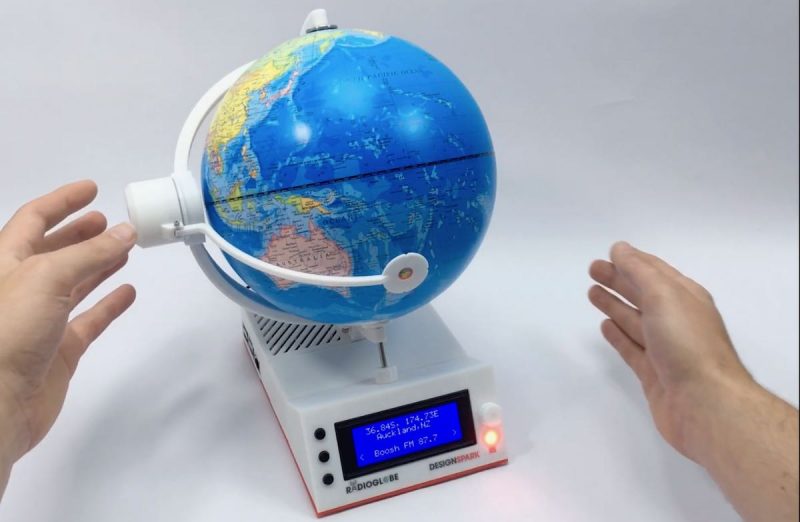
[…]RadioGlobe lets the user tune in over 2000 stations from around the world by spinning a real globe. It works by using two absolute rotary encoders that each have a whopping 1024 positions available. One encoder is stuck into the South Pole, and it reads the lines of longitude as the user spins the globe.

The other encoder is on the left side of the globe, and reads whatever latitude is focused in the reticle. Both encoder are connected to a Raspberry Pi 4, though if you want to replicate this open-source project using the incredibly detailed instructions, he says a Raspberry Pi 3 B+ will work, too.[…]

Just check out this video of Radio Globe in action!

I love it. It’s like a physical version of the amazing Radio Garden website and app.

Hackaday notes that if you want detailed information about this project, the designer made a series of vlog posts about the build. Click here to check it out on his website. Click here to read through build details on Instructables.

Thank you for the tip, Dennis!

Pizzoloruss’s CityRadio: An Internet radio with a nostalgic & simple interface

Source: Wallpaper.com

Many thanks to SWLing Post contributor, Dennis Dura, who shares a link to this radio project by Emanuele Pizzolorusso who wishes to combine a modern Internet radio with old-school city-labeled memory buttons. From Wallpaper.com:

CityRadio, designed by Emanuele Pizzolorusso for Italian design brand Palomar, allows you to access local radio around the world, with a simple – and satisfying – click of a physical button. It’s a contemporary re-imagination of radio’s early history, where city names where displayed to identify frequencies. As travel looks to remain restricted for the time being, get your multicultural fix through the airwaves.

Of course, you can go online and access local radio anywhere fairly easily, but for Pizzolorusso, there’s a certain romanticism to, and interconnection with, the act of listening physical object. ‘In my childhood home there was an old portable radio, one of those appliances that had the names of several European cities on the tuning dials – a feature from the time when one could still listen to stations from foreign countries,’ explains the Italian designer, who is based in Helskinki. ‘The list of those places, which to me as a child appeared so mysterious and exotic, stimulated my imagination and gave that ordinary forgotten object a deep sense of magic.’

Press magnetic keys to access 18 different cities around the world – from Barcelona to Beijing, Nairobi to New York.[…]

Click here to continue reading the full article.

The Worldwide Listening Guide: A deep dive into online and over-the-air listening

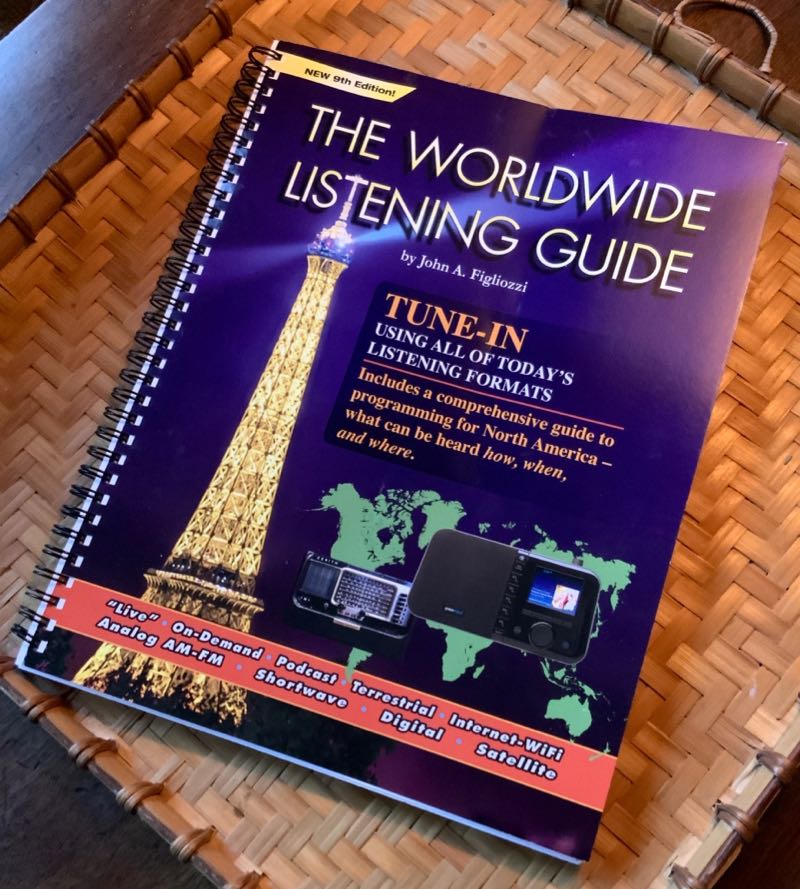
I recently received a review copy of the 9th Edition of the Worldwide Listening Guide by John Figliozzi:

While WRTH is my favorite guide for radio frequencies and schedules, Figliozzi’s Worldwide Listening Guide (WWLG) is my go-to for programming and content, not only helpful on the shortwaves, but especially handy when tracking online content.

The WWLG is a unique guide–there’s nothing quite like it on the market. I look forward to each edition because it truly takes a deep dive into the world of broadcasting, technology, and programming.

“Deep dive” almost feels like an understatement. I received the latest edition only a few days before Christmas travels, so packed it in my luggage and read it over the course of a week. Being the editor of the SWLing Post, I’m in the middle of a constant stream of news items and tips about the world of broadcasting and communications technology. When I read the WWLG, however, I discover so much information about the broadcasting industry as a whole, the health of various platforms, particular media companies, and even the history and technology behind content delivery systems.

Case in point: I always assumed SiriusXM satellite radio was delivered by a network of geostationary satellites. Turns out, they use a hybrid system of both “roving” satellites that orbit in a figure 8 pattern and geostationary satellites in the Clarke Belt. The WWLG is chock-full of details like this.

Each media delivery platform–AM, Shortwave, FM, Satellite Radio, Internet (WiFi Radio), and Podcasting–has a dedicated section in the book where Figliozzi explores each in detail. He also includes a “State of the Radio Platforms” chapter where he examines the health and potential direction of each.

SWLing Post contributor, Mark Fahey, recently summed up his love of the WWLG in the following comment: 

[I]t’s the best guide to digital streaming media I have ever found. An indispensable guide to the world’s public broadcasters and others broadcasters who appeal to us raised on decades of shortwave.

As shortwave transmitters close, don’t make the mistake of thinking your favourite broadcasters disappear – they in most cases continue and the Worldwide Listening Guide will guide you to them as live and on-demand programs.

I use the guide as a directory for online listening, but of course RF transmission broadcasts are comprehensively covered as well.

I agree 100%.

Like Mark and many SWLs, I’m something of a “Content DXer:” I love chasing obscure programming––news, documentaries, music, and variety shows, anything the broadcasting world has to offer.  For this, I often turn to Wi-Fi radio.  Wi-Fi radio offers the discerning listener the ability to track down fascinating regional content from every corner of the globe––content never actually intended for an international audience.

Digging into local content via a WiFi radio isn’t nearly as challenging or fun (for me, at least) as scanning the shortwave bands in search of elusive weak signal DX or a pop-up pirate radio station. Though my WiFi radio offers an easy and reliable way to “tune” to online content–both station streams and podcasts–the actual content discovery part is quite difficult.

Truth is, there’s so much content out there–tens of thousands of stations and shows–it’s hard to know where to start!

This is where the WWLG comes in: Figliozzi exhaustively curates thousands of programs, indexing their airing times, stations, days of broadcast, program types, frequencies, and web addresses. Additionally, he sorts the programs by genre:  arts, culture, history, music, sports, and more. And Figliozzi also includes a well-thought-out directory of at least forty genres. In my shack and office, the WWLG has been an invaluable tool for content discovery.

There’s a surprising amount of information packed into this slim, spiral-bound edition of the Worldwide Listening Guide…enough to keep even a seasoned content DXer happy for years.

The 9th edition of Worldwide Listening Guide can be purchased here:

Petition calls for BBC to allow streaming on 3rd party sites/apps


(Source: Southgate ARC)

A petition calling on the BBC to reinstate its internet radio stations to third-party apps has attracted nearly 2,000 signatures.

The petition is asking the broadcaster to reverse its decision to remove BBC stations from TuneIn, a popular app for listening to live internet radio.

The BBC removed its streams from the service at the end of September.

In a blogpost at the time, the BBC said that it was making the move because services like TuneIn do not allow it to collect data on its streams.

Kieran Clifton, the BBC’s director of distribution and business development, said: “We want our programmes, products and services to be the best they can be. And a major way we ensure that is by using meaningful data. Data is more and more important – as it helps us to make more types of programmes we know people like, and equally importantly, identify gaps in our commissioning to ensure we’re making something for all audiences. We also use the data collected about what you watch, listen to or read online to offer personalised programme recommendations – and make our services even more tailored to you.

“When we make our programmes available via third parties, we ask that those platforms either allow you to sign into your BBC account – or provide us with meaningful data directly. Unfortunately, TuneIn doesn’t do either of these, so we couldn’t reach a data sharing agreement with them.”

According to the petition, however, the move means that many listeners with digital radio devices can no longer listen to BBC stations.

The petition’s creator, Julian Prokaza, said: “The changes mean that a great many new internet devices are now effectively obsolete for people who used them mainly to listen to BBC radio.

“The changes also do not abide by the BBC remit of ‘making sure you can watch and listen to our programmes in ways that are both easy and convenient for you.’

“The BBC should restore its TuneIn streams immediately and maintain them at least until fully functional replacement services for affected devices are available.”

Source:
https://www.prolificlondon
.co.uk/marketing-tech-news/other-media-news/2019/10/bbc-internet-radio-petition-gathers-pace

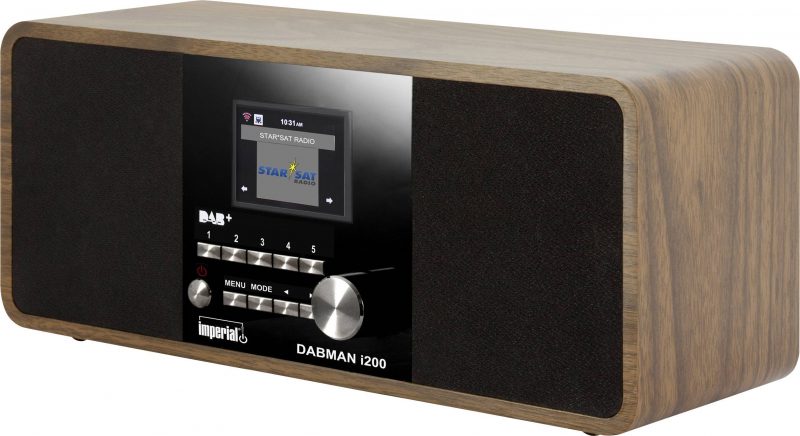
Security vulnerability affects Imperial Dabman web radios

Many thanks to SWLing Post contributor, Ed, who writes:

I’m wondering if SWLing Post readers who use Imperial Dabman web
radios might want to read about this serious security vulnerability.

(Source: Threat Post)

Attackers can drop malware, add the device to a botnet or send their own audio streams to compromised devices.

Imperial Dabman IoT radios have a weak password vulnerability that could allow a remote attacker to achieve root access to the gadgets’ embedded Linux BusyBox operating system, gaining control over the device. Adversaries can deliver malware, add a compromised radio to a botnet, send custom audio streams to the device, listen to all station messages as well as uncover the Wi-Fi password for any network the radio is connected to.

The issue (CVE-2019-13473) exists in an always-on, undocumented Telnet service (Telnetd) that connects to Port 23 of the radio. The Telnetd service uses weak passwords with hardcoded credentials, which can be cracked using simple brute-forcing tactics. From there, an attacker can gain unauthorized access to the radio and its OS.

In testing, researchers said that the password compromise took only about 10 minutes using an automated “ncrack” script – perhaps because the hardcoded password was simply, “password.”

Click here to read the full article at Threat Post.

Thank you for the tip, Ed!

Frontier Silicon’s favorites feature is back

Many thanks to SWLing Post contributor, John Figliozzi, who discovered that the favorites feature is back on his Frontier Silicon-based WiFi radio and notes:

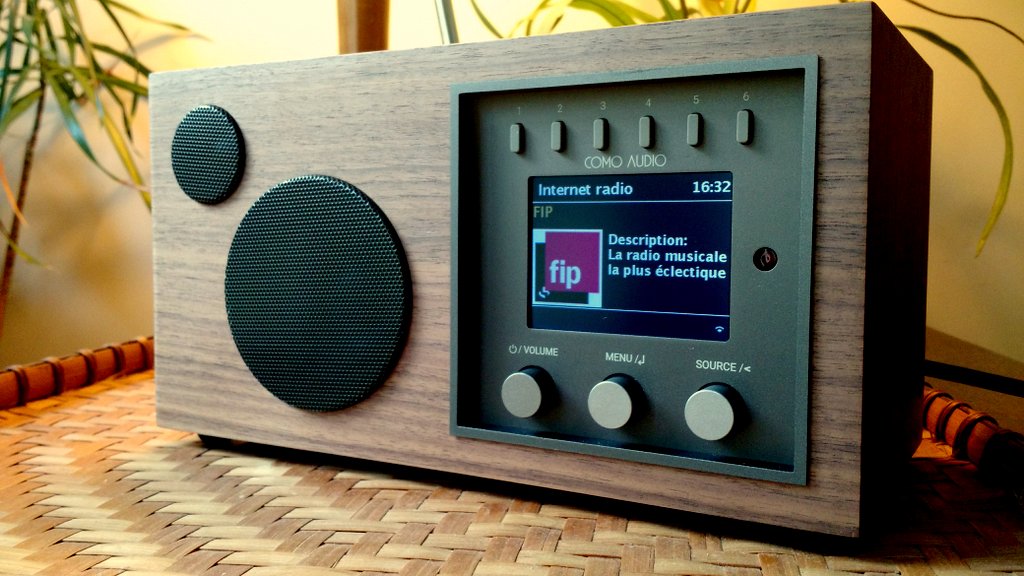
Check out the screen on your Como Solo and follow the instructions. Full features appear to be back! Wrote to Peter Skiera at Como and he said it wasn’t planned to go live until [today], but it showed up on my screen [Saturday]. Seems to work smoothly and flawlessly.

Brilliant news! Thank you for sharing, John. I’m happy to see that Frontier Silicon is getting back on its feet after dropping the vTuner backbone that powered its aggregator for so many years. Several others have commenting with this good news. This is certainly a positive sign.