Shortwave listening and everything radio including reviews, broadcasting, ham radio, field operation, DXing, maker kits, travel, emergency gear, events, and more
From the Isle of Music, Week of December 26-31:
From Mambo to Songo: A Special Cuban Dance Party
For our final program of 2016, we bring you a special Cuban dance party without interview, plus a tribute to Pérez Prado, who was born 100 years ago on December 11, 1916.
Three options for listening on shortwave:
WBCQ, 7490 KHz, Tuesdays 0100-0200 UTC (8pm-9pm EDT Mondays in the Americas)
Channel 292, 6070 KHz, Fridays 1100-1200 UTC (1200-1300 CET) and Saturdays 1600-1700 UTC (1700-1800 CET)*
*The Saturday broadcast may suffer significant interference from the Voice of Turkey in some areas but should be listenable in the UK and other areas outside of TRT’s target area. We will have a new time for Saturdays in 2017.
See our Facebook Page for more information.
Deep in the massive FY2017 National Defense Authorization Act is a provision to eliminate, in its present form, the U.S. Broadcasting Board of Governors. The NDAA has been passed by the House and the Senate and is expected to be signed by President Obama. The BBG is the topmost authority of the elements of U.S. government-funded international broadcasting: Voice of America, Radio Free Europe/Radio Liberty, Radio Free Asia, Radio and TV Martí, and the Arabic-language Alhurra TV and Radio Sawa. Together they broadcast in 61 languages.
This BBG’s demise eliminates the “firewall” of a nine-person bipartisan board with fixed and staggered terms, and replaces it with one politically-appointed CEO. This change will have consequences.
Traditionally, people around the world huddled around a shortwave radio to get news from abroad. Increasingly, they watch an international news channel via cable or satellite television, or access a foreign website or social media outlet. Whatever the medium used, the need for a credible alternative to domestic state-controlled media is the main reason international broadcasting has had an audience since the 1930s.
Credibility is the essence of successful international broadcasting. The shortwave frequencies, satellite channels, and online media are full of propaganda, but serious news consumers seek out the news organizations that they trust.
International broadcasting in languages such as Burmese or Hausa has little commercial potential. National governments must step in to provide the funding. The foremost challenge is to ensure that the journalism is independent from the governments that hold the purse strings.
To achieve this, there is no substitute for a multipartisan governing board. Its main function is to appoint the senior managers of the broadcasting organization, so that politicians don’t. This is how “public service” broadcasting corporations throughout the world, e.g. BBC, Canadian Broadcasting Corporation, Australian Broadcasting Corporation, maintain their independence.
When a government is directly involved in the production of news, the results are generally deleterious. The outcome can be as extreme as the lies and distortions of German broadcasts before and during World War II. Or the output can be something like the stultifying commentaries that filled much of Radio Moscow’s schedule during the Cold War. And, as can be observed by watching Russia’s RT or China’s CCTV News on cable TV, propaganda can also be manifest by emphasizing some topics, while downplaying or ignoring others.[…]
Reginald Aubrey Fessenden (October 6, 1866 – July 22, 1932)
Now an annual Christmas tradition, Brian Justin (WA1ZMS) will put his longwave experimental station WI2XLQ on the air to commemorate the 110th anniversary of Reginald Fessenden’s first audio transmission.
WI2XLQ will broadcast under its new callsign (formerly WG2XFQ) on 486 kHz from Forest, Virginia, beginning on December 24 at 0001 UTC. WI2XLQ will remain on the air for 48 hours.
My buddy, Skip Arey (N2EI), shared the following poem on his Facebook page and has kindly allowed me to post it here!
Skip writes:
“I originally published this in the NASWA “FRENDX” club journal in 1987 and later in the December 1992 issue of Monitoring Times magazine. Many thanks to Steven K. Roberts for recovering the text for me as it never stuck to my hard drive. Enjoy.”
A DXer’s Christmas
(With apologies to Clement Clarke Moore)
‘Twas the night before Christmas, and all through the house The “Harmonics” were sleeping, and so was the spouse; The antennas were hung from the chimney with care in hopes that some signals would come through the air; The receivers were nestled all neat in a row, With filters and tuners all ready to go; With a strong cup of coffee, sitting at my right hand, I had just settled in to some radio band, When out of my headphones there arose such a clatter, I sprang from my desk to see what was the matter. Away to the window I flew like a flash, To determine the cause of this odd static crash. The Moon on the breast of the new -fallen snow, Gave my antenna wires an unusual glow; When what to my wondering eyes should appear, But a weird little sleigh and eight tiny reindeer. With a strange little driver, who looked like a “Hippie,” I though for a moment my brain had gone dippy. More rapid than eagles his coursers they came, And he wheezed, and he cursed, as he called them by name: “Now Ten-Tec! Now Icom! Now Yaesu and Philips! On Grundig! On Sony! On Kenwood and Collins! Watch out for the porch! Watch out for the wall! Stay out of the way, and don’t let me fall!” As dry leaves that before the wild hurricane ride, When they met with an obstacle, they kicked it aside. So up to the house -top the coursers they flew, And got tangled in wire; the old Hippie did too. And then, in a twinkling I heard through the ceiling, a great deal of cursing, and swearing, and squealing. As I shook my head, and hollered out “Stop!” Down the chimney the bearded one fell with a plop. He was dressed all in denim, from his headphones to tail, His clothes smelled like sweatsocks, and his breath like cheap ale; The stump of a stogie he held tight in his teeth. And the rancid smoke circled his head like a wreath; He had a fat face and a great big beer -belly, That shook when he burped, like a bowlful of jelly. He spoke not a word but went straight to his work, Opened up my receiver, and tuned with a jerk. Then sticking a finger inside of his nose, And giving a burp, up the chimney he rose. The receiver it squealed, and gave out a whistle, And the stations I heard that night, would fill an epistle. And I heard him exclaim, ere he drove out of sight, “Happy DX, Old Man, next time, leave on a light!”
The French Superior Council of Audiovisual (Content), CSA, is calling for expressions of interest in broadcasting on 162 kHz
They say: In accordance with the provisions of Article 26 of the amended Freedom of Communication Act of September 30, 1986 and at the request of the Government, the CSA decided to withdraw from Radio France the use of the 162 kHz frequency for broadcasting of France Inter.
In order to determine whether the Commission should initiate the procedures necessary to appeal the 162 kHz frequency, it decided to issue a call for expressions of interest for the broadcast of a radio service on the 162 kHz frequency.
Responses are expected no later than January 16, 2017.
Saturday 24 December 2016
1600-1652 [UTC]
Mass in Chinese 5975 7200 kHz 2025-2230
Portuguese 11625 kHz Angola and Mozambique
French 6080 kHz West Africa
English 7275 kHz Central Africa
Chinese 6185 kHz China
Sunday 25 December 2016
1055-1130 [UTC]
Portuguese 21560 kHz Angola and Mozambique
French 17520 kHz West Africa
English 15570 kHz Central Africa
I’m grateful to SWLing Post contributor, Ron, who has persistently reminded me that these are some of the last days to catch France Inter as LW DX here in North America. Indeed, he shared a bit of interesting and encouraging news a couple weeks ago:
On the Radiodiscussions DX forum, Jim Farmer over in San Antonio got and recorded France Inter on 162 khz using a PK loop and Sony 7600GR.
While I’d love to try to grab France Inter with my Sony, my schedule makes it very difficult to arrange. Fortunately, I have SDRs which allow me to record spectrum throughout the night, then review the recordings in the morning.
Throughout the month of December, I’ve been recording a small chunk of longwave spectrum–with my WinRadio Excalibur–during the night and reviewing it in the morning in hopes that I could grab an opening from France Inter.
I was rewarded on December 19, 2016 around 0300 UTC. Though there was atmospheric noise that night in the form of static crashes, I snagged France Inter on 162 kHz.
My spectrum display from the Excalibur.
The 162 kHz carrier was barely above the noise floor (see above), so it was certainly weak signal DX. Here’s an audio sample:
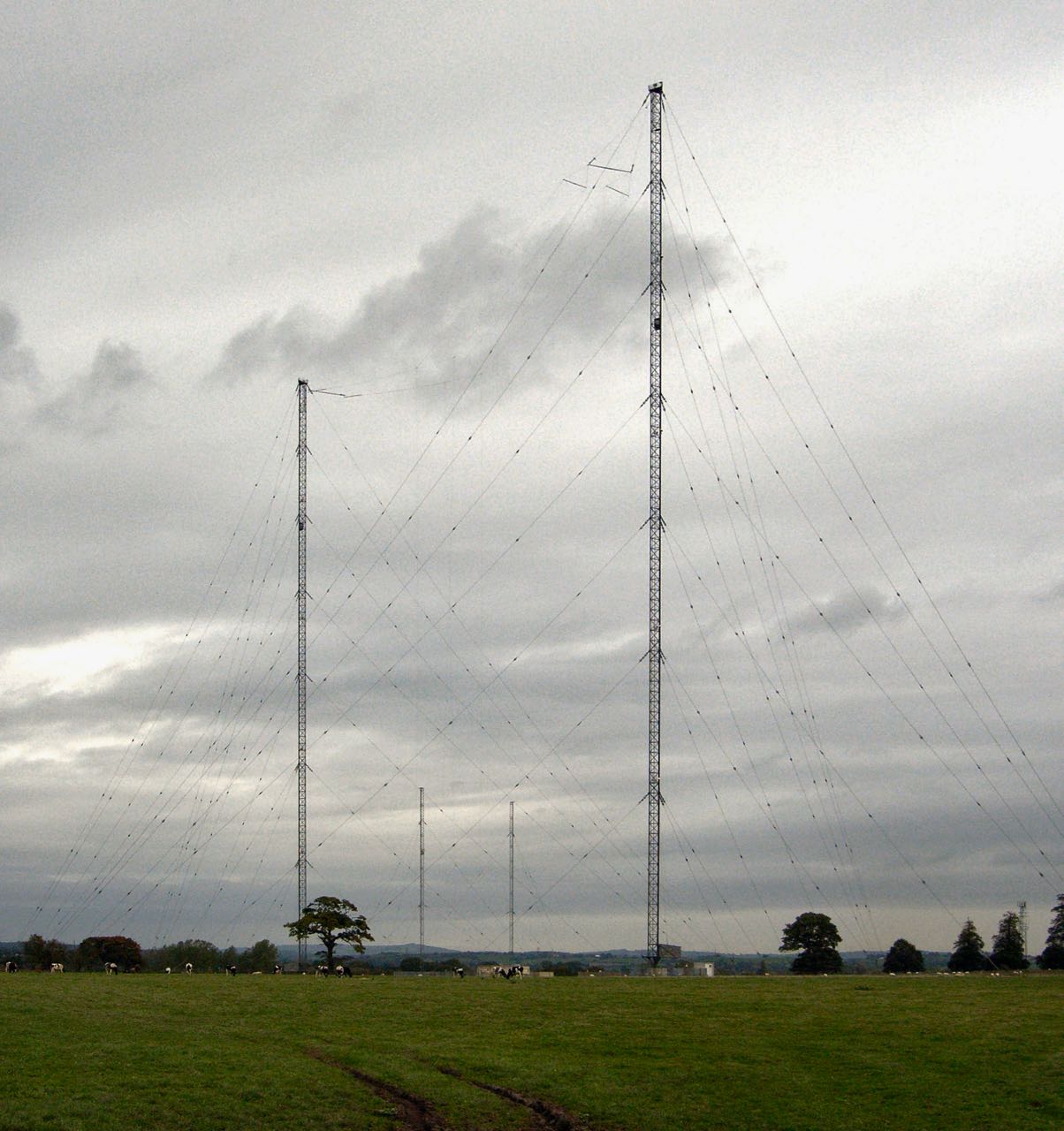
Mind you, both France Inter and Medi 1 only transmit at 2,000 watts–that’s flea power compared to our shortwave broadcasters. It’s amazing those signals can even hop the Atlantic.
Actually, the power of France Inter and Medi1 is 2000 kW and 1600 kW respectively. So the power of most SW broadcasters should be called a “flea power” in comparison to what is used on longwave. The smallest output on LW band in Europe is 50 kW, it’s used by Denmark and Czech Rep. The 162 kHz transmitter is closing on Dec 26th, according to the latest news.
Wow!
Again, if you’d like to grab longwave stations before they disappear, now is the time! Our LW broadcasters are disappearing rapidly. Fortunately, winter (here in the northern hemisphere) is the best time to chase LW DX.
Thanks, again, Ron for your encouragement! I’ll keep listening and recording!
Please support this website by adding us to your whitelist in your ad blocker. Ads are what helps us bring you premium content! Thank you!