Tag Archives: Digital Radio Mondiale

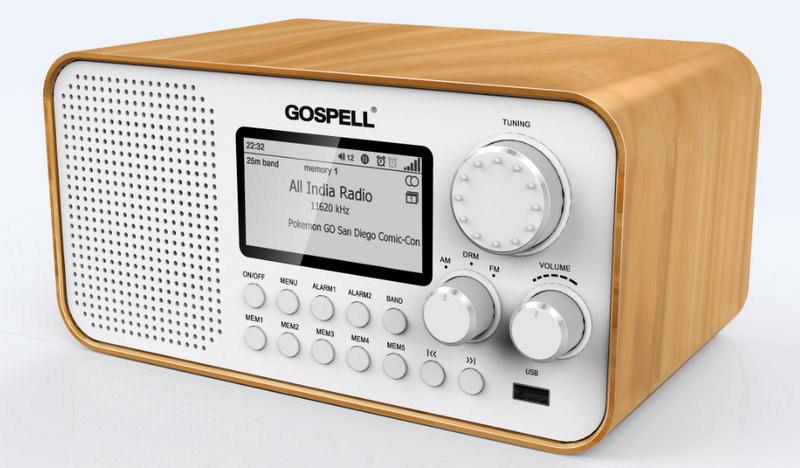
The Gospell GR-216: DRM Consortium announces new DRM portable

GOSPELL-DRM-Portable-Radio

(Source: DRM Consortium via Alokesh Gupta)

Gospell announces the imminent release of GR-216 DRM/AM/FM digital radio

Chengdu, China, September 05, 2016

Gospell, a leading supplier of pay TV system and equipment, satellite TV receiving products and microwave products, is delighted to announce the imminent release of GR-216 DRM/AM/FM digital radio, the first model in its Global Radio series range of tabletop radio. The product is designed to meet the demands of easy access to high quality information for cost-sensitive market at an affordable price.
GR-216 is equipped to receive DRM broadcast, as well as traditional FM with RDS and AM in medium wave band and shortwave band. Featuring a high performance DRM/AM/FM tuner, GR-216 provides noise-free reception of even the weakest stations. It supports the latest audio compression standard xHE-AAC and traditional HE-AAC as well as SBR and parametric stereo.
Besides the built-in whip antenna and ferrite bar antenna, dedicated AM/FM external antenna terminals with switch are located on the rear side of the radio, this will help those who live or work in a metal or concrete building and enjoy listening to a radio.
This unique radio will automatically turn itself on and initiate its emergency-tuning process when the Emergency Warning Broadcasting is engaged. The radio will enlarge its volume, flash the backlight, play siren sound and tune itself to the emergency program.
In addition to DRM program recording, AM/FM are also supported. Recorded program will be stored on the attached USB pen drive and can be played back on other devices such as a phone or a tablet. The GR216 also includes a scheduler which allows the user to schedule regular and unattended recordings for their favorite radio programme.
The built-in high-quality 3 inch full-range speaker with enlarged magnet provides outstanding audio performance and room filling sound. With the help of state-of-the-art audio processing technology, GR-216 includes separate bass, mid and treble tone controls and a graphics equalizer, users can tailor the sound to their taste. We’ve provided an output for headphones along with an audio output on the rear side of the radio for line recording or to connect GR-216 as a radio tuner to a home audio system.
As a tabletop radio, GR-216 features dual independent alarm clocks with sleep timer. The alarm clock allows for once, daily, weekday and weekend settings. The alarm can be adjusted to the volume you prefer with buzzer or radio stations.
All aspects of set-up, time and program information are clearly shown through an easy to read large LCD display with white backlight, which is paired with an intuitive rotary control, enabling quick and easy navigation. The display brightness and contrast can be adjusted for a comfortable night’s sleep.
“GR-216 is designed with the purpose and vision of providing easy access to high quality information, while utilizing a simple and intuitive user interface”. Said Haochun Liu, director of DRM development department, Gospell. “With the help of a carefully design and concrete quality, GR-216 will be a durable device that supports long-term use.”
For additional information, please visit www.gospell.com or contact Gospell sales at
[email protected]
About Gospell
Founded in 1993, Gospell Digital Technology Co Ltd (GOSPELL). is a private hi-tech enterprise with R&D, manufacturing, business consultancy and planning, trade, delivery, project implementation and after sales service, acting as a complete DTV and triple-play solution provider for Digital TV/OTT related projects. Headquartered in GOSPELL INDUSTRIAL PARK at Chenzhou, Hunan Province for CPE related production manufacturing, GOSPELL also has its office in Shenzhen for business/marketing management and administration, in Chengdu for R&D and headend/transmitter system production/debugging and Customer Service Center, and in 12 cities
in China as well as international offices in India, Africa and Mexico.
Gospell announces the imminent release of GR-216 DRM/AM/FM digital radio
Chengdu, China, September 05, 2016
Gospell, a leading supplier of pay TV system and equipment, satellite TV receiving products and microwave products, is delighted to announce the imminent release of GR-216 DRM/AM/FM digital radio, the first model in its Global Radio series
range of tabletop radio. The product is designed to meet the demands of easy access to high quality information for cost-sensitive market at an affordable price.
GR-216 is equipped to receive DRM broadcast, as well as traditional FM with RDS and AM in medium wave band and shortwave band. Featuring a high performance DRM/AM/FM tuner, GR-216 provides noise-free reception of even the weakest stations. It supports the latest audio compression standard xHE-AAC and traditional HE-AAC as well as SBR and parametric stereo.
Besides the built-in whip antenna and ferrite bar antenna, dedicated AM/FM external antenna terminals with switch are located on the rear side of the radio, this will help those who live or work in a metal or concrete building and enjoy listening to a radio.
This unique radio will automatically turn itself on and initiate its emergency-tuning process when the Emergency Warning Broadcasting is engaged. The radio will enlarge its volume, flash the backlight, play siren sound and tune itself to the emergency program.
In addition to DRM program recording, AM/FM are also supported. Recorded program will be stored on the attached USB pen drive and can be played back on other devices such as a phone or a tablet. The GR216 also includes a scheduler which allows the user to schedule regular and unattended recordings for their favorite radio program.
The built-in high-quality 3 inch full-range speaker with enlarged magnet provides outstanding audio performance and room filling sound. With the help of state-of-the-art audio processing technology, GR-216 includes separate bass, mid and treble tone controls and a graphics equalizer, users can tailor the sound to their taste. We’ve provided an output for headphones along with an audio output on the rear side of the radio for line recording or to connect GR-216 as a radio tuner to a home audio system.
As a tabletop radio, GR-216 features dual independent alarm clocks with sleep timer. The alarm clock allows for once, daily, weekday and weekend settings. The alarm can be adjusted to the volume you prefer with buzzer or radio stations.
All aspects of set-up, time and program information are clearly shown through an easy to read large LCD display with white backlight, which is paired with an intuitive rotary control, enabling quick and easy navigation. The display brightness and contrast can be adjusted for a comfortable night’s sleep.
“GR-216 is designed with the purpose and vision of providing easy access to high quality information, while utilizing a simple and intuitive user interface”. Said Haochun Liu, director of DRM development department, Gospell. “With the help of a carefully design and concrete quality, GR-216 will be a durable device that supports long-term use.”
For additional information, please visit www.gospell.com or contact Gospell sales at [email protected]
About Gospell
Founded in 1993, Gospell Digital Technology Co Ltd (GOSPELL). is a private hi-tech enterprise with R&D, manufacturing, business consultancy and planning, trade, delivery, project implementation and after sales service, acting as a complete DTV and triple-play solution provider for Digital TV/OTT related projects. Headquartered in GOSPELL INDUSTRIAL PARK at Chenzhou, Hunan Province for CPE related production manufacturing, GOSPELL also has its office in Shenzhen for business/marketing management and administration, in Chengdu for R&D and headend/transmitter system production/debugging and Customer Service Center, and in 12 cities
in China as well as international offices in India, Africa and Mexico.

August 28: BBC Atlantic Relay station special DRM broadcasts

RNZI-DRM-2(Source: DRM Consortium)

DRM will be part of a big anniversary on a small island in the Atlantic Ocean. On 28th of August at 1155 GMT Babcock International will ensure a special BBC digital transmission on 21715 kHz from the BBC Atlantic Relay station, marking the fiftieth anniversary of the BBC’s first short-wave radio broadcast from Ascension Island.

Since 1966, the Atlantic Relay station has broadcast BBC World Service programmes to Africa and South America, and to this day, continues to broadcast over 250 programme hours every week to East and West Africa in English, French, Hausa and Somali.

BBCRelayStation-Ascension IslandThe two hour-transmission on 21715 kHz will start with the old, special sound of Bow Church Bell in east London, the sound of which, even if in DRM this time,  will remind older listeners of the BBC broadcasts of many decades ago. The 21-hour transmission will be the regular BBC programmes for West and South Africa and will end at 1400.
DRM – Digital Radio Mondiale, is an international digital radio standard designed by broadcasters, for broadcasters, in co-operation with transmitter and receiver manufacturers. DRM is a high quality digital replacement for analogue radio broadcasting in the AM and FM bands.

This special transmission will be sent with greetings from Ascension Island’s BBC and Babcock International staff and visitors, who will be celebrating half a century of sterling broadcasting on August 28th.

Click here to read more about the fascinating history of the BBC’s broadcasts from Ascension Island.

Transmission Details

FREQ   TIME (UTC)       SERVICE          TX        kW       Bearing Day      LANG               TARGET

21715   1155-1201         BBC DRM         ASC     250       114       1          English             S. Africa           (Special Announcement)

21715   1201-1400         BBC DRM         ASC     250       114       1          English             S. Africa            (English – ENAFW)

21715   1400-1430         BBC DRM         ASC     250       250       1          English             Brazil                (English – ENAFW)

Additional analogue transmission will broadcast from 13.30 GMT for ceremonial purposes.

15105   1330-1430         BAB                  ASC     250       27         1          English             W. Africa                   (Special Announcement)

Details Emerge: The PantronX Titus II DRM Portable Receiver

TitusII-DRM-Receiver

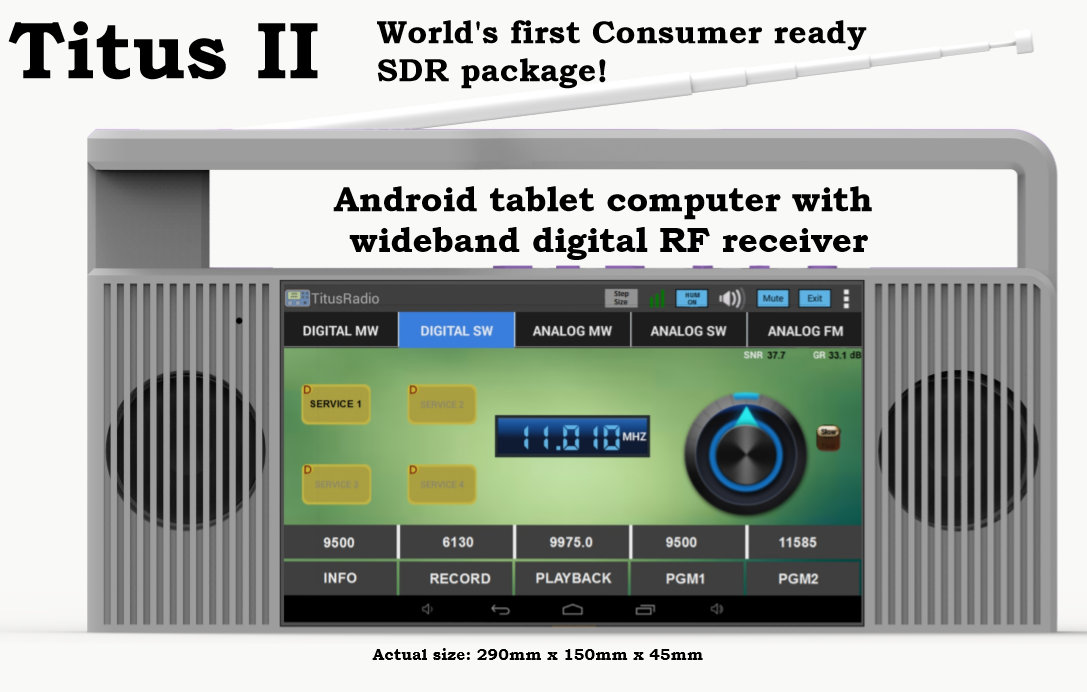
Many thanks to SWLing Post contributor, Harald Kuhl (DL1ABJ), who shares more details about the new Titus 2 DRM receiver via the DRM Consortium Chairman, Ruxandra Obreja:

NEW DRM RECEIVER UNVEILED at HFCC MEETING IN MIAMI, FLORIDA THIS WEEK!

The HFCC meeting is being held 22-26 August in Miami and on this occasion there was a live DRM transmission form Radio Vaticana received on  the new Titus2 DRM receiver (pls. see attached document with picture and details) http://www.drmna.info/.

Here is also a little testimony of how this prototype to be sold “at under 100 dollars” performed from Ray Robinson, Operations Manager at KVOH (Voice of Hope / Voz de Esperanza):

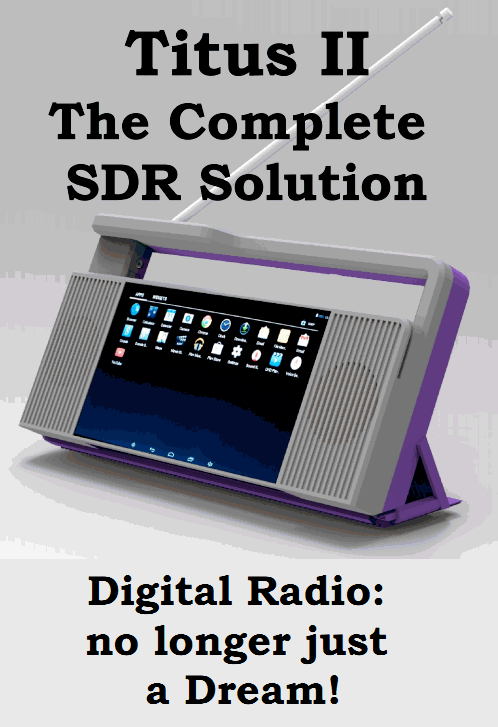
I’m currently at the HFCC conference in Miami, and reception of the DRM broadcast here this afternoon was very successful.  Reception was made outside the hotel on two receivers – a  NewStar DR-111 and a brand new pre-production receiver from Pantronix called the Titus 2, with a cluster of attendees gathered round taking photos and videos.  The latter receiver is based on an Android tablet in a stereo radio format with one speaker each side of the central horizontal tablet.  Reception on both radios was solid throughout, on a day when analog reception on 16m was plagued with a lot of atmospheric noise.  We haven’t done detailed calculations, but figure there were probably at least three hops from Italy to Miami, and for a daylight path, the reception quality was nothing short of astounding.

Click here to download the Titus II PDF brochure.

TitusII-DRM-Receiver-Specifications

The PantronX Titus II: A New DRM Receiver

titus 2 big

I had heard rumors that a new DRM receiver was in the works, but had not yet seen any specifications. DRMNA.info has just posted a few specs:

The PantronX Titus II is actually a full SDR solution in a boombox case. Few details yet, but it is running Android, has a 100 kHz to 2 GHz receiver on-board and decodes AM, FM, SSB and DRM natively.

It uses a Quad-core Arm A53 @ 1.2 GHz, 1 Gig of RAM and 8 Gig of on-board Flash. 7″ TFT display and supports Android 5, 6 or custom remixes.

Click here to read the full post at DRMNA.info…

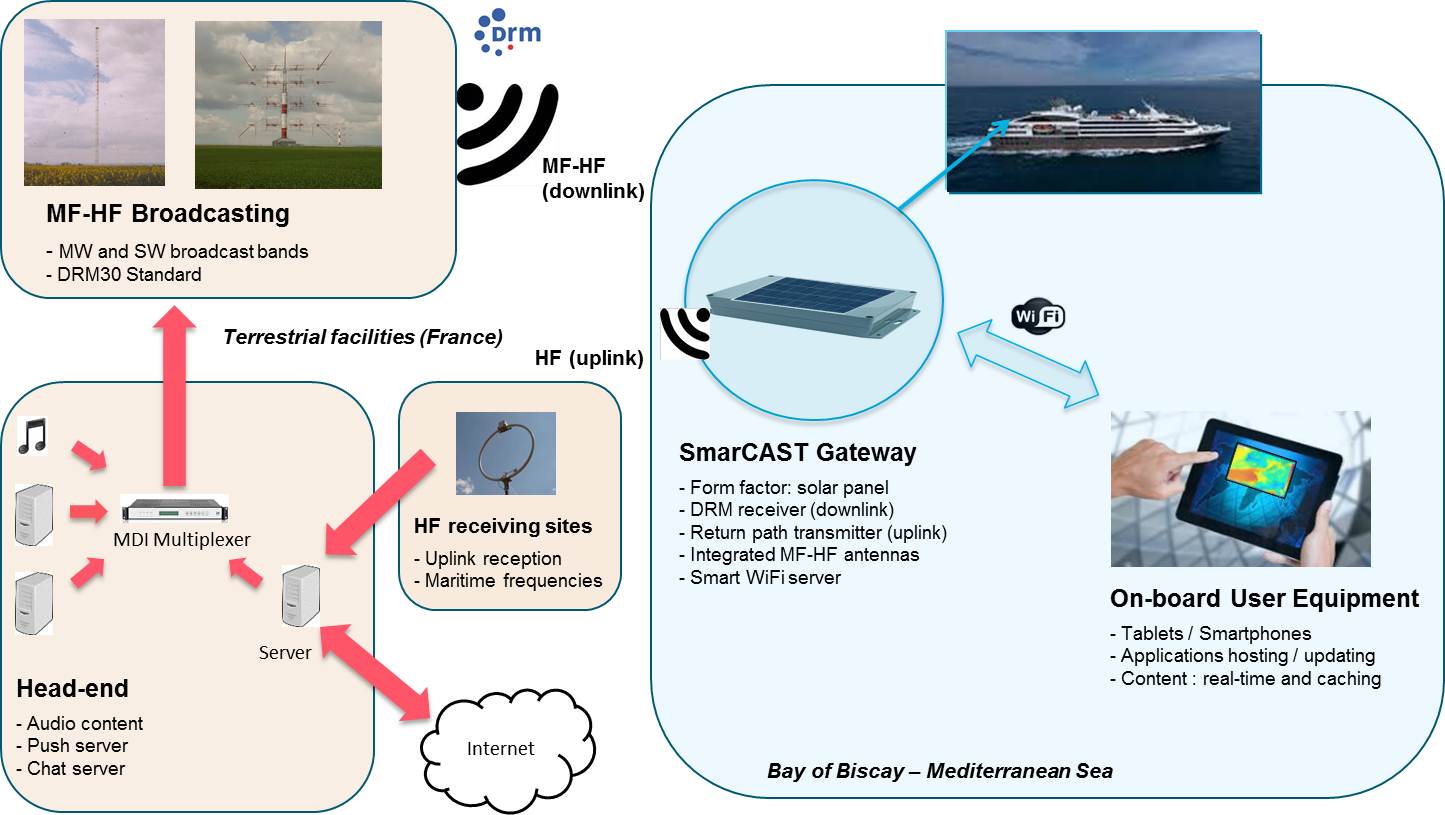
TDF Group to use DRM 30 as shortwave communications system

Click to enlarge. Source: TDF Group

Click to enlarge. Source: TDF Group

(Source: Radio Mag Online)

PARIS — The use of the medium and short wave bands can provide extensive coverage at low cost in inaccessible locations or for those at a disadvantage due to lack of infrastructure.

[…]France’s TDF Group has started a project they call SmartCast that aims to study and build a long range broadcast system, with potential interactivity where appropriate — by way of a low-speed wireless return path. Data including audio will be broadcast in a shared stream based on standard DRM 30 from Digital Radio Mondiale.

Work underway by TDF includes development of services and equipment focused on two markets:

  • Maritime Navigation, with a set of services designated as “NavCAST”.
  • International Broadcasting, with a set of services designated as “WideCAST.”[…]

Read the full article at RadioMagOnline.com

First DRM European Workshop

Many thanks to SWLing Post readers, Cap and Bill, who both shared this press release from the DRM consortium:

(Source: DRM Consortium)

drmlogoFirst DRM European Workshop “Flexible and Complete Digital Radio for Europe”
asks European Stakeholders to Support and Manufacture DRM and DAB+ Receivers

Following from a very successful General Assembly, the Digital Radio Mondiale (DRM) Consortium, and the German DRM Platform held a most comprehensive European workshop hosted by Fraunhofer IIS in Erlangen, Germany from 6th to 7th April 2016.

This was a first such DRM event aimed at offering solutions to all broadcasters large or small. During their presentations and discussions participants stressed that DRM is the ITU endorsed and internationally adopted standard for the distribution of programmes internationally, nationally and up to local coverage level. DRM can also provide an economic and complementary solution to exactly those coverage scenarios that the established DAB/DAB+ networks in Band-III were never designed for.

Following their deliberations the participants urged all stakeholders of Digital Radio in Europe – including European organisations, regulators, broadcasters and the receiver and automotive industry – to embrace publicly the duality and complementarity of the open DRM and DAB standards as the complete Digital Radio solution for Europe (and worldwide). This means a digital future for all broadcasters, offering more programme choice to listeners, extra multimedia services with text and images, increased energy savings and spectrum efficiency. The participants ask ‘all European stakeholders to promote actively the manufacturing and distribution of multi-standard Digital Radio receivers, comprising at least the DRM and DAB standards.’

The first session, held in conjunction with the open part of the DRM General Assembly, took a brief look at the status of DRM adoption around the world, including the DRM roll-out in India, ready to become the largest digital radio market in the world with over 600 million people being reached by DRM broadcasts. Presentations given by experts from various European countries showed that the digitisation of radio progresses in Europe. At the end of the first day Fraunhofer IIS (Bernd Linz) demonstrated the latest development to provide traffic and travel services in DRM radios, soon to be installed in Asia. Afterwards Martin Speitel demonstrated the features of the Fraunhofer software package for car radios with DRM. With this solution, radio manufacturers can quickly build or enhance radio platforms on a proven modular system covering the full DRM and DAB standards including their full feature sets, thus shortening their development times and, in turn, reducing their costs.

On the 7th April benefits and opportunities of DRM were shown with practical applications. Ampegon (Matthias Stoll) showed how easy and cost-effective the transition from analogue AM to DRM can be. Marc Holthof of the German Navy gave an example of how to use DRM over shortwave for maritime broadcasting of information and entertainment to ship crews at sea. Csaba Szombathy, Technical University of Budapest, demonstrated his original monitoring programme of DRM transmissions. Then RFmondial (Jens Schroeder), demonstrated how to provide DRM services in the crowded FM band compatible with all the existing FM stations. Joachim Lehnert, German DRM Platform Chairman, showed that DRM is a suitable system for local/regional coverage in VHF Band III, fully compatible with DAB/DAB+ and DVB-T networks and in keeping with RRC-06. RFmondial (Detlef Pagel) also referred to the use of DRM in VHF Band III and stressed that DRM+ is the most suitable digital system for the local and regional single-station broadcasters, as a complement to multiplexes, while sharing all the listener related features with the DAB+ standard. Finally, Manfred Kühn, Mobile Broadcast Consult, demonstrated the flexible transmission of multiple DRM channels in a single DAB frequency block in VHF Band III.

This session was followed by a status report on the development of digital multi-standard radios, presented by Robert Bosch Car Multimedia, NXP, Fraunhofer IIS, PnP Networks and Panasonic. All the speakers finally emphasized the market and framework requirements for the production of multistandard radios for Europe.

Joachim Lehnert, Chairman of the German DRM Platform, concluded that the workshop was an important step to bringing national activities together and added; “With all the European DRM activities presented over the past two days and the encouraging messages from the receiver industry, I believe that the famous ‘chicken or egg’ problem can be solved from the receiver end by adding DRM as a complement to existing digital receivers. This will eventually help all radio broadcasters across Europe, whether national, local or community stations, and will ensure each has a digital home in the future.”

Click here to download the PDF of this press release.