Tag Archives: DRM

DRM feeds RNZ Pacific relays

(Source: Radio World via Mike Hansgen)

RANGITAIKI, New Zealand — Radio New Zealand Pacific, the official international arm of Radio New Zealand, is using Digital Radio Mondiale digital radio transmission/reception equipment to feed studio-quality audio to some of its 20 relay stations in the Pacific Ocean region. The others use satellite feeds or web downloads.

The locations being served by DRM include the Cook Islands, where RNZ Pacific’s programs are rebroadcast locally in analog mode by Aitutaki 88FM, the islands’ only broadcaster. RNZ Pacific also serves Tonga, Samoa, and the Solomon Islands using DRM; among others. Previously, RNZ Pacific had fed its relays using analog AM shortwave radio, with that transmission mode’s limited audio range and interference issues.

“When DRM became available to us in 2005, we saw it as a great opportunity to provide high quality audio to Pacific radio stations that relayed our news broadcasts from our AM transmitter,” said RNZ Pacific’s Technical Manager Adrian Sainsbury. “As a platform to deliver good quality audio to remote island FM stations, it has been a great success.”[…]

Click here to read the full article at Radio World.

As the article points out, RNZ has been using DRM as a feed for quite a few years. I think this is a brilliant use of the technology. Of course, those of us in the rest of the world can snag RNZ DRM broadcasts as well.

PatronX Titus SDR receiver update

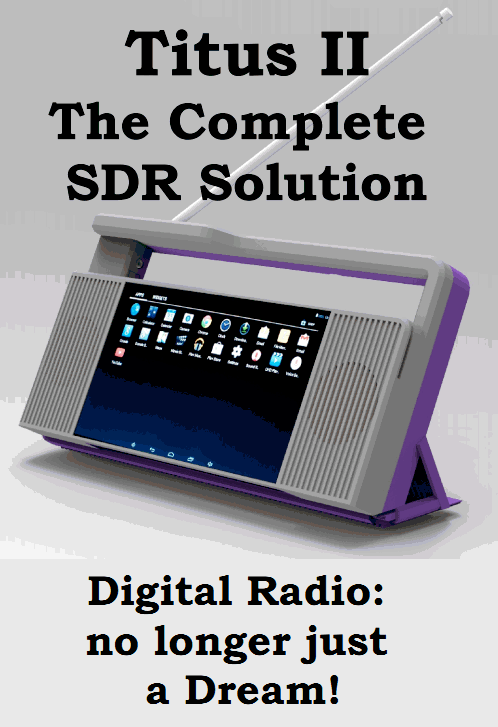
A number of SWLing Post readers have been asking about the status of the Titus II portable DRM/SDR radio. I’ve been checking the project website, but had not seen an update in a long time, so I contacted the company. Mike, with PantronX, kindly replied with the following update:

As you might be aware, we have joined up with Fraunhofer to include their MMPlayer app standard on Titus–what a difference a professional decoder, for both analog, DRM(+), and DAB(+), makes! MMPlayer is full featured even including reliable one way file downloads with DRM.

We are attempting also to license HD to include on the app for North America, making a truly worldwide receiver. Some deficiencies in our version of Android have caused issues as well as MMPlayer. All of which have caused delays leading to some serious business decisions – as you can imagine. You are correct that broadcasters have made large orders that will be fulfilled first. There are units in the field testing and such and continuing resolution of the software issues.

One of the issues that folks seem to have a hard time understanding is that we can not just build a few hundred or even thousands of units. Our minimum run is 10,000pcs! To do that everything has to be 100% – including the software. We simply will not ship units that are not 100%. Titus works, MMPlayer works – its that last 5% that takes the most time to resolve. These facts preclude any incremental production attempts. All that being said, we are very hopeful that the first production run is ready by last quarter of this year.

Thank you for the update, Mike!

BBC is “keen to exploit DRM” but manufacturers must develop a multi-standard receiver chip

(Source: Radio World via Mike Hansgen)

LONDON — The BBC World Service, available on radio, TV and online, is part of one of the largest news organization in the world, the BBC.

The weekly reach of the World Service on all platforms accounted for 269 million (up from 246 million in 2015–16).

[…]Large numbers of the BBC’s audience still need international radio broadcasts.

[…]Right from its late ’90s inception, the development of Digital Radio Mondiale was fully supported and enhanced by the BBC World Service. DRM was seen as an efficient replacement for the analog AM transmissions. When we consider scarcity of spectrum for new uses and appreciate the characteristics of the radio broadcast bands, we recognize the tremendous properties these continue to offer broadcasters to deliver programs over sometimes very large distances and areas or in difficult terrain.

[…]The BBC is keen to exploit DRM in order to deliver, to key markets, BBC content free of gatekeepers in a form that can be accessed easily.

For that to be possible, the multi-standard receiver chip is required, and manufacturers must appreciate and act on this global market potential.

Click here to read the entire article at Radio World.

Special two hour DRM broadcast today at 12:00 UTC

According to the DRM Consortium, there will be a special two hour DRM broadcast today (April 18) starting at 12:00 UTC:

Special DRM transmission tomorrow 18th April from Spaceline during DRM GA at 1200-1400UTC on 11600kHz. From Kostinbrod, Bulgaria with antenna directed at 260 degrees. The content will be from Mighty KBC.

Note that this broadcast starts less than two hours from time of posting. Please comment if you log this broadcast!

Kuwait updates shortwave transmitters

(Source: Kuwait News Agency via Mike Hansgen)

KUWAIT, March 8 (KUNA) — Minister of Information Mohammad Al-Jabri on Thursday opened a project updating shortwave transmitters from analogue to digital radio mondiale (DRM) broadcasting systems, at Kabd radio station.

This is a new achievement for the ministry to be added to a series of vital projects that aim to keep pace with the rapid technical progress around the globe, Al-Jabri told KUNA and the Kuwait TV.

Kabd station, through the new DRM system, will allow “Kuwait’s voice” to reach the entire Middle East region, Europe and Asia, he noted.

Kuwaitis have planned and supervised the project, the minister said, noting that updating the infrastructure of radio stations aims to cope with latest digital broadcasting development, the minister said.

Al-Jabri praised officials, and all the personnel at the ministry’s Engineering Affairs Sector, for their hard sincere efforts.

Click here to read the full article at the KUNA website.

October DRM Consortium news

Many thanks to SWLing Post contributor, Ed, who shares the following news from the DRM Consortium via their newsletter:

Digital Radio Mondiale: Audio Codec xHE-AAC at No Additional Cost
to Boost DRM Receiver Industry

Via Licensing Corporation, a global intellectual property solutions
provider, announced that the highly efficient MPEG xHE-AAC audio codec
(Extended High Efficiency AAC) will become a default feature of the
popular Advanced Audio Coding (AAC) patent pool. The move to include
the XHE-AAC audio codec into the current patent pool at no extra cost,
is a move that could boost DRM receiver manufacturing. Read more.

DRM Delivers at IBC 2017

Following a very successful appearance at IBC 2017 in Amsterdam, with
many delegates attending the four successful DRM events hosted by
Gospell, Thomson Broadcast, Nautel and Ampegon, we have compiled a
slideshow from IBC to share. Click here to view.

DRM Delivers at IBC 2017

Following a very successful appearance at IBC 2017 in Amsterdam, with
many delegates attending the four successful DRM events hosted by
Gospell, Thomson Broadcast, Nautel and Ampegon, we have compiled a
slideshow from IBC to share. Click here to view.

All India Radio (AIR) External Services to Provide more Broadcasts

The External Services Division of AIR is to launch several new
services aimed at new overseas target areas. Read more.

US Coast Guard DRM Tests Continue

U.S. Coast Guard testing in DRM with Journaline Service continues and
the latest schedules can be downloaded here.

You can follow discussions on the project on the DRMNA Group here.

Fraunhofer Software Defined Radio (SDR) Digital Receiver Introduced
at IBC 2017

The Fraunhofer IIS audio blog published an article summarising the
products launched at IBC and powered by the Fraunhofer
MultimediaPlayer Radio App. Read more.

Radio Taiwan Carries Out DRM Tests

Radio Taiwan International carried out tests in DRM in German on Oct 4
and 10 from 1800-1900 UTC on 9680 and 12030 kHz from Tamsui. Read
more.

International Day for Disaster Reduction 13th October

On Friday 13th October, the United Nations Office for Disaster Risk
Reduction, explores how communities around the world are reducing their
exposure to disasters. In a recent blog “When digital is more than
just radio”, the DRM Chair, Ruxandra Obreja, outlined the considerable
benefits to be realised if Governments and manufacturers were to fully
exploit the emergency warning feature embedded in DRM and digital
radio technology. Read more.

NASB: “Digital Radio Mondiale Delivers at IBC 2017”

Photo credit: NASB


(Source: National Association of Shortwave Broadcasters Facebook Page)

Digital Radio Mondiale Delivers at IBC 2017

Participants in the four DRM events organised at IBC by Gospell, Thomson Broadcast, Nautel and Ampegon between 15th-17th of September have had an insight into a wide range of DRM activities, from big projects in Morocco (Thomson Broadcast), India and Hungary (Nautel), to the progress of DRM in South Africa. And DRM used not just for broadcasting but for other vital activities was demonstrated by Rfmondial involved in a wide-ranging application for the US Coast Guard.

One constant for all events, each unique and so different from the other, was the positive messages about DRM in both AM and VHF and the increasing availability of new receiver and receiver solutions, many always on display. The first event on Friday the 15th (Gospell) saw the launch of GR-227 the multi-standard (DRM/DAB/DAB+) car adaptor that is compatible with any car stereo with USB port and able to work with Android Smart Tune App. As the manufacturer explained, this after-market solution can be a significant development allowing digital reception in cars initially fitted with analogue receivers.

Of equal major interest was also the Titus II multi-standard digital radio receiver produced by Titus SDR, a division of PantronX. The consumer software-defined radio digital receiver platform, which is the result of collaboration between Titus SDR/Patron X, Jasmin-Infotech, TWR, and Fraunhofer IIS, supports multi-standard radio reception, including DRM, DAB and DAB+ and core data applications. The representatives of PantronX and TWR received lots of questions about this receiver system based on a custom Android tablet platform, featuring multipoint touch, WiFi/Bluetooth and stereo sound.

Other receiver possibilities: the tablet solution presented by Fraunhofer IIS, the Indian receiver Avion, and a new concept DRM receiver produced in South Africa all enforced the idea that the excellent work done by transmitter companies like Thomson Broadcast, Nautel and Ampegon in providing a digital transmitter infrastructure in many parts of the world can link now with the innovative receiver solutions.

The Thomson event came alive with the presentation about the huge project in Morocco and the Nautel event attracted lots of guests already familiar with the big projects of this established transmitter manufacturer recently in India and now in Hungary.

The last of the DRM events, hosted on the 17th by Ampegon was a moment of celebration. First of this company (now 75 years old) displaying solid-state transmitters of all capacities successfully used globally, as well. As Ampegon has been also involved in Africa and supported the first DRM trial in South Africa two years ago, they were the natural hosts of a special DRM award moment. The DRM Enterprise Award 2017 (Africa) has been awarded to 3 pioneering experts in promoting DRM digital radio in South Africa. The winners are Dr Roelf Petersen on behalf of Radio Pulpit (member of the Pulpit Media Group) and Broadcom International involved in the trial of DRM in mediumwave. The other two winners Thembeka Khaka (Thembeka Khaka and Associates) and Johannes von Weyssenhoff have been very active in getting the legal framework and conducting the current trial (DRM for local coverage) that is taking place in conjunction with a community station in Johannesburg. (This event was streamed on Twitter click here to view.)

As Ruxandra Obreja, Consortium Chairman, remarked: ”All those who have hosted successful DRM events, the new and old supporters and specialists interested in digital radio and DRM, all the other companies supporting DRM and present at IBC (BBC, Babcock, Becil, RFI, Riz, NXP, Rfmondial, Sentech, to mention just a few) all the guests from countries as far apart as India, Argentina, the Netherlands, Belgium, Pakistan, the Philippines have seen how much effort goes so that DRM can deliver for all, globally.”