Tag Archives: Radio History

Don recommends Radio Boulevard for a deep dive into radio history!

Many thanks to SWLing Post contributor, Don (W7SSB), who writes:

Hi Thomas,

One of my friends has probably the best museum in the history of radio !

https://www.radioblvd.com/

Your readers can spend days looking at all the information from the early days to present ! Plenty of pictures!

Don W7SSB

Thank you for the tip, Don! What a deep treasure trove of radio nostalgia!

Guest Post: Remembering the great “Radio Moving Day” of 1941

Many thanks to SWLing Post contributor, Bill Hemphill, who shares the following guest post and addendum to his most recent post on BBC Re-Tune messages:


Radio Moving Day

by Bill Hemphill (WD9EQD)

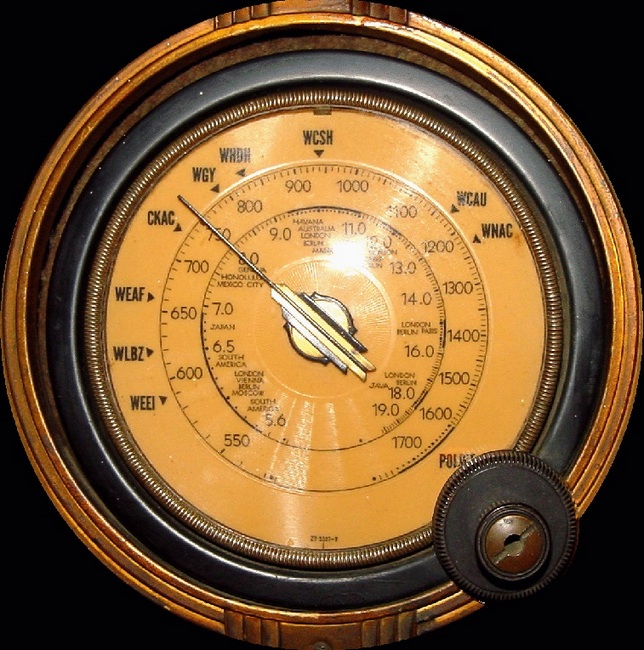
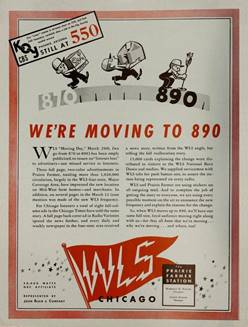
After listening to the BBC “Re-Tune” broadcasts, it reminded me of when the United States had its own “Re-Tune” day on March 29, 1941.  It was referred to as “Moving Day”.

At 3:00 am, 802 of the 890 radio stations moved frequency.  Following are a couple of articles about this day:

http://www.jimramsburg.com/the-march-of-change-audio.html

https://www.radioworld.com/columns-and-views/in-1941-stations-confronted-39moving-day39

And a previous SWLing Post article:

https://swling.com/blog/2021/04/am-radio-history-80th-anniversary-of-the-havana-treaty/

Like the BBC, there were also broadcasts helping listeners to get ready:

Audio Clip 1

Audio Clip 2

Audio Clip 3

Audio Clip 4


I love how it was used as an opportunity to get the radio listener to call on the radio technician to re-program the radio push buttons.  And of course while the technician is there, have him do a full alignment and maybe replace a tube.

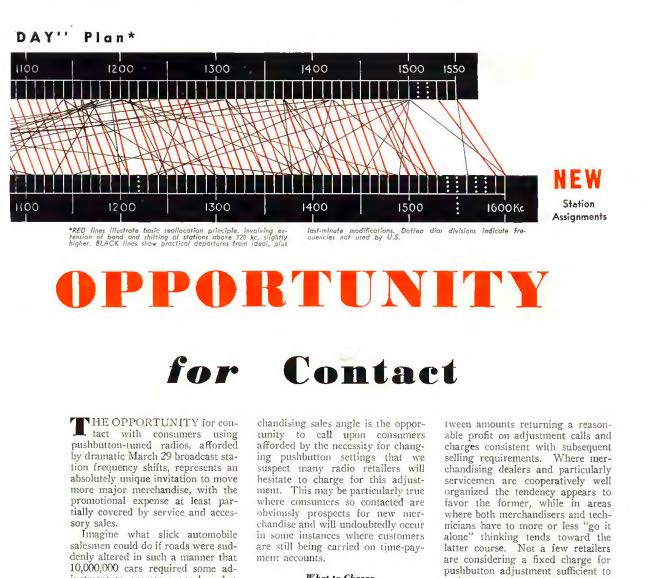
The March 1941 issue of Radio and Television Retailing (Pages 16-17) had the article “Radio’s Opportunity for Contact”.

Link:  https://worldradiohistory.com/Archive-Radio-Retailing/40s/Radio-Retailing-1941-03.pdf

While the entire article is an interesting read, the first few paragraphs sums up the opportumities:

THE OPPORTUNITY for contact with consumers using pushbutton-tuned radios., afforded by dramatic March 29 broadcast station frequency shifts, represents an absolutely unique invitation to move more major merchandise, with the promotional expense at least partially covered by service and accessory sales.

Imagine what slick automobile salesmen could do if roads were suddenly altered in such a manner that 10,000,000 cars required some adjustment to operate properly, what refrigerator salesmen might accomplish if a change in current necessitated motor manipulation, how laundry equipment salesmen would positively gloat over the glut of prospects if that many people with old machines actually asked them to call.

Calls make sales, as the records of many home specialty retailers conclusively prove, and the beauty of this particular opportunity to make them lies in the three-fold fact that cold-canvassing is completely unnecessary, that the motivating power of any campaign built around it is obviously not just trumped-up by the trade and that only dealers selling or servicing radios can capitalize in all departments of their business.

So valuable from a major merchandising sales angle is the opportunity to call upon consumers afforded by the necessity for changing pushbutton settings that we suspect many radio retailers will hesitate to charge for this adjustment.

This may be particularly true where consumers so contacted are obviously prospects for new merchandise and will undoubtedly occur in some instances where customers are still being carried on time-payment accounts.

The Feb 1941 issue of Radio Service-Dealer (Page 8) also stressed the opportunities.

Link: https://worldradiohistory.com/Archive-Radio-Service-Dealer/40s/Radio-Service-Dealer-1941-02.pdf

From Page 8:

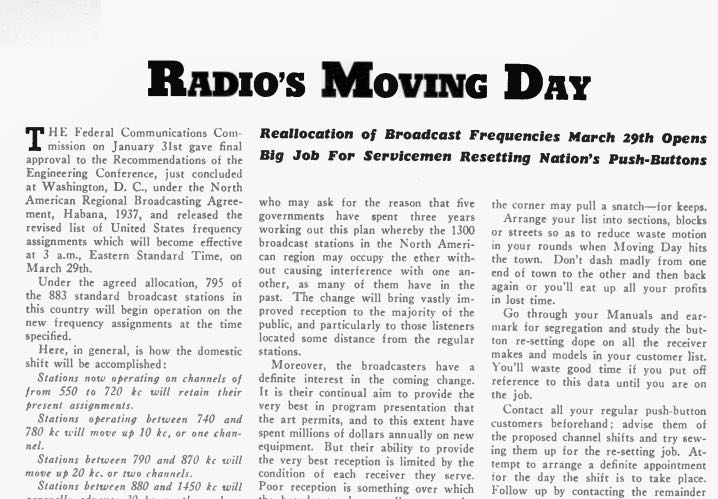
Reallocation of Broadcast Frequencies M arch 29th Opens Big Job For Service men Resetting Nation’s Push-Buttons

YOUR JOB

There are approximately 10 million push-button receivers in operation in this country. It will be your job to re-set the buttons for the new frequencies in the shortest possible time and with the least amount of confusion. It will also be your job and your opportunity to inspect these receivers for faulty operation. No such opportunity is likely to present itself again, so make the best of it.


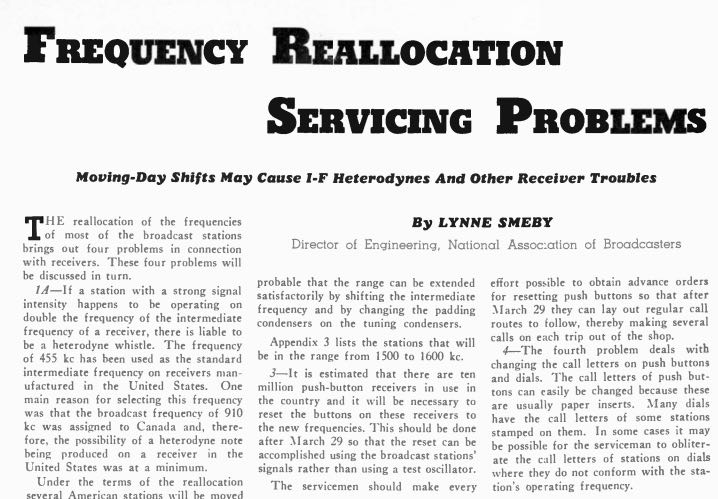
And on page 7 of the Mar 1941 issue of Radio Service-Dealer has the article FREQUENCY REALLOCATION SERVICING PROBLEMS

Link: https://worldradiohistory.com/Archive-Radio-Service-Dealer/40s/Radio-Service-Dealer-1941-03.pdf

The first Problem discussed is the IF Frequency:

1A—If a station with a strong signal intensity happens to be operating on double the frequency of the intermediate frequency of a receiver, there is liable to be a heterodyne whistle. The frequency of 455 kc has been used as the standard intermediate frequency on receivers manufactured in the United States.  One main reason for selecting this frequency was that the broadcast frequency of 910 kc was assigned to Canada and, therefore, the possibility of a heterodyne note being produced on a receiver in the United States was at a minimum. Under the terms of the reallocation several American stations will be moved to 910 kc thus producing a problem in the cities where these stations are to be located. If a heterodyne note is heard due to this cause the remedy is to shift the intermediate frequency to one side or another.


Thank you, Bill, for shedding more light on Radio Moving Day and, especially, providing us with the broadcaster and technician’s point of view.

Radio Waves: Ireland and Northern Ireland Masses On The Air, Radio History Film, Improving ULR FM reception, UsedRadioMall.com, and Observations Needed for June 2021 Arctic Eclipse

Radio Waves:  Stories Making Waves in the World of Radio

Because I keep my ear to the waves, as well as receive many tips from others who do the same, I find myself privy to radio-related stories that might interest SWLing Post readers.  To that end: Welcome to the SWLing Post’s Radio Waves, a collection of links to interesting stories making waves in the world of radio. Enjoy!

Many thanks to SWLing Post contributors David Shannon, Sheldon Harvey (Int. Radio Report), Jorge Garzón Gutiérrez, and Ulis Fleming for the following tips:


CQ CQ CQ IE —Holy Broadcasting from Ireland and Northern Ireland (DXing.info)

European DX listeners have recently discovered a wonderful new target. On 27 MHz it is possible to receive Catholic mass celebrations from Ireland and Northern Ireland. Hundreds of local churches around the island are broadcasting holy masses live. If you tune in between 27000 and 28000 kHz, you might be able to hear many interesting churches. The transmitter power is usually only 3 watts, so a strong F2 opening is needed. Luckily with the current solar maximum this happens quite often.

How did all this start? This is a fascinating story, told by a Father, who has been helping the idea to become reality.

The broadcasting of Masses was introduced in a rural Irish diocese over 30 years ago when the resident priest was considering a way of reaching out to those who were housebound in his parish. They had access to religious broadcasts on National Radio and TV, but he knew that it was no comparison to a local broadcast. There were many incidents of families coming home from Mass on Sunday and their housebound parent or grandparent had ‘all the news’ (they were aware of all the happenings in the parish) when they arrived home.[…]

Click here to continue reading at DXing.info.

Utica man producing film about the history of radio (The Voice)

Decades before Spotify, Pandora, and even satellite radio, terrestrial (land-based) AM and FM radio reigned supreme. Many listeners, including Utica resident Ron Robinson, idolized the disc jockeys just as much as the artists they played.

Robinson, 51, is working on a documentary film entitled “Radio Dayz… The Movie,” which focuses on the history of radio, including the early days of Detroit radio. “(The film) tells the story of radio through the people who worked in radio,” he said.

Robinson interviewed several well-known radio personalities such as Paul W. Smith, Dick Purtain, Fred Jacobs, Dick Kernen, and more for the film. Robinson, who worked for WJR for 20 years before starting his own production company, has several connections in the industry. He started interviewing for the documentary in 2013.

“Most people think of radio, they think of New York, California, and Chicago, and rightfully so. But, Detroit has been an important and ground-breaking city for the medium of radio,” Robinson said.

The documentary is a chronological look at the history of radio, starting with the first radio stations. It also takes aim at the first radio “celebrity,” Fr. Charles Coughlin. The Detroit-area priest took to the airways in the 1920s and eventually garnered an audience of 30 million to his weekly radio show. Coughlin would later become a polarizing figure as World War II approached. “He’s on the wrong side of history, if you will,” Robinson said.

[]

Improving ULR FM reception (Iberia DX)

Often I get surprised when I listen to the FM Band with my autoradio. It has no bandwidth options, no filters, but sensitivity and selectivity are much better than most of the well-know portables. Mine is inserted into the Skoda console so I have no way to know who manufactured it, the brand/model or its tech specifications. Most of the times I wonder why other portable firmwares does not include, for instance, similar choices like the high speed decoding RDS info. Then I thought… Will be my ULR Sangean DT-800 up to the task?

An autoradio like mine (SKODA Spaceback car) decodes RDS and hears weak signals at once. It is part of a well balanced system: receiver-feedline and rubber antenna on the metallic car roof. My pocket ultralight radios use the earphone cable as an aerial, so even being very good receivers, the antenna is far to be reliable with tricky and changing reception as it depends on the cable position at every moment. Uhmmm! I needed to find a better way to listen using my small toys.

In the shack I had some whips with male BNC and PL-359 connectors, but the Pocket ULR has a 3,5 mm female plug-in, so I found a “female BNC > male jack 3,5 mm” adapter and connected the whip. I chose a telescopic antenna 20/115 cm long folded/unfolded to test the Sangean DT-800T versus the SKODA autoradio, focused on the BOTB from 87,5 to 91,5 MHz. When a long whip is used some unwanted effects come into the scene. The first is related with audio; connecting the whip the sound must be heard via the small speaker so don’t forget to choose a quiet environment not to miss weak stations. The second one is pure physics; due to the whip length, the ULR 3,5 mm female plug-in gets extra strain and that could damage the inner weldings, so extra care must be kept in mind at any time.[]

Read the full article at Ideria DX.

UsedRadioMall.com

Many thanks to SWLing Post contributor, Matt, who shares a link to a radio classifieds site he has created. Check it out!

The UsedRadioMall.com web site lists radios and items related to the subject of radio. The list may include receivers, transmitters, transceivers, amplifiers, antennas, parts, and components related to amateur radio, two-way radio, cb radio, broadcasting, recording, production, and hi-fi.

Introduction
Changes in ionospheric electron density caused by space weather and diurnal solar changes are known to cause Doppler shifts on HF ray paths. For example, see Figure 7 in Boitman et al., 1999. As part of the WWV centennial, 50 stations collected Doppler shift data for the original Festival of Frequency Measurement, demonstrating the value of volunteer participation in collecting this data. This June, we request that all amateur radio stations, shortwave listeners, and others capable of making high-quality HF frequency measurements help us collect frequency data for the June 10 annular eclipse. Researchers will use the crowdsourced data to investigate the superimposed effects of auroral particle precipitation and the eclipse on Doppler shift.

All you need to collect data is an HF rig connected to a computer running open-source software. A precision frequency standard, such as a GPS-disciplined oscillator, is desired but not required to participate. All ham operators and shortwave listeners around the globe are invited to join in, even if your station is far from the path of totality. Last year’s eclipse festivals included over 100 participants from 45 countries. The experiment will run from 7-12 June. All participants will receive QSL certificates and updates as the data is processed. This is a pilot experiment for HamSCI’s Personal Space Weather Station project, which seeks to develop a global network monitoring the geospace environment.

Contact information:
Kristina Collins: [email protected]

Click here to read the full article at HamSci.org.


Do you enjoy the SWLing Post?

Please consider supporting us via Patreon or our Coffee Fund!

Your support makes articles like this one possible. Thank you!

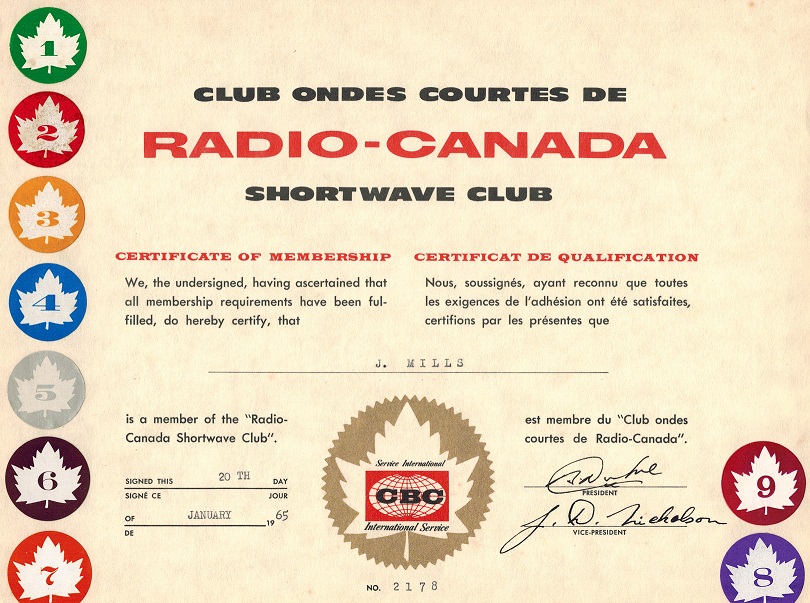
John’s 1965 RCI Shortwave Club certificate triggers serious shortwave nostalgia!

View of the western cluster of curtain antennas from the roof of RCI Sackville’s transmissions building. (Photo: The SWLing Post) –Click to enlarge

Many thanks to SWLing Post contributor, John (G3VUO), who shares the following:

Hi Tomas,

Seeing [the] article about RCI prompted me to remember the halcyon days of SW Listening.

I still have my RCI Shortwave Club certificate issued in 1965 when I was only 14 years old!

In those days you had to monitor their broadcasts regularly and send listening reports on (if I remember correctly) green airmail reception forms every month.

Hope the attached may give other readers some memories.

73

John G3VUO

Wow! Thank you for sharing this, John. Those were, indeed, the halcyon days of shortwave radio listening!

Post readers: Please comment if you’ve also received a certificate from RCI!

AM Radio History: 80th Anniversary of the “Havana Treaty,”

Many thanks to SWLing Post contributor, Bob Colegrove, who writes:

Hi Thomas,

I came across this article on Wikipedia. It is a few days late, but thought it might be of interest to others. The link is

https://en.wikipedia.org/wiki/North_American_Regional_Broadcasting_Agreement.

Briefly, this past Monday, was the 80th anniversary of the implementation of the “Havana Treaty,” which was actually signed on December 13, 1937, and finally implemented 80 years ago on March 29, 1941. It provided for reorganization of the “AM” medium wave band into frequency allocations for clear channel, regional and local stations.

AM radio was the Internet of its day. The invention of the telegraph notwithstanding, radio provided widespread, instant communication, albeit one way, to a vast population reaching hundreds of miles from the transmission source. It extended to the most rural parts of the country adding “A battery” and “B battery” to the lexicon.

The initial licensing process had been done with very little planning and forethought using 96 channels between 550 and 1500 kHz. The reorganization was the culmination of the need for some order to reduce mutual station interference and provide more reliable service to listeners. It involved frequency changes for about 1000 stations in several countries. March 29, 1941 was informally known as “moving day.”

The Wikipedia article details the changes made at that time and goes on to describe subsequent expansions of the AM broadcast band.

Fascinating! Thank you for sharing this bit of radio history with us, Bob!

1940: When Sears Roebuck sold a wide array of radio gear

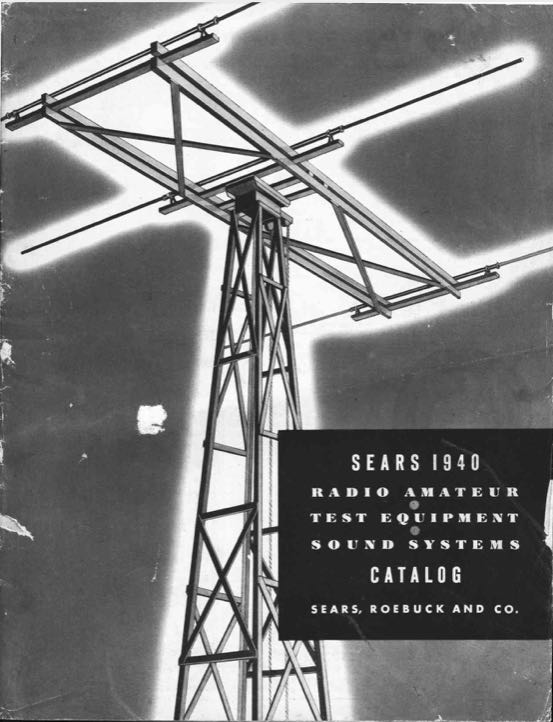
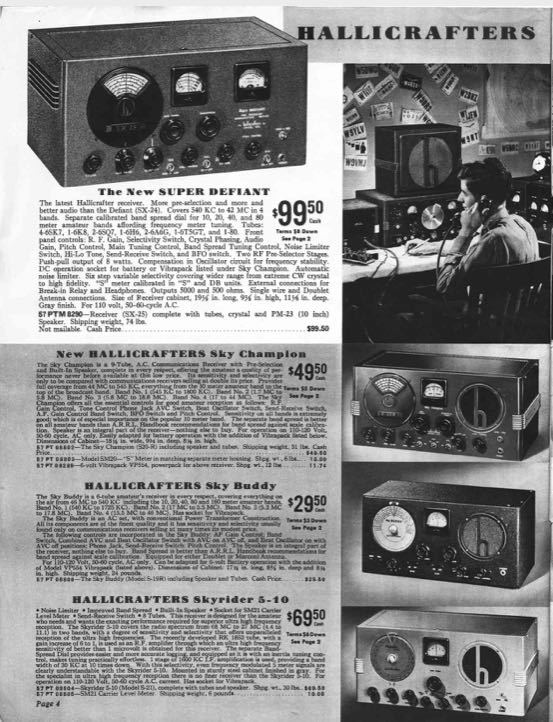
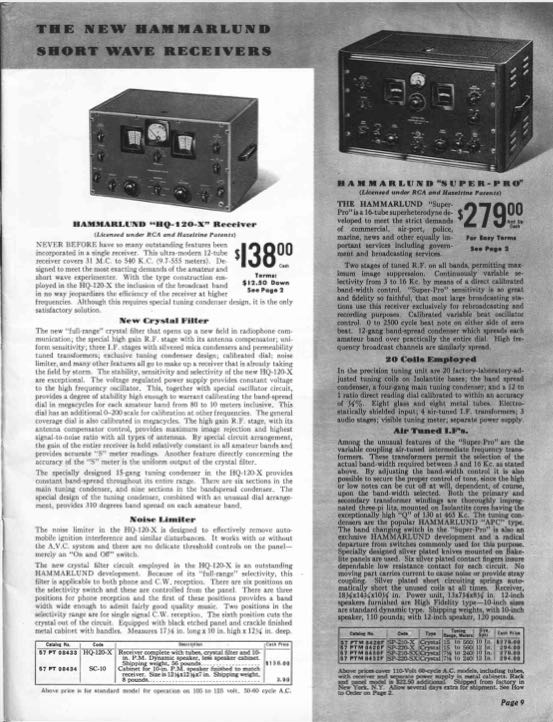
Many thanks to SWLing Post contributor, Charlie (W4MEC), who shares a PDF of the 1940 Sears Roebuck Co. catalog section featuring a wide array of radio gear and test equipment.

This file is hosted on the Pro Audio Design forum and can be downloaded as a PDF (15.8 MB) by clicking here.

It’s a real nostalgia trip reading through the fine Hallicrafters, Hammarlund and National HRO descriptions. Thanks so much for sharing this, Charlie!

Radio Waves: China Bans BBC, Invention of Radio, Diversity and Connections, and DJ Broadway Bill Lee Talks Radio and AM DXing

Radio Waves:  Stories Making Waves in the World of Radio

Because I keep my ear to the waves, as well as receive many tips from others who do the same, I find myself privy to radio-related stories that might interest SWLing Post readers.  To that end: Welcome to the SWLing Post’s Radio Waves, a collection of links to interesting stories making waves in the world of radio. Enjoy!

Many thanks to SWLing Post contributors Patrick, Marcus, Mike and Tracy for the following tips:


China bans BBC World News from broadcasting (BBC News)

China has banned BBC World News from broadcasting in the country, its television and radio regulator announced on Thursday.

China has criticised the BBC for its reporting on coronavirus and the persecution of ethnic minority Uighurs.

The BBC said it was “disappointed” by the decision.

It follows British media regulator Ofcom revoking state broadcaster China Global Television Network’s (CGTN) licence to broadcast in the UK.

Separately, the broadcaster Radio Television Hong Kong (RTHK) said it would stop relaying BBC World Service programming in the region, prompting condemnation from the BBC.

China’s State Film, TV and Radio Administration said that BBC World News reports about China were found to “seriously violate” broadcast guidelines, including “the requirement that news should be truthful and fair” and not “harm China’s national interests”.

It said that the BBC’s application to air for another year would not be accepted.

The BBC said in a statement: “We are disappointed that the Chinese authorities have decided to take this course of action. The BBC is the world’s most trusted international news broadcaster and reports on stories from around the world fairly, impartially and without fear or favour.”[]

In Our Time: The Invention of Radio (BBC Sounds)

Melvyn Bragg and his guests discuss the invention of radio. In the early 1860s the Scottish physicist James Clerk Maxwell derived four equations which together describe the behaviour of electricity and magnetism. They predicted the existence of a previously unknown phenomenon: electromagnetic waves. These waves were first observed in the early 1880s, and over the next two decades a succession of scientists and engineers built increasingly elaborate devices to produce and detect them. Eventually this gave birth to a new technology: radio. The Italian Guglielmo Marconi is commonly described as the father of radio – but many other figures were involved in its development, and it was not him but a Canadian, Reginald Fessenden, who first succeeded in transmitting speech over the airwaves.

With:

Simon Schaffer
Professor of the History of Science at the University of Cambridge

Elizabeth Bruton
Postdoctoral Researcher at the University of Leeds

John Liffen
Curator of Communications at the Science Museum, London

Producer: Thomas Morris

Click here to listen via BBC Sounds.

World Radio Day 2021: Radio creates diversity and connects people (RADIOZENTRALE GmbH)

World Radio Day 2021: Radio creates diversity and connects people

World Radio Day will be announced by UNESCO for the tenth time on February 13th and once again refers to how important radio is for society and why it connects people.

Time to celebrate: UNESCO has proclaimed World Radio Day for the tenth time. In Germany, radio has been the everyday companion of people for a hundred years and, more than ever, radio is the medium of the hour. So this jubilee round provides many good reasons to pause and ask what radio means for each individual, society and the world. Radio itself does not take a break, it is on the air – every day and around the clock. Radio informs, entertains and offers a variety of programs, opinions and content. As a matter of course – and yet so indispensable – radio, both large and small, is the vital voice of people and for people.

At the global level, radio remains the most widely consumed medium

The world is changing rapidly. Social and political processes are becoming more dynamic due to new technologies, the communication network is getting faster and bigger and the challenges are becoming more important. In these processes, radio not only offers diversity, classification and orientation, but is also an integral part of opinion-forming because it is the platform for democratic discourse. This unique ability to reach a wide audience means radio can shape a society through diversity and is the place for those who want to speak up.

100 years of radio in Germany

In Germany, the medium for the ears and the head cinema is celebrating its centenary this year. The innovative strength of the medium and the trust base with listeners that has grown over the decades make it possible for radio to be the medium of the hour more than ever. It is the last mass medium and at the same time can digitally reach everyone with the entire range of offers. Radio is at eye level with people – both in terms of content and technology. Because just as society and people’s everyday lives have changed dramatically, so too have listening habits and content. What remains, however, is the great art of putting complex topics into understandable words and giving diversity a voice.

“Today we are experiencing that the world is changing rapidly. We face major challenges when I think of climate change, the current corona pandemic or the debates on racism, for example. The task of radio here is to inform and classify. To make the soft tones heard and to reflect the diversity of opinions, ”says Grit Leithäuser, Managing Director of Radiozentrale. “But the most important thing is to act at eye level with the listeners. This grown connection and mutual trust are something for both sides that one should be aware of and that it has to be preserved every day. Then, in a hundred years, radio will be the medium for people who listen on whatever technical route, in order to learn from one another and to live diversity. ”

World Radio Day was first proclaimed by UNESCO in 2012 and this year it has the motto: “New World, New Radio”. At the suggestion of Spain, the General Conference of UNESCO initiated World Radio Day in memory of the founding of United Nations Radio on February 13, 1946. The aim of the day is to make the public and the media more aware of the importance of radio, to the decision-makers Encourage information to be established and made accessible through the radio.

Further information on World Radio Day can be found at: https://en.unesco.org/commemorations/worldradioday

The generic initiative Radiozentrale sees itself as a common platform for public and private radio stations as well as generic companies in the radio industry. The radio center has set itself the goal of positioning the medium of radio and providing comprehensive information about the (advertising) medium of radio. More information: www.radiozentrale.de

DJ Broadway Bill Lee talks about today’s radio, AM DXing and much more (Stars Cars Guitars via YouTube)

Broadway Bill Lee raps to Alex Dyke about growing up in Cleveland, the impact of the Beatles in 1964 and honing his craft as a DJ. Bill remembers being on-air in New York City the night that John Lennon was murdered and how he felt compelled to take to the air on September 11th 2001.


Do you enjoy the SWLing Post?

Please consider supporting us via Patreon or our Coffee Fund!

Your support makes articles like this one possible. Thank you!