Tag Archives: Radio Waves

Radio Waves: Digitizing Pakistan, BBC MW Closures, Lowe HF-250 Review, and BBC News suspends 450 job cuts

Radio Waves:  Stories Making Waves in the World of Radio

Because I keep my ear to the waves, as well as receive many tips from others who do the same, I find myself privy to radio-related stories that might interest SWLing Post readers.  To that end: Welcome to the SWLing Post’sRadio Waves, a collection of links to interesting stories making waves in the world of radio. Enjoy!

Many thanks to SWLing Post contributors Alan, Mike, and Dave Zantow for the following tips:


Government to fully digitize Radio Pakistan (Radio Pakistan)

The incumbent government, under its vision of introducing modern trends and technology in different sectors, has planned to fully digitize the state-owned Radio Pakistan.

This information has been revealed in official documents during the ongoing week-long national workshop on Digital Radio Migration policy of Radio Pakistan at Pakistan Broadcasting Academy, Islamabad.

The digitization will bring about a revolution in the field of broadcasting in the country, and will capture the audience at home and abroad including South Asia and Central Asia and the Middle East through quality news, current affairs and programs.

Under the plan, the biggest 1000-Kilowatt DRM Medium-wave transmitting station of Radio Pakistan will be set up at Fort Monroe hill station in Dera Ghazi Khan district in South Punjab at an estimated cost of three billion rupees.

It will be the first ever most powerful but digital transmitter of Radio Pakistan that is to be established in center of the country as part of Phase-II of Digital Radio Migration policy and it will help cover the entire population of Pakistan with crystal clear and noise-free waves.

The project has already been approved by the federal cabinet while the Punjab government has been asked to acquire land for the said purpose.

Under Phase-II of DRM plan, five DRM+FM transmitters of 10-kilowatt each will be installed in Islamabad, Lahore, Karachi, Faisalabad and Multan in the existing Radio Stations.

Besides, eight DRM+FM transmitters of five kilowatt each will be installed in Quetta, Peshawar, Gilgit, Skardu, Gwadar, Mirpur (Azad Kashmir), Khairpur and Narowal in the existing radio stations.

The phase-II of the plan would be accomplished in three years with an overall estimated cost of 3,153 million rupees.

And under Phase-III of the plan, four DRM medium wave transmitters of 100-kilowatt each will be installed in Lahore, Skardu, Quetta and Peshawar for strategic purposes.[]

BBC Radio to close more medium wave transmitters (Radio Today)

The BBC says it is closing a further 18 medium wave transmitters across England, Scotland and Wales in the next stage of its plan to cut costs.

Services being closed range from BBC Radio Solent’s two AM frequencies on the South Coast to BBC Radio Scotland’s service in Aberdeen.

Six more BBC Local Radio services will no longer be transmitted on AM – they are Three Counties Radio (630 and 1161 kHz), BBC Radio Merseyside (1485 KHz), BBC Radio Newcastle (1458 KHz), BBC Radio Solent and BBC Radio Solent (for Dorset) 999 and 1359 KHz, BBC Radio Cornwall (630 and 657 kHz) and BBC Radio York (666 and 1260 KHz).

Kieran Clifton, Director, BBC Distribution & Business Development explains: “The majority of radio listening in the UK – including to the BBC – is now digital, and digital listening is continuing to grow.

“This change was planned as long ago as 2011, but we have taken a measured approach to implement it to ensure that as many of you as possible have already moved on to other ways of receiving the services before we make this change. We know that the changes will impact some of you, and that’s why we’re speaking about the plans again now. We want to make sure that people listening to these transmissions will be able to use other methods to hear the same programmes.”[]

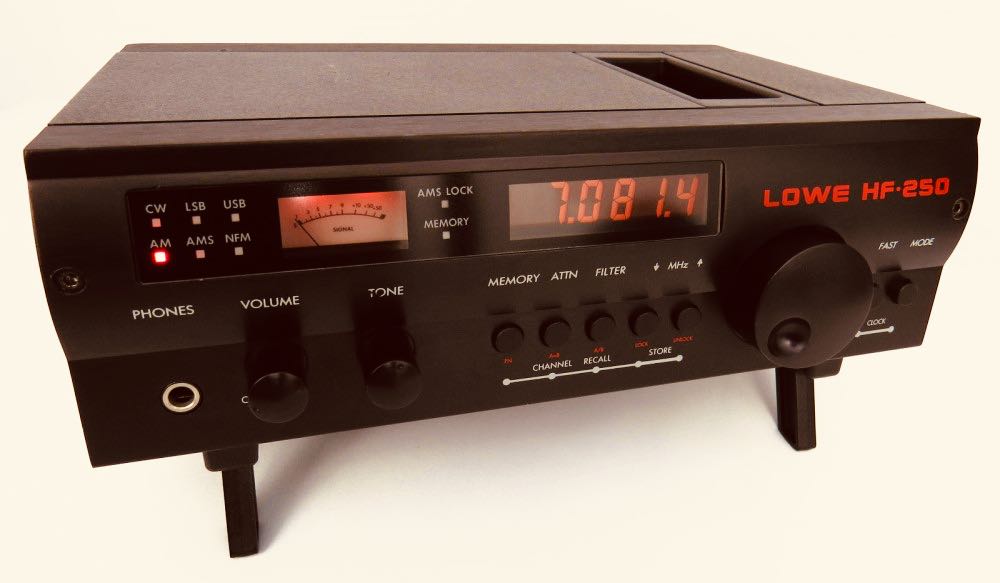
Dave’s review of the Lowe HF-250 (N9EWO)

[…]As far as audio quality goes, it’s extremely difficult to beat the Lowe HF-250. Mind you it has it’s share of “bug-a-boos” as well.

In our view it has held up much better in it’s old age vs. the AOR AR7030. Properly operating and in decent condition samples are fairly rare on the used market now (even more so in North America). Most owners know what the receiver is and hang on to them. But once a great while one does show up on the used market. Click here to read the full review.

BBC News suspends 450 job cuts to ensure Covid-19 coverage (BBC News)

BBC News has suspended plans to cut 450 jobs as it faces the demands of covering the coronavirus pandemic.

The job losses were announced in January and were part of a plan to complete a £80m savings target by 2022.

Outlets due to be hit include BBC Two’s Newsnight, BBC Radio 5 Live and the World Service’s World Update programme.

Director general Tony Hall gave staff the news on Wednesday, a week after the broadcaster delayed the end of the free TV licence scheme for all over-75s.

Lord Hall said “we’re suspending the consultation on those saving plans”.

He told staff: “We’ve got to get on with doing the job that you’re doing really brilliantly.

“It would be inappropriate. We haven’t got the resource to plough ahead with those plans at the moment, so we’ll come back to that at some point.

“But for the moment we just want to make sure you are supported and you’ve got the resources to do the job that you and your colleagues are doing amazingly.”[]


Do you enjoy the SWLing Post?

Please consider supporting us via Patreon or our Coffee Fund!

Your support makes articles like this one possible. Thank you!

Radio Waves: Quantum Sensors, Sinking Mi Amigo, Submarine Radio Network, and Video Games Over The Air

Radio Waves:  Stories Making Waves in the World of Radio

Because I keep my ear to the waves, as well as receive many tips from others who do the same, I find myself privy to radio-related stories that might interest SWLing Post readers.  To that end: Welcome to the SWLing Post’sRadio Waves, a collection of links to interesting stories making waves in the world of radio. Enjoy!

Many thanks to SWLing Post contributors Kim Elliott and Dennis Dura for the following tips:


Scientists create quantum sensor that covers entire radio frequency spectrum (Phys.org)

A quantum sensor could give Soldiers a way to detect communication signals over the entire radio frequency spectrum, from 0 to 100 GHz, said researchers from the Army.

Such wide spectral coverage by a single antenna is impossible with a traditional receiver system, and would require multiple systems of individual antennas, amplifiers and other components.

In 2018, Army scientists were the first in the world to create a quantum receiver that uses highly excited, super-sensitive atoms—known as Rydberg atoms—to detect communications signals, said David Meyer, a scientist at the U.S. Army Combat Capabilities Development Command’s Army Research Laboratory. The researchers calculated the receiver’s channel capacity, or rate of data transmission, based on fundamental principles, and then achieved that performance experimentally in their lab—improving on other groups’ results by orders of magnitude, Meyer said.

“These new sensors can be very small and virtually undetectable, giving Soldiers a disruptive advantage,” Meyer said. “Rydberg-atom based sensors have only recently been considered for general electric field sensing applications, including as a communications receiver. While Rydberg atoms are known to be broadly sensitive, a quantitative description of the sensitivity over the entire operational range has never been done.”[]

Forty years ago today Sheerness lifeboat crew rescued Radio Caroline DJs from the sinking Mi Amigo (Kent Online)

It was the original ‘ship that rocked.’ But 40 years ago today (Thursday)the Mi Amigo, home to original pop pirates Radio Caroline, finally disappeared beneath the waves in a violent force 10 storm.

In a daring rescue which lasted 12 hours in appalling weather, the crew of the Sheerness lifeboat saved the lives of everyone onboard – including the ship’s canary.

Leading the operation was colourful RNLI coxswain Charlie Bowry, who was later presented with the Institute’s coveted silver medal.

It was during the day that the radio station’s 60-year-old ship started dragging its anchor and drifted 10 nautical miles onto the Long Sand sandbank off Southend.

As the tide rose, the ship started to float free. But the bottom of the boat began being buffeted on the seabed with such a force the steel plates sprung a leak and water gushed into the engine room.

When the bilge pumps couldn’t cope, the three British DJs and a Dutch engineer called the Coastguard who dispatched Sheerness lifeboat the Helen Turnbull.[]

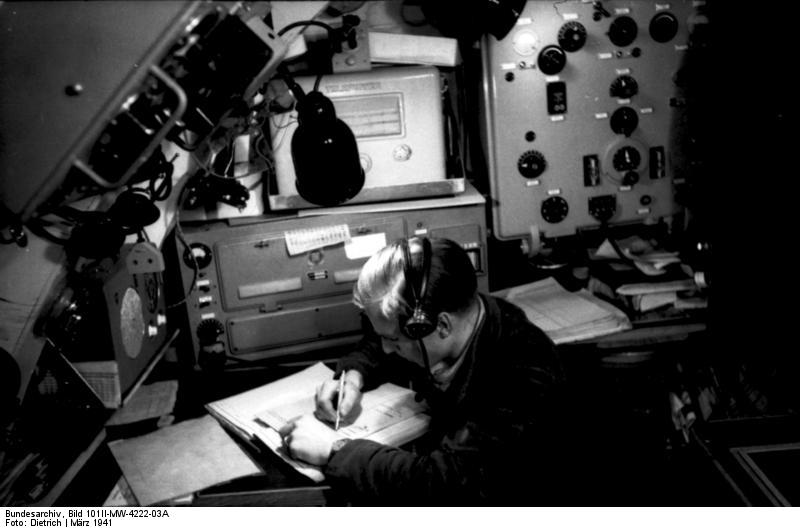
The Radio Network that Allowed Communication with Submarines (Interesting Engineering)

Communicating with covert fleets during WWII required some special equipment.

What do you do when you need to communicate with a crew of 50 sailors submerged in a submarine in an undisclosed location across the world’s oceans? That was a difficult question to answer for Navy leaders in WWII.

Radio waves don’t easily travel through saltwater, which meant that getting active communication with a submarine crew meant making the submarine surface an antenna. This was the obvious solution, but it made a previously covert submarine now a visible target.

[…]Engineers tasked with finding a more covert solution soon discovered that radio waves with low frequencies, around 10 kHz, could penetrate saltwater to depths up to around 20 meters. They realized that if the transponders on submarines were switched to these frequency ranges, then they communicate with leadership on land.

The problem with this idea was that creating and broadcasting these low-frequency radio waves required massive antennas. Essentially, the lower the frequency of a radio wave, the longer and larger the antenna is required to be.[]

You Could Download Video Games From the Radio in the 1980s (Interesting Engineering)

Certain radio programs broadcast the raw data to video games for viewers to download.

[…]In 1977, the world’s first microprocessor-driven PCs were released. These were the Apple II, the Commodore PET, and the TRS-80. All these machines had one thing in common – they used audio cassettes for storage.

Hard drives at the time were still quite expensive, and everyone at the time had access to cheap audio cassettes. Early computer designers actually flaunted cassette storage as it aided in the early adoption of personal computers. As PCs became more common, so to did the emergence of their use as video game machines.

As the 1980s rolled around, engineers at the Nederlandse Omroep Stichting, NOS, a Dutch broadcasting organization, realized something incredible. Since computer programs and video games were stored on audio cassettes, it meant that their data could be transmitted with ease over the radio. They started taking programs and video games and setting up broadcasts where people could “download” games onto their own personal computers.

The audio that was transmitted would’ve sounded reminiscent of a dial-up modem booting up.

[…]NOS started a radio program specifically for transmitting gaming data called “Hobbyscoop,” and it became incredibly popular. The company even created a standard cassette format called BASICODE to ensure computer compatibility.

Eventually, transmitting games through computers became so popular that radio shows popped up all around the world. A Yugoslovik station called “Ventilator 202” broadcasted 150 programs between 1983 and 1986. As the practice evolved, it became less of a novelty and rather a practical way for people to share calculation programs, educational tools, encyclopedias, and even flight simulators.[]


Do you enjoy the SWLing Post?

Please consider supporting us via Patreon or our Coffee Fund!

Your support makes articles like this one possible. Thank you!
Radio Waves: Keeping Car Radios, Moon Bounce, Voyager 2, and ABC Delays Plan

Radio Waves:  Stories Making Waves in the World of Radio

Because I keep my ear to the waves, as well as receive many tips from others who do the same, I find myself privy to radio-related stories that might interest SWLing Post readers.  To that end: Welcome to the SWLing Post’sRadio Waves, a collection of links to interesting stories making waves in the world of radio. Enjoy!

Many thanks to SWLing Post contributors Benn, Tony, and Michael Bird for the following tips:

Opinion: Automakers, don’t remove radios from the dashboard (The Detroit News)

Make no mistake about it: The renaissance of electric vehicle manufacturing has been one of the most significant blessings of innovation in the 21st century. The continued production and voluntary adoption of electric vehicles have made the United States a greener and cleaner nation. However, while EV makers continue working to bring the U.S. forward environmentally, they need to ensure their design methods do not have a negative impact on one of the country’s most crucial national security apparatuses.

As the former administrator of the Federal Emergency Management Agency (FEMA) that oversaw the operations of over 220 declared disasters, I am concerned about what I’ve seen from automakers removing AM radios from vehicles — an action that will make Americans less safe in emergency situations.

Interference between the broadcast reception and the electric motors of certain cars, principally electric vehicles, is the reasoning behind some companies’ decision to eliminate the radio from car dashboards. However, scrapping radio rather than making the signals compatible can severely harm the federal government’s disaster relief efforts.

Federal law mandates that FEMA always possess the capabilities to deliver messages to the American people. To this end, FEMA has spent tens of million dollars and counting perfecting the Primary Entry Point (PEP) stations — consisting mostly of AM stations, but some FM ones as well — that connect to The National Public Warning System.[]

Australia’s first ever moon bounce remembered as a feat that shocked industry experts (ABC News)

You probably haven’t heard of Ray Naughton’s feat of science — not many people have. But 55 years ago, the quiet electronics store owner from Birchip, in western Victoria, successfully completed Australia’s first ever moon bounce.

The amateur radio fanatic had spent most of his time alone in a paddock, tinkering away on a 250-metre wide, 30-metre tall antenna capable of bouncing a radio signal off the moon and back again.

Mr Naughton was driven by news that astronauts would soon be walking across its surface.

When that day came, on July 20 1969, Mr Naughton used his antenna to tune into conversations between astronauts and NASA.

A small group of locals watched on in wonder, realising for the first time what their private neighbour had been working on.[]

When Voyager 2 Calls Home, Earth Soon Won’t Be Able to Answer (NY Times)

NASA will spend 11 months upgrading the only piece of its Deep Space Network that can send commands to the probe, which has crossed into interstellar space.

Voyager 2 has been traveling through space for 43 years, and is now 13 billion miles from Earth. But every so often, something goes wrong.

At the end of January, for instance, the robotic probe executed a routine somersault to beam scientific data back to Earth when an error triggered a shutdown of some of its functions.

“Everybody was extremely worried about recovering the spacecraft,” said Suzanne Dodd, who is the Voyager project manager at NASA’s Jet Propulsion Laboratory in Pasadena, Calif.

The mission’s managers on our planet know what to do when such a fault occurs. Although it takes about a day and a half to talk to Voyager 2 at its current distance, they sent commands to restore its normal operations.

But starting on Monday for the next 11 months, they won’t be able to get word to the spry spacecraft in case something again goes wrong (although the probe can still stream data back to Earth). Upgrades and repairs are prompting NASA to take offline a key piece of space age equipment used to beam messages all around the solar system.[]

ABC forced to delay five-year plan and job cuts announcement (The Age)

The ABC has been forced to delay the release of its five-year blueprint – including job cuts – to prioritise its response to the coronavirus pandemic.

The national broadcaster was due to announce its long-term plan at the end of this month. A three-year funding freeze that took effect last July, stripping $84 million from ABC’s budget, will result in an estimated 200 redundancies.

In an email to staff, managing director David Anderson said, “I think you will agree with me when I say that the current situation with COVID-19 means our focus must be on the welfare of all of you and our role as a public broadcaster in providing the community with timely and credible information in this challenging time for our country.

“For this reason, I’m sure you will understand my decision to postpone the announcement until we are through this period … your patience and professionalism are, as always, greatly appreciated.”

Anderson told employees he would reveal his plan “as soon as we have returned to normal levels of activity”.[]


Do you enjoy the SWLing Post?

Please consider supporting us via Patreon or our Coffee Fund!

Your support makes articles like this one possible. Thank you!
Radio Waves: First Microprocessors, Ocean FM, SWL Interviews, and NPR’s take on All-Digital AM

Radio Waves:  Stories Making Waves in the World of Radio

Because I keep my ear to the waves, as well as receive many tips from others who do the same, I find myself privy to radio-related stories that might interest SWLing Post readers.  To that end: Welcome to the SWLing Post’sRadio Waves, a collection of links to interesting stories making waves in the world of radio. Enjoy!

Many thanks to SWLing Post contributors Marty, Martin Butera, and the Radio Survivor for the following tips:

The Surprising Story of the First Microprocessors (IEEE Spectrum)

Transistors, the electronic amplifiers and switches found at the heart of everything from pocket radios to warehouse-size supercomputers, were invented in 1947. Early devices were of a type called bipolar transistors, which are still in use. By the 1960s, engineers had figured out how to combine multiple bipolar transistors into single integrated circuits. But because of the complex structure of these transistors, an integrated circuit could contain only a small number of them. So although a minicomputer built from bipolar integrated circuits was much smaller than earlier computers, it still required multiple boards with hundreds of chips.[]

Ocean FM Was Fire: How Local Radio Done Right Can Heat A Cabin | Radio Schmaltz (Part-Time Audiofile)

[…]The cabin on a rocky peninsula in Northwest Ireland might not have had all the letters for its Scrabble set or a microwave, but it did have another marvel of 20th century technology. It was a little CB/AM/FM radio crouching behind a box of matches on top of a kitchen cabinet.

I decided to put the switch on FM and started swirling the dial. As soon as I heard a lilting woman’s voice underneath a sheet of static, I began carrying it around the tiny room while adjusting the rabbit ears.

Now the signal was as clear as the peat-rich water was brown, a farmer was being interviewed about the economic downturn. It was a quick piece — just some brogue-ish assurances that one doesn’t choose agriculture for an easy life. Then came a trio playing an Irish ballad, and then came North West Hospice Bingo: a bingo game that allows listeners from across the broadcast range of Ocean FM’s two regional frequencies to play bingo, including the residents of the hospice.

I’d bundle up for walks outside where the wind was loud, blustery, and sacred. The ocean crashed against the rocks in a way I never conceived as being real outside of movies. But when I was inside, the radio might as well have been a Soviet relic with only a volume control and no tuner because I simply couldn’t touch that dial. I learned the schedule quickly, timing walks and firewood runs so that I’d be back in time for Country Jamboree, a boy-girl-boy-girl style line-up of Irish and American country tunes.

As I’d stand by the wood-stove, taking off my cold wet socks to put on the toasted, at time singed socks that I’d been roasting, I felt the fulfillment of the promise of radio. I could hear Fessenden making history with the first radio broadcast of music, Oh Holy Night transmitted on a rocky coast on Christmas Eve of 1906 and heard by ships at sea.[]

Coffee and Radio Listen

Coffee and Radio Listen is an investigation of Brazilian radio listener, by Martin Butera.

How they began listening to radio, the local or international stations that influenced them, the interests they have when tuning to a station, the languages they like to listen to, if they send listeners reports and collect QSLs, their antennas and receivers, and all aspects related to the radio listen both in shortwave and in other bands and modes.

Each month they will have in this blog, an exclusive interview with a Brazilian radio listen. At the end of this project, a free downloadable e-book will be available, which contains all the interviews and statistical references.

Every month there will be a new interview, this month of March launch month we start with 2 interviews

Martin is Argentinian, born in the city of Buenos Aires capital. He currently lives in Brasília DF, capital of Brazil. He is also a journalist, documentary maker and founding member of Radio Atomika 106.1 MHz (Buenos Aires, Argentina).

To know more about CREW 15.61 Radio Listeners’, please visit the following link.

Guest Post: Brazil’s newly-formed “15.61 Crew”

Collaborate on this project by Martín, our friend Rob Wagner (VK3BVW), Mount Evelyn DX Report (adapting the recordings).

Click here her to check out the Coffee And Radio Listen website.

NPR Supports All-Digital on AM, With Caveats (Radio World)

National Public Radio “generally supports” allowing stations to transition, if they wish, to all-digital AM transmission using HD Radio in the United States. But it believes the commission needs to go further on how it would handle interference complaints from neighboring analog stations in the band.

About 80 AM public radio stations are affiliated with NPR or receive operational funding from the Corporation for Public Broadcasting, including WNYC(AM) in New York City.

NPR says it has significant interest in any measures to help AM broadcasters better serve the public by improving the listening experience.

“Facilitating the expansion of HD Radio and its additional functionality for program and public safety information and services would serve the public interest, provided the transition to all-digital HD Radio operation does not cause harmful interference,” NPR wrote in comments filed with the FCC this week.

“As it has in the past, NPR supports the expansion of HD Radio, but not at the expense of current analog AM service.”[…]


Do you enjoy the SWLing Post?

Please consider supporting us via Patreon or our Coffee Fund!

Your support makes articles like this one possible. Thank you!

Radio Waves: WNPV Off Air, Privat-Ear, End of Radio, and China COVID-19 shut-ins tune-in

(Source: JamesButters.com)

Radio Waves:  Stories Making Waves in the World of Radio

Because I keep my ear to the waves, as well as receive many tips from others who do the same, I find myself privy to radio-related stories that might interest SWLing Post readers.  To that end: Welcome to the SWLing Post’sRadio Waves, a collection of links to interesting stories making waves in the world of radio. Enjoy!

Many thanks to SWLing Post contributors Ron, Tracy Wood, and Dennis Dura for the following tips:


WNPV Radio preparing to go off air April 30 (The Reporter)

TOWAMENCIN — When April ends, the airwaves above the North Penn valley region will be emptier, and so will a little brick building on Snyder Road in Towamencin.

Sitting below five 165-foot-tall radio antennas and one cell tower, that brick building has been the home for six decades of WNPV, the local radio station found at 1440 AM and 98.5 FM.

“We’ve been at it for 60 years, and our mission and our core values are really no different today than they were in October of 1960. It literally is to serve the community,” said Phil Hunt, the station’s General Manager.

“It’s gotten to the point where it’s not sustainable for us to continue to do that. It takes resources to do it properly; those resources, primarily, are people, and we were having trouble making ends meet,” he said.

Hunt announced Wednesday that WNPV will go off the air on April 30, bringing an end to an era of live, local news that began on Oct. 17, 1960. The station’s coverage of local sports, politics, breaking news, and key issues have earned dozens of awards, a handful of which greet visitors as you walk past an old teletype machine through the station’s front door.[]

Privat-ear Subminiature Tube Pocket Radio (JamesButters.com)

The Privat-ear pocket radio was manufactured in the USA and released onto the market by Electronics Systems Corporation in 1949 (1a, b, c). Although small enough to fit in a shirt pocket this is not a transistor radio; it owes its small size to the use of subminiature tubes developed during WWII and was designed as an earphone only model. It predates the first commercially available transistor radio by five years and was an innovative, but ultimately doomed, attempt at realizing an American cultural objective; the creation of a portable shirt pocket radio with mass appeal.

The Privat-ear was invented by Frank L Stuck, a Minister of Lakeland Florida. Born in Washington, Pennsylvania on October 13 1904 to William and Maise Stuck, he was the second youngest of four children (1d, e). He studied Theology at Bethany College, West Virginia from 1924 – 1927 and received a Doctor of Divinity degree from the American Theological Seminary at Wilmington Delaware (1f). Whilst attending College he was one of the founding members of Alpha Pi Alpha, was a member of the Student Volunteers and met and married Iva Myrtle Driggs.[]

IN CASE YOU MISSED IT – The End Of Radio. Really? (Radio Ink)

(By Mike Bustell) I try to keep my head down and quietly work behind the scenes helping our salespeople make a killing for our advertisers and our company. However, I had to react to Roger Lanctot’s “Technology Tyranny and the End of Radio” LinkedIn article published in last Friday’s Radio Ink headlines.

How Tesla and Silicon Valley (and other tech giants) feel about local radio is not much different than what our salespeople hear when talking with their local garden center or auto dealer group — that local radio is no longer relevant to bother putting it on their 2020 dashboards.

All these objections are happy opportunities to educate, bond, and sway hearts, minds, and advertising budgets. We have to be happy well-armed warriors with targeted customer-specific information every time we ask for a decision-maker’s valuable time. Once we earn an advertiser’s business we can never stop educating, bonding, or working on helping them grow their business.

Below is the most up-to-date look at the audio sources that $100K+HHI purchasers and lessees for new hybrid and electric vehicles are using. Like Mike Bloomberg taking the salt shakers off of New York City restaurants’ tables, Tesla’s removing easy access to local AM/FM radio stations on their new vehicles’ dashboards shows a similar out-of-touch-with-the-people attitude. Ninety-four and a half percent of $100K+ Age 25+ adults who plan to buy or lease a new hybrid or electric vehicle in 2020 listen to Local AM/FM radio every week — nearly three times that of Spotify, the second most-listened-to audio source every week used by these consumers.[]

China COVID-19 shut-in tunes in to the world via radio (Marketplace)

The battle to contain the COVID-19 virus in China has kept most people at home since the end of January.

Life is slowly returning to streets in cities like Shanghai, but face masks are now required in nearly all public spaces, even though they are not recommended for the general public by the Centers for Disease Control or World Health Organization.

Since there is a shortage of masks, most people are still effectively forced to stay home. As Marketplace’s China correspondent, this includes me. My window to the world for a better part of a month has been through radio.[]


Do you enjoy the SWLing Post?

Please consider supporting us via Patreon or our Coffee Fund!

Your support makes articles like this one possible. Thank you!
Radio Waves: Eugène Aisberg, Filter Design, ABC Workers Face Cuts, and Data via Web SDRs

Radio Waves:  Stories Making Waves in the World of Broadcasting 

Because I keep my ear to the waves, as well as receive many tips from others who do the same, I find myself privy to radio-related stories that might interest SWLing Post readers.  To that end: Welcome to the SWLing Post’s Radio Waves, a collection of links to interesting stories making waves in the world of radio. Enjoy!

Many thanks to SWLing Post contributors Paul, Marty, and Michael Bird for the following tips:

Eugène Aisberg, Radio Writer (OneTubeRadio.com)

After a wartime absence, the January 1946 issue of Radio Craft carried an article by writer Eugène Aisberg.  While that name might not be familiar to American readers, Aisberg was a prolific author in the early days of radio, and wrote some of the best treatises on radio for the popular audience.  He was fluent in French, Esperanto, German, Russian, and English.

Aisberg was born in Odessa, Ukraine, in 1905, and lived most of his life in France. He was the director of the French magazine Toute la Radio and a prolific author of a number of books. His most popular book, which is still in print, is La Radio? Mais c’est très simple (Radio? But It’s So Simple!)  The book, currently in its 29th edition, an extremely solid background covering all aspects of electronics, and is written in a popular, easy-to-read style. While the book was ultimately translated into several languages, it was apparently never published in English.[]

Filter Design Software (Nuts and Volts)

If you’ve ever lived close to an AM broadcast station, you probably experienced the phenomenon known as fundamental overload. It occurs when a receiving device is functioning entirely properly but unable to reject a strong signal. The receiver might be a wireless telephone, a scanner, or even a TV or radio receiver. The AM signal is completely legal but just too strong, disrupting the function of the receiver or overriding the desired programming.

[…]Hams often experience fundamental overload on the 160 meter band (1.8–2.0 MHz) which is adjacent to the AM broadcast (BC) band (550 kHz–1.7 MHz). Antennas for those frequencies pick up a lot of AM band RF, overloading the input circuits and creating distortion or false signals inside the receiver. The usual solution is to install a high-pass broadcast-reject filter at the receiver input, attenuating the unwanted AM signals below 1.6 MHz while passing the desired 160 meter signals with little attenuation.

So far, so good, but a filter that doesn’t attenuate signals very much above 1.8 MHz while attenuating them significantly in the adjacent broadcast band is not a simple thing to design. There are tables and equations, but they are tedious to work with. Practically, you’ll need to build the filter with standard-value components as well, and that will affect filter performance too. Sounds like a job for some filter design software, doesn’t it?

There are several filter design software packages ranging from simple calculators to sophisticated CAD programs. Luckily for hams and other experimenters, there are plenty of free or low-cost programs to try.[]

ABC workers face anxious wait over job, program cuts (The Age)

David Anderson did not mince words at a Senate Estimates hearing last October. “There will be job losses,” ABC’s managing director warned. “It’s not something I can quantify at this point in time. There’s still more work to be done.”

Towards the end of March, Anderson will reveal a five-year plan for the national broadcaster. To the frustration of staff, it’s unlikely to specify which parts of the organisation will bear the brunt of these cuts or how many workers they might lose.

Several senior sources spoke about the situation at ABC on the condition of anonymity, given sensitive funding negotiations are yet to be finalised.

“All these media reports claiming the redundancy numbers will be finalised in March are just wrong,” says one ABC executive. “What we need is some clarity [about long-term resourcing] from the government.”[]

Receiving Data With Web Based Shortwave Radios (Nuts and Volts)

Your computer and the Internet give you free access to over 100 web based shortwave receivers that you can use as if they were your own. Unfortunately, employing these radios to decode data transmissions can be very difficult or impossible — unless you know the secret. So, read on and we’ll guide you through the details of how to do it.

Web based shortwave radios are an amazing new implementation of software defined radios (SDR). These SDRs are free to use and widely available on the Internet. Even more remarkable is that they are located in countries all around the world.[]


Do you enjoy the SWLing Post?

Please consider supporting us via Patreon or our Coffee Fund!

Your support makes articles like this one possible. Thank you!

Radio Waves: Plant-powered Satellite Comms, BBC Pips, Filter Basics, and Replacing Shortwave

Radio Waves:  Stories Making Waves in the World of Radio

Because I keep my ear to the waves, as well as receive many tips from others who do the same, I find myself privy to radio-related stories that might interest SWLing Post readers.  To that end: Welcome to the SWLing Post’sRadio Waves, a collection of links to interesting stories making waves in the world of radio. Enjoy!

Many thanks to SWLing Post contributors Marty, Dennis Howard, Dennis Dura, Kris Partridge and Richard Langley and for the following tips:


Plant-powered sensor sends signal to space (Phys.org)

A device that uses electricity generated by plants as its power source has communicated via satellite—a world first.

[…]The device can inform farmers about the conditions of their crops to help increase yield, and enable retailers to gain detailed information about potential harvests.

It transmits data on air humidity, soil moisture and temperature, enabling field-by-field reporting from agricultural land, rice fields or other aquatic environments.

The extremely low power device sends signals at radio frequencies that are picked up by satellites in low Earth orbit. It was developed by Dutch company Plant-e and Lacuna Space, which is based in the Netherlands and the UK, under ESA’s programme of Advanced Research in Telecommunications Systems (ARTES).[]

The eccentric engineer: a tale of six pips and how the BBC became the national arbiter of time (Engineering and Technology)

This edition of Eccentric Engineer tells the story of the BBC Time Signal and how, over the years, it has just got more complicated.

Every engineer needs to know the time, if only so as to not miss lunch. Since 1924, many Britons have been checking their watches against the BBC time signal, known affectionately as ‘the pips’.

The history of the ‘pips’ is almost as long as the history of the BBC itself. The first transmissions from what was then the British Broadcasting Company began in late 1922 and soon afterwards there were suggestions of broadcasting a time signal under the control of the Royal Observatory at Greenwich – then the arbiter of time in the UK.

No one seems to have seen a need for this degree of precision, but early broadcasts did use their own ad hoc ‘pips’, marking the 8pm and 9pm news programmes with a time signal consisting of the announcer playing the Westminster chimes on a piano and later a set of tubular bells. This proved rather popular with listeners, who could now adjust their clocks and watches daily, so the BBC decided to invest in some more high-tech clocks from the Synchronome Company. These provided audible ‘ticks’, which the announcer then simply counted down.[]

What Is Replacing Shortwave? (Radio World)

A joint effort is necessary to bring the digitization of radio to a successful end

Analog shortwave will celebrate about 100 years of existence in 2028 when many hope 5G will have been properly defined, tested and applied, though broadcasting is low on its long list of perceived advantages.

It’s true that shortwave was typically a medium of the Cold War that peaked in 1989 and that afterward its listenership dwindled. Many international broadcasters gave up on it as the post-war transmitters got rustier and the energy bills kept mounting.

After all, when budget cuts are needed, no transmitter will go on strike or write to the press, as happened when the BBC World Service tried to unsuccessfully close its Hindi shortwave transmissions in 2011. In 2020 these broadcasts stopped, when committed BBC Indian listeners, writers and thinkers who opposed it in 2011 did not protest too much.

The slow death of shortwave has been blamed on the internet and satellite. As technology and content are inextricably linked, shortwave created its type of content that is no longer favored by the savvy FM listener, internet user and cellphone obsessed.[]

Filter Basics: Stop, Block and Roll(off) (Nuts and Volts)

A casual observer might think that wireless systems consist primarily of filters connected by the occasional bit of circuit! Block diagrams of transceivers often include as many filters as any other function. This is true at the system level, just as it is at the circuit level — and many circuits behave in a filter-like way, whether intended to be a filter or not! That makes understanding filter basics important for wireless success.[]


Do you enjoy the SWLing Post?

Please consider supporting us via Patreon or our Coffee Fund!

Your support makes articles like this one possible. Thank you!