Tag Archives: Radio Waves

Radio Waves: LPFMs Go Non-Directional, ABC Cuts Remain, WBCQ Videos, and Demolition of Hara Arena

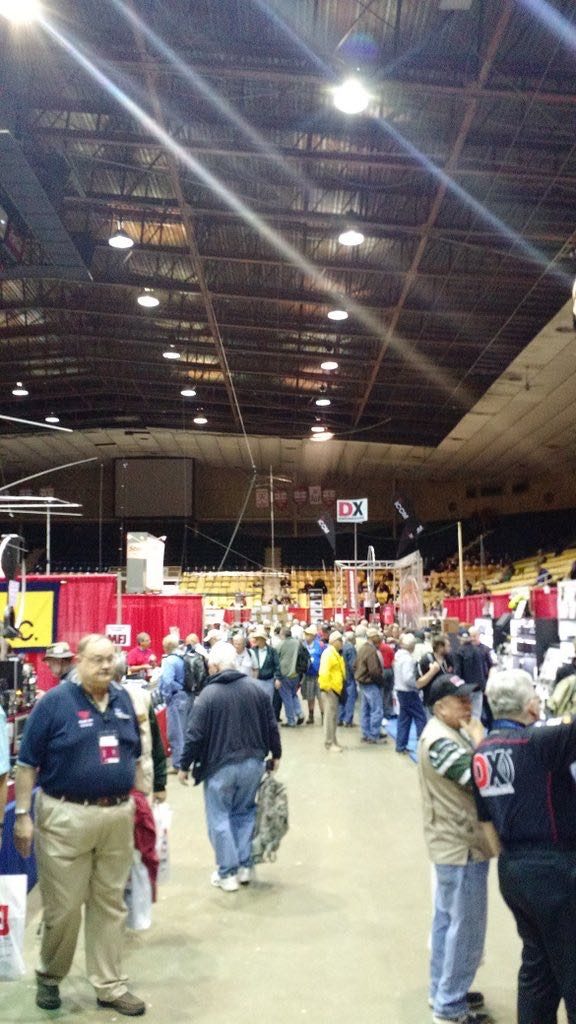
Hara Arena during the 2016 Dayton HamventionRadio Waves:  Stories Making Waves in the World of Radio

Because I keep my ear to the waves, as well as receive many tips from others who do the same, I find myself privy to radio-related stories that might interest SWLing Post readers.  To that end: Welcome to the SWLing Post’s Radio Waves, a collection of links to interesting stories making waves in the world of radio. Enjoy!

Many thanks to SWLing Post contributors Ulis (K3LU), Michael Bird, and Trevor Dailey for the following tips:


New FCC Rules Would Allow LPFMs To Use Non-Directional Antennas. (Inside Radio)

The FCC is scheduled to vote on controversial new rules that would potentially end a prohibition on low-power FM stations using directional antennas, among other things. At its April Open Commission Meeting, the agency will vote on a Report and Order to update its technical rules for LPFM stations.

Since the Local Community Radio Act of 2010 was passed nearly a decade ago, the number of LPFMs has grown to more than 2,100 stations. The LPFM service has “matured since engineering requirements were first established in 2000,” FCC Chair Ajit Pai said in a blog post announcing the April meeting agenda. “This maturation means that LPFM stations should be able to take advantage of additional engineering options to improve reception.”

In addition to improving reception, the proposed new rules would “increase flexibility while maintaining interference protection and the core LPFM goals of diversity and localism,” Pai said.

Along with expanded LPFM use of directional antennas, the proposal would allow LPFM stations to use FM booster stations.[…]

The ABC is an essential service but funding cuts remain, says boss (The Age)

The ABC could have to look at closing a channel if the government remains committed to the funding cuts announced in the 2018 federal budget, according to managing director David Anderson.

“We don’t think we can bridge the gap purely from efficiency alone,” said Mr Anderson on Thursday, as the broadcaster revealed a suite of programming that it hopes will help Australians through the next three months of social isolation.

“That’s where you start to look at what it is you’re providing on what service. At the moment we have no plans to turn off a channel or a network, but I have to say that in the foreseeable future turning off a channel will happen one day. It’s just not right now.”

The ABC is in the second year of its current triennial funding round, in which the government declined to index its base funding, effectively meaning its budget has been cut by $84 million over the three years to 30 June, 2022.[…]

Two WBCQ Videos

Trevor Dailey shares two videos produced by Peter Kroon and OfficialSWLchannel that focus on WBCQ and their free speech mission. Click here for the first video (18:30) and here for the second video (4:37).

Note that while all of the commentary in the first video is in Dutch, much of the content is in English.

Demolition of most of Hara Arena will start soon (Dayton Daily News)

Michael Heitz, the developer of the Hara Arena property, said Monday that sometime in the next two to three months, demolition of about two-thirds of the tornado-damaged property should begin.

Heitz said he is putting together a legal description of the recently rezoned former entertainment property, with an environmental report and surveys, for JobsOhio. He expects JobsOhio, the state’s private jobs creation arm, to put its marketing muscle behind the 130-acre site, to help him find a future user.

“This is one of their biggest tracts in the state of Ohio, under one piece of land,” Heitz said in an interview. […]


Do you enjoy the SWLing Post?

Please consider supporting us via Patreon or our Coffee Fund!

Your support makes articles like this one possible. Thank you!

Radio Waves: The Future of On-Air DJs, SDR Comparison, Radios That Never Were, and an Internet Radio Player for Linux

Radio Waves:  Stories Making Waves in the World of Radio

Because I keep my ear to the waves, as well as receive many tips from others who do the same, I find myself privy to radio-related stories that might interest SWLing Post readers.  To that end: Welcome to the SWLing Post’s Radio Waves, a collection of links to interesting stories making waves in the world of radio. Enjoy!

Many thanks to SWLing Post contributors Jack Kratoville, Dave Zantow, and Dennis Dura for the following tips:


Live From Everywhere? The American Radio DJ In An On-Demand World (1A)

iHeartMedia owns and operates 858 broadcast radio stations, serving more than 150 markets throughout the U.S. The company reaches over a quarter billion monthly listeners ?in America.

In January, news hit that iHeartMedia was reassessing its ability to adapt to the modern music industry. The company said that it plans to make “significant investments … in technology and artificial intelligence.”

However, its on-air DJs were caught off guard when they found out that the company’s restructuring plan didn’t include them.

Streaming platforms has ushered in the digital age of music where each person make their own playlists. What does that mean for the future of the on-air DJ in the United States?

Click here to listen to the audio.

A comprehensive lab comparison between multiple software defined radios (RTL-SDR.com)

Librespace, who are the people behind the open hardware/source SatNOGS satellite ground station project have recently released a comprehensive paper (pdf) that compares multiple software defined radios available on the market in a realistic laboratory based signal environment. The testing was performed by Alexandru Csete (@csete) who is the programmer behind GQRX and Gpredict and Sheila Christiansen (@astro_sheila) who is a Space Systems Engineer at Alexandru’s company AC Satcom. Their goal was to evaluate multiple SDRs for use in SatNOGS ground stations and other satellite receiving applications.

The SDRs tested include the RTL-SDR Blog V3, Airspy Mini, SDRplay RSPduo, LimeSDR Mini, BladeRF 2.0 Micro, Ettus USRP B210 and the PlutoSDR. In their tests they measure the noise figure, dynamic range, RX/TX spectral purity, TX power output and transmitter modulation error ratio of each SDR in various satellite bands from VHF to C-band.

The paper is an excellent read, however the results are summarized below. In terms of noise figure, the SDRplay RSPduo with it’s built in LNA performed the best, with all other SDRs apart from the LimeSDR being similar. The LimeSDR had the worst noise figure by a large margin.[…]

Radios that Never Were (N9EWO)

Dave Zantow (N9EWO) shares a new page on his website devoted to receivers and amateur transceivers that never quite made it to the marketplace. […]

Shortwave: A Modern Internet Radio Player for Linux (It’s Floss)

Brief: Shortwave is a modern looking open source Internet Radio player for Linux desktop. We take a quick look at it after its recent stable release.

Shortwave is an interesting open-source radio player that offers a good-looking user interface along with a great experience listening to the Internet stations. It utilizes a community-powered database for the Internet stations it lists.

Shortwave is actually a successor of the popular radio app for Linux, Gradio. Its developer Felix joined GNOME and discontinued Gradio to create Shortwave from scratch in Rust programming language. If you were using Gradio as your preferred Internet radio station player, you can import the library as well.

Recently, Shortwave released its first stable version and seems to push new updates after that as well.[…]


Do you enjoy the SWLing Post?

Please consider supporting us via Patreon or our Coffee Fund!

Your support makes articles like this one possible. Thank you!
Radio Waves: ACMA Report, Maine Stations Close, The National Emergency Library, and RAF Bombing Disrupted Propaganda

Radio Waves:  Stories Making Waves in the World of Radio

Because I keep my ear to the waves, as well as receive many tips from others who do the same, I find myself privy to radio-related stories that might interest SWLing Post readers.  To that end: Welcome to the SWLing Post’sRadio Waves, a collection of links to interesting stories making waves in the world of radio. Enjoy!

Many thanks to SWLing Post contributors Alan, Bill Mead, Bill Hemphill, and Gregg Freeby for the following tips:


The future delivery of radio (Australia Communications and Media Authority)

The ACMA released an issue paper in May 2019 to hear from industry about the delivery of radio.  We also wanted to consider if there needs to be any changes to support radio services into the future.

Following this, we conducted a public consultation, receiving submissions from across the industry. We found that live radio across different platforms is important to Australians. This is especially relevant during emergency situations, such as the recent bushfires. We also determined that a mix of platforms is crucial to bringing radio to listeners.

Our report identifies four broadcast spectrum planning priority activities to help support radio:

    • converting commercial, community and national radio broadcasting services from AM to FM where available
    • improving the coverage of radio broadcasting services where spectrum is readily available
    • making digital radio channel plans for regional DAB+ where there is a planned rollout
    • supporting trials of new broadcasting technology.

Report to the Minister Future delivery of radio (319.59 KB)

WOXO says farewell to listeners; Gleason Radio Group to go silent after 45 years (Sun Journal)

AUBURN — On Maine Big Z’s “The Breakfast Club,” Mark Turcotte interviewed local business owners, entertainers, activists, and once last summer, a mixed martial arts cage fighter and state senator one hour apart.

“Had to shift gears pretty quickly that morning,” quipped Turcotte, the morning show host since December 2018.

On Wednesday, he was abruptly down to two final shows.

Gleason Radio Group announced that its five stations will go off the air at 7 p.m. Sunday. They include Norway, Paris, Rumford, Mexico and Auburn.

“This feels like the end of an era in Maine radio,” Turcotte said.

Kathy Gleason has run the business with WOXO station manager Vic Hodgkins in the year since her husband, founder and former Auburn Mayor Dick Gleason, died.

“I feel that I tried very hard to keep it going and at the same time have it be for sale,” Gleason said. “It didn’t sell, it may sell. The coronavirus was kind of like the last straw as far as finances go.”

Hodgkins said a combination of low receivables and slow payments, combined with a projected drop in advertising because of COVID-19, has resulted in the need to close the stations.[…]

Announcing The National Emergency Library (Internet Archive)

To address our unprecedented global and immediate need for access to reading and research materials, as of today, March 24, 2020, the Internet Archive will suspend waitlists for the 1.4 million (and growing) books in our lending library by creating a National Emergency Library to serve the nation’s displaced learners. This suspension will run through June 30, 2020, or the end of the US national emergency, whichever is later.

During the waitlist suspension, users will be able to borrow books from the National Emergency Library without joining a waitlist, ensuring that students will have access to assigned readings and library materials that the Internet Archive has digitized for the remainder of the US academic calendar, and that people who cannot physically access their local libraries because of closure or self-quarantine can continue to read and thrive during this time of crisis, keeping themselves and others safe.

This library brings together all the books from Phillips Academy Andover and Marygrove College, and much of Trent University’s collections, along with over a million other books donated from other libraries to readers worldwide that are locked out of their libraries.

This is a response to the scores of inquiries from educators about the capacity of our lending system and the scale needed to meet classroom demands because of the closures. Working with librarians in Boston area, led by Tom Blake of Boston Public Library, who gathered course reserves and reading lists from college and school libraries, we determined which of those books the Internet Archive had already digitized.  Through that work we quickly realized that our lending library wasn’t going to scale to meet the needs of a global community of displaced learners. To make a real difference for the nation and the world, we would have to take a bigger step.[…]

World War II’s Strangest Bombing Mission (Air & Space)

The RAF knew how to cut the power on propaganda.

eichsmarschall Hermann Göring was beside himself with anger. Years before, he had told the people of Germany that no enemy aircraft would ever cross the country’s borders. Now, on January 30, 1943, a national day of celebration marking the 10th anniversary of Hitler’s rise to power, Göring was made to look like a buffoon.

Dodging in and out of slate gray clouds, Royal Air Force bombers from No. 105 Squadron howled across Berlin. With bomb doors open and Merlin engines at their limits, the wail from a trio of de Havilland Mosquitos mixed with blasts from anti-aircraft batteries below. If everything went as planned, all that noise was going to be on the radio.

In Berlin, amid the grim news from the battlefronts in North Africa and Stalingrad, the January 30 celebration was intended to take German minds off their fallen soldiers and reversals of fortune. The Nazis were going to have a parade. Göring, one of the most powerful figures in the National Socialist German Workers’ Party, was about to deliver a speech to kick off the opening ceremonies in the capital city. British operatives knew it all. They even found out what time the Luftwaffe commandant was due to step to the podium at the Air Ministry Building—exactly 1100.

Royal Air Force leaders had dispatched orders to a pair of Mosquito squadrons experienced in low-level attacks. “I was playing [cards] in the crew room when my driver first told me we were going on an op,” Sergeant Richard Charles “Lofty” Fletcher later told reporters. “I must admit I was a bit shattered when I found out it was Berlin.”

The 400-mph Mosquitos were undertaking the RAF’s first daylight bombing attack on Germany’s largest city. Their target was not the parade route or even the Reichsmarschall himself, but something bigger. It didn’t take a top-level English spy to figure out that Göring’s remarks would be transmitted to the far corners of the Third Reich. The bombers banked and streaked towards Berlin’s Haus des Rundfunks—the headquarters building of the German State broadcasting company.

Göring and the radio building were slightly more than four miles apart—a distance that the Mosquitos could cover, going all-out, in roughly 40 seconds. And the cacophony they brought with them traveled even faster. As the mics went live and Göring began to speak, the roar of impending catastrophe became audible over the radio.[…]


Do you enjoy the SWLing Post?

Please consider supporting us via Patreon or our Coffee Fund!

Your support makes articles like this one possible. Thank you!
Radio Waves: QSL delays, Radio’s Chance to Matter, Radio Listening Booms, and Experimental Radio News

Radio Waves:  Stories Making Waves in the World of Radio

Because I keep my ear to the waves, as well as receive many tips from others who do the same, I find myself privy to radio-related stories that might interest SWLing Post readers.  To that end: Welcome to the SWLing Post’sRadio Waves, a collection of links to interesting stories making waves in the world of radio. Enjoy!

Many thanks to SWLing Post contributors Roseanna, the International Radio Report, Bennett, and Eric McFadden for the following tips:


QSL news for March 2020: Radio Taiwan International and Radio Slovakia International (The Girl with the Radio)

I have some news, first from Radio Taiwan International:
Due to COVID-19, RTI has decided to suspend posting QSL cards to the countries listed in the image [attached].

If you live in any of these countries I would advise you to expect significant delays in receiving a physical QSL card from RTI.

Secondly, Radio Slovakia International have announced on their show that they currently don’t expect to be able to have QSL cards made and/or sent out in a timely manner for quite some time, again due to COVID-19.[…]

Radio, Don’t Blow Your Chance to Matter Again (Guest Column — Variety)

Radio, I’ve just about had enough of you and your abandonment of your defining purpose as broadcasters. With the coronavirus pandemic now ravaging everyday life and suspending every reliable comfort from work routines to sports and entertainment or actual human contact, we’re looking for steadiness somewhere — an echo of the familiar, a kindred connection. Anything to tether us to something recognizable. A service the radio dial used to provide — and public radio still does.

Corporate radio is missing its biggest opportunity in a generation right at this moment.

Based on the events of the last few days in Los Angeles, market No. 2 with a 60-plus year history of rich and vibrant local broadcasting excellence, it appears there is little wisdom or vision left. Case in point: the vast audience disconnect in Entercom’s abrupt and confusing decision at KROQ-FM to fire morning show personality Kevin Ryder on Wednesday, someone who is a heritage voice in L.A. with a long local history as half of the “Kevin & Bean Show,” a well-loved talent who had just launched the freshly-formed team “Kevin in the Morning With Allie & Jensen” this past January (in the wake of longtime partner Gene “Bean” Baxter’s retirement last year). But instead of capitalizing on that position of strength, using this particular anchor as a steady ship for the approaching tidal wave of pandemic upheavals, KROQ chooses to obliterate a main source of humor and comfort from its airwaves right at a moment when the attending audience needs stability more than ever.[…]

Coronavirus: Radio listening booms while music streaming stalls (Southgate ARC)

BBC News report that people staying at home due to the coronavirus pandemic appear to be listening to more radio rather than music apps, figures suggest.

Global, which owns Capital FM and talk station LBC, said online radio listening had risen by 15%.

The BBC said streaming of its radio stations had risen 18% since last week.

Meanwhile, data from two US analytics companies suggested use of music-streaming apps such as Spotify had dipped by about 8%.

“These figures indicate that the public are turning to radio in times of crisis,” a Global spokeswoman said.

BBC Radio and Education director James Purnell said: “People turn to us during significant events for our news and analysis but also for music, entertainment and companionship.

Article continues here:
https://www.bbc.co.uk/news/technology-52037461

Experimental Radio News 2

Experimental Radio licenses from the files of the Federal Communications Commission

On February 24, 2020, Lynk’s experimental satellite licensed as WQ9XDP was received on an unmodified mobile phone in the Falklands. The test apparently was in “cell broadcast” mode — as in Wireless Emergency Alerts and Amber Alerts — and not an individualized call to a specific handset. (The video below contains an expletive.)

[…]WJ2XUG was issued to PointView Tech, reportedly a unit of Facebook, for the Athena satellite project in the 70 and 80 GHz bands. At this writing, the public record for this experiment was incomplete as the FCC had asked PointView for additional ground station information.

[…]Viziv Technologies, licensee of WJ2XGB, a giant experimental station in Texas, has proposed additional uses for its technology beyond wireless power transmission.

[…]Another wireless power venture is Guru Wireless, which was issued WK2XRN for tests at 10, 24 and 62 GHz. “Radio wave energy is generated in the GU [generating unit], and then it is refracted and channeled into highly focused beams, which reach and power your devices,” according to the Guru website.

[…]Rohde & Schwarz USA was issued WP9XZP for Special Temporary Authority in association with Microsoft, which is evaluating security scanners apparently for its own use. The Rohde & Schwartz product is a “millimeter wave security scanner that automatically detects potentially dangerous items carried on the body or in clothing. It consists of a flat panel with 3,008 transmitter/receiver pairs that emit extremely low-power millimeter waves in very short succession,” the company said.[…]

These are clippings from Experimental Radio News–click here to read the full items.


Do you enjoy the SWLing Post?

Please consider supporting us via Patreon or our Coffee Fund!

Your support makes articles like this one possible. Thank you!
Radio Waves: Digitizing Pakistan, BBC MW Closures, Lowe HF-250 Review, and BBC News suspends 450 job cuts

Radio Waves:  Stories Making Waves in the World of Radio

Because I keep my ear to the waves, as well as receive many tips from others who do the same, I find myself privy to radio-related stories that might interest SWLing Post readers.  To that end: Welcome to the SWLing Post’sRadio Waves, a collection of links to interesting stories making waves in the world of radio. Enjoy!

Many thanks to SWLing Post contributors Alan, Mike, and Dave Zantow for the following tips:


Government to fully digitize Radio Pakistan (Radio Pakistan)

The incumbent government, under its vision of introducing modern trends and technology in different sectors, has planned to fully digitize the state-owned Radio Pakistan.

This information has been revealed in official documents during the ongoing week-long national workshop on Digital Radio Migration policy of Radio Pakistan at Pakistan Broadcasting Academy, Islamabad.

The digitization will bring about a revolution in the field of broadcasting in the country, and will capture the audience at home and abroad including South Asia and Central Asia and the Middle East through quality news, current affairs and programs.

Under the plan, the biggest 1000-Kilowatt DRM Medium-wave transmitting station of Radio Pakistan will be set up at Fort Monroe hill station in Dera Ghazi Khan district in South Punjab at an estimated cost of three billion rupees.

It will be the first ever most powerful but digital transmitter of Radio Pakistan that is to be established in center of the country as part of Phase-II of Digital Radio Migration policy and it will help cover the entire population of Pakistan with crystal clear and noise-free waves.

The project has already been approved by the federal cabinet while the Punjab government has been asked to acquire land for the said purpose.

Under Phase-II of DRM plan, five DRM+FM transmitters of 10-kilowatt each will be installed in Islamabad, Lahore, Karachi, Faisalabad and Multan in the existing Radio Stations.

Besides, eight DRM+FM transmitters of five kilowatt each will be installed in Quetta, Peshawar, Gilgit, Skardu, Gwadar, Mirpur (Azad Kashmir), Khairpur and Narowal in the existing radio stations.

The phase-II of the plan would be accomplished in three years with an overall estimated cost of 3,153 million rupees.

And under Phase-III of the plan, four DRM medium wave transmitters of 100-kilowatt each will be installed in Lahore, Skardu, Quetta and Peshawar for strategic purposes.[…]

BBC Radio to close more medium wave transmitters (Radio Today)

The BBC says it is closing a further 18 medium wave transmitters across England, Scotland and Wales in the next stage of its plan to cut costs.

Services being closed range from BBC Radio Solent’s two AM frequencies on the South Coast to BBC Radio Scotland’s service in Aberdeen.

Six more BBC Local Radio services will no longer be transmitted on AM – they are Three Counties Radio (630 and 1161 kHz), BBC Radio Merseyside (1485 KHz), BBC Radio Newcastle (1458 KHz), BBC Radio Solent and BBC Radio Solent (for Dorset) 999 and 1359 KHz, BBC Radio Cornwall (630 and 657 kHz) and BBC Radio York (666 and 1260 KHz).

Kieran Clifton, Director, BBC Distribution & Business Development explains: “The majority of radio listening in the UK – including to the BBC – is now digital, and digital listening is continuing to grow.

“This change was planned as long ago as 2011, but we have taken a measured approach to implement it to ensure that as many of you as possible have already moved on to other ways of receiving the services before we make this change. We know that the changes will impact some of you, and that’s why we’re speaking about the plans again now. We want to make sure that people listening to these transmissions will be able to use other methods to hear the same programmes.”[…]

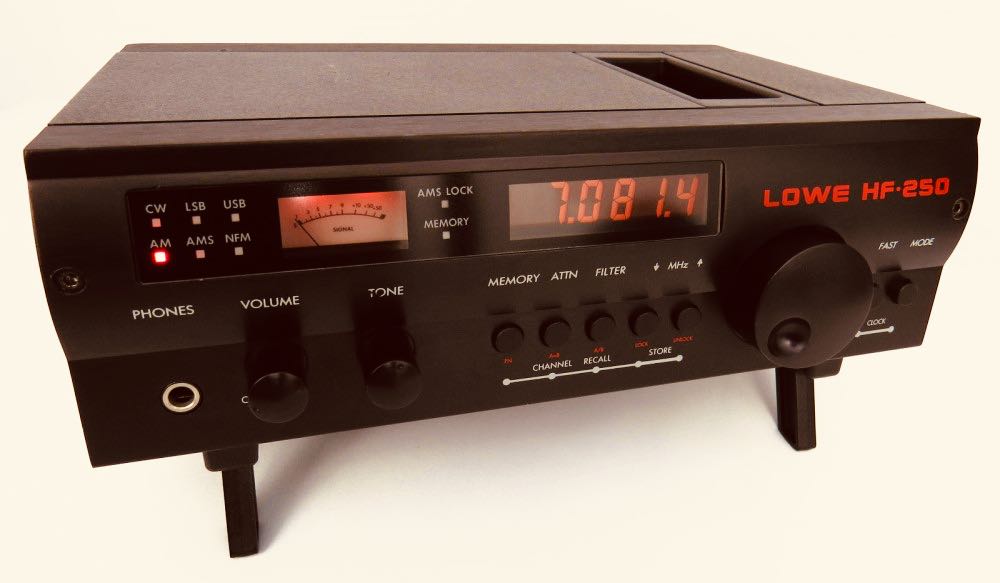
Dave’s review of the Lowe HF-250 (N9EWO)

[…]As far as audio quality goes, it’s extremely difficult to beat the Lowe HF-250. Mind you it has it’s share of “bug-a-boos” as well.

In our view it has held up much better in it’s old age vs. the AOR AR7030. Properly operating and in decent condition samples are fairly rare on the used market now (even more so in North America). Most owners know what the receiver is and hang on to them. But once a great while one does show up on the used market. Click here to read the full review.

BBC News suspends 450 job cuts to ensure Covid-19 coverage (BBC News)

BBC News has suspended plans to cut 450 jobs as it faces the demands of covering the coronavirus pandemic.

The job losses were announced in January and were part of a plan to complete a £80m savings target by 2022.

Outlets due to be hit include BBC Two’s Newsnight, BBC Radio 5 Live and the World Service’s World Update programme.

Director general Tony Hall gave staff the news on Wednesday, a week after the broadcaster delayed the end of the free TV licence scheme for all over-75s.

Lord Hall said “we’re suspending the consultation on those saving plans”.

He told staff: “We’ve got to get on with doing the job that you’re doing really brilliantly.

“It would be inappropriate. We haven’t got the resource to plough ahead with those plans at the moment, so we’ll come back to that at some point.

“But for the moment we just want to make sure you are supported and you’ve got the resources to do the job that you and your colleagues are doing amazingly.”[…]


Do you enjoy the SWLing Post?

Please consider supporting us via Patreon or our Coffee Fund!

Your support makes articles like this one possible. Thank you!
Radio Waves: Quantum Sensors, Sinking Mi Amigo, Submarine Radio Network, and Video Games Over The Air

Radio Waves:  Stories Making Waves in the World of Radio

Because I keep my ear to the waves, as well as receive many tips from others who do the same, I find myself privy to radio-related stories that might interest SWLing Post readers.  To that end: Welcome to the SWLing Post’sRadio Waves, a collection of links to interesting stories making waves in the world of radio. Enjoy!

Many thanks to SWLing Post contributors Kim Elliott and Dennis Dura for the following tips:


Scientists create quantum sensor that covers entire radio frequency spectrum (Phys.org)

A quantum sensor could give Soldiers a way to detect communication signals over the entire radio frequency spectrum, from 0 to 100 GHz, said researchers from the Army.

Such wide spectral coverage by a single antenna is impossible with a traditional receiver system, and would require multiple systems of individual antennas, amplifiers and other components.

In 2018, Army scientists were the first in the world to create a quantum receiver that uses highly excited, super-sensitive atoms—known as Rydberg atoms—to detect communications signals, said David Meyer, a scientist at the U.S. Army Combat Capabilities Development Command’s Army Research Laboratory. The researchers calculated the receiver’s channel capacity, or rate of data transmission, based on fundamental principles, and then achieved that performance experimentally in their lab—improving on other groups’ results by orders of magnitude, Meyer said.

“These new sensors can be very small and virtually undetectable, giving Soldiers a disruptive advantage,” Meyer said. “Rydberg-atom based sensors have only recently been considered for general electric field sensing applications, including as a communications receiver. While Rydberg atoms are known to be broadly sensitive, a quantitative description of the sensitivity over the entire operational range has never been done.”[…]

Forty years ago today Sheerness lifeboat crew rescued Radio Caroline DJs from the sinking Mi Amigo (Kent Online)

It was the original ‘ship that rocked.’ But 40 years ago today (Thursday)the Mi Amigo, home to original pop pirates Radio Caroline, finally disappeared beneath the waves in a violent force 10 storm.

In a daring rescue which lasted 12 hours in appalling weather, the crew of the Sheerness lifeboat saved the lives of everyone onboard – including the ship’s canary.

Leading the operation was colourful RNLI coxswain Charlie Bowry, who was later presented with the Institute’s coveted silver medal.

It was during the day that the radio station’s 60-year-old ship started dragging its anchor and drifted 10 nautical miles onto the Long Sand sandbank off Southend.

As the tide rose, the ship started to float free. But the bottom of the boat began being buffeted on the seabed with such a force the steel plates sprung a leak and water gushed into the engine room.

When the bilge pumps couldn’t cope, the three British DJs and a Dutch engineer called the Coastguard who dispatched Sheerness lifeboat the Helen Turnbull.[…]

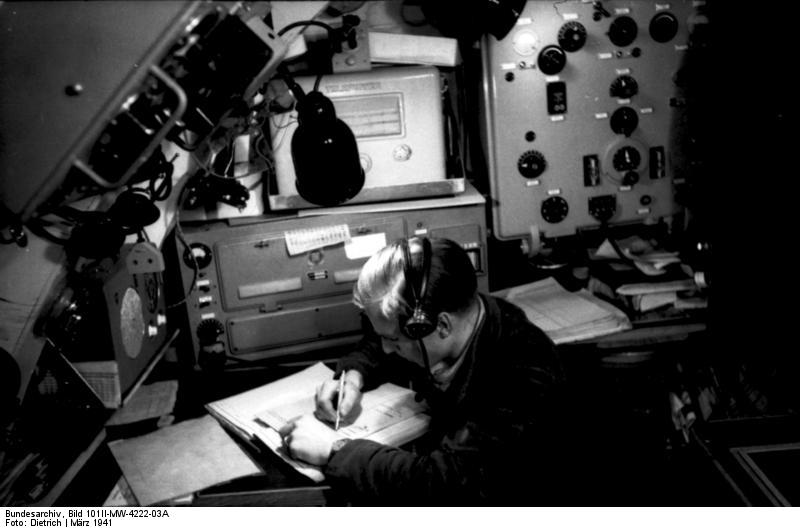
The Radio Network that Allowed Communication with Submarines (Interesting Engineering)

Communicating with covert fleets during WWII required some special equipment.

What do you do when you need to communicate with a crew of 50 sailors submerged in a submarine in an undisclosed location across the world’s oceans? That was a difficult question to answer for Navy leaders in WWII.

Radio waves don’t easily travel through saltwater, which meant that getting active communication with a submarine crew meant making the submarine surface an antenna. This was the obvious solution, but it made a previously covert submarine now a visible target.

[…]Engineers tasked with finding a more covert solution soon discovered that radio waves with low frequencies, around 10 kHz, could penetrate saltwater to depths up to around 20 meters. They realized that if the transponders on submarines were switched to these frequency ranges, then they communicate with leadership on land.

The problem with this idea was that creating and broadcasting these low-frequency radio waves required massive antennas. Essentially, the lower the frequency of a radio wave, the longer and larger the antenna is required to be.[…]

You Could Download Video Games From the Radio in the 1980s (Interesting Engineering)

Certain radio programs broadcast the raw data to video games for viewers to download.

[…]In 1977, the world’s first microprocessor-driven PCs were released. These were the Apple II, the Commodore PET, and the TRS-80. All these machines had one thing in common – they used audio cassettes for storage.

Hard drives at the time were still quite expensive, and everyone at the time had access to cheap audio cassettes. Early computer designers actually flaunted cassette storage as it aided in the early adoption of personal computers. As PCs became more common, so to did the emergence of their use as video game machines.

As the 1980s rolled around, engineers at the Nederlandse Omroep Stichting, NOS, a Dutch broadcasting organization, realized something incredible. Since computer programs and video games were stored on audio cassettes, it meant that their data could be transmitted with ease over the radio. They started taking programs and video games and setting up broadcasts where people could “download” games onto their own personal computers.

The audio that was transmitted would’ve sounded reminiscent of a dial-up modem booting up.

[…]NOS started a radio program specifically for transmitting gaming data called “Hobbyscoop,” and it became incredibly popular. The company even created a standard cassette format called BASICODE to ensure computer compatibility.

Eventually, transmitting games through computers became so popular that radio shows popped up all around the world. A Yugoslovik station called “Ventilator 202” broadcasted 150 programs between 1983 and 1986. As the practice evolved, it became less of a novelty and rather a practical way for people to share calculation programs, educational tools, encyclopedias, and even flight simulators.[…]


Do you enjoy the SWLing Post?

Please consider supporting us via Patreon or our Coffee Fund!

Your support makes articles like this one possible. Thank you!
Radio Waves: Keeping Car Radios, Moon Bounce, Voyager 2, and ABC Delays Plan

Radio Waves:  Stories Making Waves in the World of Radio

Because I keep my ear to the waves, as well as receive many tips from others who do the same, I find myself privy to radio-related stories that might interest SWLing Post readers.  To that end: Welcome to the SWLing Post’sRadio Waves, a collection of links to interesting stories making waves in the world of radio. Enjoy!

Many thanks to SWLing Post contributors Benn, Tony, and Michael Bird for the following tips:

Opinion: Automakers, don’t remove radios from the dashboard (The Detroit News)

Make no mistake about it: The renaissance of electric vehicle manufacturing has been one of the most significant blessings of innovation in the 21st century. The continued production and voluntary adoption of electric vehicles have made the United States a greener and cleaner nation. However, while EV makers continue working to bring the U.S. forward environmentally, they need to ensure their design methods do not have a negative impact on one of the country’s most crucial national security apparatuses.

As the former administrator of the Federal Emergency Management Agency (FEMA) that oversaw the operations of over 220 declared disasters, I am concerned about what I’ve seen from automakers removing AM radios from vehicles — an action that will make Americans less safe in emergency situations.

Interference between the broadcast reception and the electric motors of certain cars, principally electric vehicles, is the reasoning behind some companies’ decision to eliminate the radio from car dashboards. However, scrapping radio rather than making the signals compatible can severely harm the federal government’s disaster relief efforts.

Federal law mandates that FEMA always possess the capabilities to deliver messages to the American people. To this end, FEMA has spent tens of million dollars and counting perfecting the Primary Entry Point (PEP) stations — consisting mostly of AM stations, but some FM ones as well — that connect to The National Public Warning System.[…]

Australia’s first ever moon bounce remembered as a feat that shocked industry experts (ABC News)

You probably haven’t heard of Ray Naughton’s feat of science — not many people have. But 55 years ago, the quiet electronics store owner from Birchip, in western Victoria, successfully completed Australia’s first ever moon bounce.

The amateur radio fanatic had spent most of his time alone in a paddock, tinkering away on a 250-metre wide, 30-metre tall antenna capable of bouncing a radio signal off the moon and back again.

Mr Naughton was driven by news that astronauts would soon be walking across its surface.

When that day came, on July 20 1969, Mr Naughton used his antenna to tune into conversations between astronauts and NASA.

A small group of locals watched on in wonder, realising for the first time what their private neighbour had been working on.[…]

When Voyager 2 Calls Home, Earth Soon Won’t Be Able to Answer (NY Times)

NASA will spend 11 months upgrading the only piece of its Deep Space Network that can send commands to the probe, which has crossed into interstellar space.

Voyager 2 has been traveling through space for 43 years, and is now 13 billion miles from Earth. But every so often, something goes wrong.

At the end of January, for instance, the robotic probe executed a routine somersault to beam scientific data back to Earth when an error triggered a shutdown of some of its functions.

“Everybody was extremely worried about recovering the spacecraft,” said Suzanne Dodd, who is the Voyager project manager at NASA’s Jet Propulsion Laboratory in Pasadena, Calif.

The mission’s managers on our planet know what to do when such a fault occurs. Although it takes about a day and a half to talk to Voyager 2 at its current distance, they sent commands to restore its normal operations.

But starting on Monday for the next 11 months, they won’t be able to get word to the spry spacecraft in case something again goes wrong (although the probe can still stream data back to Earth). Upgrades and repairs are prompting NASA to take offline a key piece of space age equipment used to beam messages all around the solar system.[…]

ABC forced to delay five-year plan and job cuts announcement (The Age)

The ABC has been forced to delay the release of its five-year blueprint – including job cuts – to prioritise its response to the coronavirus pandemic.

The national broadcaster was due to announce its long-term plan at the end of this month. A three-year funding freeze that took effect last July, stripping $84 million from ABC’s budget, will result in an estimated 200 redundancies.

In an email to staff, managing director David Anderson said, “I think you will agree with me when I say that the current situation with COVID-19 means our focus must be on the welfare of all of you and our role as a public broadcaster in providing the community with timely and credible information in this challenging time for our country.

“For this reason, I’m sure you will understand my decision to postpone the announcement until we are through this period … your patience and professionalism are, as always, greatly appreciated.”

Anderson told employees he would reveal his plan “as soon as we have returned to normal levels of activity”.[…]


Do you enjoy the SWLing Post?

Please consider supporting us via Patreon or our Coffee Fund!

Your support makes articles like this one possible. Thank you!