Tag Archives: shortwave radio time stations

Time Stations from the 1970s Heard in Ontario, Canada — And What You Can Still Hear Today

by Dan Greenall

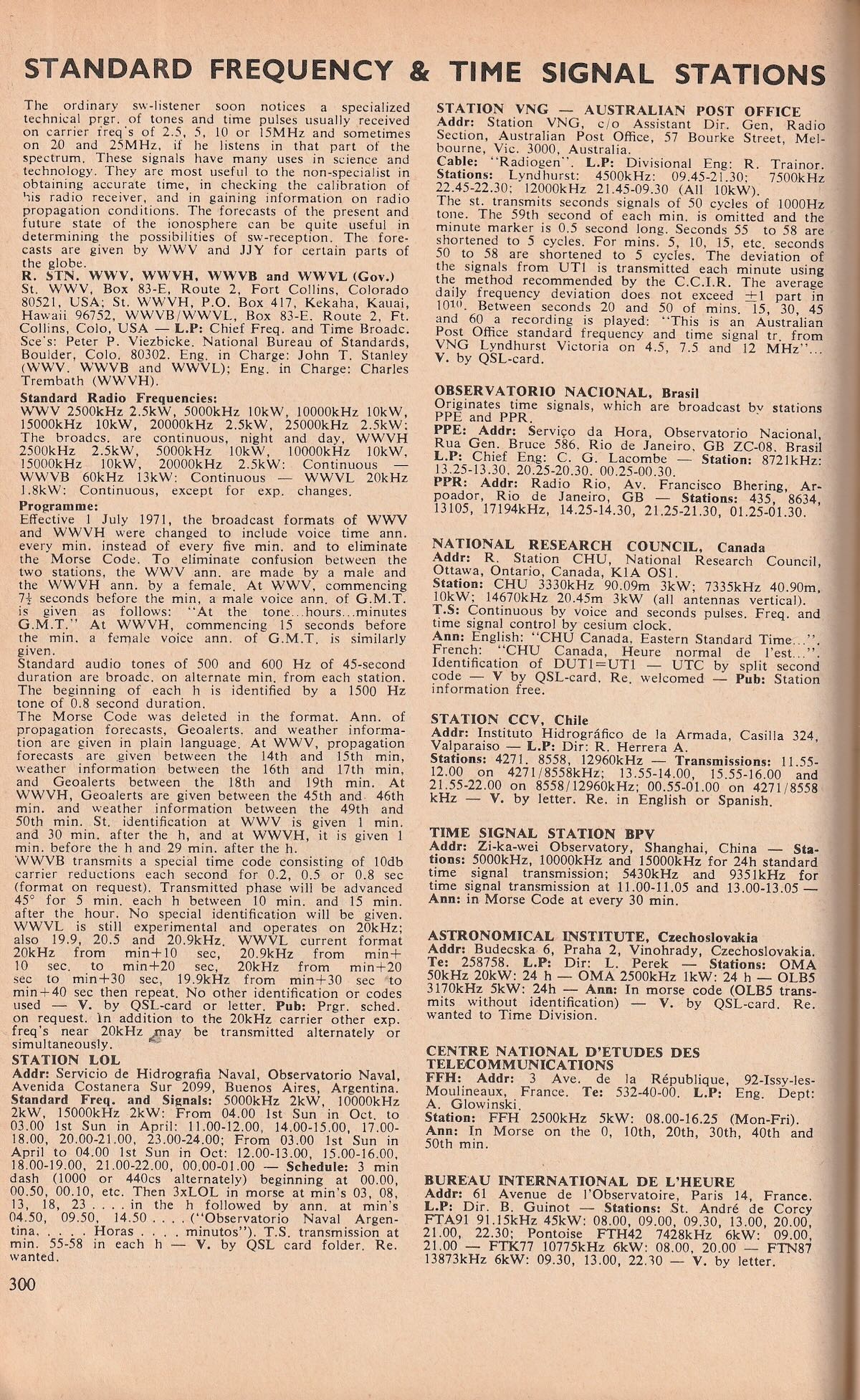
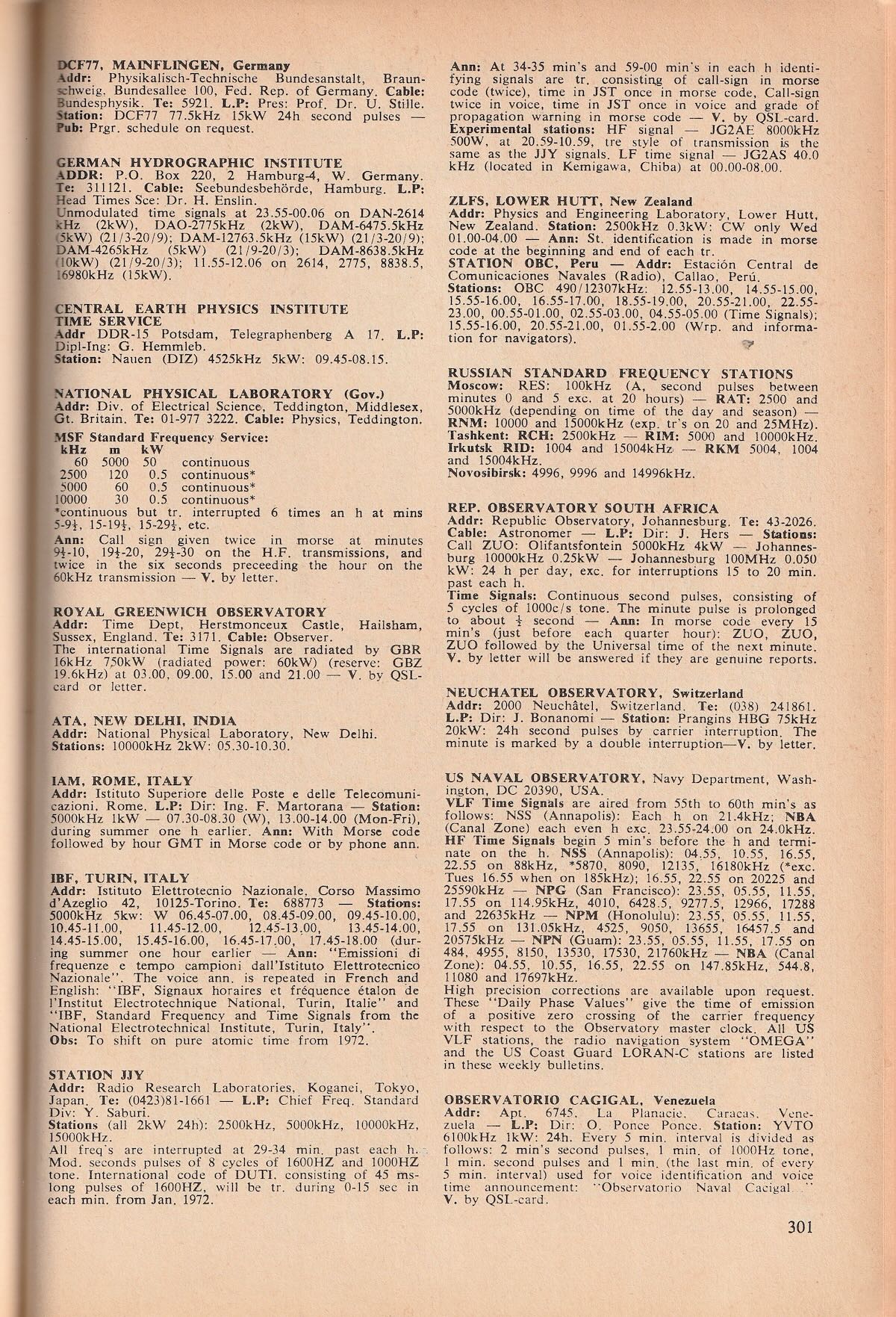
Time and standard frequency stations have been around for a long time.  In my early years of DXing, there were more than 20 of them scattered all over the globe.  These two pages from the 1972 World Radio TV Handbook show what could be heard back then, along with the frequencies used.
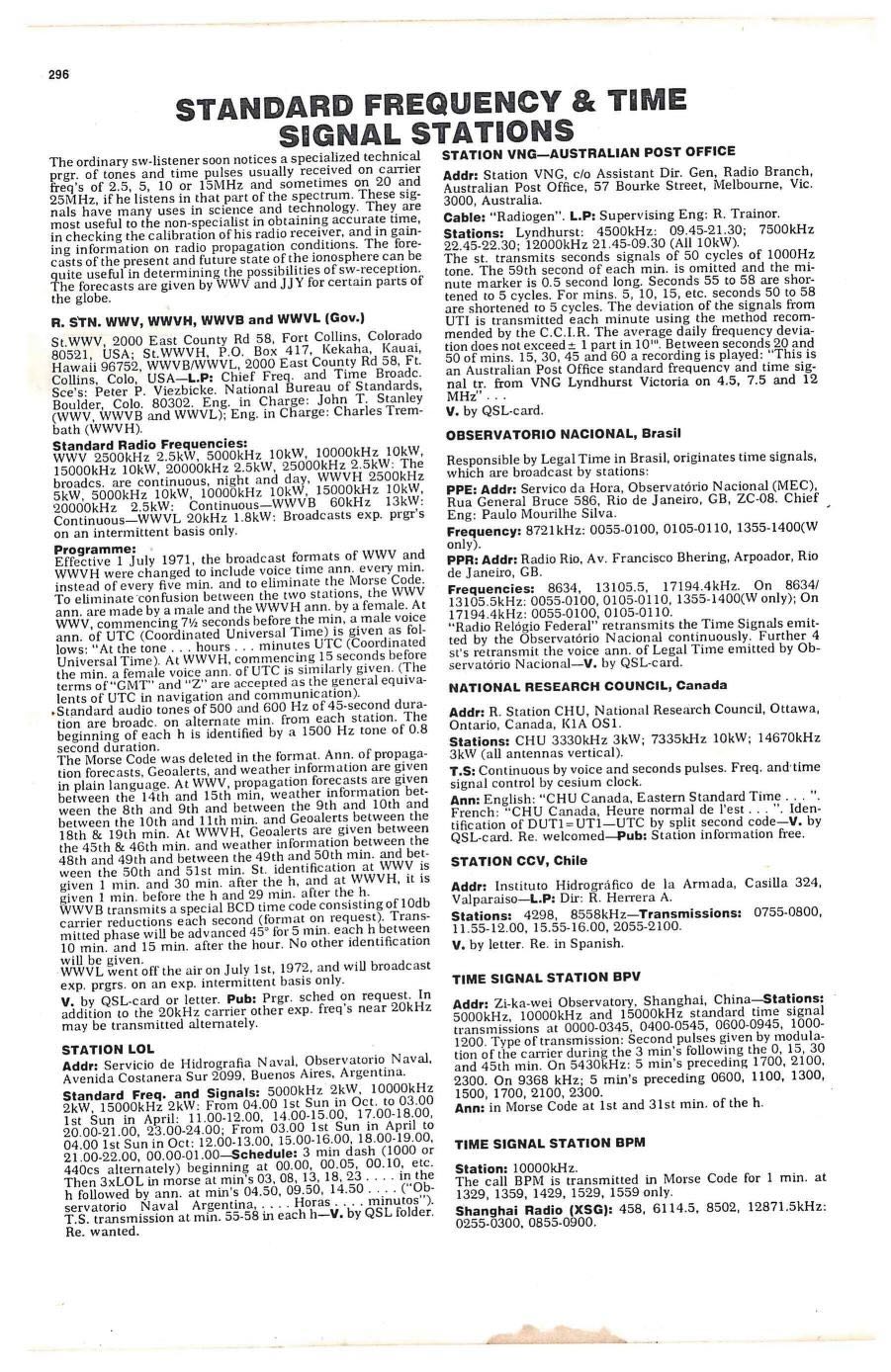
A page from the 1975 WRTVH indicates the arrival of BPM.
I managed to log at least ten of them from my listening post in southern Ontario, Canada.  They are listed below, some of them including links to recordings I made, have survived for over half a century.
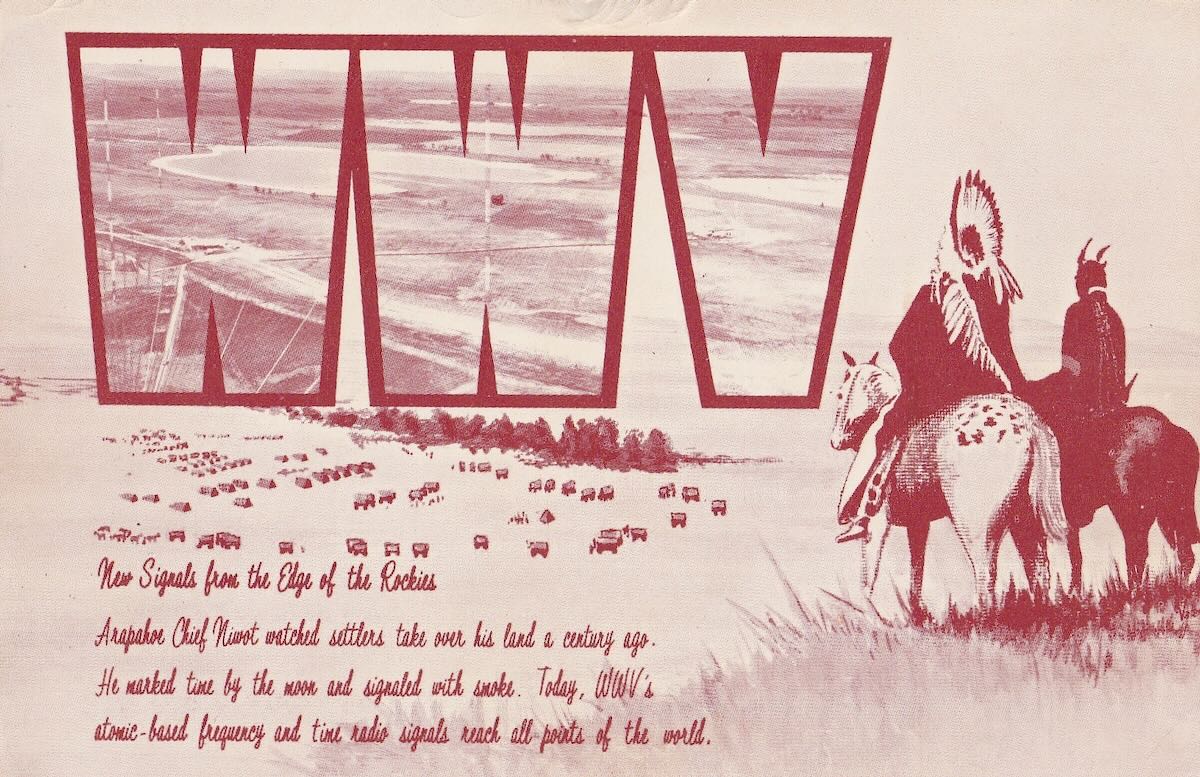
WWV, Fort Collins, CO   (change of format in 1971)

WWVH, Kekaha, Kauai, Hawaii

YVTO, Caracas, Venezuela

LOL, Buenos Aires, Argentina

VNG, Lyndhurst, Victoria, Australia

JJY, Tokyo, Japan

BPM, Shaanxi Province, China

CHU, Ottawa, Ontario, Canada

RID, Irkutsk, USSR

FTK77, Bureau International de l’Heure, Paris, France

A link to some of their vintage QSL cards can be found here: https://archive.org/details/vng-australia-1971

Time stations in 2026

Today, only a handful of these time signal stations remain on shortwave.  Most are listed below.
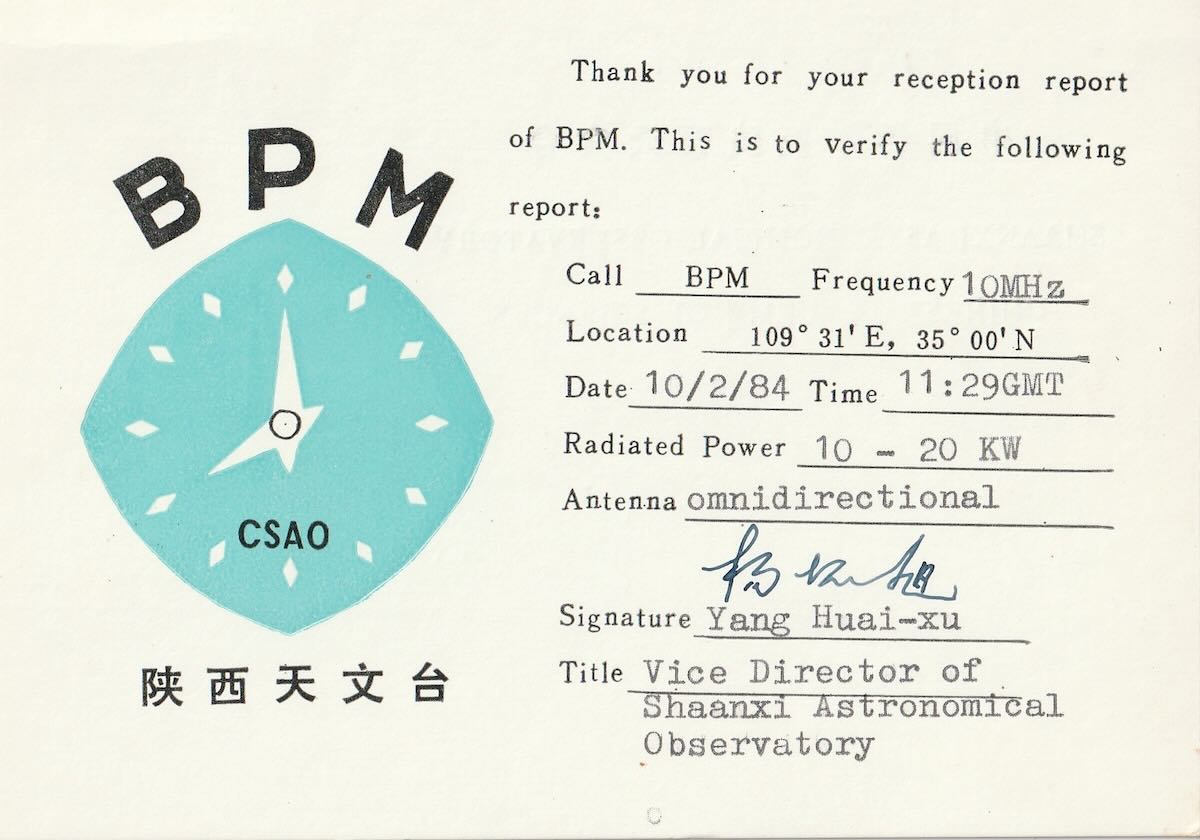
BPM, Shaanxi Province, China (70 km northeast of Lintong)   2500, 5000, 10000 and 15000 kHz

ID given twice per hour during the 29th and 59th minute.  BPM was sent 10 times in CW, then the announcement in Chinese was given twice.

RWM, near Moscow, Russia   4996, 9996 and 14996 kHz

ID’s given twice per hour.  During 9th and 39th minute, RWM sent 21 times in CW.
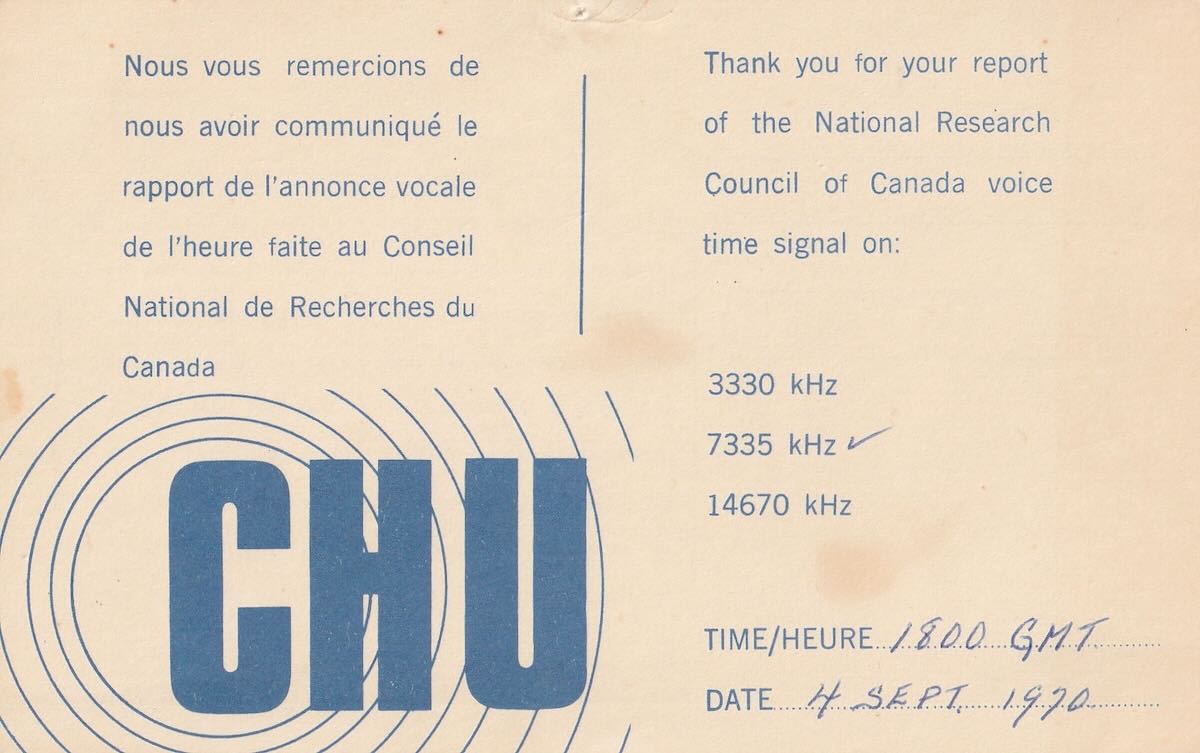
CHU, Ottawa, Ontario Canada   3330 kHz, 7850 and 14670 kHz

ID and time announcement (English/French) in UTC, last 9 seconds of each minute.  Scheduled to close June 22, 2026.

WWV, Fort Collins, Colorado, USA   2500, 5000, 10000, 15000, and 20000 kHz

Time announcement (UTC) in English, each minute (male voice).  Station ID at :00 and :30 minutes.

WWVH, Kekaha, Kauai, Hawaii   2500, 5000, 10000 and 15000 kHz

Time announcement (UTC) in English, each minute (female voice).  Station ID at :29 and :59 minutes.

Best to log the remaining ones before their time runs out.
Recording the 2015 Leap Second

Fullscreen capture 6302015 115321 PM

Yesterday, I posted a brief article about the leap second that occurred between 23:59:59 June 30, 2015 and 00:00:00 UTC July 01, 2015.

I decided to record the leap second on as many shortwave time station frequencies as possible. The only viable options for me–based on time of day and my reception location–were the WWV frequencies 10, 15, 20, and 25 MHz, and CHU frequencies 7,850 and 14,670 kHz.

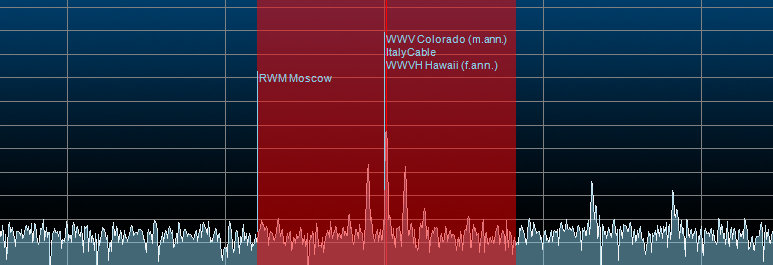
I was able to record four different time station frequencies simultaneously on the TitanSDR Pro.

I was able to monitor four different time station frequencies simultaneously on the TitanSDR Pro. (click to enlarge)

Unfortunately, HF propagation was very poor yesterday, so the higher WWV frequencies–20 and 25 MHz–were completely inaudible, as was CHU on 14,670 kHz. There were numerous thunderstorms in our area, so static crashes were prevalent.

Still, since this was a first attempt to record a “leap second,” I didn’t want to take any chances.  I had the Titan SDR Pro monitoring and recording two CHU and two WWV frequencies [screenshot], the Elad FDM-S2 recording WWV on 15 MHz [screenshot], and the WinRadio Excalibur on WWV’s 10 MHz frequency, as well as recording the whole 31 meter band spectrum [screenshot].

In the end, the strongest frequencies I captured were CHU on 7,850 kHz and WWV on 15,000 kHz. WWV on 10,000 kHz was much weaker than normal and the band was quite noisy–still, it’s readable, so I included this recording, too. Recordings follow…

Recordings

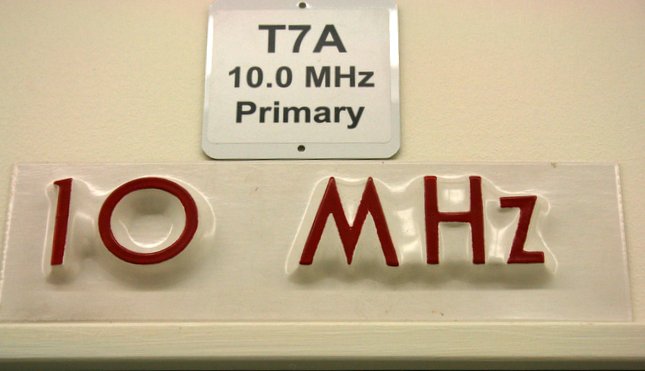
Photo I took in 2014 of the sign above WWV's primary 10 MHz transmitter.

The sign above WWV’s primary 10 MHz transmitter (2014).

All of the recordings start just before the announcement of 23:59 UTC.

WWV added the extra second and higher tone, then continued with their top of the hour announcements, including a note about leap second (which begins after the 00:04 announcement). CHU simply injects a one second silence before the long tone.

WWV on 15,000 kHz using the Elad FDM-S2:

CHU on 7,850 kHz using the TitanSDR Pro:

WWV on 10,000 kHz using the WinRadio Excalibur:

One interesting note about the 10 MHz WWV recording above: I believe I may be hearing BPM China in the background. I’m curious if anyone can confirm this because I don’t know BPM’s cadence/pattern well enough to ID it.

Other recordings…?

Did you record a shortwave time station as leap second happened? If so, please comment, and feel free to share a link to your recording!

Hang on a second…seriously

WWV-TimeCodeGenerator

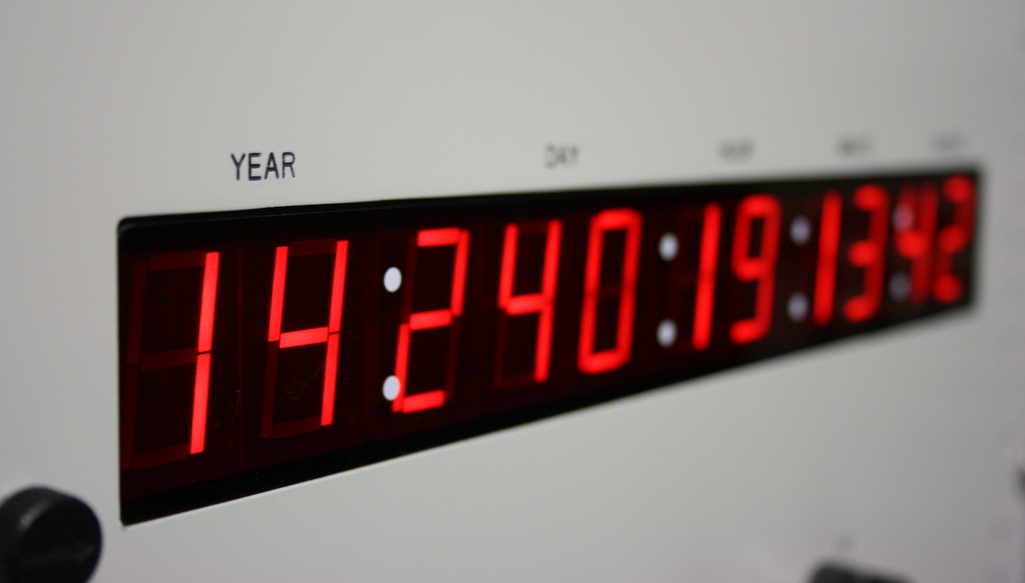
One of four WWV time code generators in late August, 2014

Tonight, for the first time in three years, we will experience a leap second. What is a leap second?  Wikipedia provides a concise explanation:

A leap second is a one-second adjustment that is occasionally applied to Coordinated Universal Time (UTC) in order to keep its time of day close to the mean solar time, or UT1. Without such a correction, time reckoned by Earth’s rotation drifts away from atomic time because of irregularities in the Earth’s rate of rotation. Since this system of correction was implemented in 1972, 25 such leap seconds have been inserted. The most recent one happened on June 30, 2012 at 23:59:60 UTC. A leap second, the 26th, will again be inserted at the end of June 30, 2015 at 23:59:60 UTC.

Like many of you, when I think of time–or UTC–I think about the NIST radio station WWV in Fort Collins, Colorado.

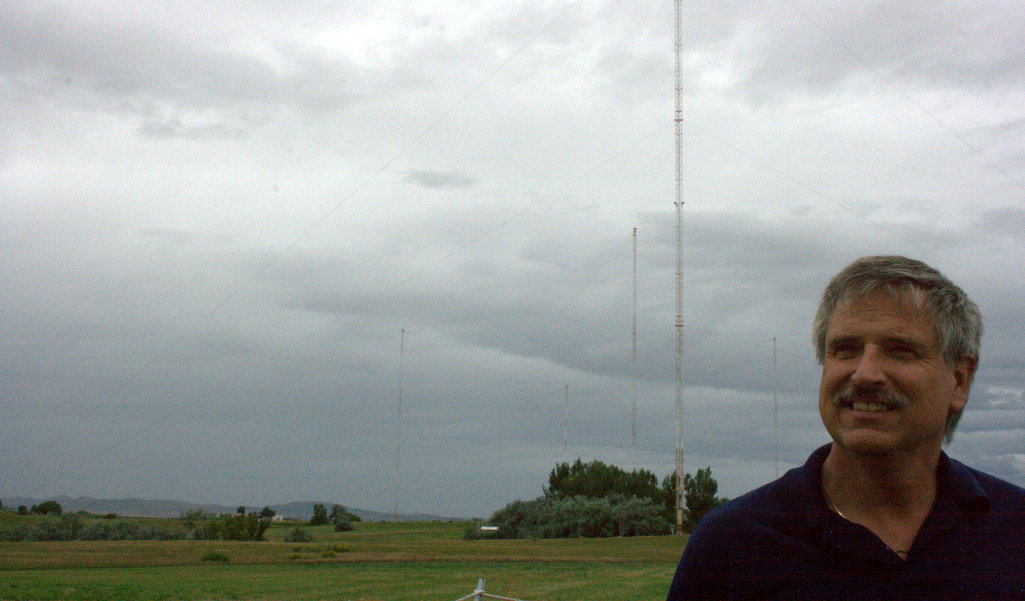
I had the honor of visiting the facility last year (yes, photo tour still forthcoming!).  During the tour, my guide and Chief Engineer at WWV and WWVB, Matthew Deutch, told me that he’s always going to be on site come Leap Second!

MattDeutch-WWVB

WWV’s Matthew Deutch with WWVB antennas in background

I wrote Matt this morning to ask what were his plans tonight?  His reply:

“The leap second happens at 0000 UTC tonight, which is 6:00 pm here in Fort Collins. All of the programming took place at the beginning of the month, so the equipment is armed…we just sit back and watch for the leap this evening.

Even though it is automated I hang around the station to make sure everything goes smoothly at the critical moment…”

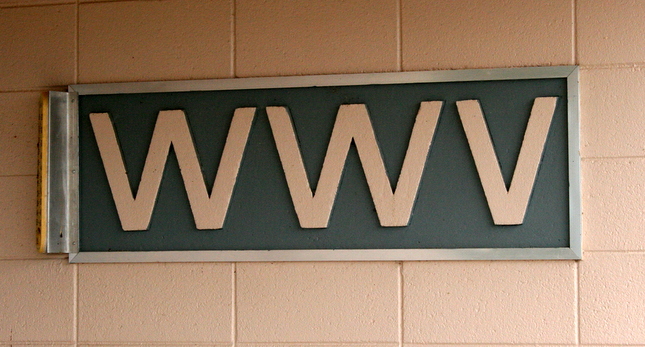
WWV-First-Sign-SMMatthew closed his message by wishing me a “Happy Leap Second.”

Back at you, Matt! We hope that second leaps as smoothly as you’d like!

Not to put Matt on the spot, but you can listen to WWV (or the atomic clock of your choice) make the leap second tonight at 00:00 UTC. As for me, I’ll hop on 10 MHz and 15 MHz to hear (and hopefully record) the extra “tick.” At the end of this post, I’ve provided a list of time stations for your convenience.

Happy Leap Second!

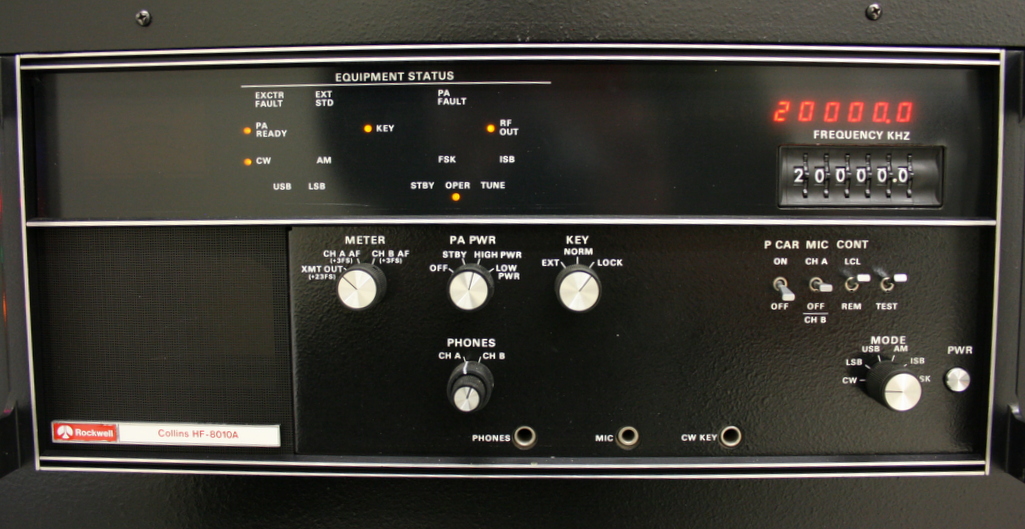
20MHZtransmitter

WWV 20 MHz Collins transmitter

List of shortwave radio time stations

  • CHU Canada: 3330 kHz, 7850 kHz, 14670 kHz
  • BPM China: 2,500, 5,000, 10,000, and 15,000 kHz
  • HLA South Korea: 5,000 kHz
  • BSF Taiwan: 5,000 and 15,000 kHz
  • WWV (Ft. Collins)/WWVH (Hawaii) United States:  2,500, 5,000, 10,000, 15,000, 20,000 and 25,000 kHz

Update

Click here to listen to Leap Second recordings from WWV and CHU.