
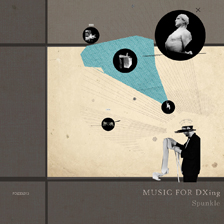
 After posting the article about Elliott Sharp last Sunday, I received an email which drew my attention to a shortwave radio-inspired series of musical works entitled Music for DXing, by Spunkle, now an album on the label First Fold Records. Musician James Davies describes his work thus:
Music For DXing is a suite of sixteen songs rooted in the hobby of listening to the radio. Originally released amongst friends and fans in 2003, Music for DXing mixes the sounds of shortwave with primeval electronica in a drumless, bassless, trebleless midrange landscape of anticipation.
I’ve listened to Music For DXing on the label’s website–it’s a form of musical minimalism and experimentalism, layering analog and synth sounds into an atmospheric whole, full of sonic texture that incorporates and celebrates radio’s unique sound characteristics.
Davies describes the radio medium:
[I]t’s impossible to really hear “nothing” on the radio, particularly on the shortwave frequencies; there’s always something there, even if it’s noise. That in itself is part of DXing––sifting through the noise for something that you want to hear, and you start to recognise different bits of noise and so on. What a DXer ends up looking for is often very subtle––like when a station is about to come on air, they’re often just broadcasting silence. So the transmitter is on, but they aren’t playing anything. If you listen, there’s a certain quality to the silence––it’s really hard to describe, but it’s like fishing, or birdwatching, and knowing there’s a change in the atmosphere that means something interesting is out there––and, well, that’s just describing some of the basic sounds of nothingness!
Then there is the aesthetic of the broadcast aspect of shortwave. For example, when I was younger a lot of the broadcast stations had “interval signals” which they’d play before a transmission to let you know you had tuned in correctly. These would be a little melody that they’d repeat, and they’d sometimes have speech announcing the station as well. Most DXers would know about these, and I bet, like me, they loved them in and of themselves. Things like the Radio Sweden song which was played on something like a vibraphone with loads of reverb. It used to sound fantastic floating out there on HF. It would go round and round with the voice announcing in different languages, and then when the station came on air they’d play it again with a little tooty band. I loved all of that. Different stations have a different sonic fingerprint.
If you, like this artist, love the audio characteristics of shortwave radio, you’ll appreciate “Music For DXing.”
After listening to “Music for DXing,” I was intrigued, and had a few more questions for Davies; he was kind enough to provide the following interview.
SWLing Post: What do you tell people when they ask, “What kind of music do you create?”
Davies: When I was working as “Spunkle” (the project stopped around 2004, just after I finished “Music For DXing”), I made electronic music. That is to say, sounds manipulated electronically by tapes, synthesizers, sampling and computers. I started playing with tapes about 30 years ago (when I got my first radio-cassette recorder) so I’ve been doing it for a long time!
SWLing Post: Any artists or musicians inspire you over the years? Any
other influences?
Davies: Absolutely loads––I love all sorts of music, art, films, books, etc. But I would specifically say for this project, that I was influenced by techniques as much as specific musicians. So, like a lot of people, I really love The Beatles, but in particular I love their experimental, pioneering methods of working. Whatever was new at the time, they were able to try it. In the same way I was very influenced by electronic pop of the 80s like Scritti Politti, OMD, The Art Of Noise, Depeche Mode––not just the songs, but how they were making them with new technology, as well. When I was at school we were shown a documentary about musique concrete which was very influential on me as an 11 year old––people making tape loops of road drills, and so on! I also really like artists that defy description, too, like Jandek.
SWLing Post: What shortwave radio(s) do you own/use today?
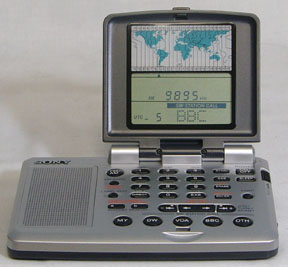
The Sony Sony ICF-SW07 (photo: Universal Radio)
Davies: I have two Sony radios. An ICF-SW7600GR upstairs in my work room, and an ICF-SW07 downstairs in the kitchen. I have posted some videos of my listening to my YouTube channel if anyone is curious as to what they are like.
They are both excellent, excellent radios, and I like to take the little SW07 with me when I travel.
SWLing Post: When you listen to/tune in the radio, what are you in search of? Why?
Davies: Variety, surprise, information and culture. Culture is very important––by that I mean the culture of a nation, like an official broadcast from a different country, or the culture of a hobby like Ham operators. Or it can even be the culture of a technology like data transmissions. I like to hear things that I can’t hear at other times during the day. When I started listening as a boy I liked it that I was able to go around the world via my radio, and discover things about far away countries.
I like the variety of the radio, both in the programmes and the chance elements like propagation conditions, and even interference, too. I love discovering new music and also listening to documentaries and news. I also like DJs that you come to feel are friends…[R]adio has the power to be so friendly and human; I think that’s a really important aspect.
I also like the surprise, in particular with DXing, of finding new stuff. It’s sad that a lot of the European stations of my youth have gone now, but it has made, for me at least, finding transmissions from the Far East and Asia much easier now (although the internet has also assisted that enormously with the look-up tables and services you can check frequencies against).
 In conclusion, Davies adds:
I just love the idea of radio, and transmitting and receiving sound through the airwaves. The radio has a vocabulary all of its own––the formatting of different programmes, the use of music in speech shows and the use of speech in music shows. Even the physical sound of switching on your radio and it flooding with electricity and coming to life is a part of the experience. I love those formal qualities of life and I like playing with them in my own art.
I think many SWLers would avidly agree: radio does transcend mere communication to become an art form. We’re grateful that musicians like Davies recognize this and take it to the next level. Thanks to James Davies for the fascinating interview, as well as for the fascinating music. You can listen to his album, purchase it, and read another, more in-depth interview with him at First Fold Records.
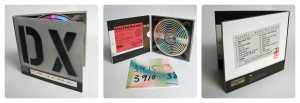
Listen to Spunkle Music For DXing below, or at First Fold Records. Purchase a copy here.
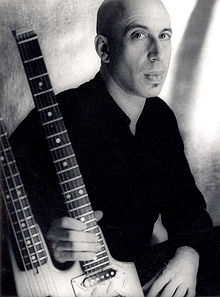 In the past, we’ve noted several artists and musicians who were inspired by the audible characteristics and sonic texture of shortwave radio (check out the
 A problem worth noting: Radio Korea has been having difficulty keeping their shortwave broadcasts on the air. As North Korea Tech points out, their domestic broadcasting arm is still operating:
 (Source: